Author: CryptoNarratives (Viktor)
Compiled by: Deep Tide TechFlow
Deep Tide Guide: This monthly recap thoroughly breaks down the key movements in the February crypto market: BTC's extreme $60k rebound, the panic and rapid recovery on the day Iran was attacked, the pre- and post-ZRO conference expectation games, and the manipulative coins thriving in the bear market. Dense with information, it serves as excellent background material for understanding the current market structure.
Full Text Below:
BTC Timeline
Below is the main timeline for February:
Gold saw a significant pullback after reaching a peak in late January, falling from $5600 to $4400. The bottom was hit on February 2nd, followed by a rapid rebound to $5100 within two days. Silver also experienced a peak collapse, plummeting nearly 50% from $121 to $64 on February 6th.
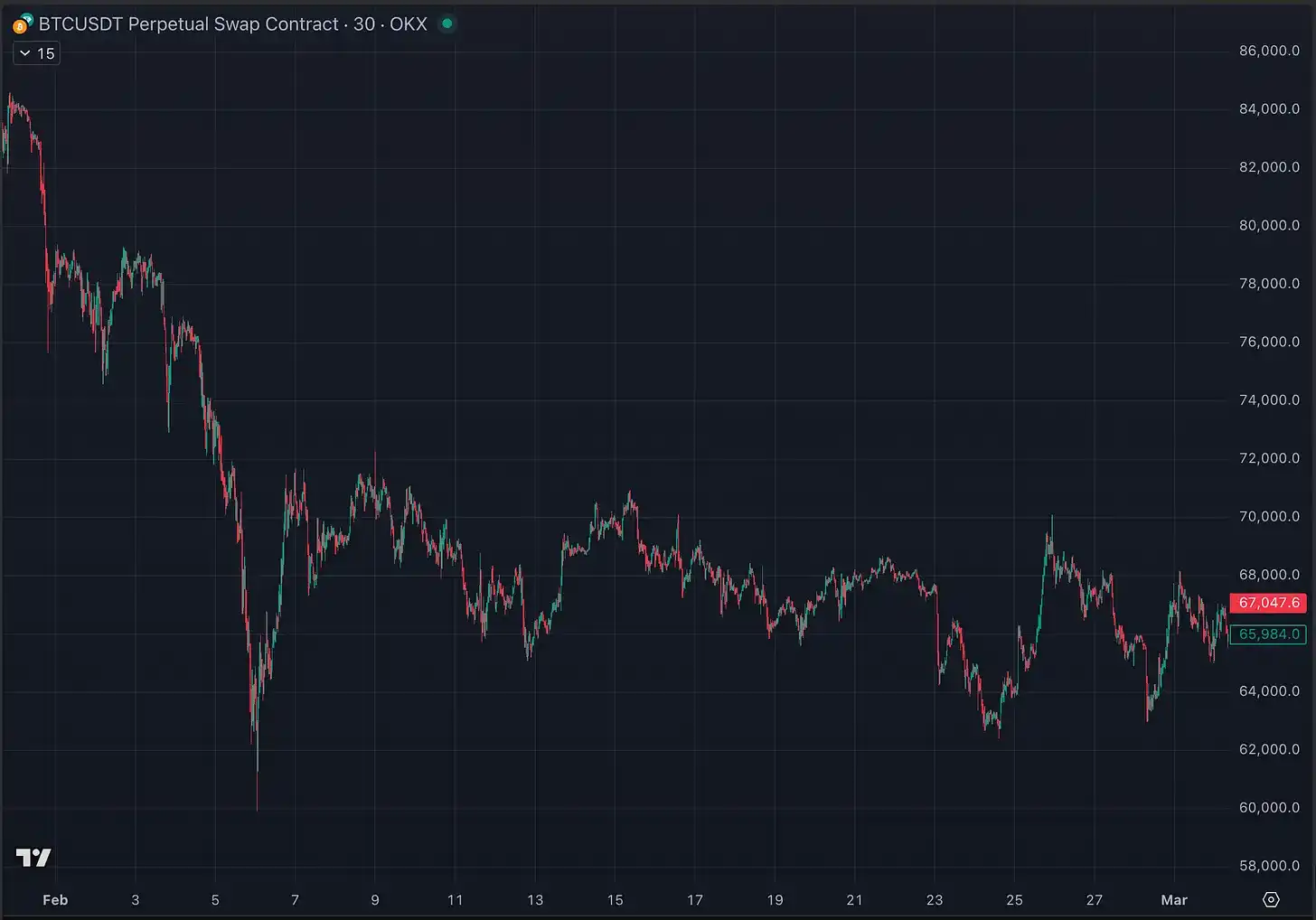
BTC started February on an extremely weak note. After hitting a high of $98k in January, it opened February at $78k, dropped to $70k within 4 days, and then experienced a single-day crash from $70k to $60k on February 5th.
BTC staged a strong rebound at the $60k level, recovering to nearly $72k in less than a day. This complete move defined the trading range for the entire subsequent month, largely fluctuating between $60k and $70k.
After the first week, BTC spent most of the month oscillating around $68k, with only two distinct periods of strength: February 13th-14th and February 25th. These periods each saw some stronger altcoin performances.
On February 27th, BTC dropped from $68k to $65k on rumors of an impending US airstrike on Iran. The attack was officially confirmed a day later. Upon the actual news landing, BTC fell further from $65k to $62k but was met with sustained buying pressure throughout the day, ultimately closing near $68k, which also marked the month's closing price. On the same day, the announcement of Khamenei's death was made, which the market generally interpreted as a bullish signal (as it suggested the US was unlikely to invest excessive resources in this conflict).
ZRO Conference
Almost the only significant narrative in the altcoin space in February was the LayerZero conference on February 10th. $ZRO had been strengthening consistently since the beginning of the year, primarily driven by anticipation for this event. I initially predicted this would be a typical 'sell the news' opportunity, but the reality was slightly different.
On the day, a video announcing the launch of their own blockchain was leaked early, triggering a sell-off and a roughly 20% drop within an hour, which also marked the day's low. Later that day, the official announcement was made – indeed, the launch of their own blockchain "Zero" – but it was accompanied by a slate of heavyweight partnership announcements, including Citadel Securities, Cathie Wood/ARK, DTCC, and ICE.
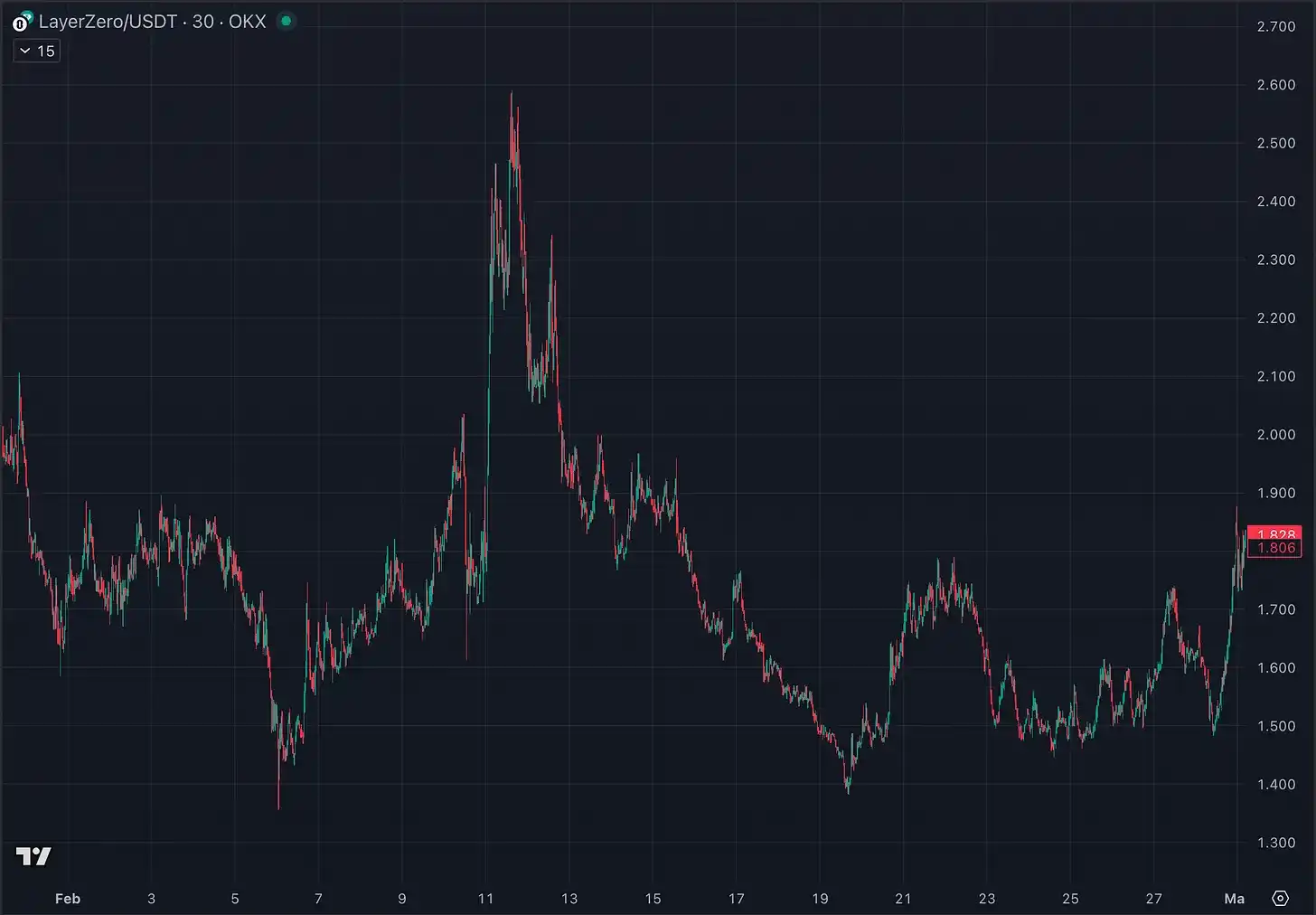
The result was a strong rally post-conference, with $ZRO gaining about 45% in 12 hours, catching many 'sell the news' traders off guard. But subsequently... all gains were erased, and the token slid all the way down to $1.5, a level that currently appears to be forming strong support.
VVV's Abnormal Strength
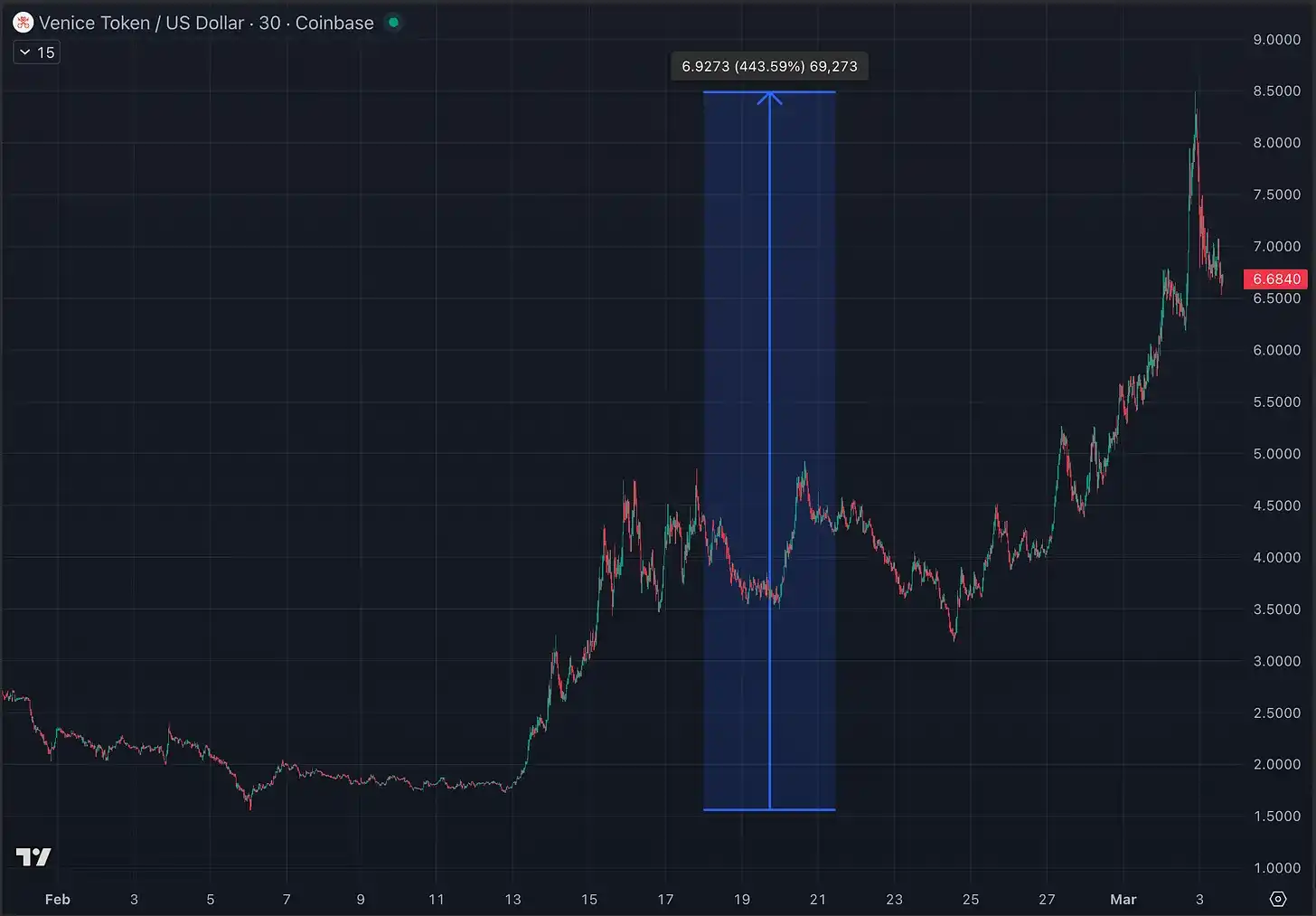
VVV was the best-performing "non-scam" token in February, rising from a bottom of $1.65 to $5.5 by month-end (with a further squeeze to $8 on March 2nd). One catalyst was its status as a legitimate project at the intersection of AI, privacy, and crypto, with a bottom valuation below $100M;另一方面, it also benefited from the tailwind of OpenClaw, as OpenClaw listed Venice as a recommended model supplier in its documentation until just yesterday.
(I'm inclined to think it peaked at the $8.4 squeeze in early March, but I could be wrong)
Other AI tokens briefly awakened late in February, with $SAHARA squeezing +70% in a single day and $GRASS gaining +70% over 4 days.
A Bountiful Month for Scam Coins: $PIPPIN, $SIREN, $POWER
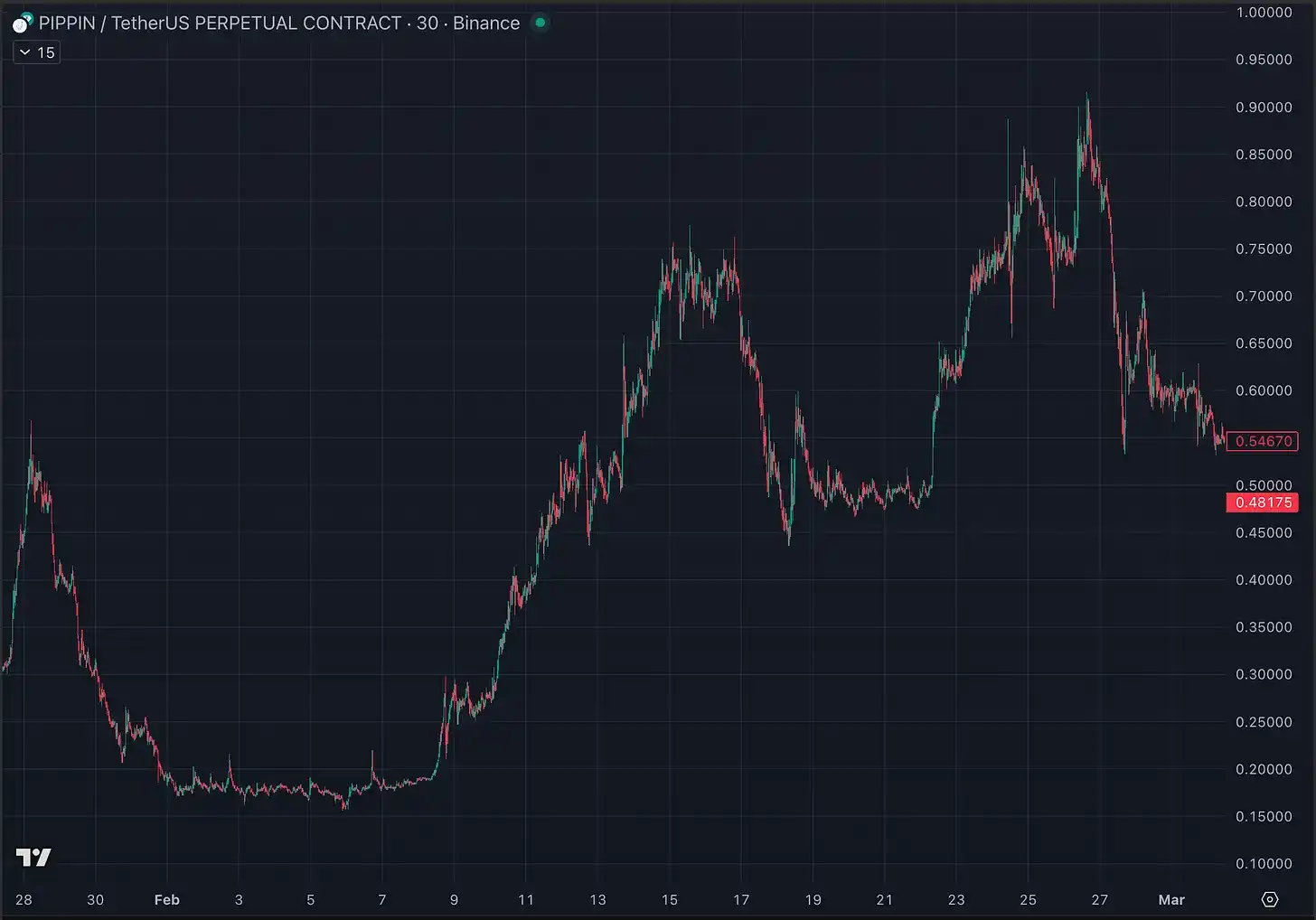
Bear markets seem to provide excellent breeding ground for scam coins. In February, the veteran AI Meme coin $PIPPIN made a comeback – its supply is completely locked by a single entity, and its price action is典型的 of manipulation. $PIPPIN started the month steadily at a $180M market cap, having already experienced a 70% crash over the previous 4 days. It began a strong rally from February 8th, rising +315% in 7 days to set a new high of $750M market cap, then pulled back to $500M before surging again to a new high of $900M. Strangely, its funding rate is no longer negative, making it a relatively less risky (though still risky) short target for a scam coin. Even so, I wouldn't be surprised to see it break the $1bn market cap.
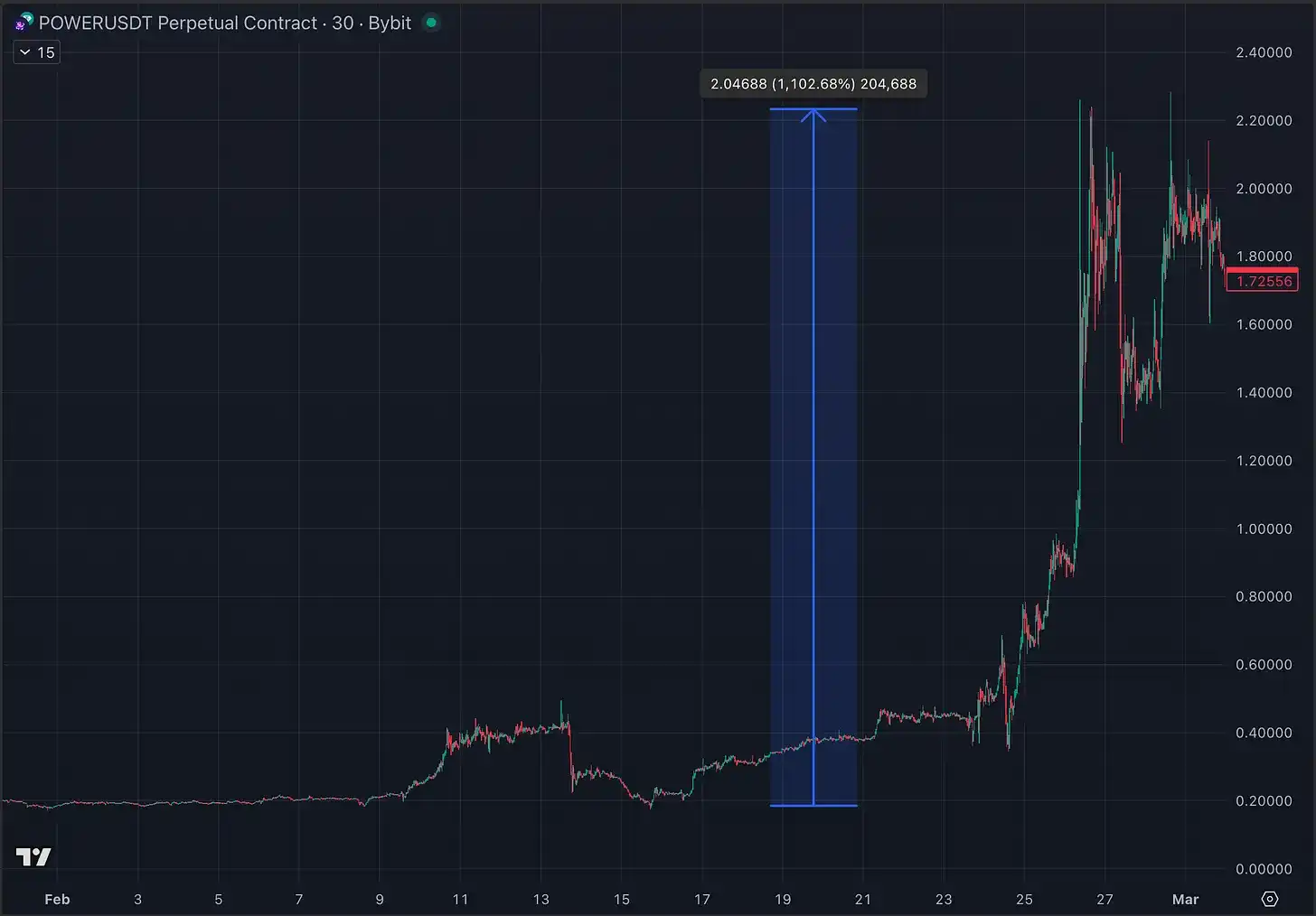
$POWER was one of the new manipulative plays emerging in February, with a 12x move from bottom to top, squeezing to a $2.3bn FDV, with extremely negative funding rates. Be very cautious shorting this.
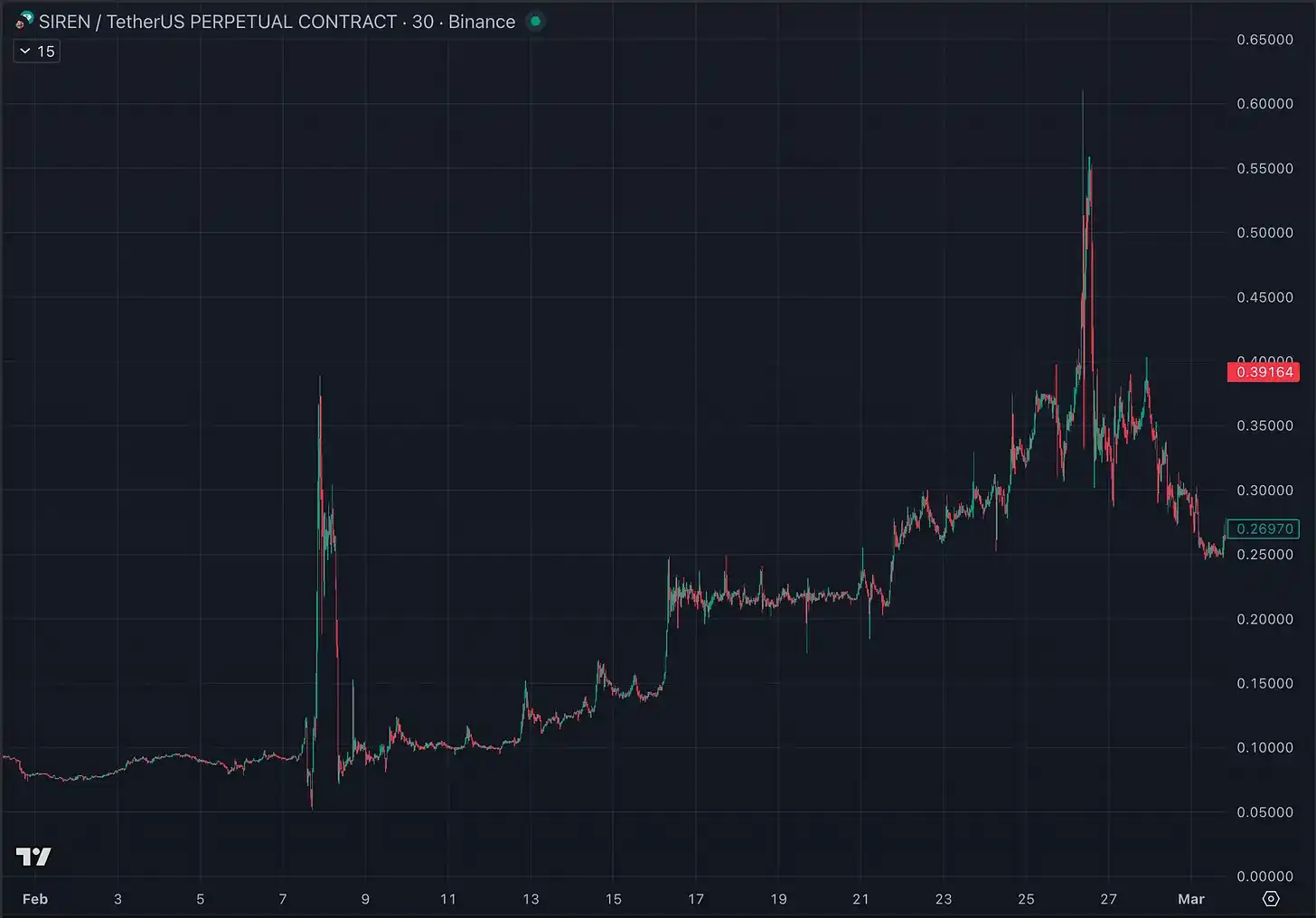
Another notable move was $SIREN, this BSC scam meme coin executed a pump and dump on February 8th – running from $100M market cap to $400M and back to $100M – then spent the rest of February slowly climbing to new highs, eventually executing a major squeeze at a $600M market cap.
It's also worth mentioning $BULLA, which did a 13x run in late January, then crashed 95% in a single day on February 1st, falling from $450M FDV to $25M FDV. $ARC also experienced an 80% collapse after rising from $40M to $130M.
Bear Market Characteristics
We are in a bear market environment: most bullish moves in altcoins are short squeezes that are quickly given back. Here are tokens that exhibited this behavior in February: ZK ZIL LA NIL SONIC DYM ME MOVE 0G INIT RPL ESP AZTEC BIO AGLD SAHARA. These moves typically involve +50% to +100% gains within a single day, accompanied by negative funding rates (making it difficult for shorts), followed by weakness over subsequent days.
Aside from post-crash bounces, altcoins only had two brief periods of strength. The first was February 13th-15th, led by Meme coins (USELESS+50%, PEPE+35%) and AI tokens ($TAO+35%, $VVV+150%, VIRTUAL+25%). The second occurred on February 25th, was extremely brief, and was purely a short squeeze on "dead" large-cap coins, which gained +25% to +30% that day (DOT NEAR UNI APT FIL TIA......).
$HYPE & Perp DEX Sector
$HYPE ended January strongly, rallying from $22 to $34 in a day, and this strength carried over into early February. It reached $38 on February 3rd and was one of the strongest tokens on February 5th, the day of the market-wide crash and liquidation cascade. Its strength was notable – on February 6th it nearly touched $37, as if the market crash never happened for HYPE – but this also marked its top relative to the altcoin market. It slightly underperformed the altcoin market over the next 20 days, pulling back to $26.
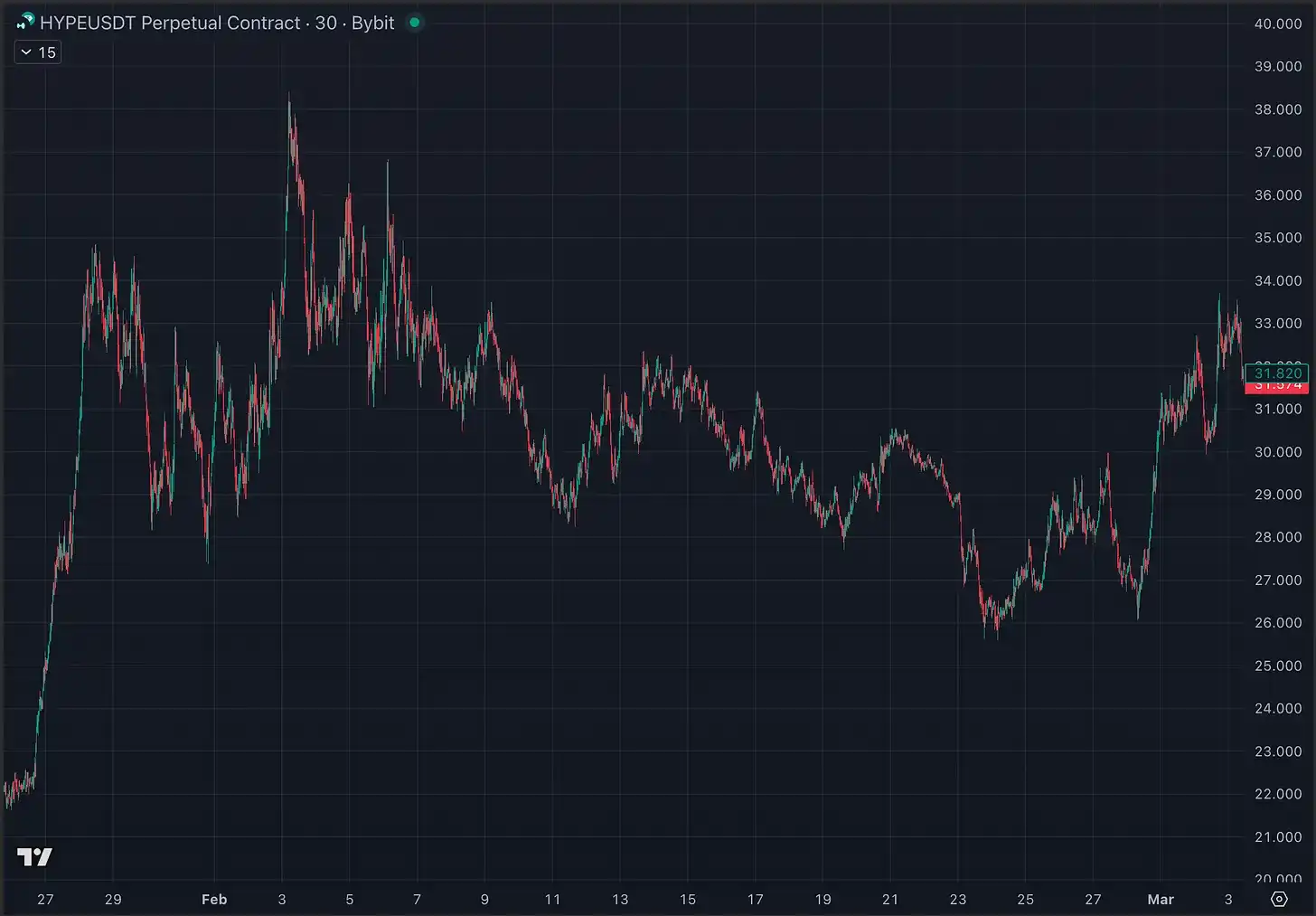
One reason for $HYPE's strength in early February was significant buying by Multicoin over several days, and HSI/PURR (HYPE's DAT) were also accumulating steadily.
In the Perp DEX sector, $LIT continued to show extreme weakness in February, finding support around $1.3, which has been tested four or five times.
$ASTER saw a strong bounce after the February 5th crash, rising from a low near $0.4 to $0.7, then strangely consolidated sideways around $0.7 for the remainder of February. It has a bullish catalyst: the launch of its own L1/blockchain in March.
Uniswap x BlackRock
On February 11th, Uniswap announced a partnership with BlackRock to provide liquidity for the latter's BUIDL product, simultaneously announcing BlackRock's direct investment in $UNI tokens (amount undisclosed). The market reaction was extremely strong, with $UNI gaining +40% in 10 minutes – quite remarkable for a token with an FDV over $30 billion. But the gains were completely erased over the next 10 hours, a classic bear market pump and dump.
Aave went through a period of controversy in February. On February 20th, BGD Labs announced its withdrawal from the Aave DAO due to disagreements over the V4 strategy, causing $AAVE to drop 8%. At the end of the month, Marc Zeller, a well-known figure in the Aave ecosystem, published a critique of Aave Labs, characterizing it as effectively an value extraction vehicle, leading to further token weakness.
Particularly unfavorable for Aave is that its main competitor, $MORPHO, has performed strongly in 2026, gaining nearly +75% in February. The FDV of the two tokens is now roughly equal, around $2bn each.
Other Important Events in February
On February 18th, Base announced it would transition from the Optimism tech stack to building its own. This was devastating for $OP, which fell 40% over 4 days. $ARB was also dragged down by correlation, now with an FDV of "only" $1bn, down 96% from its ATH ($OP is down 97%).
On February 11th, $BERA experienced a very strong short squeeze, gaining +160% in 8 hours, with a extreme discrepancy between spot and futures prices (a 15% gap). This is a weirdly trading token, mostly significantly underperforming the market but occasionally experiencing very strong random squeezes, having already seen a 2x move over 5 days last month.
On February 18th, $WLFI suddenly rose +30% for no apparent reason, simultaneously with open interest (OI) increasing by nearly $100M – this likely means a single entity pulled the price by going long $100M worth of $WLFI. The price then topped out here, has fallen about 20% from the high, and there has been no news since. This entity's move was quite strange, and I expect $WLFI to go much lower in the coming months.
At the end of February 2026, the bankruptcy estate of Terraform Labs sued Jane Street in Manhattan federal court, accusing it of using non-public information during the May 2022 Terra collapse to trade ahead of key UST liquidity events. $LUNC gained +35% in the days following the news.
$ZEC is still digesting its Q4 2025 rally, generally underperforming, but also occasionally seeing powerful squeezes, like the +45% on February 13th-14th. I think it's quite possible it falls to $150 or even $100 in the coming months.
$HNT had a strong 2x move in February. Is this a dead cat bounce for an asset suffering from excessive dilution, or has this DePIN token finally become cheap enough to be a worthwhile buy?
Like last month, $STABLE continued to trade as if its supply is locked, rising +144% from a local bottom of $1.6bn FDV to set a new high near $4bn FDV. DegenSpartan also endorsed it in an article, and given DegenSpartan's rare public commentary lately, this endorsement is quite bullish.
$BCH is a strange token. It consistently rose relative to BTC (outperforming by 40%) for 22-day stretch, then suddenly reversed, giving back all its excess returns in less than a week. Many became bullish on BCH due to the "quantum-resistant" narrative and its overall strength since early 2025, but it now looks like an entity holding a large amount of BCH decided to exit, continuously TWAP selling.
Robinhood listed two altcoins in February: $SNX (February 19th) and $CC. $CC barely reacted, but $SNX gained +42% over several days as a result. Upbit listings remain a very strong catalyst for tokens; $AZTEC (+70%), $ESP (+100%), and $SKR (+40%) all experienced this, with extremely negative funding rates within hours of listing. $BIRB also saw a 2x move after listing on Bithumb on February 3rd.
Two notable TGEs in February were $AZTEC and $ESP (Espresso). Both traded at relatively low valuations (FDV both below $500M, whereas这类 projects easily reached $1bn+ FDV a few months ago), indicating that altcoin premiums are slowly being repriced downward. However, $ESP had a stronger performance, with a +280% move from its late February low to high.
Polymarket announced a partnership with Kaito to launch an attention market. $KAITO rose +13% in 3 minutes after the news, then gave back all gains within an hour.