Farcaster Is Not a Pivot, It's Evolution: The True Ambition from Social to Wallet

marsbitPublished on 2025-12-10Last updated on 2025-12-10

Abstract

Recently, Farcaster co-founder Dan Romero announced a shift in the project’s focus from "social-first" to "wallet-first," sparking widespread discussion. While some interpreted this as Farcaster abandoning social features or even signaling the failure of Web3 social networks, the move is better understood as a strategic evolution rather than a pivot. Farcaster’s integration of a built-in wallet is not a replacement for social functionality but an upgrade to improve user experience. It enables seamless on-chain interactions, especially as Frames evolve into more powerful Mini Apps. This enhancement allows users to mint NFTs, execute trades, and engage with decentralized applications without leaving the app—reducing friction and supporting richer crypto-native experiences. The shift reflects a broader trend: social apps are integrating wallets, and wallet apps are adding social features. This convergence is becoming the natural direction for consumer crypto applications. By combining social graphs with built-in wallets and Mini Apps, Farcaster enables closed-loop scenarios for asset creation, discovery, trading, and community interaction—all within a unified experience. Other platforms like Telegram, Zapper, Base App, and Binance are also exploring similar integrations, highlighting the growing importance of blending social context with financial activity. Farcaster’s open and composable social protocol allows developers to build diverse clients and applications, further exp...

Recently, a post by Farcaster co-founder Dan Romero about Farcaster's current focus shifting from "social-first" to "wallet-first" has attracted widespread attention and discussion. For active Farcaster users, this should come as no surprise. Since the Farcaster App introduced its built-in wallet feature in February, support for more chains has been added, and related functions have become increasingly rich. This announcement is essentially a reiteration and a summary of the team's direction throughout the year. For those less familiar with Farcaster, however, this statement seems somewhat unexpected. Many can't help but exclaim, "The last hope of crypto social," "the village's hope for SocialFi," has "admitted failure," "abandoned social," "deviated from its original intention." They express disappointment that "the social track has been disproven," "Web3 social is unworkable," and worry about the community atmosphere sliding into "casino-ization," with the team "charging headlong in the wrong direction."

This divergence stems from different understandings of the positioning of the Farcaster wallet. In fact, the built-in wallet added to the Farcaster App this year is not an abrupt strategic pivot but a natural upgrade from the previous experience that required connecting an external wallet for on-chain operations. Simultaneously, as Frames have gradually evolved into more feature-rich and complex Mini Apps, users' demand for seamless on-chain interaction has also increased. The emergence of the built-in wallet is essentially to accommodate new scenarios, to complete the foundational capabilities on top of the social network, not to abandon the existing social network.

The wallet is an increment, not a replacement; it drives social, does not侵占 social; it expands social, does not abandon social; it is顺势而为, not a forced transformation.

The original open social protocol底层 remains as always, and the diverse client ecosystem is still healthy. You can switch to another client to experience pure social interaction. The original social functions of the official client, Farcaster App, are still there; it's just that this year, an additional built-in wallet was added, expanding upon the original functions. It can seamlessly connect with Mini Apps, deeply integrate with the identity graph, and interact smoothly with the social feed.

The team has merely adjusted the focus of product-side work, adjusting the path to try to achieve growth for the entire network. They are no longer spending time on onboarding users from all walks of life for network diversification, nor optimizing the less effective Channels community function. They have spent enough time building a small but beautiful "comfortable corner," but the "social-first" strategy failed to achieve sufficient Product-Market Fit (PMF), with tens of thousands of daily active users still being very small. Thus, they very pragmatically returned to the first principles of crypto applications: serving value flow.

On this basis, the combination of wallet and social interaction becomes a stronger product differentiator, a more realistic growth path, and closer to the Schelling point of crypto social PMF. In fact, Farcaster's shift in focus this year is also a footnote to the development direction of the entire crypto social application landscape. "Social applications becoming wallet-like, wallet applications becoming social-like" is the natural convergence direction for consumer-grade crypto applications. Now, almost all products that have even a hint of social features have wallet functions, and wallet applications are also trying to add social elements, not to mention many applications that started with social + wallet as their native positioning from the beginning.

Social Applications Becoming Wallet-Like

If they want to stand out, all crypto applications must answer what distinguishes them from their traditional off-chain counterparts. Of course, crypto social applications must also answer how they differ from traditional social products. Product manager Yu Jun once proposed a famous formula to measure whether a new product is attractive enough to users:

Product Value = (New Experience − Old Experience) − Migration Cost

Some new products have very low migration costs. Threads, backed by Instagram's substantial social graph, reached 100 million users in 5 days. The luckiest scenario is encountering users who migrate precisely for the sake of migration. Bluesky, by hitting the single point of "Twitter without censorship," caught the rare and unforeseen wave of Twitter refugee word-of-mouth.

But the vast majority of crypto applications do not have that kind of foundation or luck. To get users to take a glance away from traditional social products with larger user bases and more mature products, they can only focus on enhancing the new experience. Crypto social started from a technical perspective, focusing on how to integrate with blockchain at the底层 to achieve decentralization. But embedding加密 technology at the底层 is imperceptible to the vast majority of users and does not bring a new experience. It lacks differentiation when competing with traditional social products and can even result in more cumbersome onboarding processes. For example, both major social protocol底层, Farcaster and Lens, use blockchain. Farcaster stores identity data on the OP chain, and Lens stores identity and social graphs on the Lens Chain, ensuring "not your private key, not your social account." But most users don't really care about the underlying technology; they care about what fresh experiences exist at the product level.

The Farcaster team, of course, realized this early on. Their philosophy is "product leads protocol development." They hope to drive the growth of the entire Farcaster network through a flagship product. If they had only wanted to build a social protocol, the team's task would have been基本上 completed. They implemented many theories of decentralized social networking from the start, creating a "sufficiently decentralized" protocol that actually emphasizes the protocol's openness, programmability, and composability. Developers can build various applications based on the open social graph. But if, like the Nostr, ActivityPub, and Lens social protocols, they let the ecosystem develop wildly, users won't migrate just because your underlying technology is different. The content noise brought by野蛮生长 would further reduce the user experience, ultimately resulting in users not wanting to come, and those who come not staying. The Farcaster team building their own client is precisely hoping to attract users to join at the product level.

A high-quality social circle is a new experience, unique alpha information is a new experience, the combination of加密 and social is a new experience. Farcaster initially achieved the first point by onboarding a group of high-quality users, which is also a rare moat, but growth is limited. It's difficult to attract the vast majority of加密 users whose profile is "no profit, no early rise; empty gloves套白狼" (unwilling to act without benefit, seeking gain without investment). Interestingly, Farcaster was once criticized for being too "清真" (pure, referring to avoiding financial talk). For a long time, discussing token price fluctuations on Farcaster was异类 (an anomaly),只能 hiding in the corner of the /DEGEN Channel. 曲高当然和寡 (Highbrow songs find few singers). So it wasn't until early 2024, with the launch of Frames—a crypto-native feature somewhat different from traditional social apps—and the community spawning the $DEGEN creator economy project, that Farcaster's daily active users began to grow significantly, increasing more than tenfold from around 2,000 DAU at the end of January 2024. This was thanks both to innovation at the product level and to the already formed high-quality community possessing the ability to incubate projects within this open social network.
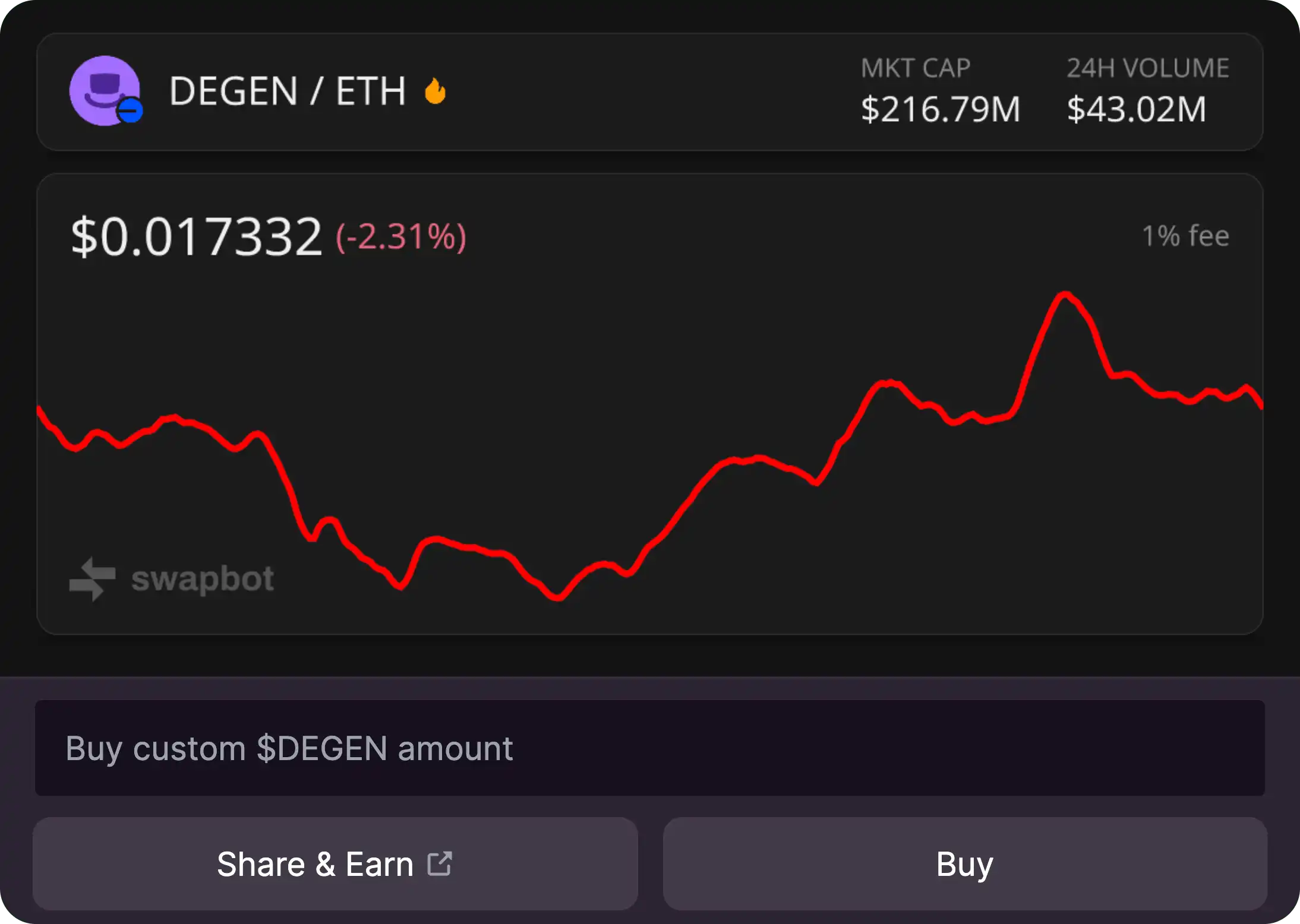
An early version of a Farcaster mini-program, a trading Frame

At that time, Farcaster had actually completed the leap from the "agricultural age" of pure social networks to the初步 "handicraft age" combining加密 functions: Social Graph + Frames + External Wallet, truly connecting social content flow and on-chain operations for the first time. Solana later also attempted to achieve wallet interaction with加密 mini-programs within Twitter feed through the Actions protocol using a browser extension. Social Media × Crypto Applications × Wallet Interaction is a direction everyone wants to explore. Through Frames, users could mint NFTs and execute trades within the social feed—a genuine new experience. But it was limited to a maximum of 4 action buttons, the screen transitions were like PPTs, functionality and performance were very limited, and any action involving wallet authorization required jumping to an external wallet. Functionality was restricted, the experience was fragmented, and it still wasn't smooth enough. So, actually, from the first day Frames were launched, the community has been calling for full wallet functionality, but it took a year to arrive.
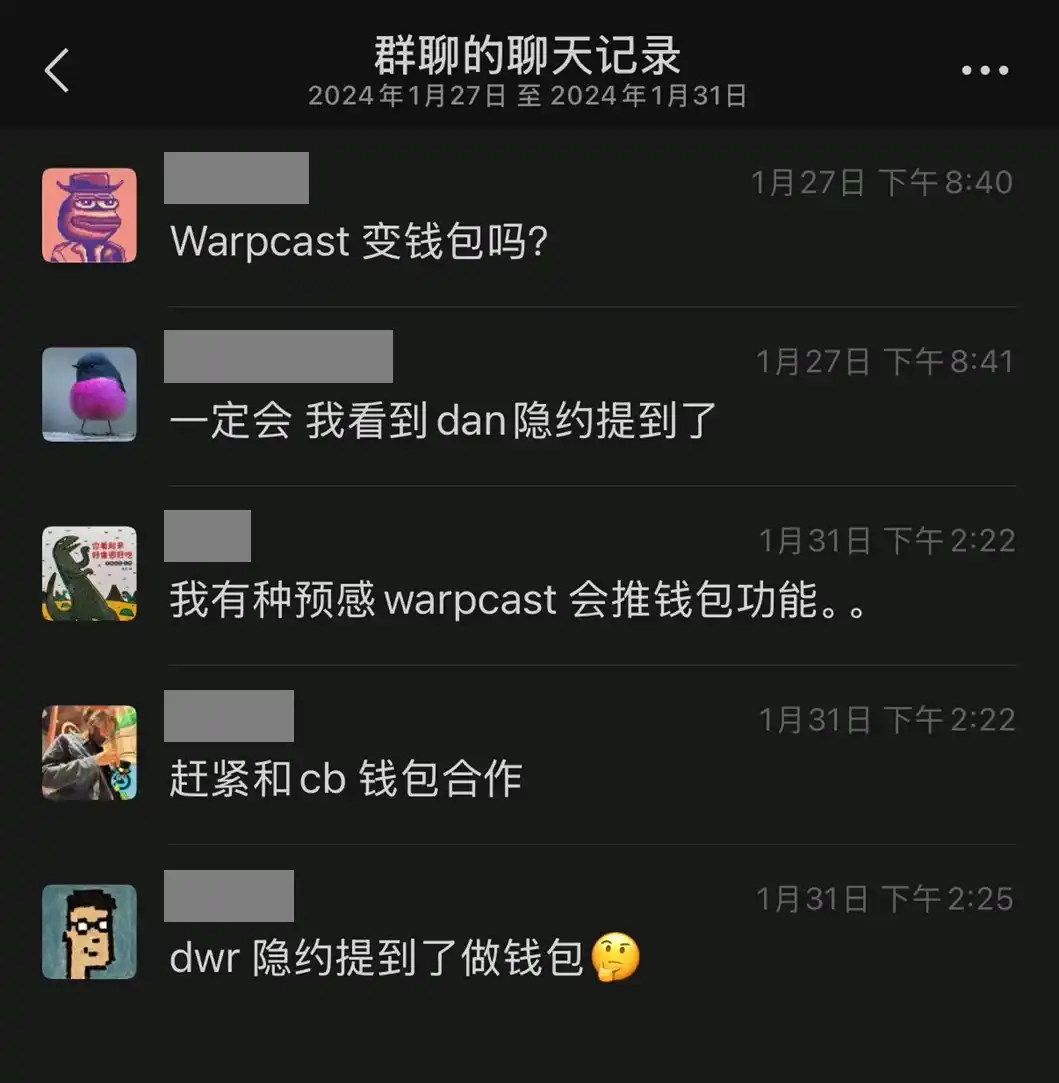
In the Farcaster Chinese community WeChat group, everyone started excitedly envisioning wallet functionality when Frames were first launched in early 2024

Later last year, with the arrival of the memecoin supercycle, from the popularity of PumpFun to Clanker, which grew out of Farcaster itself, more asset issuance brought more trading demand. The entire path from discovery to交易 became increasingly important, and the wallet naturally became an increasingly critical entry point in this process.

So it's easy to understand that to allow users to interact more naturally with加密 applications within a social media platform, it is necessary to:

1. Have a底层 framework with higher freedom and higher performance to carry more powerful mini-applications.

2. Shift from connecting external wallets to using built-in wallets to make on-chain interaction truly seamless.

This has also been验证 on the instant messaging social application Telegram, whose Mini Apps ecosystem and built-in TON wallet have already sparked a wave of enthusiasm. Therefore, Farcaster's upgrade this year logically followed suit:

1. Frames → Mini Apps

2. External Wallet → Built-in Wallet

What a webpage can achieve, Mini Apps can achieve. Anyone can build permissionlessly, and they are cross-client compatible, greatly expanding the functional boundaries within the social media application. Interaction with the built-in wallet also does not require jumping to an external wallet. Thus, it moves from the "handicraft age" with basic加密 functions to the "industrial age" with richer functionality. This is not a deviation from the course but a natural expansion along the trend; not a被迫转向, but an inevitable evolution顺应市场需求.

Integrating a built-in wallet is not the death knell for crypto social media, but the industrial revolution of crypto social media.
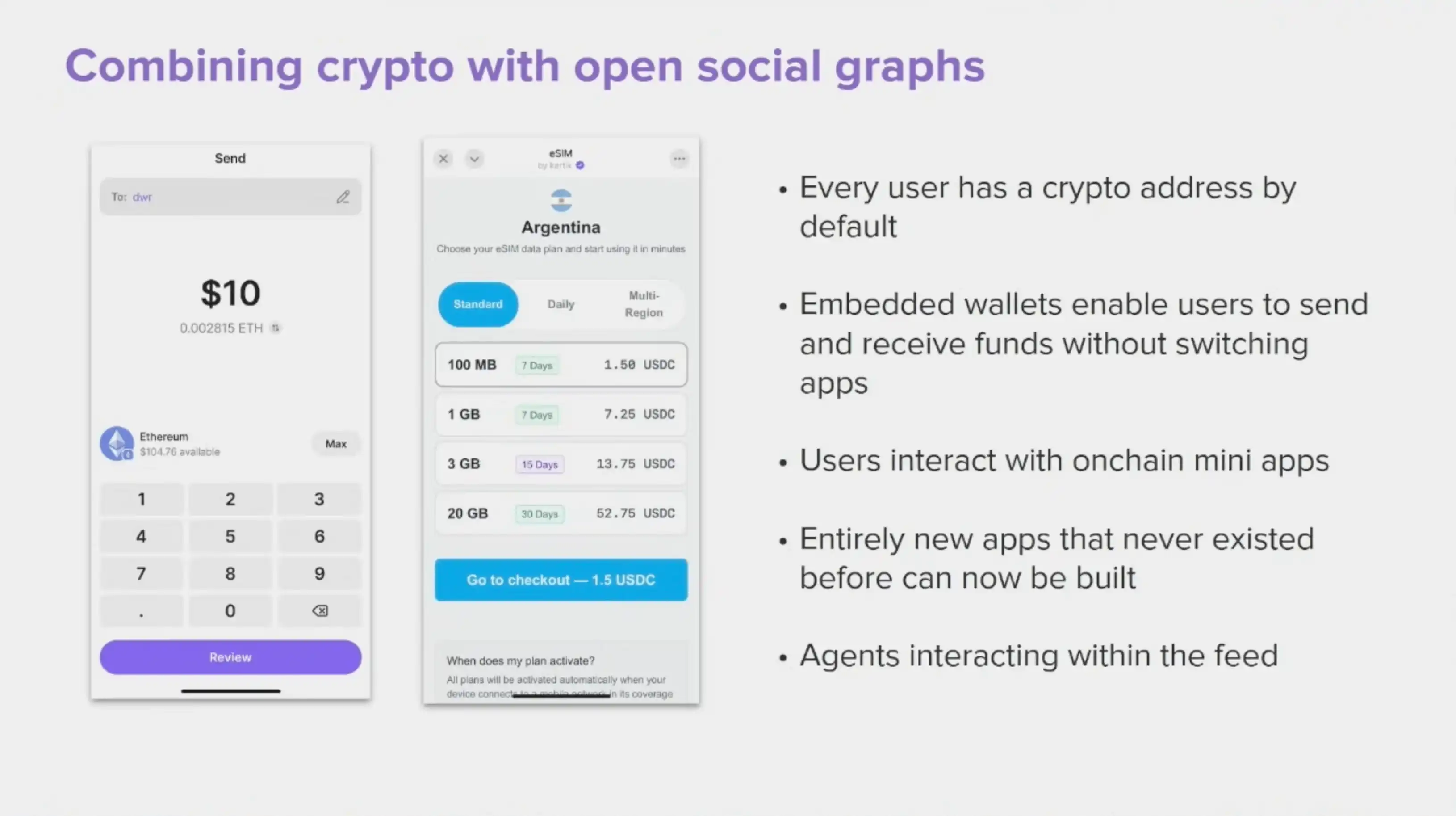
Crypto Apps and Decentralized Social by Linda Xie

With the built-in wallet, there naturally come trading signals based on the social graph. Asset issuance, dissemination, discovery, trading, and community building can form a closed loop within the same application. It also facilitates convenient interaction with Mini Apps, enabling almost all functions of加密 applications, including games, video, live streaming, voice Spaces, podcasts, prediction markets, DeFi... A rich Mini Apps ecosystem and the built-in wallet advance side by side like two carriages, integrating on-chain interaction into users' daily social behaviors. Applications like Noice, Bracky, QR, and Harmonybot have also催生 a series of new crypto social interaction scenarios due to the existence of social graph + Mini Apps + built-in wallet, each having their own moments of glory. Against this backdrop, Farcaster's daily active users also once broke new highs at the end of October.
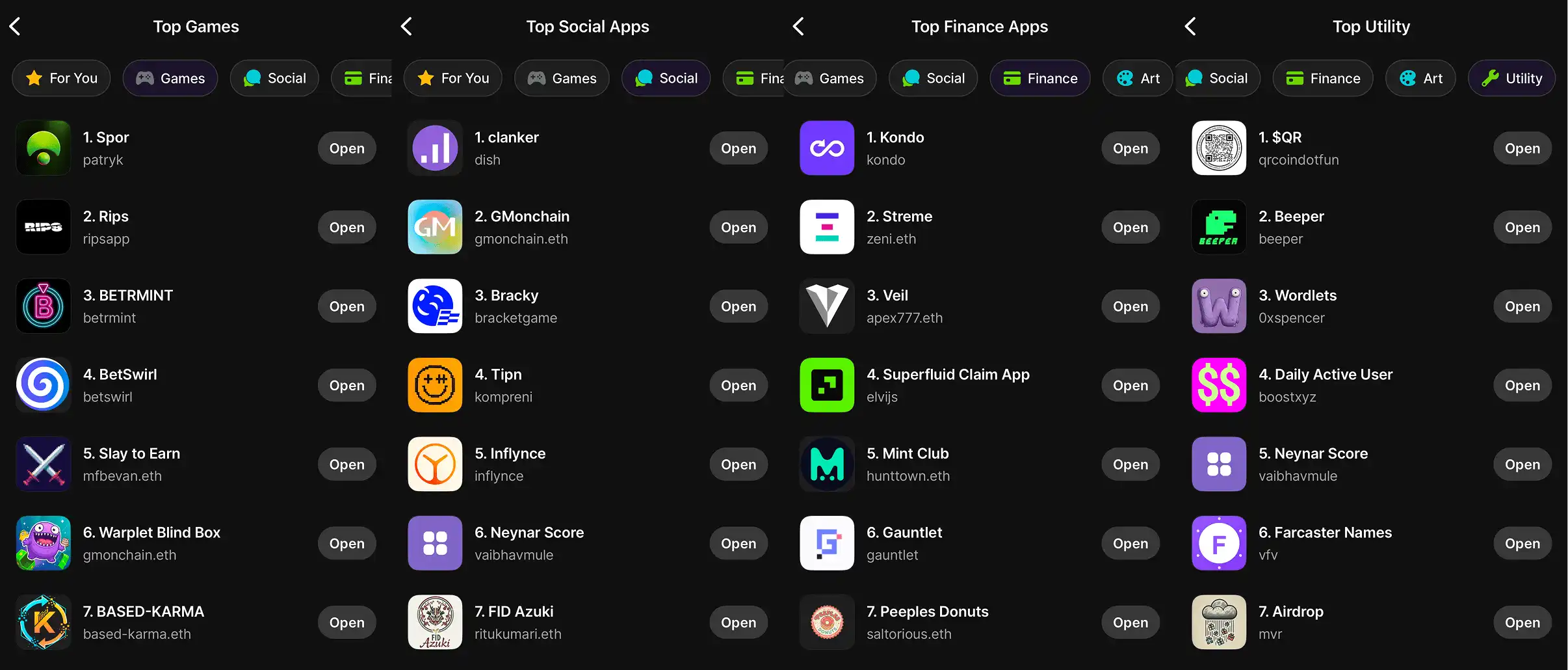
Trending Mini Apps of Different Categories

These are all experiences that users can perceive, use, and that unlock全新 scenarios. They are also what truly differentiates them from traditional social products. Even if users initially only use the trading function because the wallet provides a more convenient entry point, lower fees, and a more seamless cross-chain experience, there is still a chance to achieve "come for the tool, stay for the network." This is already a step forward compared to the previous situation of competing for attention from Twitter solely relying on the吸引力 of the social network.

It's no coincidence that some instant messaging applications are also actively adding wallet functions on top of social interaction. For example, Farcaster ecosystem chat application frens and applications like DeBox allow users to simply send a CA (Contract Address) in a chat group to call the built-in wallet for trading. More and more developers are realizing: they should not avoid mainstream加密 users; the characteristic of加密 social is not to stay away from wallets but to embrace them; they should not sever the value layer but integrate it. 加密 social without a built-in wallet is what has "taken some detours."
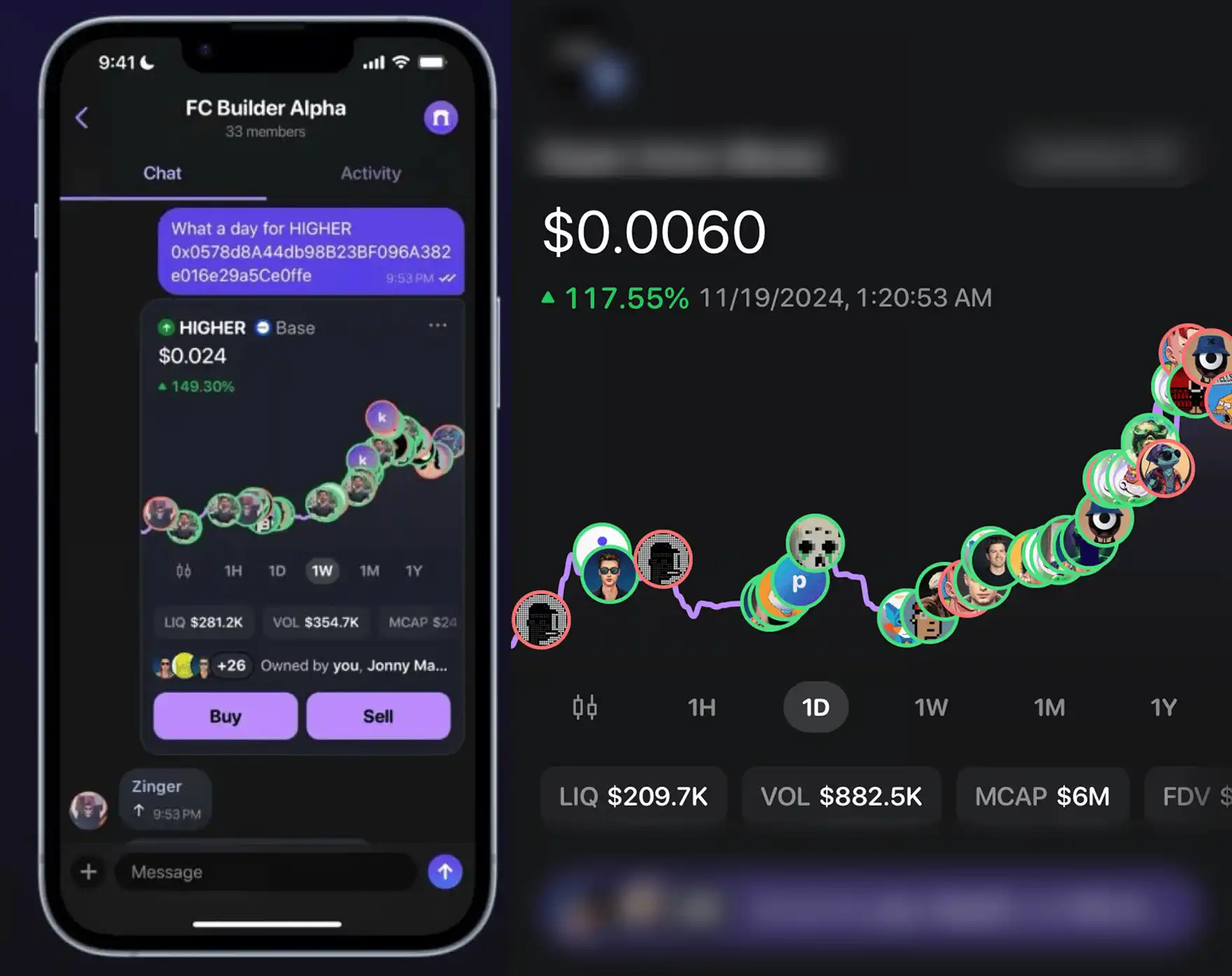
frens screenshots

Wallet Applications Becoming Social-Like

Similarly, crypto wallet applications are also trying to incorporate social elements. From being mere containers for assets and entry points for transactions, as user needs and on-chain behaviors become more diverse, they also want to add social signals and social interactions based on the social graph.

Zapper and Base App were originally both wallet applications. Now they have both integrated content and social graphs from the Farcaster social protocol, effectively acting as clients for the Farcaster protocol. This actually also demonstrates the value of Farcaster as an open, programmable, composable social protocol. The protocol is open, the interfaces are clear, and developers can freely build a client or an application based on Farcaster. Whether it's a wallet or any other application, they can directly integrate Farcaster's social layer into their product without permission.

Zapper has added Farcaster network content and on-chain activity & trading signals based on the Farcaster social graph on top of the wallet. Users can directly discover trading opportunities from the on-chain behavior of followed users and quickly complete trades with one click.

Base App, on the foundation of the original wallet, has integrated Farcaster as a social feed, Zora as a tool for creators to monetize content, and XMTP as the underlying protocol for instant messaging and group chats. Thus, within Base App, content creation, asset issuance, social discovery, token trading, application interaction, community chatting, and interaction with agents can be achieved, forming a closed loop of content, relationships, and value in the same space.

Zerion has now also integrated social graphs to achieve social discovery功能. On the basis of its previously well-established function of following wallet addresses, it has incorporated Twitter, Farcaster, and Lens social identities to better discover users of interest and trading signals from top traders.
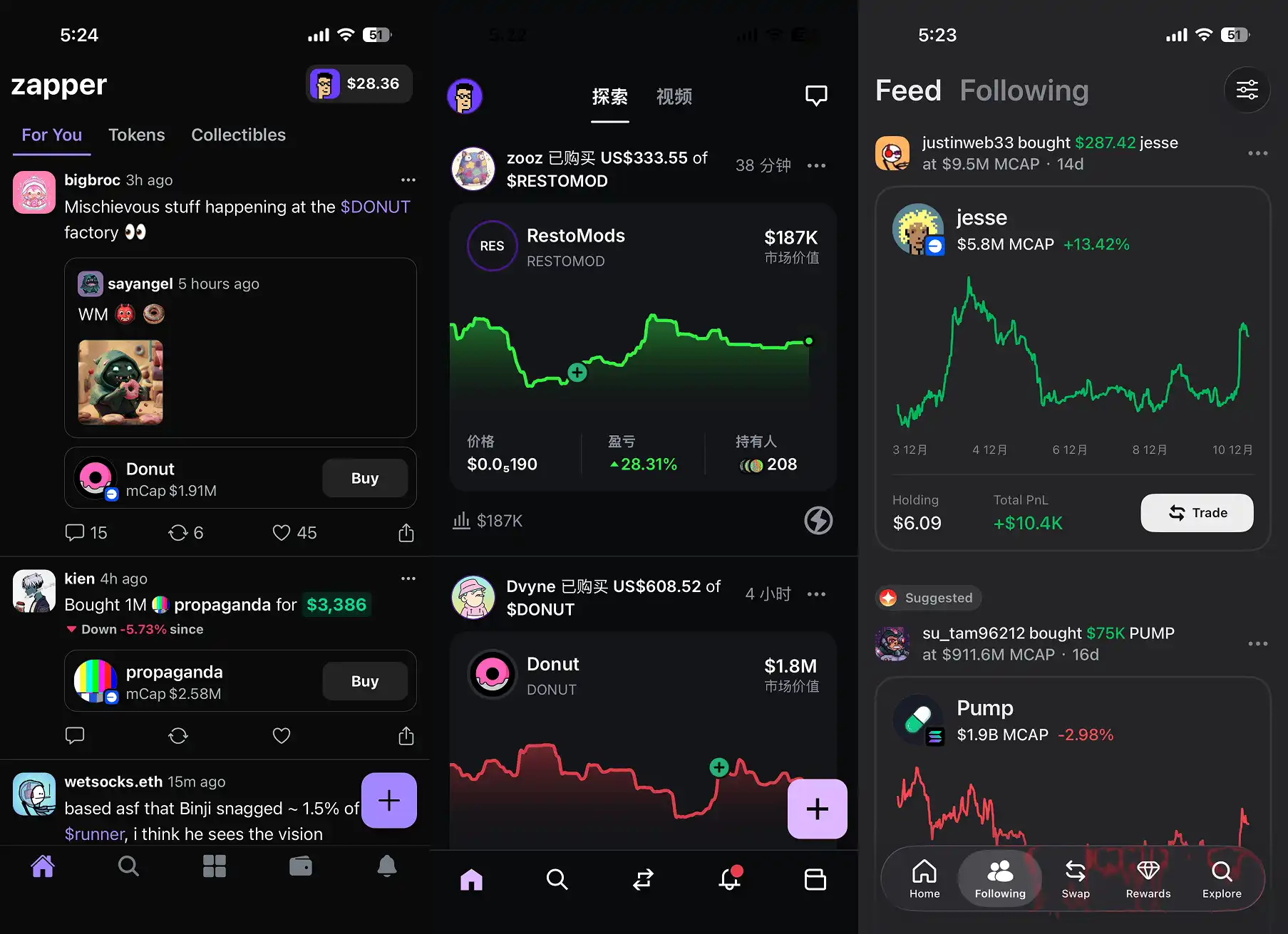
Zapper, Base App, Zerion

Centralized exchanges can also be considered wallets, and they are also actively exploring integration with social features. Binance launched Binance Feed in 2022,升级为 Binance Square in 2023. Leveraging the world's largest crypto trading traffic入口, it has built a comprehensive community platform focused on trading, allowing users to, within the same application, besides trading, also follow trader dynamics, obtain in-depth content information, exchange strategies, and enjoy diverse social interaction functions like voice and live streaming, keeping users engaged on the application for longer periods.

Similarly, Robinhood, a centralized exchange now involved in cryptocurrency and prediction markets, recently announced it is exploring social features, allowing users to communicate strategies, discover signals, and copy trades on the platform.

However, centralized exchanges building their own social features often result in closed ecosystems. Like traditional social platforms, users' relationship chains, content, and identities are still held by the platform. It is somewhat regrettable that ordinary developers cannot freely build new applications based on their social graph; all functions can only rely on the exchange team's point-by-point iteration. But again, users don't care about this; they only care if your product is useful and easy to use.
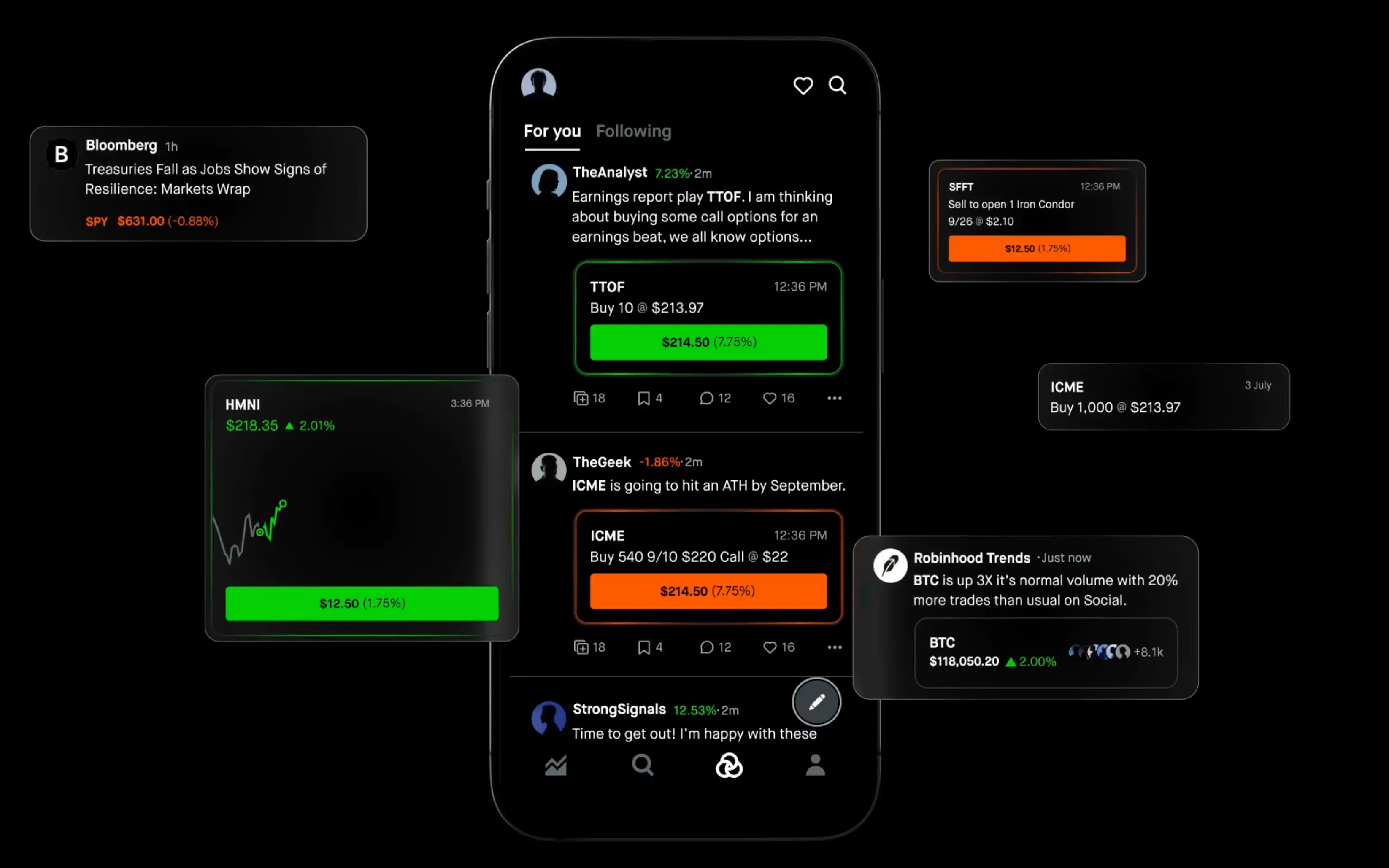
Robinhood is exploring social

For wallets, social is not a decorative function but a key step in upgrading the wallet from a "tool" to a "network." Social provides context for asset behavior, a source for trading decisions, and轨迹 for content distribution. Adding social elements to wallets allows them to better possess network effects, moving from tools to ecosystems.

Social + Wallet: Trading, Discovery, Creation

Social applications are becoming wallet-like, wallet applications are becoming social-like. The two are interwoven and increasingly convergent. This is actually the natural convergence direction for consumer-grade crypto applications. For crypto social, if it does not actively integrate with wallets, it is essentially a passive choice that背离 mainstream crypto users. If they don't do it, they will inevitably fall behind and be replaced by more complete product forms. Social applications need wallets to complete the puzzle of on-chain interaction. Core capabilities such as the crypto application ecosystem and creator economy, which constitute the differentiated experience of crypto social, must rely on complete wallet functionality to be realized. Adding a value layer on top of the social layer provides a growth lever for the social network.

For wallets, adding social features is the icing on the cake. Users no longer "use and leave" but can stay because of relationships, content, and community. Wallets transform from tools into networks, from entry points into scenarios, from asset managers into interactive spaces, naturally expanding into more application scenarios and network effects.

Of course, some applications have aimed for the "social + wallet" route from the very beginning,及早 realizing that the two are naturally complementary and can form a value closed loop of content, relationships, and assets.

· interface.social: Supports discovery of popular tokens, tracking user on-chain activity, copy trading, and allows users to publish trading views (Takes).

· 0xppl.com: Supports discovery of popular tokens, multi-chain wallet behavior tracking, copy trading, and profit monitoring.

· Firefly.social: Firefly itself is an aggregator client for multiple social networks, including X, Farcaster, Lens, Bluesky, supporting cross-platform one-click posting. It挖掘 trading opportunities in social data by aggregating friends' trading activity.

· fomo.family: Supports real-time tracking of friends' and top traders' on-chain transactions, and quickly discovers new assets through built-in transaction analysis and profit/loss tracking.

· Share.xyz: Allows users to share any transaction, follow any wallet, receive real-time transaction notifications, and supports copy trading with收益分成 (revenue sharing) for the copied party.

· gmgn.ai: Supports快速 discovery of热门 assets, tracking of smart money and followed users' holdings and trades, performing秒级上链 transactions (second-level on-chain transactions), and provides an integrated on-chain intelligence and trading tool with automatic copy trading, risk control checks, and real-time alerts.

· Vector.fun: Supported on-chain user trading activity and asset discovery. Acquired by Coinbase and operations suspended.
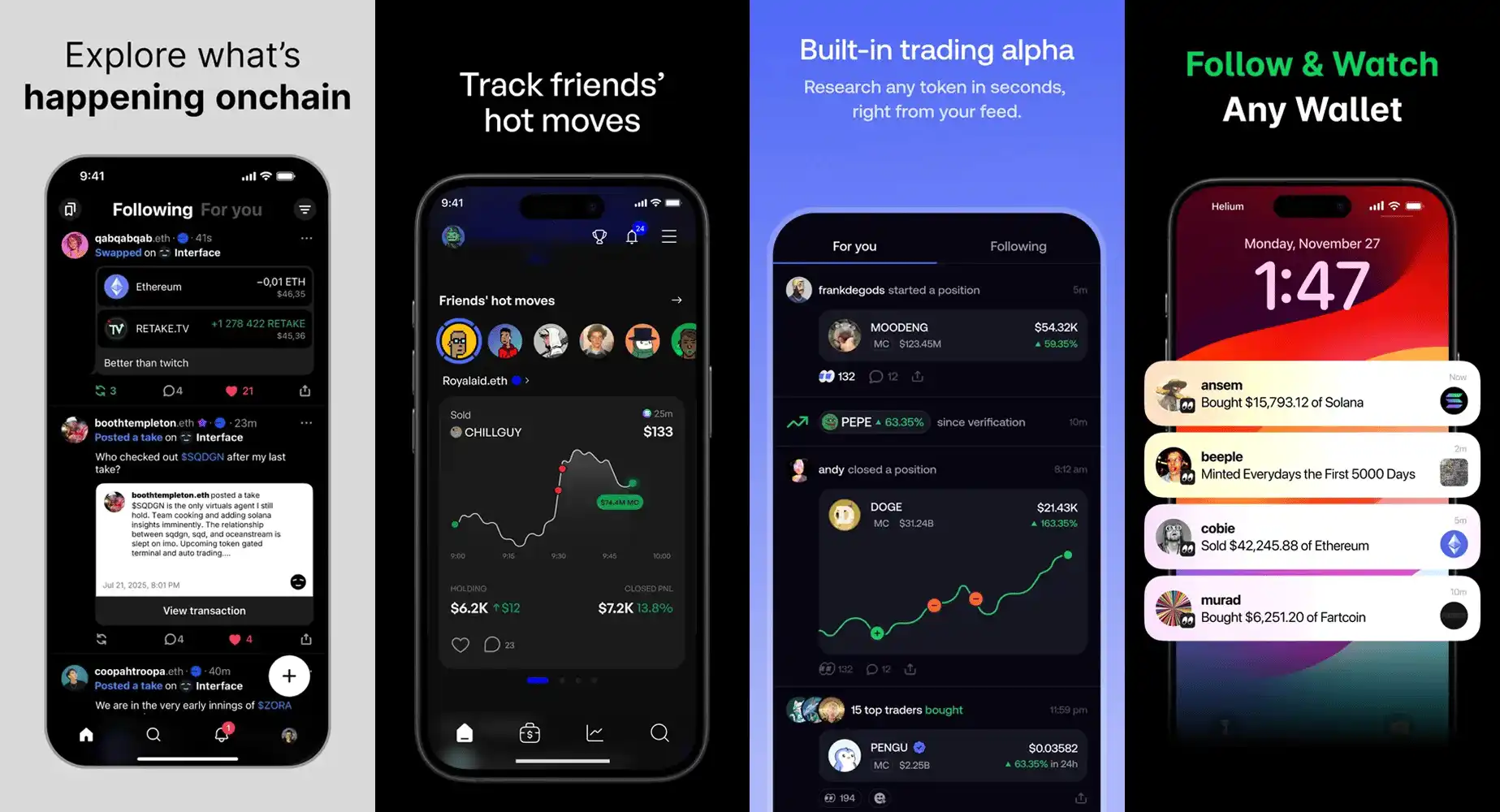
Interface, 0xppl, fomo, Share

Looking from start to finish, you'll find that their functions and interfaces are similar in many ways. "Trade, Discover, Create" is Farcaster's new slogan. Applying this phrase to other "social + wallet" applications doesn't seem out of place either. They are basically about discovering trading signals, quickly copying trades, and sharing trading strategies.

The difference might lie in how each product chooses its focus. Different applications make trade-offs on functional dimensions, with varying emphasis and depth. Some emphasize content production, allowing users to clearly explain "what to buy and why"; some几乎不做 content, instead倾斜 resources towards trade execution, data insight, and copy trading efficiency. These trade-offs ultimately shape different product strengths and create significantly different user experiences.

Who will stand out? It might depend on who can make one point professional and deep enough.

For example, 0xPPL has become increasingly professional in on-chain graph analysis, and with its connections to many social graphs, it has become a tool for quickly identifying on-chain address identities, which is very useful during new token launches. GMGN has made the entire process from discovery to analysis to execution of trades as efficient as possible. In terms of multi-chain support, Zapper and Zerion, as professional wallets themselves, cover a very wide range of chains. In terms of actual cross-chain experience, the Farcaster Wallet is very smooth with extremely low磨损 (friction/costs).

The "Takes," "Comment," or "Share" features of Interface, fomo, and Share are differentiating points, allowing users to write their own trading logic, hoping their applications can沉淀 (accumulate) content creation, but the centralized content has略少 network effect. Of course, other applications could directly integrate the Farcaster protocol to achieve content creation, allowing produced content to diffuse within a larger social network.

Additionally, applications based on the Farcaster protocol have another advantage: they can reuse the hundreds of functionally diverse Farcaster Mini Apps, embedding mini-programs directly into the social flow, easily expanding the functional boundaries within the application without reinventing the wheel.
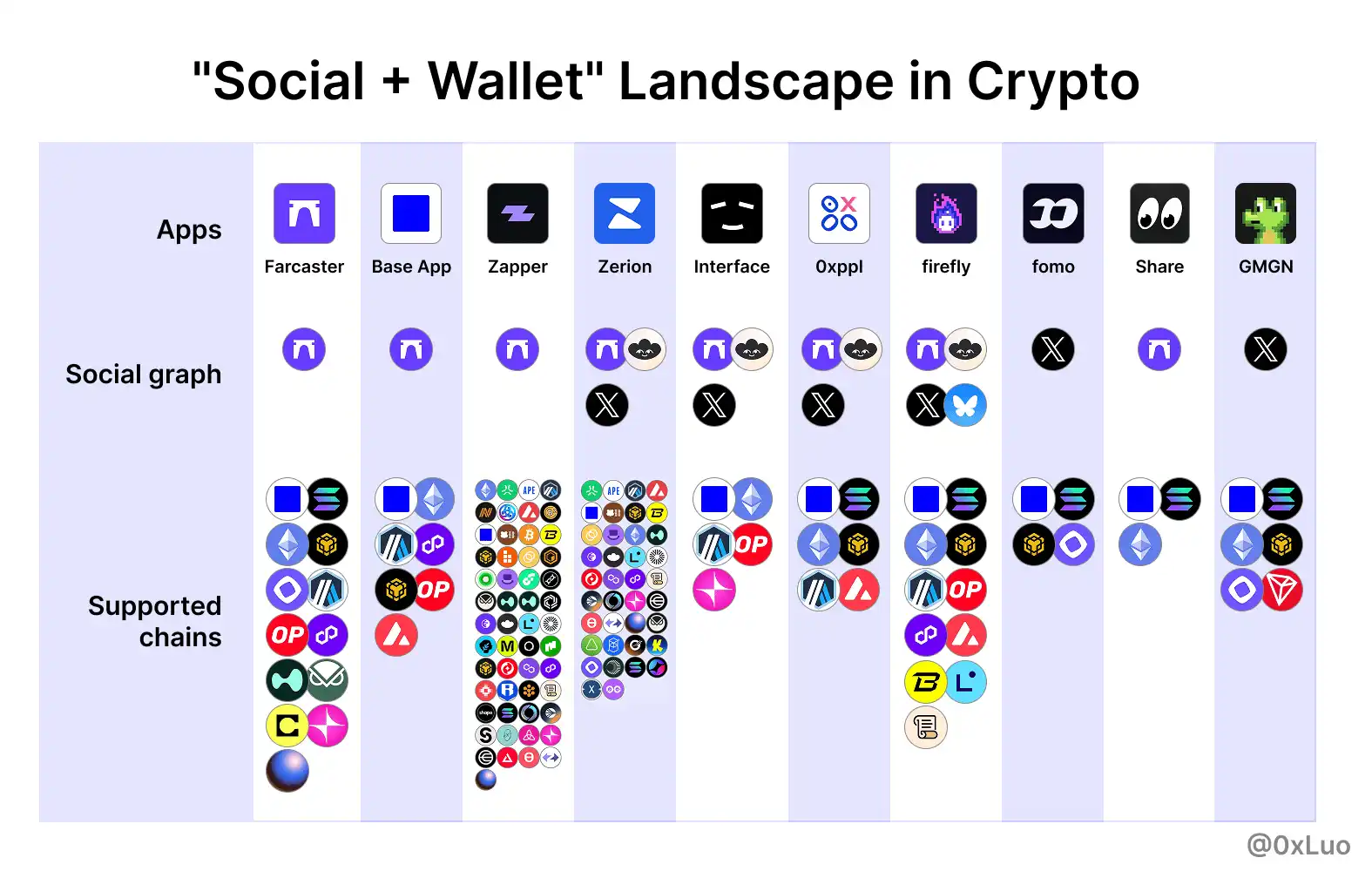
Panoramic View of "Social + Wallet" Crypto Applications

Dan Romero once said, "Adding a wallet to a social network is much easier than adding a social network to a wallet." Expanding wallet capabilities on an existing social network might be easier from a product perspective for Farcaster. However, other applications can also directly integrate existing social networks, unless they are sufficiently confident in their own user base.

From the panoramic view of "social + wallet" crypto applications, it can also be seen that currently, if one wants to build a "social + wallet" application, Farcaster and X are the most chosen options for social graphs. Slightly different is that, due to differing degrees of openness, when integrating the X social graph, it often only involves associating wallet addresses with X accounts. But when integrating the Farcaster social graph, besides associating with identity, it can easily import users' existing social relationships and even content produced on the social network, thus obtaining a ready-made social network with one click, rather than starting from scratch to accumulate social content and build a relationship graph.

As more and more applications adopt Farcaster as social infrastructure, the value of the entire network is放大 (amplified) in reverse, thereby enhancing the network effect of the entire protocol. Looking back over the past four years, the Farcaster team, with a restrained development path, has built a "small but refined" social graph. Although growth was limited, the accumulated social relationships, content, and culture are becoming the underlying assets and infrastructure of the open crypto social ecosystem. This network will continue to be enriched, extended, and adopted in the future.

Conclusion

Farcaster is not dead, crypto social is not dead, and Farcaster as crypto social is not dead. True crypto social does not stop at just building a social network; it must combine social interaction with value flow. Therefore, this year's upgrade of the Farcaster App from the inconvenient connection of external wallets to a fully functional built-in wallet is a key leap to补上 (make up for) this long-overdue底层 capability. This is not abandoning social interaction but driving it, giving social interaction a new growth engine.

The recent "mockery" Farcaster encountered恰好说明 (precisely indicates) that Farcaster's social graph is still too small, and its daily active users are still too limited, leading to some information gaps and interpretive偏差 (deviations) among friends observing from afar. Simultaneously, in the trend of "social applications becoming wallet-like, wallet applications becoming social-like," the Farcaster App will continue to face sustained competition—these are also current real challenges. It needs to continue relying on the dual drivers of Farcaster's product-side "wallet-first" approach and the continuously emerging Mini Apps within the ecosystem to共同驱动增长 (drive growth together), the value flow capability at the product layer continuing to配合 (cooperate with) the composable ecosystem capability at the protocol layer.

What will happen next? Still, no one can guarantee the answer. But perhaps加密 social truly begins by expanding wallet functionality on existing social media. Let value flow, and the加密 social network will become more active.


Related Questions

QAccording to the article, why did Farcaster shift its focus from 'social-first' to 'wallet-first'?

AThe shift was not an abandonment of social features but a natural evolution to enhance the user experience. The team found that the 'social-first' strategy had limited product-market fit (PMF) with only tens of thousands of daily active users. By integrating a built-in wallet, Farcaster aims to better serve value flow, which is a core crypto principle, and this integration provides a stronger product differentiation and a more viable growth path by enabling seamless on-chain interactions within the social network.

QWhat is the significance of the transition from Frames to Mini Apps in Farcaster?

AThe transition from Frames to Mini Apps represents a major upgrade in functionality and performance. Frames were limited to about four interaction buttons and had performance constraints like 'PPT-like' screen transitions, requiring jumps to external wallets for authorizations, which created a fragmented experience. Mini Apps, however, offer much higher freedom, are as capable as web pages, can be built permissionlessly, are cross-client compatible, and enable almost any crypto application function (e.g., games, DeFi, video) to be integrated directly into the social feed, working seamlessly with the built-in wallet.

QHow does the built-in wallet in Farcaster App contribute to the platform's growth?

AThe built-in wallet allows for a closed-loop experience within the Farcaster App where asset issuance, propagation, discovery, and trading can be integrated with community building. It enables seamless interactions with Mini Apps, lowers transaction fees, provides a smoother cross-chain experience, and reduces the friction of on-chain operations. This functionality attracts users who may initially come for the trading tools but potentially stay for the social network, embodying the strategy of 'come for the tool, stay for the network.'

QWhat is the broader trend in consumer crypto applications that the article identifies regarding social and wallet features?

AThe article identifies a convergent trend where 'social applications are becoming walletized, and wallet applications are becoming socialized.' This means almost all crypto-social products are incorporating wallet functions, and wallet apps are adding social elements. This convergence is seen as the natural direction for consumer crypto applications, as combining social layers with value layers creates differentiated experiences, enhances network effects, and provides a more complete product形态 that integrates content, relationships, and assets.

QBesides Farcaster, name another type of application mentioned in the article that is integrating social features and what is the benefit?

AWallet applications like Zapper, Base App, and Zerion are integrating social features. For example, Zapper and Base App integrate the Farcaster protocol to display network content and social graph-based on-chain activity and trading signals, allowing users to discover trading opportunities from people they follow and execute trades quickly. The benefit is that social features transform wallets from mere 'tools' into 'networks,' providing context for asset behavior, sources for trading decisions, and pathways for content distribution, thereby enhancing user retention and expanding application scenarios.

Related Reads

iQiyi Is Too Impatient

The article "iQiyi Is Too Impatient" discusses the controversy surrounding the Chinese streaming platform IQiyi's recent announcement of an "AI Actor Library" during its 2026 World Conference. IQiyi claimed over 100 actors, including well-known names like Zhang Ruoyun and Yu Hewei, had joined the initiative. CEO Gong Yu suggested AI could enable actors to "star in 14 dramas a year instead of 4" and that "live-action filming might become a world cultural heritage." The announcement quickly sparked backlash. Multiple actors named in the list issued urgent statements denying they had signed any AI-related authorization agreements. This forced IQiyi to clarify that inclusion in the library only indicated a willingness to *consider* AI projects, with separate negotiations required for any specific role. The incident, which trended on social media with hashtags like "IQiyi is crazy," is presented as a sign of the company's growing desperation. Facing intense competition from short-video platforms like Douyin and Kuaishou, as well as Bilibili and Xiaohongshu, IQiyi's financial performance has weakened, with revenues declining for two consecutive years. The author argues that IQiyi is "too impatient" to tell a compelling AI story to reassure the market, especially as it pursues a listing on the Hong Kong stock exchange. The piece concludes by outlining three key "AI questions" IQiyi must answer: defining its role as a tool provider versus a content creator, balancing the "coldness" of AI with the human element audiences desire, and properly managing the interests of platforms, actors, and viewers. The core dilemma is that while AI can reduce costs and increase efficiency, it risks creating homogenized, formulaic content and devaluing human performers.

marsbit16m ago

iQiyi Is Too Impatient

marsbit16m ago

Trading

Spot
Futures

Hot Articles

What is SONIC

Sonic: Pioneering the Future of Gaming in Web3 Introduction to Sonic In the ever-evolving landscape of Web3, the gaming industry stands out as one of the most dynamic and promising sectors. At the forefront of this revolution is Sonic, a project designed to amplify the gaming ecosystem on the Solana blockchain. Leveraging cutting-edge technology, Sonic aims to deliver an unparalleled gaming experience by efficiently processing millions of requests per second, ensuring that players enjoy seamless gameplay while maintaining low transaction costs. This article delves into the intricate details of Sonic, exploring its creators, funding sources, operational mechanics, and the timeline of significant events that have shaped its journey. What is Sonic? Sonic is an innovative layer-2 network that operates atop the Solana blockchain, specifically tailored to enhance the existing Solana gaming ecosystem. It accomplishes this through a customised, VM-agnostic game engine paired with a HyperGrid interpreter, facilitating sovereign game economies that roll up back to the Solana platform. The primary goals of Sonic include: Enhanced Gaming Experiences: Sonic is committed to offering lightning-fast on-chain gameplay, allowing players and developers to engage with games at previously unattainable speeds. Atomic Interoperability: This feature enables transactions to be executed within Sonic without the need to redeploy Solana programmes and accounts. This makes the process more efficient and directly benefits from Solana Layer1 services and liquidity. Seamless Deployment: Sonic allows developers to write for Ethereum Virtual Machine (EVM) based systems and execute them on Solana’s SVM infrastructure. This interoperability is crucial for attracting a broader range of dApps and decentralised applications to the platform. Support for Developers: By offering native composable gaming primitives and extensible data types - dining within the Entity-Component-System (ECS) framework - game creators can craft intricate business logic with ease. Overall, Sonic's unique approach not only caters to players but also provides an accessible and low-cost environment for developers to innovate and thrive. Creator of Sonic The information regarding the creator of Sonic is somewhat ambiguous. However, it is known that Sonic's SVM is owned by the company Mirror World. The absence of detailed information about the individuals behind Sonic reflects a common trend in several Web3 projects, where collective efforts and partnerships often overshadow individual contributions. Investors of Sonic Sonic has garnered considerable attention and support from various investors within the crypto and gaming sectors. Notably, the project raised an impressive $12 million during its Series A funding round. The round was led by BITKRAFT Ventures, with other notable investors including Galaxy, Okx Ventures, Interactive, Big Brain Holdings, and Mirana. This financial backing signifies the confidence that investment foundations have in Sonic’s potential to revolutionise the Web3 gaming landscape, further validating its innovative approaches and technologies. How Does Sonic Work? Sonic utilises the HyperGrid framework, a sophisticated parallel processing mechanism that enhances its scalability and customisability. Here are the core features that set Sonic apart: Lightning Speed at Low Costs: Sonic offers one of the fastest on-chain gaming experiences compared to other Layer-1 solutions, powered by the scalability of Solana’s virtual machine (SVM). Atomic Interoperability: Sonic enables transaction execution without redeployment of Solana programmes and accounts, effectively streamlining the interaction between users and the blockchain. EVM Compatibility: Developers can effortlessly migrate decentralised applications from EVM chains to the Solana environment using Sonic’s HyperGrid interpreter, increasing the accessibility and integration of various dApps. Ecosystem Support for Developers: By exposing native composable gaming primitives, Sonic facilitates a sandbox-like environment where developers can experiment and implement business logic, greatly enhancing the overall development experience. Monetisation Infrastructure: Sonic natively supports growth and monetisation efforts, providing frameworks for traffic generation, payments, and settlements, thereby ensuring that gaming projects are not only viable but also sustainable financially. Timeline of Sonic The evolution of Sonic has been marked by several key milestones. Below is a brief timeline highlighting critical events in the project's history: 2022: The Sonic cryptocurrency was officially launched, marking the beginning of its journey in the Web3 gaming arena. 2024: June: Sonic SVM successfully raised $12 million in a Series A funding round. This investment allowed Sonic to further develop its platform and expand its offerings. August: The launch of the Sonic Odyssey testnet provided users with the first opportunity to engage with the platform, offering interactive activities such as collecting rings—a nod to gaming nostalgia. October: SonicX, an innovative crypto game integrated with Solana, made its debut on TikTok, capturing the attention of over 120,000 users within a short span. This integration illustrated Sonic’s commitment to reaching a broader, global audience and showcased the potential of blockchain gaming. Key Points Sonic SVM is a revolutionary layer-2 network on Solana explicitly designed to enhance the GameFi landscape, demonstrating great potential for future development. HyperGrid Framework empowers Sonic by introducing horizontal scaling capabilities, ensuring that the network can handle the demands of Web3 gaming. Integration with Social Platforms: The successful launch of SonicX on TikTok displays Sonic’s strategy to leverage social media platforms to engage users, exponentially increasing the exposure and reach of its projects. Investment Confidence: The substantial funding from BITKRAFT Ventures, among others, emphasizes the robust backing Sonic has, paving the way for its ambitious future. In conclusion, Sonic encapsulates the essence of Web3 gaming innovation, striking a balance between cutting-edge technology, developer-centric tools, and community engagement. As the project continues to evolve, it is poised to redefine the gaming landscape, making it a notable entity for gamers and developers alike. As Sonic moves forward, it will undoubtedly attract greater interest and participation, solidifying its place within the broader narrative of blockchain gaming.

1.1k Total ViewsPublished 2024.04.04Updated 2024.12.03

What is SONIC

What is $S$

Understanding SPERO: A Comprehensive Overview Introduction to SPERO As the landscape of innovation continues to evolve, the emergence of web3 technologies and cryptocurrency projects plays a pivotal role in shaping the digital future. One project that has garnered attention in this dynamic field is SPERO, denoted as SPERO,$$s$. This article aims to gather and present detailed information about SPERO, to help enthusiasts and investors understand its foundations, objectives, and innovations within the web3 and crypto domains. What is SPERO,$$s$? SPERO,$$s$ is a unique project within the crypto space that seeks to leverage the principles of decentralisation and blockchain technology to create an ecosystem that promotes engagement, utility, and financial inclusion. The project is tailored to facilitate peer-to-peer interactions in new ways, providing users with innovative financial solutions and services. At its core, SPERO,$$s$ aims to empower individuals by providing tools and platforms that enhance user experience in the cryptocurrency space. This includes enabling more flexible transaction methods, fostering community-driven initiatives, and creating pathways for financial opportunities through decentralised applications (dApps). The underlying vision of SPERO,$$s$ revolves around inclusiveness, aiming to bridge gaps within traditional finance while harnessing the benefits of blockchain technology. Who is the Creator of SPERO,$$s$? The identity of the creator of SPERO,$$s$ remains somewhat obscure, as there are limited publicly available resources providing detailed background information on its founder(s). This lack of transparency can stem from the project's commitment to decentralisation—an ethos that many web3 projects share, prioritising collective contributions over individual recognition. By centring discussions around the community and its collective goals, SPERO,$$s$ embodies the essence of empowerment without singling out specific individuals. As such, understanding the ethos and mission of SPERO remains more important than identifying a singular creator. Who are the Investors of SPERO,$$s$? SPERO,$$s$ is supported by a diverse array of investors ranging from venture capitalists to angel investors dedicated to fostering innovation in the crypto sector. The focus of these investors generally aligns with SPERO's mission—prioritising projects that promise societal technological advancement, financial inclusivity, and decentralised governance. These investor foundations are typically interested in projects that not only offer innovative products but also contribute positively to the blockchain community and its ecosystems. The backing from these investors reinforces SPERO,$$s$ as a noteworthy contender in the rapidly evolving domain of crypto projects. How Does SPERO,$$s$ Work? SPERO,$$s$ employs a multi-faceted framework that distinguishes it from conventional cryptocurrency projects. Here are some of the key features that underline its uniqueness and innovation: Decentralised Governance: SPERO,$$s$ integrates decentralised governance models, empowering users to participate actively in decision-making processes regarding the project’s future. This approach fosters a sense of ownership and accountability among community members. Token Utility: SPERO,$$s$ utilises its own cryptocurrency token, designed to serve various functions within the ecosystem. These tokens enable transactions, rewards, and the facilitation of services offered on the platform, enhancing overall engagement and utility. Layered Architecture: The technical architecture of SPERO,$$s$ supports modularity and scalability, allowing for seamless integration of additional features and applications as the project evolves. This adaptability is paramount for sustaining relevance in the ever-changing crypto landscape. Community Engagement: The project emphasises community-driven initiatives, employing mechanisms that incentivise collaboration and feedback. By nurturing a strong community, SPERO,$$s$ can better address user needs and adapt to market trends. Focus on Inclusion: By offering low transaction fees and user-friendly interfaces, SPERO,$$s$ aims to attract a diverse user base, including individuals who may not previously have engaged in the crypto space. This commitment to inclusion aligns with its overarching mission of empowerment through accessibility. Timeline of SPERO,$$s$ Understanding a project's history provides crucial insights into its development trajectory and milestones. Below is a suggested timeline mapping significant events in the evolution of SPERO,$$s$: Conceptualisation and Ideation Phase: The initial ideas forming the basis of SPERO,$$s$ were conceived, aligning closely with the principles of decentralisation and community focus within the blockchain industry. Launch of Project Whitepaper: Following the conceptual phase, a comprehensive whitepaper detailing the vision, goals, and technological infrastructure of SPERO,$$s$ was released to garner community interest and feedback. Community Building and Early Engagements: Active outreach efforts were made to build a community of early adopters and potential investors, facilitating discussions around the project’s goals and garnering support. Token Generation Event: SPERO,$$s$ conducted a token generation event (TGE) to distribute its native tokens to early supporters and establish initial liquidity within the ecosystem. Launch of Initial dApp: The first decentralised application (dApp) associated with SPERO,$$s$ went live, allowing users to engage with the platform's core functionalities. Ongoing Development and Partnerships: Continuous updates and enhancements to the project's offerings, including strategic partnerships with other players in the blockchain space, have shaped SPERO,$$s$ into a competitive and evolving player in the crypto market. Conclusion SPERO,$$s$ stands as a testament to the potential of web3 and cryptocurrency to revolutionise financial systems and empower individuals. With a commitment to decentralised governance, community engagement, and innovatively designed functionalities, it paves the way toward a more inclusive financial landscape. As with any investment in the rapidly evolving crypto space, potential investors and users are encouraged to research thoroughly and engage thoughtfully with the ongoing developments within SPERO,$$s$. The project showcases the innovative spirit of the crypto industry, inviting further exploration into its myriad possibilities. While the journey of SPERO,$$s$ is still unfolding, its foundational principles may indeed influence the future of how we interact with technology, finance, and each other in interconnected digital ecosystems.

54 Total ViewsPublished 2024.12.17Updated 2024.12.17

What is $S$

What is AGENT S

Agent S: The Future of Autonomous Interaction in Web3 Introduction In the ever-evolving landscape of Web3 and cryptocurrency, innovations are constantly redefining how individuals interact with digital platforms. One such pioneering project, Agent S, promises to revolutionise human-computer interaction through its open agentic framework. By paving the way for autonomous interactions, Agent S aims to simplify complex tasks, offering transformative applications in artificial intelligence (AI). This detailed exploration will delve into the project's intricacies, its unique features, and the implications for the cryptocurrency domain. What is Agent S? Agent S stands as a groundbreaking open agentic framework, specifically designed to tackle three fundamental challenges in the automation of computer tasks: Acquiring Domain-Specific Knowledge: The framework intelligently learns from various external knowledge sources and internal experiences. This dual approach empowers it to build a rich repository of domain-specific knowledge, enhancing its performance in task execution. Planning Over Long Task Horizons: Agent S employs experience-augmented hierarchical planning, a strategic approach that facilitates efficient breakdown and execution of intricate tasks. This feature significantly enhances its ability to manage multiple subtasks efficiently and effectively. Handling Dynamic, Non-Uniform Interfaces: The project introduces the Agent-Computer Interface (ACI), an innovative solution that enhances the interaction between agents and users. Utilizing Multimodal Large Language Models (MLLMs), Agent S can navigate and manipulate diverse graphical user interfaces seamlessly. Through these pioneering features, Agent S provides a robust framework that addresses the complexities involved in automating human interaction with machines, setting the stage for myriad applications in AI and beyond. Who is the Creator of Agent S? While the concept of Agent S is fundamentally innovative, specific information about its creator remains elusive. The creator is currently unknown, which highlights either the nascent stage of the project or the strategic choice to keep founding members under wraps. Regardless of anonymity, the focus remains on the framework's capabilities and potential. Who are the Investors of Agent S? As Agent S is relatively new in the cryptographic ecosystem, detailed information regarding its investors and financial backers is not explicitly documented. The lack of publicly available insights into the investment foundations or organisations supporting the project raises questions about its funding structure and development roadmap. Understanding the backing is crucial for gauging the project's sustainability and potential market impact. How Does Agent S Work? At the core of Agent S lies cutting-edge technology that enables it to function effectively in diverse settings. Its operational model is built around several key features: Human-like Computer Interaction: The framework offers advanced AI planning, striving to make interactions with computers more intuitive. By mimicking human behaviour in tasks execution, it promises to elevate user experiences. Narrative Memory: Employed to leverage high-level experiences, Agent S utilises narrative memory to keep track of task histories, thereby enhancing its decision-making processes. Episodic Memory: This feature provides users with step-by-step guidance, allowing the framework to offer contextual support as tasks unfold. Support for OpenACI: With the ability to run locally, Agent S allows users to maintain control over their interactions and workflows, aligning with the decentralised ethos of Web3. Easy Integration with External APIs: Its versatility and compatibility with various AI platforms ensure that Agent S can fit seamlessly into existing technological ecosystems, making it an appealing choice for developers and organisations. These functionalities collectively contribute to Agent S's unique position within the crypto space, as it automates complex, multi-step tasks with minimal human intervention. As the project evolves, its potential applications in Web3 could redefine how digital interactions unfold. Timeline of Agent S The development and milestones of Agent S can be encapsulated in a timeline that highlights its significant events: September 27, 2024: The concept of Agent S was launched in a comprehensive research paper titled “An Open Agentic Framework that Uses Computers Like a Human,” showcasing the groundwork for the project. October 10, 2024: The research paper was made publicly available on arXiv, offering an in-depth exploration of the framework and its performance evaluation based on the OSWorld benchmark. October 12, 2024: A video presentation was released, providing a visual insight into the capabilities and features of Agent S, further engaging potential users and investors. These markers in the timeline not only illustrate the progress of Agent S but also indicate its commitment to transparency and community engagement. Key Points About Agent S As the Agent S framework continues to evolve, several key attributes stand out, underscoring its innovative nature and potential: Innovative Framework: Designed to provide an intuitive use of computers akin to human interaction, Agent S brings a novel approach to task automation. Autonomous Interaction: The ability to interact autonomously with computers through GUI signifies a leap towards more intelligent and efficient computing solutions. Complex Task Automation: With its robust methodology, it can automate complex, multi-step tasks, making processes faster and less error-prone. Continuous Improvement: The learning mechanisms enable Agent S to improve from past experiences, continually enhancing its performance and efficacy. Versatility: Its adaptability across different operating environments like OSWorld and WindowsAgentArena ensures that it can serve a broad range of applications. As Agent S positions itself in the Web3 and crypto landscape, its potential to enhance interaction capabilities and automate processes signifies a significant advancement in AI technologies. Through its innovative framework, Agent S exemplifies the future of digital interactions, promising a more seamless and efficient experience for users across various industries. Conclusion Agent S represents a bold leap forward in the marriage of AI and Web3, with the capacity to redefine how we interact with technology. While still in its early stages, the possibilities for its application are vast and compelling. Through its comprehensive framework addressing critical challenges, Agent S aims to bring autonomous interactions to the forefront of the digital experience. As we move deeper into the realms of cryptocurrency and decentralisation, projects like Agent S will undoubtedly play a crucial role in shaping the future of technology and human-computer collaboration.

540 Total ViewsPublished 2025.01.14Updated 2025.01.14

What is AGENT S

Discussions

Welcome to the HTX Community. Here, you can stay informed about the latest platform developments and gain access to professional market insights. Users' opinions on the price of S (S) are presented below.

活动图片