Fact Check: How Much Money Did the University of Chicago Really Lose in Cryptocurrency Trading?

marsbitPublished on 2026-01-15Last updated on 2026-01-15

Abstract

Fact Check: Did the University of Chicago Lose Billions in Cryptocurrency Investments? A claim by Professor Zhao Dingxin suggested the University of Chicago lost over $6 billion in cryptocurrency investments, leading to budget cuts. However, the university’s official statement denies significant crypto losses, describing its crypto investments as "relatively small" and having doubled over five years. Financial reports show the university’s endowment ranged between $10.9–11.6 billion in recent years. A loss of $6 billion would require an implausibly large and risky allocation. More reliable sources, including the Stanford Daily, report actual crypto losses in the tens of millions—not billions. The university’s 2022 financial report indicated a drop in crypto holdings from $64 million to $45 million within a year, suggesting a loss of around $19 million. The university did experience a $1.5 billion total investment loss in FY2022, though it is unclear how much was related to crypto. Critics point to other major financial pressures, including $9.2 billion in debt from aggressive expansion and infrastructure projects. Administrative salaries also rose significantly during this period. In response to financial strain, the university is implementing budget cuts and plans to enroll more undergraduate students to increase revenue. The claim of a $6 billion crypto loss appears exaggerated and unsupported by official data.

Author: Darren Terminator

Recently, Jiemian News interviewed Professor Zhao Dingxin on the occasion of the third edition of his book "Lectures on Social and Political Movements" (the second edition was truly an excellent book). During the interview, Professor Zhao mentioned that the recent budget-cutting measures at the University of Chicago were because, "It is said that the university administration apparently took investment advice from some Nobel laureates, lost over six billion dollars trading cryptocurrency, so it can be said that the reduction in humanities at the University of Chicago has little to do with Trump's policies."

So, did the University of Chicago really lose over six billion dollars trading cryptocurrency?

Coincidentally, the University of Chicago's updated Q&A from December 2025 [1] mentioned the cryptocurrency trading issue. According to the official statement: "Contrary to claims in a certain news report, the University of Chicago has not suffered losses on cryptocurrency investments. The University's investments in cryptocurrency are relatively modest but have more than doubled over the past five years. The University's investment goals are to provide a stable source of income to support the University's programs long-term and secure its future."


Is the University of Chicago Provost necessarily telling the truth?

Hard to say. But intuitively, the total endowment of the University of Chicago has been around $10 billion in recent years (peaking at about $11.6 billion in FY2021; approximately $10.9 billion in FY2025 [2]). Unless the University of Chicago was truly疯狂 enough to invest at least 60% of its endowment in cryptocurrency (which显然 violates various regulations), or misappropriated a large amount of operational funds for crypto trading and lost it all, it should not have lost as much as six billion dollars.


So how much was actually lost? Or did they actually make a fortune as the Q&A suggests?

The Stanford University student newspaper [3], the Financial Times [4], and Investopedia [5] reported on this matter last year. According to the Stanford paper, their four sources indicated: "The University of Chicago lost tens of millions of dollars on cryptocurrency investments around 2021."
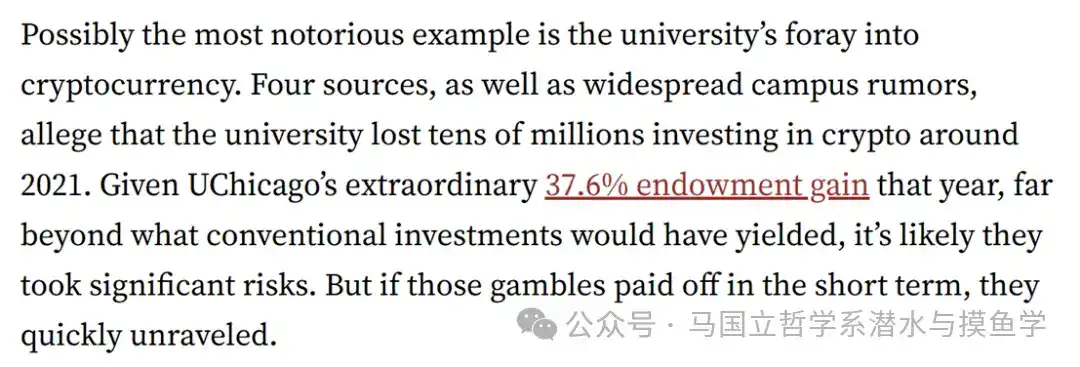

What do the University of Chicago's financial reports [6] say?

Unfortunately, the financial reports do not directly tell us exactly how much was lost on cryptocurrency trading. However, in the FY2022 financial report, the University of Chicago disclosed its cryptocurrency investments (fair market value): As of the end of June 2021, it was approximately $64 million, and as of the end of June 2022, it was approximately $45 million (a difference of about $19 million). In subsequent financial reports, perhaps because they made a fortune or lost a fortune, the University of Chicago changed its reporting method and no longer discloses its cryptocurrency investments. However, according to the 2025 Q&A statement, the University of Chicago is still investing in cryptocurrency relatively cautiously.

It is worth noting that the 2022 financial report showed that as of the end of June that year, the total investment loss of the University of Chicago's endowment fund was surprisingly high, at about $1.5 billion. The 2023 financial report then showed that the University's investments only incurred a small loss. In the following two years, the University of Chicago returned to profitability.
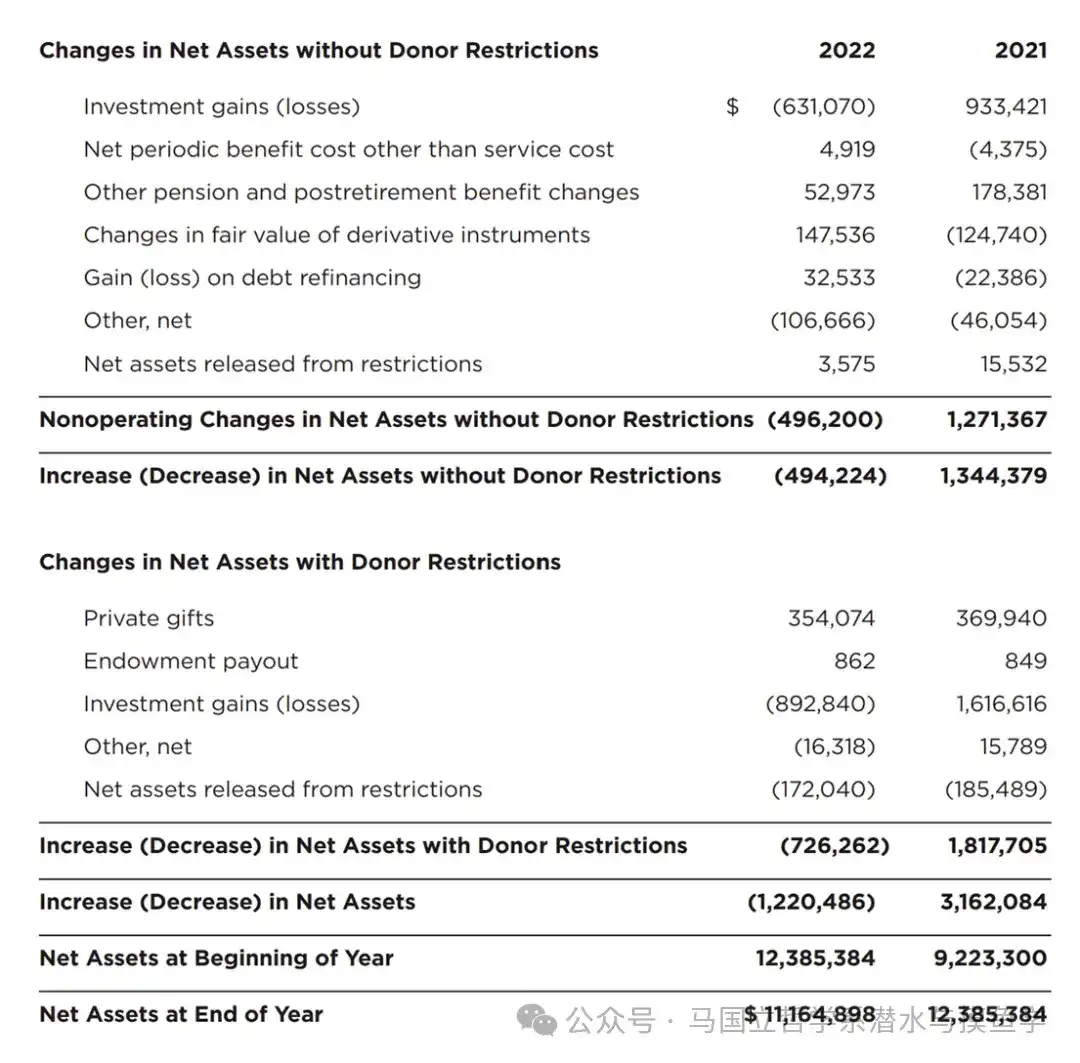
However, we do not know how much of these losses and gains came from cryptocurrency trading. The Stanford University student paper provided a less reliable clue: "[The University of Chicago's] target asset allocation shows that the ideal allocation for private debt and 'absolute return' investments (which include alternative assets such as cryptocurrency) has decreased from 25.5% in 2020 to 20% in 2022,暗示 a significant withdrawal (or downturn) in high-risk alternative assets."
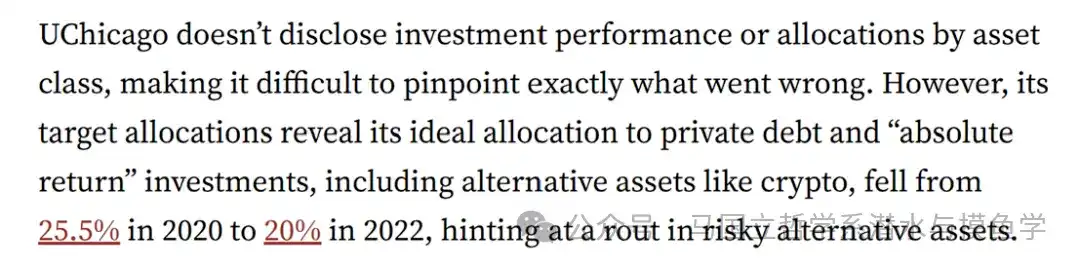
However, the Stanford paper also made an interesting observation: "Between 2013 and 2023, the University of Chicago endowment's annualized return was only 7.48%, while the stock market's annualized return during the same period was 12.8%, and the average for Ivy League schools was 10.8%. If the University of Chicago had simply followed market performance, its endowment would now be $6.5 billion larger. And this (dream) fund would be more than enough to pay off the university's entire debt. Of course, universities cannot simply replicate market indices, as they must hedge during economic downturns to maintain financial stability. But even if the University of Chicago had only reached the average of its approximate peer group, the Ivy League, its endowment would still be $3.69 billion larger today. This would be enough to cover the university's current budget deficit for the next 15 years."


However, besides cryptocurrency trading and investment losses, what other reasons can explain the University of Chicago's budget cuts?

Common explanations, besides Trump being a scoundrel, often emphasize the University of Chicago's own strategic mistakes: taking on debt and leverage, massive infrastructure construction, and aggressive expansion. [7][8] As of the end of June 2025, the University of Chicago's debt was approximately $9.2 billion [9], about 90% of its endowment. Although the financing cost of this debt is relatively low, unlike on the other side of the ocean, the interest the university needs to pay this fiscal year still amounts to over $200 million.

Such high debt did not come out of nowhere. Since the new century, in order to enhance its reputation and enrollment, and compete with various established prestigious schools, the University of Chicago has spent huge sums on new laboratories, libraries, dormitories, technology, etc., and this expansion has been largely supported by heavy borrowing. However, new infrastructure brings持续 operating costs, and the school did not plan how to sustain them long-term.

The University of Chicago student newspaper [10] quoted Professor Clifford Ando as saying that any parent wanting to send their child to the University of Chicago needs to think about whether the tuition they painstakingly pay is for their child's education or for paying off the school's debt. The疯狂 expansion and the ensuing debt problem are clearly the responsibility of the school's management for being impulsive and overly ambitious. More ironically, the base salary of the president increased by 285% between 2006 and 2022. Now encountering some economic problems, the management is passing the difficulties on to students and general faculty: even in years of selling assets, layoffs, and暂停招生, executive compensation continues to rise.


So what should the University of Chicago do next?

Besides continuing to cut costs, it must, of course, increase revenue. Obviously, a common trick for American universities to make more money is to enroll more undergraduates. The University of Chicago is also going to do this, though the理由 will certainly be stated冠冕堂皇.


[1]https://provost.uchicago.edu/actions-budget

[2]In this article, the budget, endowment, and debt of the University of Chicago are consolidated calculations for the University proper, the Medical Center, and the Marine Biological Laboratory. Common news reports (especially the University of Chicago's own publicity materials) usually consolidate the endowment but only calculate the debt for the University proper.

[3]https://stanfordreview.org/uchicago-lost-money-on-crypto-then-froze-research-when-federal-funding-was-cut/

[4]https://www.ft.com/content/4501240f-58b7-4433-9a3f-77eff18d0898?utm_source=chatgpt.com

[5]https://www.msn.com/en-us/money/careersandeducation/university-s-investment-losses-spark-outrage-resulting-in-drastic-program-cuts/ar-AA1Nxhgx

[6]https://intranet.uchicago.edu/en/tools-and-resources/financial-resources/accounting-and-financial-reporting/financial-statements

[7]https://www.wsj.com/us-news/education/colleges-face-a-financial-reckoning-the-university-of-chicago-is-exhibit-a-8918b2b0

[8]https://www.ft.com/barrier/corporate/d5c7c0f4-abf1-4469-8dca-87ff01cbebf6

[9]The debt of the University proper is approximately $6 billion. Perhaps this is the source of Professor Zhao's $6 billion figure.

[10]https://chicagomaroon.com/40486/news/uchicago-professor-sounds-alarm-over-troubling-university-finances/


Related Questions

QDid the University of Chicago lose over $6 billion in cryptocurrency investments, as claimed by Professor Zhao Dingxin?

ANo. The university's official statement and financial data refute this claim. The university stated it 'did not suffer losses on cryptocurrency investments' and that its investment in this area was 'relatively modest.' Financial reports show its cryptocurrency holdings were valued at approximately $64 million in 2021 and $45 million in 2022, a difference of about $19 million, not billions.

QWhat is the more accurate estimate of the University of Chicago's losses from cryptocurrency investments according to the Stanford University newspaper?

AAccording to the Stanford University newspaper, which cited four sources, the University of Chicago lost 'tens of millions of dollars' on cryptocurrency investments around 2021.

QWhat were the main financial reasons cited for the University of Chicago's budget cuts and financial difficulties?

AThe primary reasons were aggressive expansion, high debt, and subpar investment returns. The university took on significant debt (around $9.2 billion for the consolidated entity) to fund new infrastructure like labs and dorms. Furthermore, its endowment's 7.48% annualized return from 2013-2023 underperformed compared to the market (12.8%) and Ivy League peers (10.8%), representing a massive opportunity cost.

QHow did the University of Chicago's official statement characterize its cryptocurrency investment strategy?

AThe university's official statement characterized its strategy as cautious and long-term. It stated the investment was 'relatively modest' but had 'more than doubled over the past five years.' The goal was to 'provide a steady source of income to support the University’s programs in the long term and secure its future.'

QWhat potential source might have led to the mistaken $6 billion loss figure mentioned in the article?

AThe article's footnote [9] suggests the $6 billion figure might be a confusion with the size of the university's core debt, which was approximately $6 billion (as opposed to the $9.2 billion for the consolidated institution including the medical center).

Related Reads

After Three Consecutive Quarters of Decline, Can the Crypto Market Find a Window for Stabilization in Q3?

The cryptocurrency market has just concluded its worst-performing quarter since 2022, with total capitalization dropping 12.6% to $2.1 trillion. All core metrics indicate capital is leaving the sector, not just rotating within it. Bitcoin fell 14.2% and Ethereum dropped 25.4% in Q2, breaking their previous correlation with US tech stocks. A key driver is the reversal in US spot Bitcoin ETF flows, which saw a net outflow of approximately $4.67 billion in Q2, including a record monthly outflow near $4.5 billion in June. While recent data suggests long-term holders are accumulating again, sustained ETF outflows mean continued selling pressure. Market focus is now singularly on the Federal Reserve. The upcoming July FOMC meeting is seen as the most critical event for Q3. A dovish signal could support Bitcoin reclaiming a $68,000-$84,000 range, while a hawkish stance might establish a new trading band around $50,000-$56,000. Additionally, regulatory uncertainty persists, with the progress of the crucial *CLARITY Act* stalling in the Senate, reducing its perceived 2026 passage probability to 40-45%. Despite the broad downturn, a few sectors showed growth. Prediction markets saw nominal volume surge 48.7% year-over-year to $113.8 billion, and tokenized collectibles transaction volume rose 143% quarterly to $1.4 billion. The Real-World Asset (RWA) tokenization sector also continued steady growth, now representing ~$28.1 billion in on-chain value. The market's foundation for an extreme crash appears limited, with Bitcoin price hovering near its 200-week moving average. However, the trading paradigm has shifted from narrative-driven speculation to decisions based on price action, policy developments, and interest rate expectations, making a broad sentiment-driven rally unlikely in the near term.

marsbit12h ago

After Three Consecutive Quarters of Decline, Can the Crypto Market Find a Window for Stabilization in Q3?

marsbit12h ago

BIT Trading Moment: BTC Still Suppressed by Weekly 200 EMA, Rejection May Restart Decline; Storage and Semiconductors that Surged Last Night Begin Falling in Evening Trading

**Crypto & Stock Market Wrap: Bitcoin Tests Resistance, Stocks Retreat After AI Surge** Bitcoin consolidates around $66,000, facing key resistance near $68,000—an area seen as a major psychological and technical hurdle where previous rallies have failed. Analysts note the cryptocurrency is caught between its 200-week moving average (~$63,333) and 200-week EMA (~$68,328). A clear break above $68k is needed to signal a stronger bullish trend, while a rejection could lead to a retest of $63k support. Market sentiment remains cautious, with low futures open interest pointing to a low-liquidity rebound rather than a full bull market. Bitcoin spot ETFs saw another $203 million inflow. US stock futures pointed lower after a strong Tuesday session led by a massive rebound in semiconductors and memory stocks. The rally was fueled by renewed optimism about AI-driven hardware demand, with Micron, SanDisk, and SK Hynix surging. However, those gains reversed in pre-market trading. Super Micro Computer (SMCI) soared over 20% after hours on strong guidance and a record backlog. Other standouts included Rocket Lab and nuclear energy plays Oklo and X-Energy. Rising oil prices (Brent above $91) and climbing Treasury yields (10-year near 4.64%), however, are reigniting inflation concerns and acting as a headwind for equities. In Asia, markets were mixed. South Korea's KOSPI pared early gains to close slightly higher as semiconductor stocks like SK Hynix gave back initial surges. Japan's Nikkei edged lower as the yen hit a fresh 38-year low against the dollar, raising fears of potential market intervention. Key events to watch include the Samsung Galaxy launch, AMD's AI event, and a slew of major tech earnings from Alphabet, Tesla, and IBM after the close on Wednesday, followed by the ECB meeting and Intel's earnings on Thursday.

marsbit13h ago

BIT Trading Moment: BTC Still Suppressed by Weekly 200 EMA, Rejection May Restart Decline; Storage and Semiconductors that Surged Last Night Begin Falling in Evening Trading

marsbit13h ago

Former CFTC Chairman, Circle President Tarbert: Preaching Long-Termism While Cashing Out $30 Million Himself

Former CFTC Chairman and Circle President Heath Tarbert has consistently advocated for a long-term vision in public, urging patience from investors as Circle’s stock price has fallen significantly from its peak. However, it has been revealed that since Circle’s IPO, Tarbert has continuously sold his CRCL shares through pre-arranged trading plans, cashing out approximately $30 million, without making any public market purchases. This contrast between his public messaging and personal actions has drawn criticism. Tarbert joined Circle in July 2023 as Chief Legal Officer, leveraging his regulatory experience to help guide the company through its IPO and expansion. Despite promoting stablecoins as long-term infrastructure, he established a 10b5-1 trading plan just before Circle went public, leading to substantial stock sales over the following year. In March 2026, he initiated another plan to sell more shares. His career trajectory highlights a pattern of moving between high-level regulatory roles and influential positions in the financial sector. After resigning as CFTC Chairman in early 2021, he joined Citadel Securities as Chief Legal Officer just 27 days later, during a period of intense regulatory scrutiny for the firm. He later joined Circle, aiding its efforts to navigate regulatory challenges for its public listing. While Tarbert's expertise in policy and compliance is valuable to companies like Circle, his actions—advocating long-term confidence while personally divesting—raise questions about the alignment between his public statements and his private financial decisions, leaving investors who followed his advice to bear the market risks.

marsbit13h ago

Former CFTC Chairman, Circle President Tarbert: Preaching Long-Termism While Cashing Out $30 Million Himself

marsbit13h ago

Gate Research Institute: The 'Wall Street-ization' Wave of Crypto Financial Products – Competition or Integration?

The article titled "Gate Research Institute: Are Crypto Financial Products Sparking a 'Wall Street' Wave—Competition or Convergence?" explores the evolving relationship between the crypto ecosystem and traditional finance (TradFi). The piece begins by reflecting on Bitcoin's original 2009 vision of decentralization, disintermediation, and moving away from banks. It then contrasts this with the 2024 landscape, where key crypto assets like Bitcoin are increasingly held through Wall Street products like ETFs issued by giants like BlackRock. The article questions whether this signifies that TradFi is systematically taking over the rights to issue, price, custody, and distribute crypto financial assets. The core argument is that this is not a zero-sum takeover but rather a bidirectional convergence where each side addresses the other's weaknesses. Crypto offers 24/7 global markets, programmable settlement, and open access but lacks compliant channels, institutional-grade custody, deep fiat liquidity, and mainstream distribution. TradFi possesses these but is constrained by legacy systems, limited operating hours, and slow settlement. Two primary convergence paths are highlighted: * **Path A (CEX to TradFi):** Exemplified by Gate, which has progressed from offering tokenized stocks and CFDs to providing direct, real stock trading (US, Hong Kong, South Korea) within its platform, using USDT. * **Path B (TradFi to Crypto):** Exemplified by Robinhood, which has integrated crypto trading, acquired exchanges like Bitstamp, and is moving traditional assets like stocks onto the blockchain via tokenization and its own Layer 2. Both paths are ultimately competing to become the next-generation, unified financial account—a "super account" where users can seamlessly trade cryptocurrencies, stocks, ETFs, RWA (Real World Assets), and tokenized treasury products in one interface. The growth of RWA and tokenized treasuries (e.g., BlackRock's BUIDL) is presented as the asset-layer fusion, providing stable, yield-bearing assets on-chain and acting as a bridge between the two worlds. In conclusion, the "Wall Street-ization" of crypto is framed as a mutual transformation. Decentralized ideals persist in the protocol layer, while at the application layer, a more efficient, global, and accessible unified capital market is emerging from this convergence. The future competition lies not between crypto exchanges and stockbrokers, but between platforms vying to offer the most comprehensive asset coverage, liquidity, and user experience within a single account.

marsbit13h ago

Gate Research Institute: The 'Wall Street-ization' Wave of Crypto Financial Products – Competition or Integration?

marsbit13h ago

Trading

Spot
活动图片




