The market has switched again from "eternal growth" mode to "all is lost" mode. This week, $BTC fell below $90,000 amid deteriorating risk appetite: investors were frightened by signals that the AI spending boom might generate profits slower than expected, meaning pressure on risky assets is returning.
Against this backdrop, the most "toxic" price target in crypto has resurfaced: $10,000 for Bitcoin. It is actively promoted in the media by Mike McGlone from Bloomberg Intelligence — he links the risk of a significant drawdown to a deflationary scenario following a period of inflation. The idea is not that "tomorrow it will be $10k," but that when the cycle turns, the market can overshoot downward just as aggressively as it overshot upward.
But here's what many discussions miss: even if you believe in the long-term growth of $BTC, in the short term you still need infrastructure that makes Bitcoin a working tool, not just a "ticker on Twitter." High fees, limited throughput, and almost zero native programmability are a basic UX pain. And this time, "rescue" on the market is more often sought not in another meme story, but in Bitcoin Layer 2 and the infrastructure around it (yes, it sounds less exciting — but much more practical). Projects from this niche regularly make it into lists of the best coins for 2025.
This leads to a logical bridge to Bitcoin Hyper: if the next market phase is about efficiency, speed, and applications on Bitcoin, then projects that provide $BTC with a proper execution layer will gather attention — even if someone is simultaneously drawing horror stories about $10,000. In previous cycles, similar logic has already worked: when growth slows, the market begins to value what brings real utility.
BUY BITCOIN HYPER
How Layer 2s Become a Stress Test for $BTC
When volatility increases, capital becomes more selective. Investors stop buying narratives for the sake of narratives and start looking at where real activity will appear: transactions, fees, liquidity, developers. Reuters is just noting a shift towards more cautious strategies and the market's attempts to "mature" after sharp movements.
Right now, Bitcoin Layer 2 is a race for two goals simultaneously: scaling payments and launching a full-fledged on-chain economy (DeFi, NFTs, games) around Bitcoin, all without losing trust in the base asset. Solutions have different approaches: Lightning handles micropayments, rollup approaches promise computations "off L1," and the BitVM narrative pushes the market towards more complex constructions without changing the L1 consensus. But the user demand is the same: "give us speed and fees at the level of modern networks, without breaking trust in $BTC."
And this is where Bitcoin Hyper appears as one of the bets on "Bitcoin with normal speed and programmability" — without the need to convince people to abandon $BTC for another L1. It sounds reasonable. And it's precisely such utilitarian stories that usually start "preparing" the next rotation of the cycle.
Why Bitcoin Hyper Could Launch a New Cycle for All of Bitcoin
Bitcoin Hyper promotes a clear idea: a modular architecture where Bitcoin L1 remains the settlement and trust layer, and execution moves to a fast L2 with Solana Virtual Machine integration. SVM is a bet on high performance and a developer-friendly stack, especially if you need to quickly launch DeFi mechanics, NFT platforms, or gaming dApps.
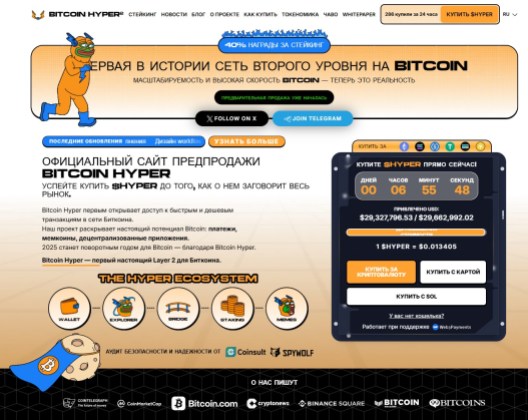
The project's key message is formulated very directly: "the first Bitcoin Layer 2 with SVM integration," which aims for ultra-low execution latency. This is important for a very practical reason: without fast smart contracts, the Bitcoin economy almost inevitably leaks to other ecosystems — to places where you can do swaps, lending, staking, and more complex strategies without waiting for blocks and without the pain of fees. And if the next market cycle is indeed about utility, then infrastructure often wins over noise — a boring thought, but a working one (and traders who track such shifts usually notice it first).
Interest in the story is also fueled by presale numbers: the project has already raised $29,556,732.75, with a token price of $0.013435. This is not a guarantee of success — it's just a marker of demand. The activity of large wallets also looks interesting: whale tracking has spotted two notable purchases totaling about $396k, with the largest transaction being approximately $53k from November 19, 2025.
The final touch is the staking mechanics after TGE: a high APY is announced (without disclosing the rate), instant launch, a 7-day vesting period for presale stakers, and a focus on rewards for community participation. The risk here is obvious: without specific yield parameters, the market will demand transparency, otherwise expectations can easily turn into disappointment. This is not a "project minus," but rather a test of communication maturity — how prepared the Bitcoin Hyper team is to disclose details on time.