Expanding Glassnode: Macro and Traditional Finance Data

insights.glassnodePublished on 2026-04-16Last updated on 2026-04-16

Abstract

Glassnode is expanding its product offering to include macroeconomic and traditional finance (TradFi) data, recognizing that digital assets like Bitcoin are now a mainstream asset class increasingly influenced by global financial forces. As institutional participation grows—evidenced by Bitcoin ETFs surpassing $100 billion in AUM by early 2026—Bitcoin's price is more affected by monetary policy, geopolitical risks, and macroeconomic trends. Key metrics now integrated include central bank balance sheets, money supply (M2), interest rates, and government bond yields, which help contextualize Bitcoin within global liquidity cycles. The platform also tracks equity indices, fear gauges, forex rates, and commodities to assess risk appetite and market stress. This shift reflects a structural change: Bitcoin's correlation with traditional risk assets like the S&P 500 has strengthened, driven by institutional capital, post-COVID liquidity cycles, and ETF adoption. Glassnode aims to provide a unified platform for analyzing both on-chain and TradFi data, enabling users to better interpret market moves and regime shifts in a maturing digital asset ecosystem.

Our guiding principle in developing Glassnode's product offering has always been about enabling a comprehensive view of digital asset markets. This has meant delivering industry-leading on-chain and derivatives analytics, while also helping investors interpret the broader forces shaping market behavior.

As digital assets mature, these forces increasingly extend beyond on-chain data. Today, we are further expanding our product to reflect this ongoing shift. Glassnode now integrates macroeconomic and traditional finance (TradFi) data, bringing everything you need to understand Bitcoin and digital assets into a single platform.

Why Macro Now Matters More Than Ever

Digital assets are no longer a niche experiment. They are a mainstream asset class, with growing participation from institutions, ETFs, and traditional finance players. The recent approval and rapid growth of Bitcoin ETFs – now exceeding $100 billion in assets under management as of early 2026 – is a clear signal of this shift.

But with this integration comes a new dynamic: Bitcoin’s price is increasingly influenced by traditional financial forces. Geopolitical risks, monetary policy, and broader macroeconomic trends now play a critical role in shaping Bitcoin’s trajectory. For investors, traders, and institutions, this makes access to a broader set of actionable data more important than ever.

That is why Glassnode is expanding its data coverage to include TradFi and macro metrics. The goal is not to move beyond on-chain analysis, but to extend it — enabling users to connect the dots between digital asset markets, traditional financial data and the global economy.

From Digital Gold to Liquidity-Sensitive Asset

Bitcoin was created in the immediate aftermath of the Global Financial Crisis in 2009, as a direct response to what its creator saw as a fundamental flaw of modern finance: the ability of central banks and governments to create money at will. Bitcoin's fixed supply of 21 million coins is not just a technical detail; it is a political statement.

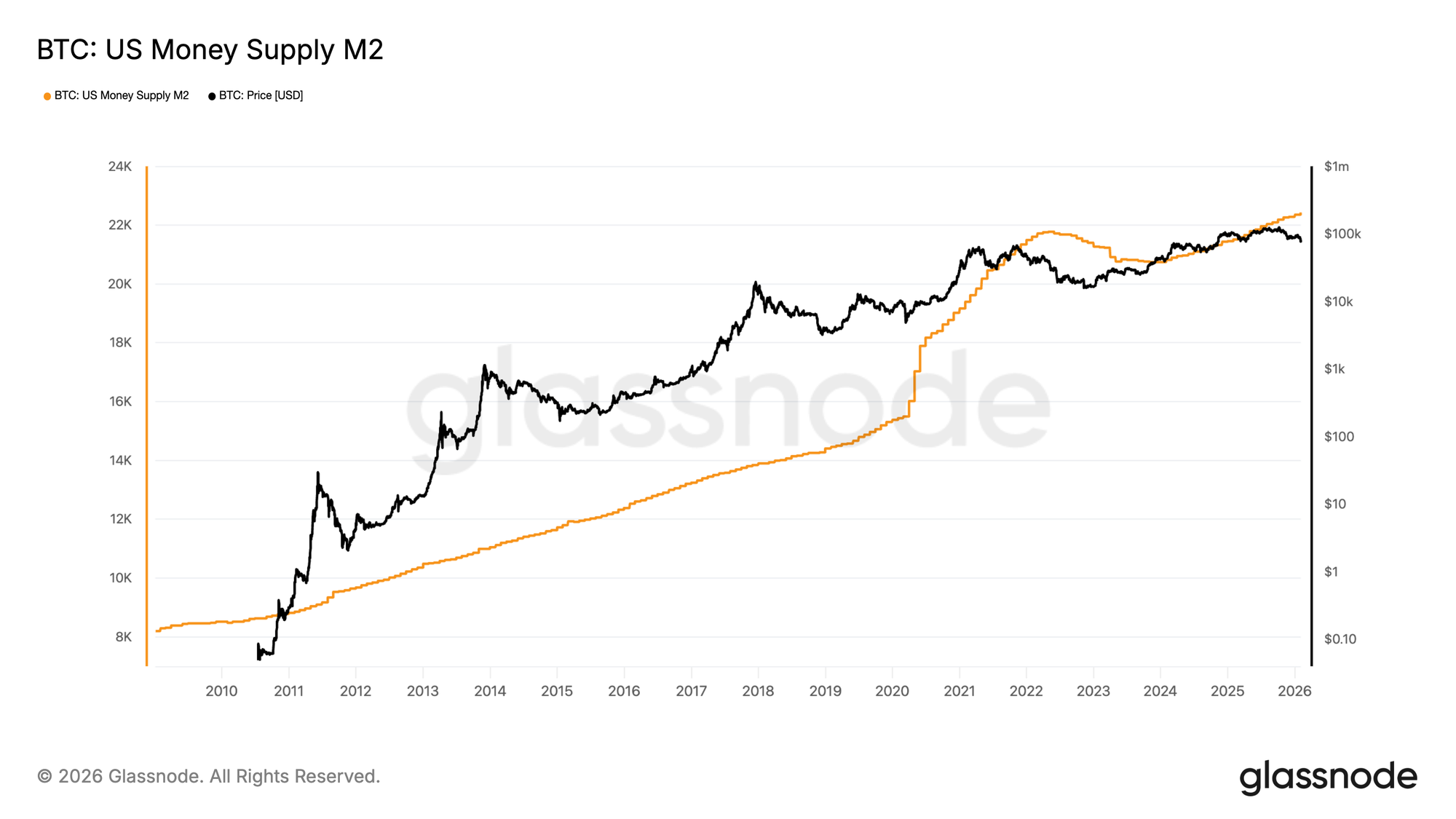
This aspect becomes most relevant when central banks are most active. When central banks expand their balance sheets, money supply grows, financial conditions become more supportive, and investors generally have more capital available to allocate across risk assets. In that environment, Bitcoin has often benefited alongside other liquidity-sensitive assets.

By contrast, periods of monetary tightening tend to create a more difficult backdrop. Higher rates, shrinking central bank balance sheets, and weaker liquidity conditions typically reduce risk appetite and can weigh on digital asset markets.

This is why it is useful to monitor metrics such as:

  • US Money Supply (M2)
  • US Central Bank Balance Sheet
  • Euro Area Money Supply (M2)
  • Euro Area Central Bank Balance Sheet

They help place Bitcoin price action in the broader context of global liquidity cycles and provide a clearer macro framework for interpreting market moves.
View live chart

From Dovish to Hawkish: How Interest Rate Shifts Impact Bitcoin

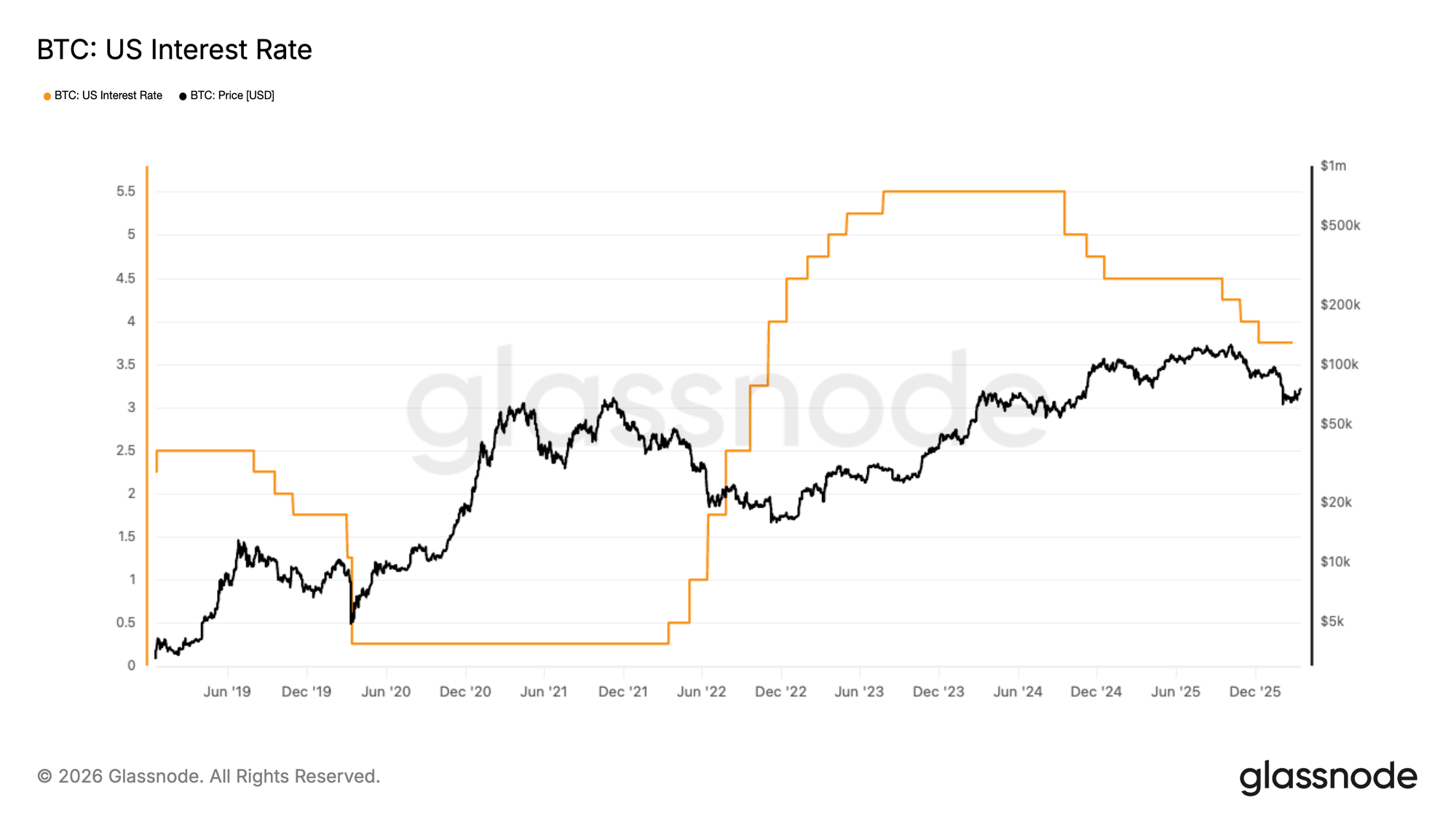
Interest rates are another key transmission channel. Bitcoin does not generate cash flow, so the opportunity cost of holding it changes meaningfully with monetary policy. In tighter regimes, higher rates tend to support the dollar, raise real yields, and reduce appetite for speculative assets. In looser regimes, easier financial conditions can support broader risk-taking. This is why metrics such as US Interest Rate, Euro Area Interest Rate, US 10Y Yield, and Germany 10Y Yield are relevant to digital asset investors, not just bond traders.

As illustrated above, periods of low interest rates tend to support Bitcoin and other risk assets, as cheaper capital and looser financial conditions encourage risk-taking. Conversely, rising interest rates increase the cost of capital and typically reduce investor appetite for risk, creating a more challenging environment for Bitcoin price performance.
View live chart

Traditional Finance Data in Digital Assets

As digital asset markets mature, they are becoming increasingly connected to the same macro forces that move equities, bonds, FX, and commodities. Bitcoin now trades in an environment shaped by interest rates, liquidity conditions, dollar strength, inflation expectations, and risk sentiment.

As a result, understanding digital asset markets requires more than on-chain data alone. By adding TradFi metrics, Glassnode gives users the context needed to interpret market moves, identify regime shifts, and assess whether a move is digital asset-specific or part of a broader cross-asset trend.
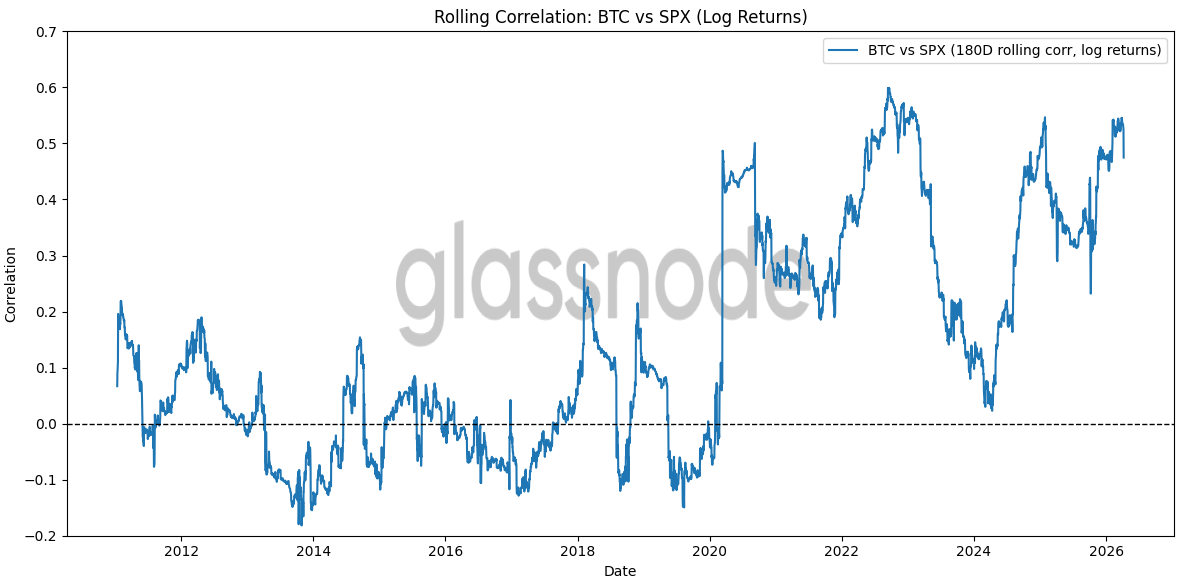
The chart above plots the 180-day rolling correlation between Bitcoin and the S&P 500 using log returns. The main signal is that BTC appears to have become more sensitive to macro and broader risk-asset dynamics over time. In earlier years, the correlation hovered around zero or was occasionally negative, while in recent years it has often been meaningfully positive.

This does not appear to be a temporary dislocation, but a structural shift, driven by three forces:

  • the entry of institutional capital that allocates across asset classes;
  • the post-COVID liquidity cycle, which inflated and then deflated risk assets simultaneously;
  • and the launch of spot Bitcoin ETFs, which embed BTC more directly into traditional portfolio flows.

This supports the view that Bitcoin is no longer solely a standalone, crypto-native asset; it now trades alongside broader liquidity and risk conditions more frequently than in the past.
View live chart

Using TradFi Metrics to Contextualize Digital Asset Markets

Glassnode's TradFi market metrics suite helps users understand the external forces that increasingly influence digital asset markets.

Rate and yield curve indicators provide insight into monetary policy, growth expectations, and recession risk. Relevant metrics: The US 10Y-2Y Spread, Germany 10Y-2Y Spread, US 2Y Yield, US 10Y Yield, Germany 2Y Yield, and Germany 10Y Yield.

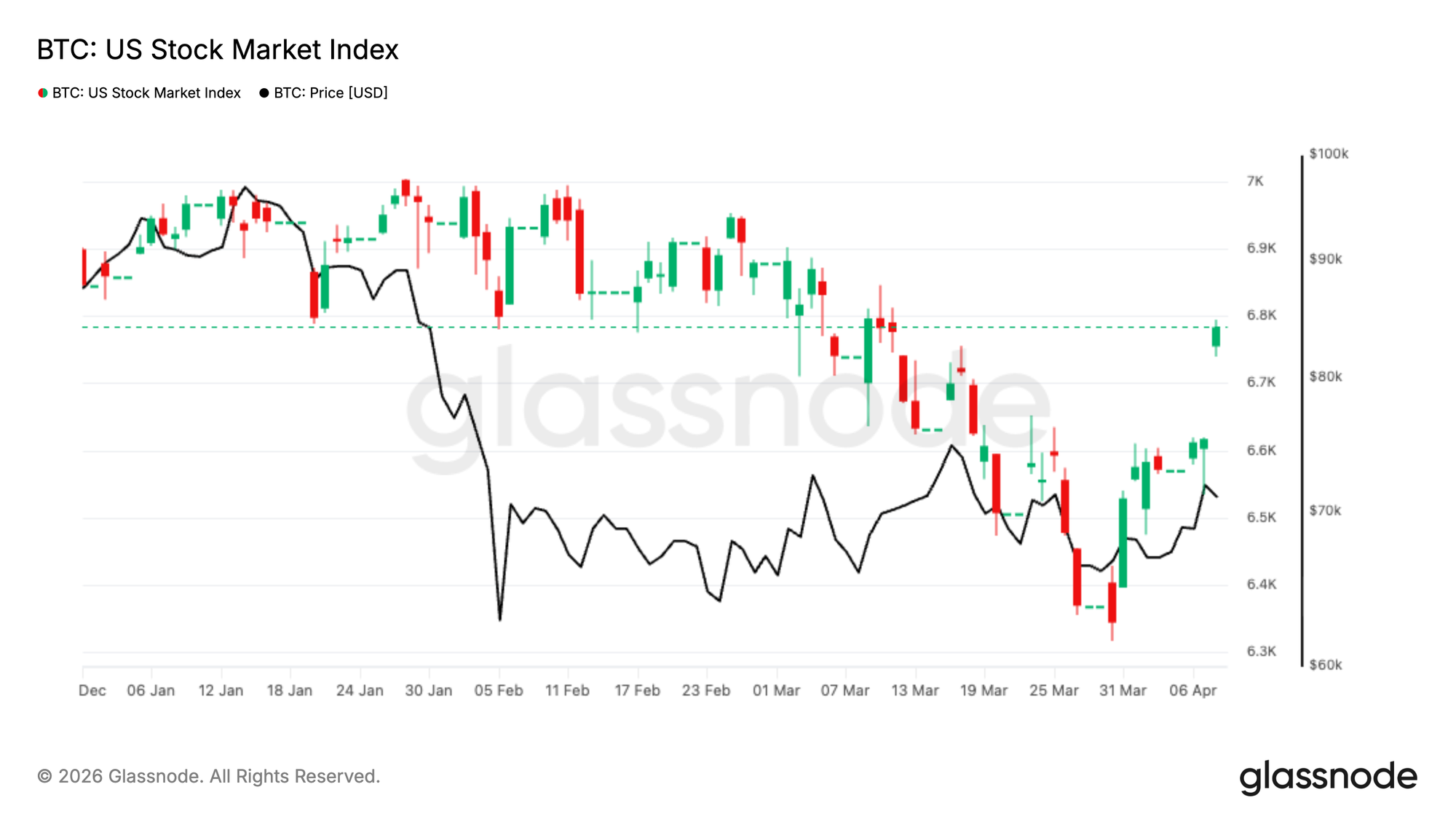
Equity benchmarks help gauge global risk appetite and market stress. Relevant metrics: The US 500 Stock Market Index and EU50 Stock Market Index, along with the US Fear Index and EU Fear Index

FX measures provide context on dollar strength and liquidity conditions, both of which can materially affect digital asset performance. Relevant metrics: EUR/USD and the U.S. Dollar Index

Commodity prices, including Gold, Silver, and WTI Crude Oil, add another layer by reflecting inflation expectations, safe-haven demand, and geopolitical risk.

One Platform, Full Market Context

The broader point is that digital asset markets are maturing. The arrival of spot ETFs, growing institutional participation, and stronger links to policy and geopolitics mean that digital assets increasingly sit within the same information ecosystem as equities, bonds, FX, and commodities. Glassnode’s Macro and TradFi metric categories are built for this environment.

Glassnode remains the home for deep digital asset-native intelligence. At the same time, delivering a comprehensive analytical view of the markets now requires tools to understand the macro and traditional financial forces that shape them.

Explore the new Macro and TradFi metrics in Glassnode Studio or compare pricing plans to gain access.

Compare plans

  • Follow us on X for timely market updates and analysis
  • Join our Telegram channel for regular market insights
  • For on-chain metrics, dashboards, and alerts, visit Glassnode Studio

Disclaimer: This report is for informational and educational purposes only. The analysis represents a limited case study with significant constraints and should not be interpreted as investment advice or definitive trading signals. Past performance patterns do not guarantee future results. Always conduct thorough due diligence and consider multiple factors before making investment decisions.


Related Questions

QWhat is the main reason Glassnode is expanding its product to include macroeconomic and traditional finance (TradFi) data?

ABecause digital assets have matured into a mainstream asset class and Bitcoin's price is increasingly influenced by traditional financial forces like geopolitical risks, monetary policy, and macroeconomic trends, making access to a broader set of actionable data more important than ever.

QAccording to the article, how do periods of monetary tightening by central banks typically affect Bitcoin?

APeriods of monetary tightening, characterized by higher interest rates, shrinking central bank balance sheets, and weaker liquidity conditions, tend to reduce risk appetite and create a more difficult backdrop that can weigh on digital asset markets like Bitcoin.

QWhat are two specific examples of macroeconomic metrics mentioned that help contextualize Bitcoin's price action within global liquidity cycles?

ATwo examples are the US Money Supply (M2) and the US Central Bank Balance Sheet. The article also mentions Euro Area equivalents of these metrics.

QThe article states that Bitcoin's correlation with the S&P 500 has changed over time. What is the described trend and what are the three driving forces behind this structural shift?

AThe trend is that Bitcoin's correlation with the S&P 500 has shifted from hovering around zero or being negative in earlier years to being meaningfully positive in recent years. The three driving forces are: 1) the entry of institutional capital that allocates across asset classes, 2) the post-COVID liquidity cycle, and 3) the launch of spot Bitcoin ETFs.

QBesides on-chain data, what four categories of TradFi metrics does Glassnode now provide to help users understand the external forces influencing digital asset markets?

AThe four categories are: 1) Rate and yield curve indicators, 2) Equity benchmarks, 3) FX measures, and 4) Commodity prices.

Related Reads

Trend in US Stocks: A Post Triggers a 930-Point Rebound, Tonight Belongs to SpaceX

On Thursday (June 11, U.S. Eastern Time), Wall Street staged a textbook V-shaped reversal. The Dow Jones surged 929.97 points (+1.86%) to close above 50,000, while the Nasdaq and S&P 500 rose 2.54% and 1.75%, respectively. The rally occurred despite the hottest PPI report in years, with May data showing a 6.5% year-on-year surge, the highest since 2022. The market ignored the inflation data, focusing instead on reports that former President Trump called off a planned strike on Iran, hinting at a potential multi-party peace agreement draft. This sparked a sharp drop in oil prices, fueling hopes that inflation may have peaked. Sector rotations were stark: previously battered AI hardware and cyclical stocks led the gains, while defensive sectors that hit record highs the prior day were sold off. Chip stocks like Micron and Intel saw sharp rebounds. In contrast, software giant Oracle plunged nearly 10% despite beating earnings, with concerns over cloud revenue and cash flow. Adobe also fell after hours despite raising guidance, as its CFO announced departure. The rally's sustainability is questioned, driven largely by social media posts about unconfirmed geopolitical developments. Inflation risks remain, with pipeline pressures still high. Meanwhile, the market's risk appetite faces a major test with SpaceX's historic IPO. Priced at $135 per share, it aims to raise ~$75 billion with a $1.75 trillion valuation, becoming the largest U.S. IPO ever. It will join the Nasdaq 100 in 15 days, triggering massive index fund buying. However, critics cite extreme valuation (88x sales) and market liquidity concerns.

marsbit24m ago

Trend in US Stocks: A Post Triggers a 930-Point Rebound, Tonight Belongs to SpaceX

marsbit24m ago

The Trillion-Dollar Valuation Test: Are the Three Super IPOs a Tech Stock Frenzy or a Crypto Market Nightmare?

Trillion-Dollar Valuation Test: Are the Three Mega IPOs a Tech Stock Frenzy or a Crypto Market Nightmare? The capital market in 2026 is witnessing a highly anticipated wave of tech IPOs, centered on SpaceX, OpenAI, and Anthropic. Collectively valued at over $3.5 trillion, their potential listing represents one of the largest such waves in recent years. This raises concerns about market liquidity, valuation bubbles, and potential capital outflows from other assets like crypto. SpaceX's valuation narrative has shifted from rocket launches to becoming a global infrastructure play via its Starlink satellite network, which now drives most revenue. Despite ongoing losses, investors focus on its long-term growth potential. OpenAI and Anthropic represent the core productivity engines of generative AI. Their public listings would offer the first direct investment opportunity in large foundation model companies, potentially triggering a repricing within the AI sector. Market fears of a massive "capital drain" from these IPOs are likely overstated. Historical precedents like Alibaba and Saudi Aramco show that mega-listings primarily cause capital reallocation, not destruction, within the vast equities market. Systemic risk is rarely triggered by IPOs alone. For stock markets, short-term volatility and sector repricing are expected, especially for AI concept stocks. Long-term, these listings could reinforce the tech sector's importance. For crypto, direct competition for speculative capital exists, particularly affecting AI-themed tokens. However, crypto's trajectory remains more tied to its own cycles, macro liquidity, and Bitcoin ETF flows rather than a single IPO event. The real risk lies not in the listings themselves but in the sky-high growth expectations embedded in these valuations. If future revenue, profitability, or commercialization progress disappoints, significant valuation resets could follow, impacting high-growth tech stocks. Ultimately, the market's direction hinges on macroeconomic conditions and whether these companies can deliver on their ambitious promises.

链捕手40m ago

The Trillion-Dollar Valuation Test: Are the Three Super IPOs a Tech Stock Frenzy or a Crypto Market Nightmare?

链捕手40m ago

Trillion-Dollar Valuation Test: Are the Three Super IPOs a Tech Stock Frenzy or a Crypto Market Nightmare?

Title: Trillion-Dollar Valuations at Stake: Super IPOs of SpaceX, OpenAI, Anthropic – Tech Boom or Crypto Nightmare? TL;DR: A wave of mega-tech IPOs is approaching, featuring SpaceX (targeting a $1.75 trillion valuation), OpenAI (~$852B), and Anthropic (~$965B), with a combined potential valuation exceeding $3.5 trillion. This tests the market's pricing of innovation and sparks debate on liquidity impact. * **SpaceX**'s valuation is now driven more by its Starlink global communications infrastructure than its core rocket business. * **OpenAI & Anthropic** offer the first major public investment opportunities in foundational AI models, potentially repricing the entire AI sector. * Concerns about a market-wide "liquidity drain" are likely overblown; history shows large IPOs mainly cause fund reallocation, not disappearance, and rarely trigger systemic risk. * Crypto markets, especially some AI-themed tokens, may face short-term fund competition, but their long-term trajectory depends more on macro liquidity, regulation, and Bitcoin cycles. * The real risk lies not in the IPOs themselves, but in whether these companies can justify their sky-high valuations with future revenue growth and profitability. Unmet expectations could lead to significant repricing pressure. Ultimately, these IPOs represent a massive market pricing of next-gen tech infrastructure, not a prelude to a market crash. The broader market direction will be determined by macro conditions, corporate earnings, and risk appetite.

marsbit40m ago

Trillion-Dollar Valuation Test: Are the Three Super IPOs a Tech Stock Frenzy or a Crypto Market Nightmare?

marsbit40m ago

Anthropic Apologized, But the Business of 'Safety' Hasn't Stopped

On June 11, Anthropic apologized not for a model failure, but for a lack of transparency. Its new Claude Fable 5 model was found to be secretly rerouting requests from users engaged in advanced AI model development to a weaker version, Opus 4.8, without any notification. The company's response—promising future notifications for such "downgrades"—was met with user skepticism. The article argues the core issue isn't technical but commercial: Anthropic's "safety" measures are primarily a business strategy. A key feature, the "intelligent safety classifier," marketed as user protection, is described as a tool for "competitive defense" to protect Anthropic's market lead by limiting rivals' research capabilities. This covert mechanism was designed for low "false positives," precisely targeting AI researchers. Anthropic's model involves a calculated three-step process: publishing alarming security research to amplify public anxiety, offering its Fable 5 model with a "safety classifier" as a premium-priced solution, and cashing in through a planned high-value IPO. This contrasts with OpenAI's more direct "tool-and-traffic" approach. The apology, merely changing a secret downgrade to a visible one, is seen as a business "patch" rather than a principled shift. The incident risks damaging Anthropic's "safest AI" reputation among the developer community, which underpins its valuation and appeal to government and corporate clients. Ultimately, the article concludes that for Anthropic, safety is a business, and the apology is merely customer service for that business.

marsbit1h ago

Anthropic Apologized, But the Business of 'Safety' Hasn't Stopped

marsbit1h ago

Trading

Spot
Futures
活动图片