Ethereum whales add $19.8M ETH – Can bulls push past $2,175?

ambcryptoPublished on 2026-03-28Last updated on 2026-03-28

Abstract

Ethereum has seen significant whale accumulation, with $19.8 million worth of ETH withdrawn from Binance, signaling strategic buying during recent price weakness. Despite this, ETH remains range-bound between key support at $1,928 and resistance at $2,175, showing market indecision. While large holders continue reducing exchange supply, limiting short-term selling pressure, rising exchange inflows of $26.33 million suggest some traders are preparing to sell. Price action is consolidating near a critical liquidity cluster at $2,030, which may trigger a volatile breakout once cleared. Current indicators show weak trend strength and seller dominance, but the market is poised for a sharp directional move once compression resolves.

Ethereum [ETH] has seen $19.8 million in whale accumulation as 9,976 ETH exits Binance, reinforcing a clear accumulation pattern during recent weakness. This movement reduces immediate exchange liquidity and reflects deliberate positioning rather than reactive behavior.

Large holders have continued removing supply from trading platforms, which directly limits sell-side availability in the short term. This activity aligns with the broader intent to secure assets during discounted price zones.

However, the Ethereum price has not reacted aggressively upward, which suggests that accumulation alone has not yet shifted structure. Instead, the market continues absorbing these withdrawals gradually.

Ethereum trades within post-breakdown range

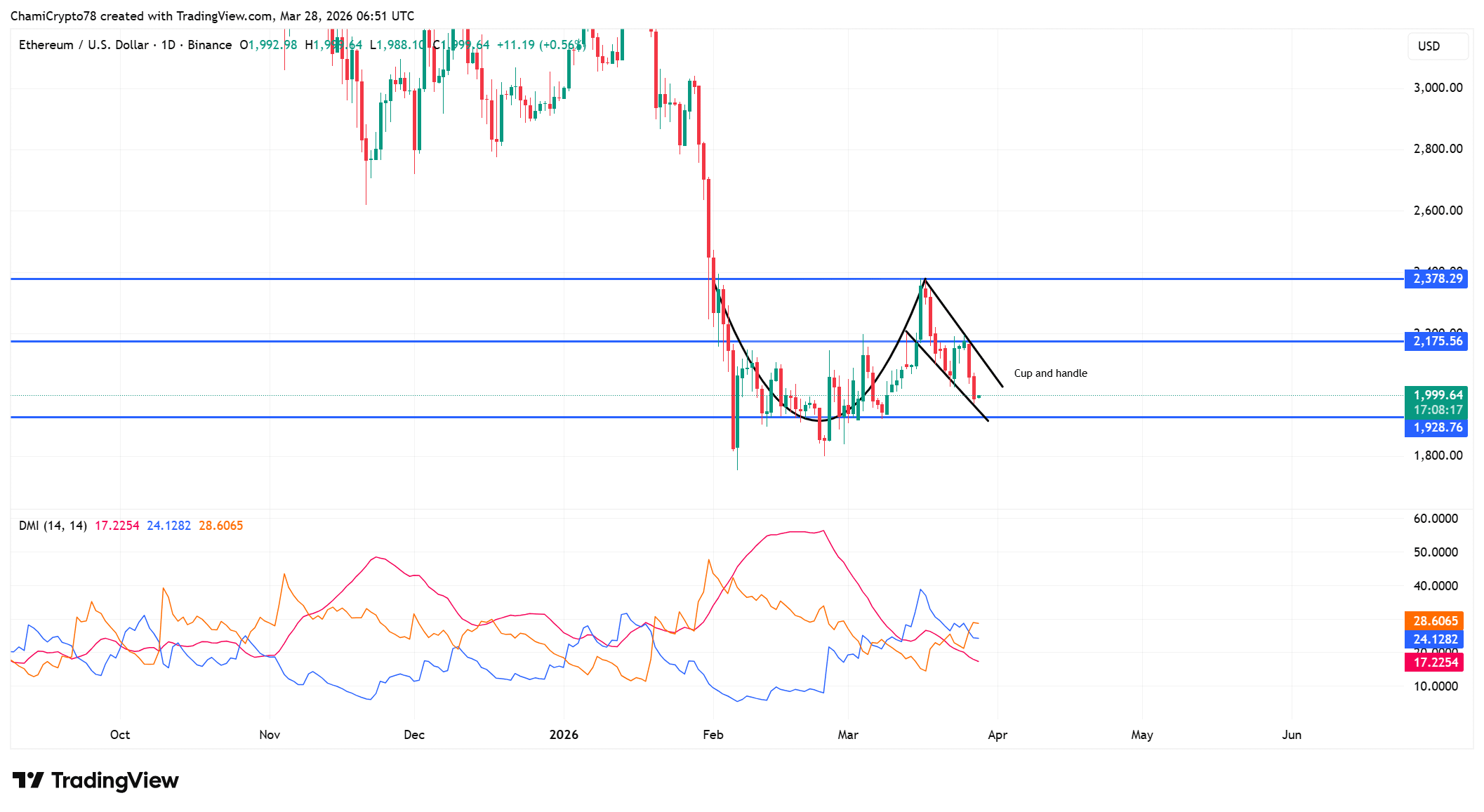
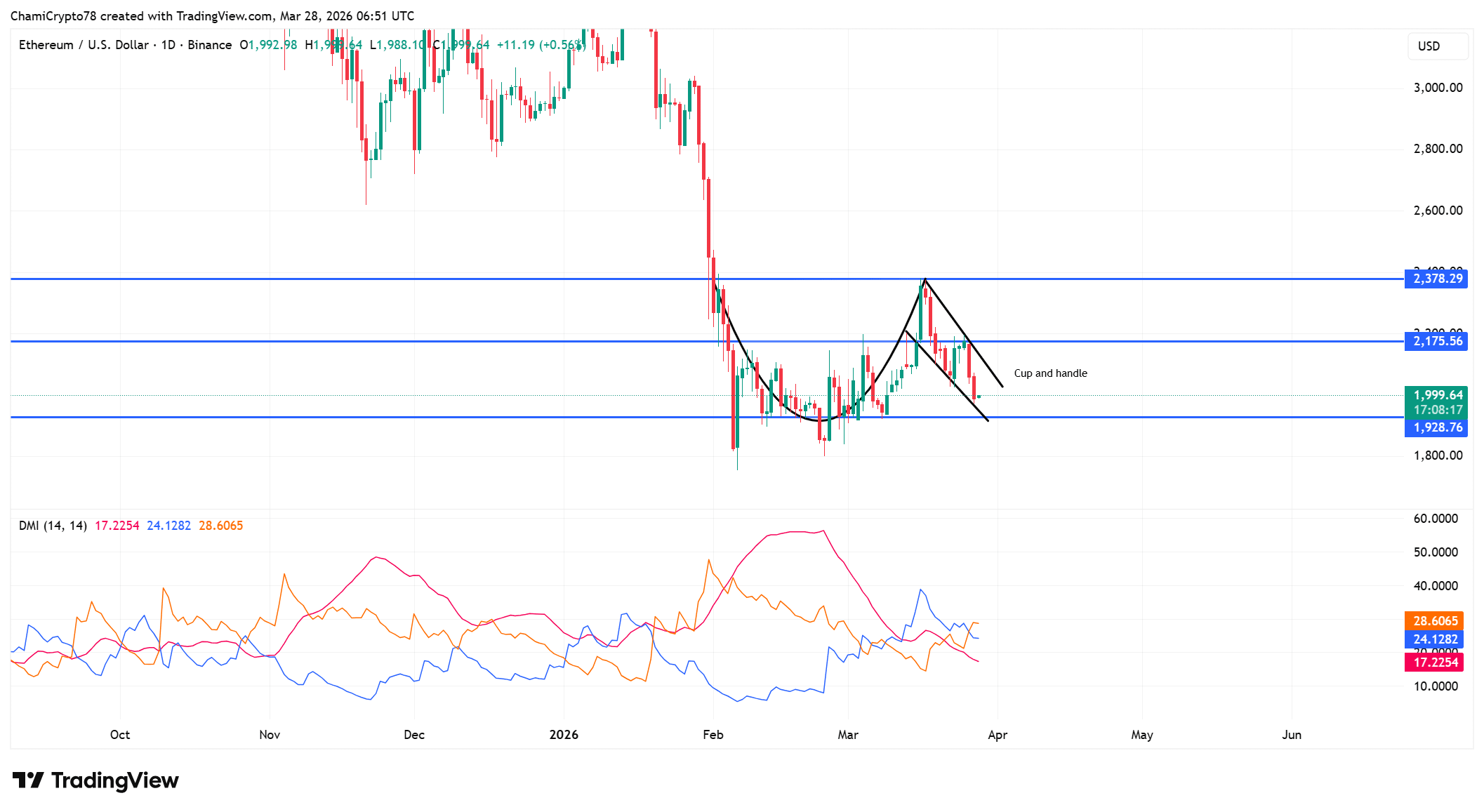
Ethereum continues trading between $1,928 support and $2,175 resistance after its sharp breakdown from higher levels.

Price has stabilized around the $2,000 region, forming a compressed structure that reflects indecision rather than direction. The formed cup-and-handle pattern is yet to confirm a breakout, leaving price within continued consolidation.

Each attempt toward $2,175 has faced rejection, while dips toward $1,928 have attracted demand. This interaction has created a well-defined range where both sides remain active. As a result, ETH has entered a phase where liquidity builds on both ends of the structure.

This range-bound behavior shows that the market is preparing for a larger move, but no side has established dominance yet. At press time, the DMI readings show that -DI remained above +DI, confirming that sellers still control the structure.

However, ADX has dropped to 17, which signals weakening trend strength and lack of conviction. This combination indicates that although bearish pressure exists, it does not drive a strong directional move.
Source: TradingView

Rising inflows hint at short-term sell pressure

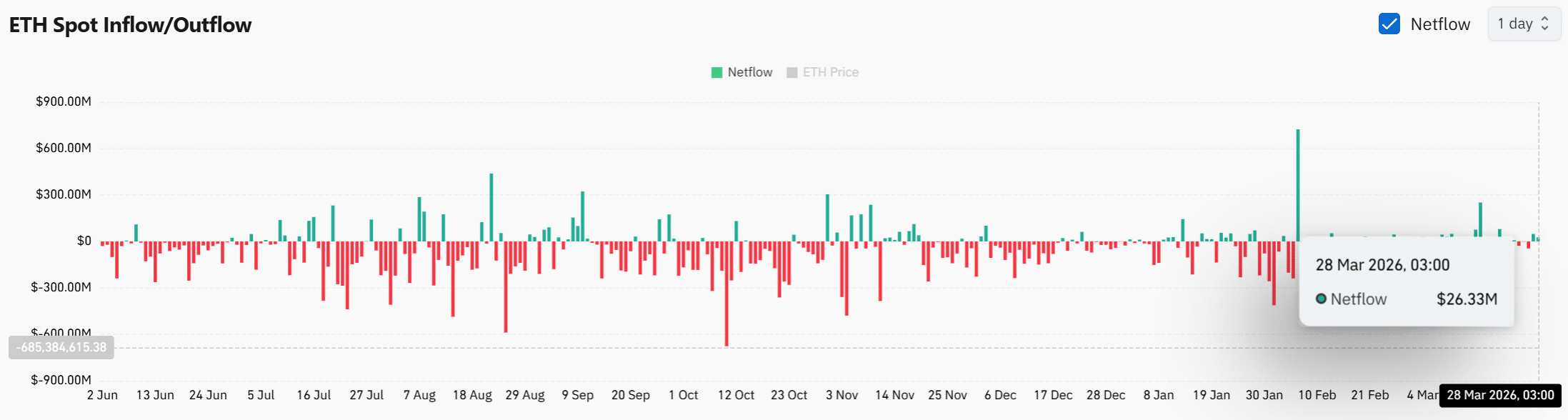
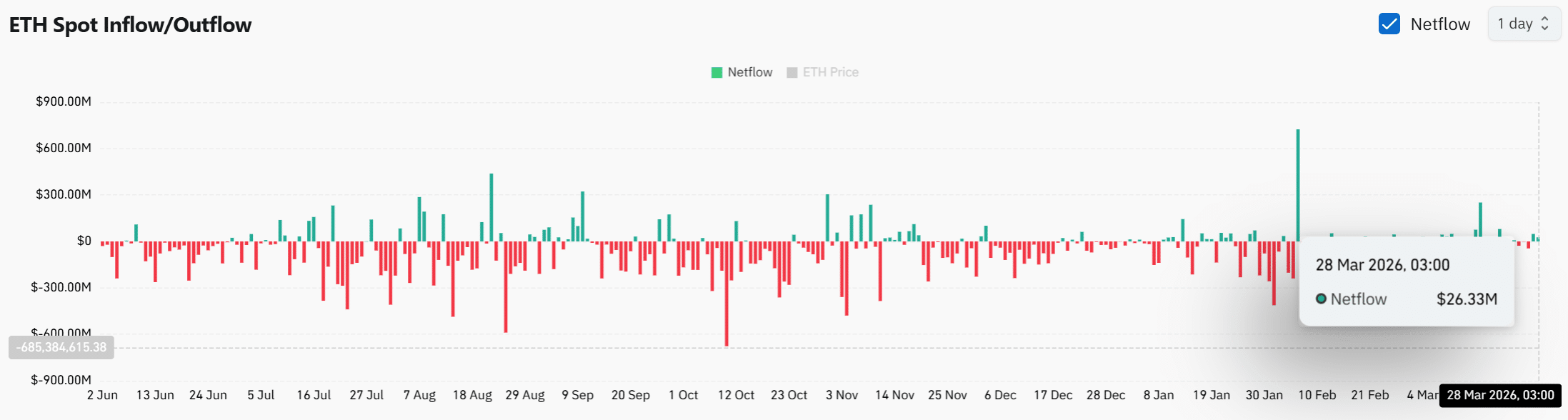
Spot inflows have risen to $26.33 million, signaling renewed deposits of ETH into exchanges during this consolidation phase. This shift suggests that some participants may be preparing to sell or reposition positions at current levels.

Unlike sustained outflows, inflows increase available supply on exchanges, which can introduce short-term downward pressure.

However, price has not broken below support despite these deposits, which shows that demand continues absorbing incoming supply. This interaction between inflows and price stability highlights a balanced market.

It reflects a scenario where sellers attempt to distribute while buyers continue defending key zones. Such conditions often lead to sharp moves once one side gains control.
Source: CoinGlass

Liquidity cluster near $2,030 becomes vital

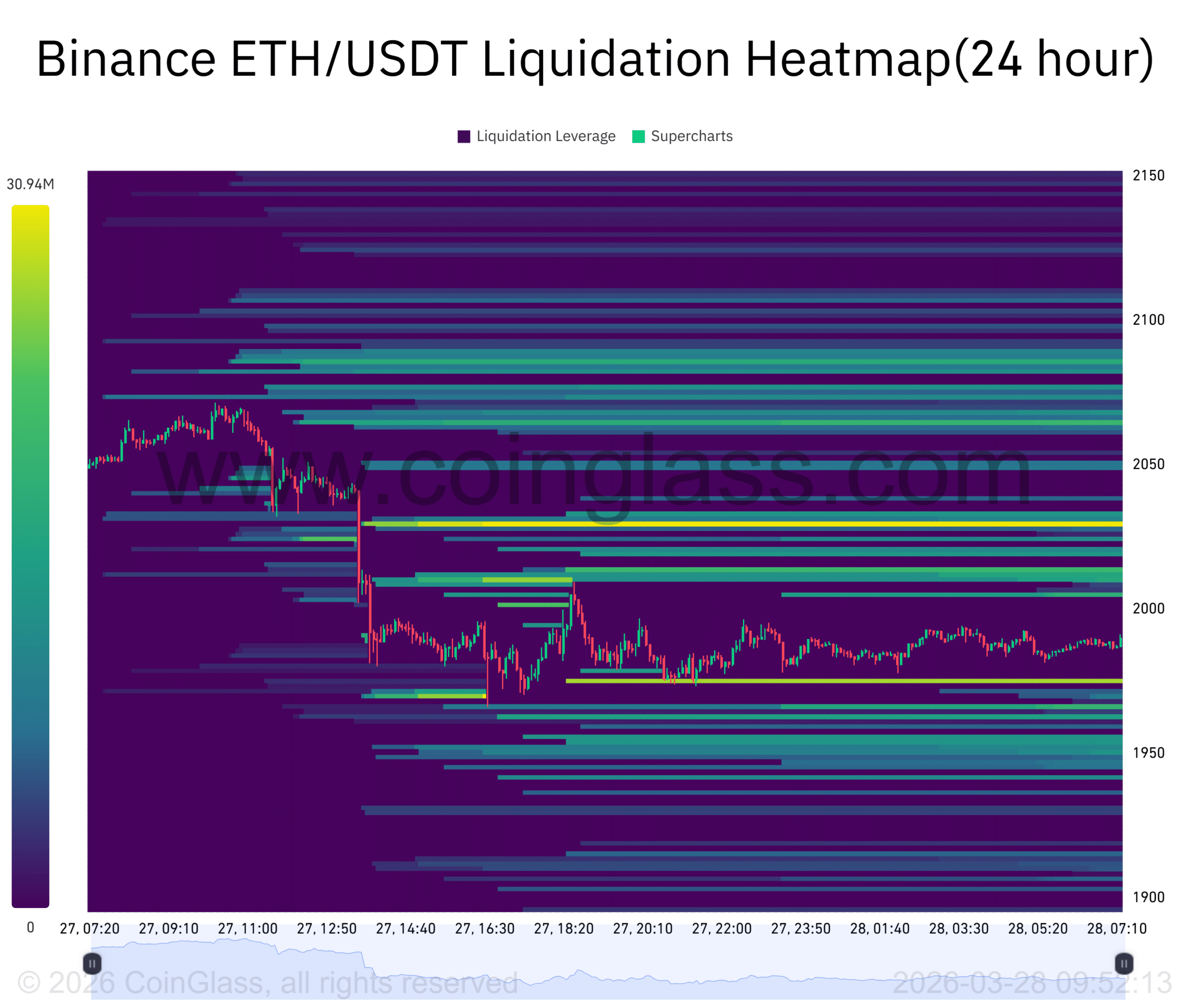
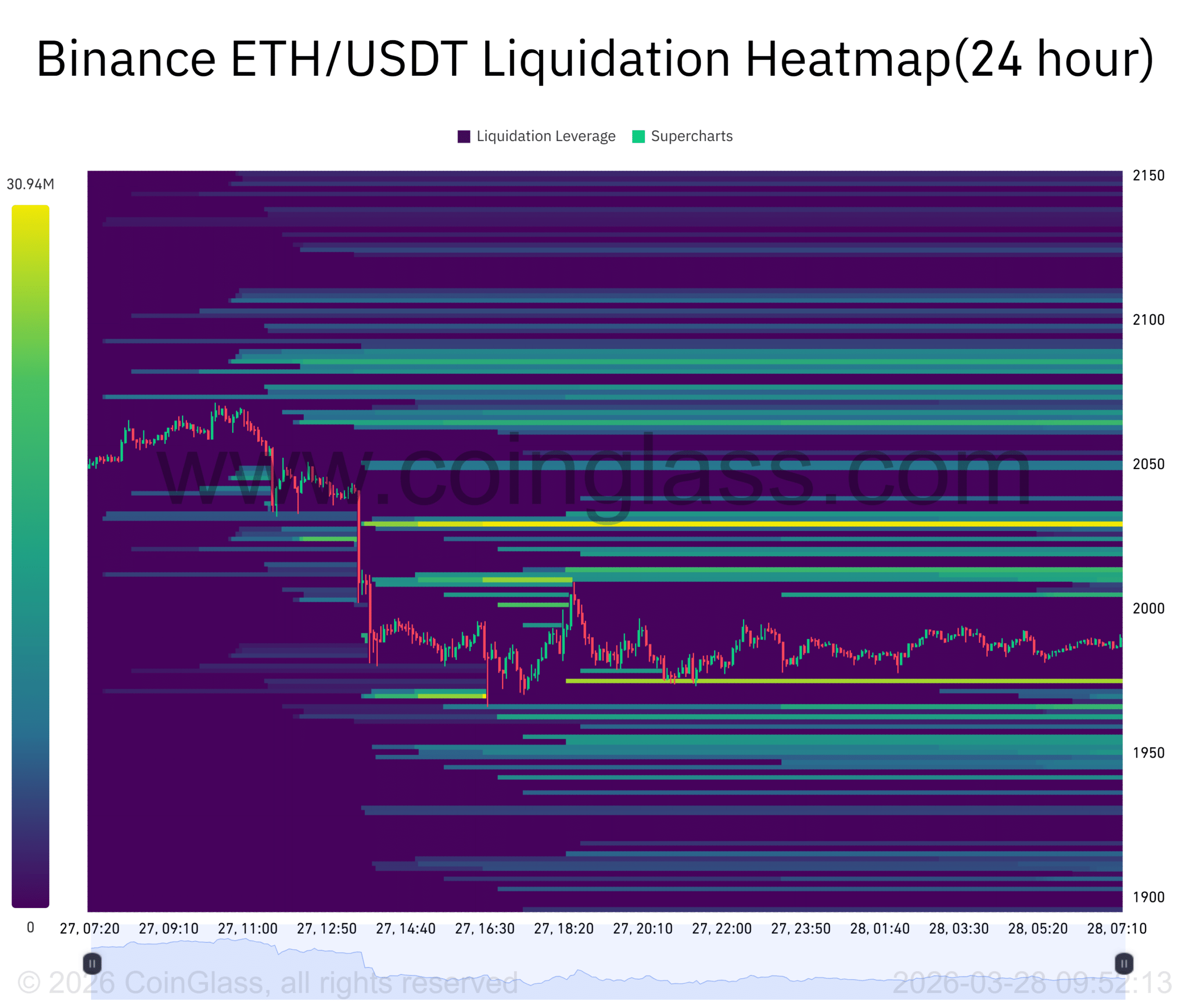
The liquidation heatmap highlights a dense $30.95 million liquidity cluster around the $2,030 level. This zone has become a critical area where price continues interacting, indicating strong positioning from both longs and shorts. Liquidity clusters typically act as magnets, drawing price toward them before a directional move occurs.

Ethereum has hovered near this region, which suggests that the market is targeting this liquidity before deciding its next move. If price clears this cluster, it could trigger a cascade of liquidations that accelerates volatility.

This setup reinforces the idea that ETH is approaching a decisive phase, where clearing nearby liquidity will likely define the next directional bias.
Source: CoinGlass

Can Ethereum break beyond this compression?

Ethereum remains compressed between key levels as accumulation tightens supply and inflows introduce short-term pressure. Weak trend strength and concentrated liquidity near $2,030 suggest an imminent breakout phase.

ETH would likely move sharply once this liquidity clears, with direction depending on which side gains control.


Final Summary

  • Whale accumulation tightens supply, but rising inflows introduce pressure, keeping Ethereum locked within a decisive structure zone.
  • Weak trend strength and dense liquidity propose Ethereum would soon resolve compression through a sharp directional breakout move.


Related Questions

QHow much Ethereum did whales accumulate and from which exchange?

AWhales accumulated 9,976 ETH (worth $19.8 million) from Binance.

QWhat is the current key resistance and support level for Ethereum's price?

AEthereum is trading between the $1,928 support and $2,175 resistance levels.

QWhat does the rise in spot inflows to exchanges indicate for Ethereum?

AThe rise in spot inflows to $26.33 million suggests some participants may be preparing to sell or reposition, potentially introducing short-term downward pressure.

QWhy is the $2,030 liquidity cluster significant for Ethereum's price movement?

AThe $30.95 million liquidity cluster at $2,030 is a critical zone where price interaction may trigger a cascade of liquidations, potentially accelerating volatility and defining the next directional bias.

QWhat do the DMI and ADX readings indicate about the current market trend?

AThe DMI shows -DI above +DI, indicating sellers control the structure, while the ADX at 17 signals weak trend strength and lack of conviction, suggesting no strong directional move yet.

Related Reads

2026 New Policy Interpretation: The "Mutual Pursuit" of Intelligent Agents and AI Terminals, and the Three Major Value Reconstructions in the AIoT Industry

In May 2026, China's national ministries released two pivotal policy documents that jointly establish a strategic "dual-track" framework for the AIoT industry. The "Intelligent Agent Standardized Application and Innovation Development Implementation Opinions" defines the "soul"—positioning intelligent agents as core AI products. The "Artificial Intelligence Terminal Intelligence Grading" national standard defines the "body"—establishing a four-tier capability ladder (L1 to L4) for AI hardware. This synchronized policy approach is globally unique, moving beyond market-led (US) or risk-focused (EU) models. It frames AIoT as a new type of "intelligent infrastructure," comparable to electricity or the internet in historical significance. The core analysis identifies a value evolution from IoT 1.0 (connection) to AIoT 4.0 (collaboration, represented by the forward-looking L4 level). This "L4" signifies a paradigm shift: from users operating tools to delegating tasks to agent-like devices ("Intelligent Action of All Things"). The article outlines three strategic paths for companies: becoming Standard Definers, Scenario Integrators (focusing on 19 specified application areas), or Infrastructure Builders. A critical 18-24 month window is identified for strategic positioning. A "Four Levers" strategy is proposed: leveraging Standards (L-level certification), leveraging Scenarios (deep vertical focus), leveraging Open Source (for cost reduction and ecosystem influence), and leveraging Momentum (engaging in global protocol ecosystems). In conclusion, these policies are a starting gun for a decade-long industrial transformation, shifting the industry narrative from "Intelligent Connection of All Things" to "Intelligent Action of All Things," with companies needing to choose their赛道and execution strategy decisively.

marsbit39m ago

2026 New Policy Interpretation: The "Mutual Pursuit" of Intelligent Agents and AI Terminals, and the Three Major Value Reconstructions in the AIoT Industry

marsbit39m ago

Splashing Out 27 Billion Yuan, OpenAI Establishes New Company to Accelerate AI Deployment

On May 11th, OpenAI announced the formation of a new company, "OpenAI Deployment Company," with an initial investment of over $4 billion (approximately 27.2 billion RMB). This venture aims to help businesses build and deploy AI solutions. OpenAI is also acquiring the AI consulting firm Toromo to rapidly scale the deployment company's capabilities. This new entity, majority-owned by OpenAI, brings together 19 investment, consulting, and system integration partners, led by TPG with co-lead founding partners including Advent International, Bain Capital, and Brookfield. OpenAI's Chief Revenue Officer, Denise Dresser, stated that while AI is becoming increasingly capable, the current challenge lies in integrating these systems into core business infrastructure and workflows. The deployment company is designed to bridge this gap and translate AI capabilities into operational impact. This move comes as OpenAI emphasizes the next competitive phase will depend on the efficiency of deploying AI in real business scenarios. The company reports over 1 million businesses already use its products and APIs. OpenAI is significantly increasing its investments in computing power, with co-founder Greg Brockman stating the company expects to spend $50 billion on compute this year, a dramatic increase from $3 million in 2017. The announcement follows OpenAI's recent completion of a record $122 billion funding round in late March, led by Amazon, Nvidia, and SoftBank, valuing the company at $852 billion post-money. Major strategic investors committed $110 billion as a base for this round. Concurrently, OpenAI is advancing its core model development. It has shifted focus from its Sora video generator to developing advanced robotics and AI models that interact with the physical world. It has also begun allowing select users access to a new model specialized in identifying software vulnerabilities and is reportedly preparing to launch an enhanced image generation model in the coming weeks. According to reports citing founder Sam Altman, OpenAI is considering an IPO as early as 2027, with a potential valuation around $1 trillion.

marsbit55m ago

Splashing Out 27 Billion Yuan, OpenAI Establishes New Company to Accelerate AI Deployment

marsbit55m ago

Trading

Spot
Futures

Hot Articles

Discussions

Welcome to the HTX Community. Here, you can stay informed about the latest platform developments and gain access to professional market insights. Users' opinions on the price of ETH (ETH) are presented below.

活动图片














