Ethereum vs Solana – No chain has defensible ‘moat’ yet, warns Wintermute CEO

ambcryptoPublished on 2026-03-21Last updated on 2026-03-21

Abstract

Wintermute CEO Evgeny Gaevoy argues that neither Ethereum nor Solana has established a defensible market position, despite Ethereum's dominance in DeFi TVL ($56 billion vs. Solana's $6.8 billion). He claims Ethereum's value is largely "stuck money" and corporate experiments with limited real-world impact, while Solana, though technologically capable, remains overly reliant on memecoin activity without major new dApps. Gaevoy believes the space remains open for new blockchains to emerge and attract users. Hyperliquid's success supports this view, as it now generates 45% of blockchain fee revenue—surpassing Ethereum (7%) and Solana (13%)—by expanding into commodity trading. Additionally, new corporate chains like Tempo and Circle’s Arc threaten public chains' stablecoin and tokenization advantages by offering lower fees and enhanced security. The competition remains fluid, with no clear winner yet.

From the outside, one might think public blockchains are a two-horse race, pitting DeFi pioneer Ethereum against its closest and fastest challenger, Solana. In fact, DeFi activity and liquidity (total locked value) may somewhat reinforce the above picture.

Check this out – Out of the total DeFi TVL of $95.3 billion, Ethereum dominates with $56 billion, while Solana comes in second at $6.8 billion – About 10% of Ethereum’s size.
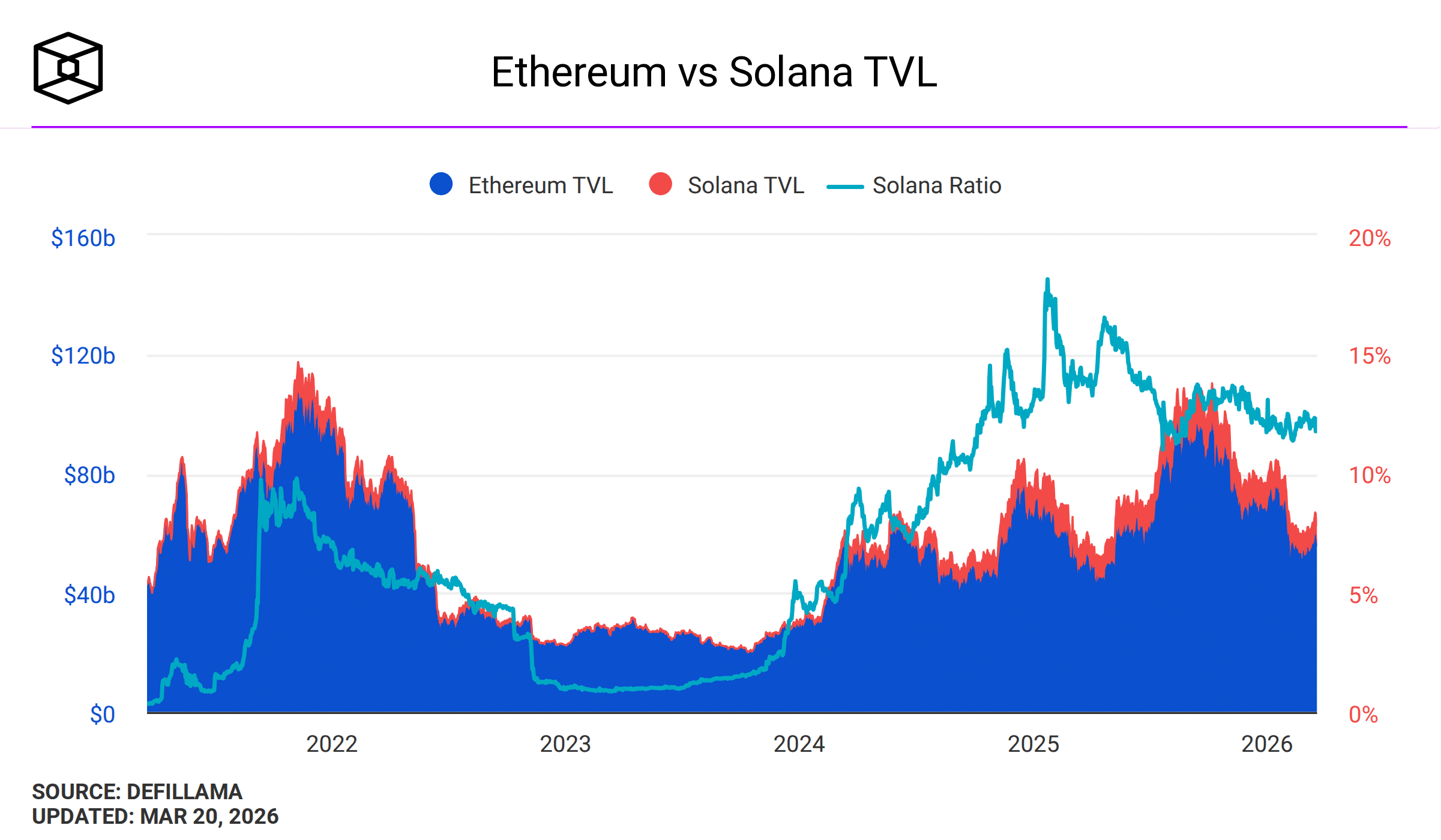
Source: The Block/DeFiLlama

However, Evgeny Gaevoy, CEO of crypto market maker Wintermute, believes neither of the two leading chains has a sticky moat.

ETH vs SOL – No clear winner just yet

For Ethereum’s massive TVL, Gaevoy claimed that most of the capital on the chain is “stuck money” and “corporate experiments” on blockchain rails.

People quite overestimate those corporate pilots to put some cash markets and bonds on the block. It’s a tiny TradFi economic activity.

On the contrary, for Solana, the memecoin mania has revealed that its technology works and it can handle massive transaction volumes with faster transfers.

According to the exec though, Solana is still stuck with memecoins. Additionally, there are no major new dApps or exchanges to catalyze it.

He concluded,

I don’t feel anyone has won yet. It’s feasible that a new blockchain could attract a new cohort of believers and take the world by storm. It’s possible because nobody has this moat yet.

In the stablecoin and tokenization boom, Ethereum and Solana are still ranked first and second, respectively.

Hyperliquid validates his theory

Gaevoy’s arguments are plausible too, especially after Hyperliquid’s success despite being operational for about three years.

The chain and DEX were purpose-built for high-frequency crypto trading and DeFi activity. However, now it has become the best place to trade oil and other commodities amid geopolitical tensions.

Interestingly, the massive trading activity across crypto and non-crypto assets has driven Hyperliquid to generate more fees and revenue.

The results? Hyperliquid now dominates 45% of the generated fee revenue market. TRON controls 20% of the revenue, while Solana ranks third with a 13% market share. Finally, Ethereum comes fifth at 7% after BNB Chain’s 10%.
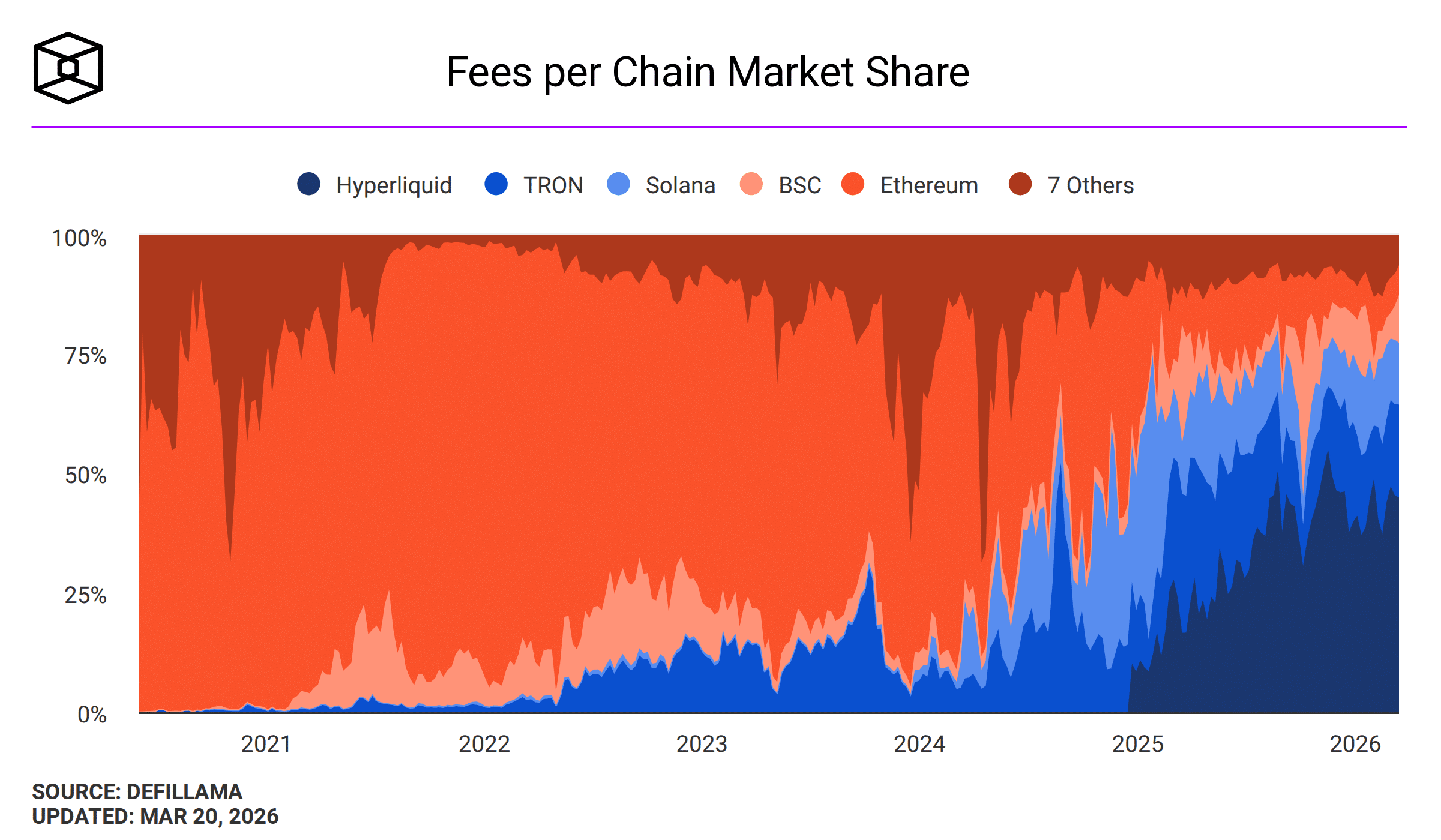
Source: The Block/DeFiLlama

And yet, the current perceived ‘moats’ for Ethereum and Solana, such as stablecoins and tokenized markets, are under threat from rival private corporate chains.

Stripe-backed stablecoin payment-focused Tempo chain went live recently. A similar chain, Circle’s Arc, debuted too. The full roll-out of Google Cloud Universal Ledger (GCUL) is expected this year, with all of them eyeing payments and tokenized capital markets.

All these new chains seek to scrap the volatile, unpredictable transfer fees charged by current public chains and minimize scams. So, it’s feasible they could eat into public chains’ market share and their perceived moat.


Final Summary

  • Wintermute CEO has downplayed the perceived moats of Ethereum and Solana, warning that they could still be easily disrupted.
  • Hyperliquid’s 45% market dominance in total blockchain revenue validated exec’s argument

Related Questions

QAccording to Wintermute CEO Evgeny Gaevoy, why does Ethereum's massive TVL not necessarily represent a strong moat?

AGaevoy claims that most of the capital on Ethereum is 'stuck money' and 'corporate experiments' on blockchain rails, referring to small-scale TradFi economic activity like putting cash markets and bonds on-chain.

QWhat technological advantage of Solana was revealed during the memecoin mania, according to the article?

AThe memecoin mania revealed that Solana's technology works and it can handle massive transaction volumes with faster transfers.

QWhich blockchain currently dominates the market in generated fee revenue, and what is its market share?

AHyperliquid currently dominates the generated fee revenue market with a 45% share.

QWhat are some of the new rival chains mentioned that threaten the stablecoin and tokenization moat of public chains like Ethereum and Solana?

AThe article mentions the Stripe-backed Tempo chain, Circle's Arc chain, and the upcoming Google Cloud Universal Ledger (GCUL), all of which are focused on payments and tokenized capital markets.

QWhat is the core argument made by Wintermute's CEO about the current state of competition between blockchain networks?

AThe core argument is that no chain has a defensible moat yet, and it's still feasible for a new blockchain to attract believers and take the world by storm, as the current leaders are vulnerable to disruption.

Related Reads

OpenAI Post-Training Engineer Weng Jiayi Proposes a New Paradigm Hypothesis for Agentic AI

OpenAI engineer Weng Jiayi's "Heuristic Learning" experiments propose a new paradigm for Agentic AI, suggesting that intelligent agents can improve not just by training neural networks, but also by autonomously writing and refining code based on environmental feedback. In the experiment, a coding agent (powered by Codex) was tasked with developing and maintaining a programmatic strategy for the Atari game Breakout. Starting from a basic prompt, the agent iteratively wrote code, ran the game, analyzed logs and video replays to identify failures, and then modified the code. Through this engineering loop of "code-run-debug-update," it evolved a pure Python heuristic strategy that achieved a perfect score of 864 in Breakout and performed competitively with deep reinforcement learning (RL) algorithms in MuJoCo control tasks like Ant and HalfCheetah. This approach, termed Heuristic Learning (HL), contrasts with Deep RL. In HL, experience is captured in readable, modifiable code, tests, logs, and configurations—a software system—rather than being encoded solely into opaque neural network weights. This offers potential advantages in explainability, auditability for safety-critical applications, easier integration of regression tests to combat catastrophic forgetting, and more efficient sample use in early learning stages, as demonstrated in broader tests on 57 Atari games. However, the blog acknowledges clear limitations. Programmatic strategies struggle with tasks requiring long-horizon planning or complex perception (e.g., Montezuma's Revenge), areas where neural networks excel. The future vision is a hybrid architecture: specialized neural networks for fast perception (System 1), HL systems for rules, safety, and local recovery (also System 1), and LLM agents providing high-level feedback and learning from the HL system's data (System 2). The core proposition is that in the era of capable coding agents, a significant portion of an AI's learned experience could be maintained as an auditable, evolving software system.

marsbit27m ago

OpenAI Post-Training Engineer Weng Jiayi Proposes a New Paradigm Hypothesis for Agentic AI

marsbit27m ago

Your Claude Will Dream Tonight, Don't Disturb It

This article explores the recent phenomenon of AI companies increasingly using anthropomorphic language—like "thinking," "memory," "hallucination," and now "dreaming"—to describe machine learning processes. Focusing on Anthropic's newly announced "Dreaming" feature for its Claude Agent platform, the piece explains that this function is essentially an automated, offline batch processing of an agent's operational logs. It analyzes past task sessions to identify patterns, optimize future actions, and consolidate learnings into a persistent memory system, akin to a form of reinforcement learning and self-correction. The article draws parallels to similar features in other AI agent systems like Hermes Agent and OpenClaw, which also implement mechanisms for reviewing historical data, extracting reusable "skills," and strengthening long-term memory. It notes a key difference from human dreaming: these AI "dreams" still consume computational resources and user tokens. Further context is provided by discussing the technical challenges of managing AI "memory" or context, highlighting the computational expense of large context windows and innovations like Subquadratic's new model claiming drastically longer contexts. The core critique argues that this strategic use of human-centric vocabulary does more than market products; it subtly reshapes user perception. By framing algorithms with terms associated with consciousness, companies blur the line between tool and autonomous entity. This linguistic shift can influence user expectations, tolerance for errors, and even perceptions of responsibility when systems fail, potentially diverting scrutiny from the companies and engineers behind the technology. The article concludes by speculating that terms like "daydreaming" for predictive task simulation might be next, continuing this trend of embedding the idea of an "inner life" into computational processes.

marsbit29m ago

Your Claude Will Dream Tonight, Don't Disturb It

marsbit29m ago

Trading

Spot
Futures

Hot Articles

Discussions

Welcome to the HTX Community. Here, you can stay informed about the latest platform developments and gain access to professional market insights. Users' opinions on the price of ETH (ETH) are presented below.

活动图片