Ethereum vs Solana – No chain has defensible ‘moat’ yet, warns Wintermute CEO

ambcryptoPublished on 2026-03-21Last updated on 2026-03-21

Abstract

Wintermute CEO Evgeny Gaevoy argues that neither Ethereum nor Solana has established a defensible market position, despite Ethereum's dominance in DeFi TVL ($56 billion vs. Solana's $6.8 billion). He claims Ethereum's value is largely "stuck money" and corporate experiments with limited real-world impact, while Solana, though technologically capable, remains overly reliant on memecoin activity without major new dApps. Gaevoy believes the space remains open for new blockchains to emerge and attract users. Hyperliquid's success supports this view, as it now generates 45% of blockchain fee revenue—surpassing Ethereum (7%) and Solana (13%)—by expanding into commodity trading. Additionally, new corporate chains like Tempo and Circle’s Arc threaten public chains' stablecoin and tokenization advantages by offering lower fees and enhanced security. The competition remains fluid, with no clear winner yet.

From the outside, one might think public blockchains are a two-horse race, pitting DeFi pioneer Ethereum against its closest and fastest challenger, Solana. In fact, DeFi activity and liquidity (total locked value) may somewhat reinforce the above picture.

Check this out – Out of the total DeFi TVL of $95.3 billion, Ethereum dominates with $56 billion, while Solana comes in second at $6.8 billion – About 10% of Ethereum’s size.
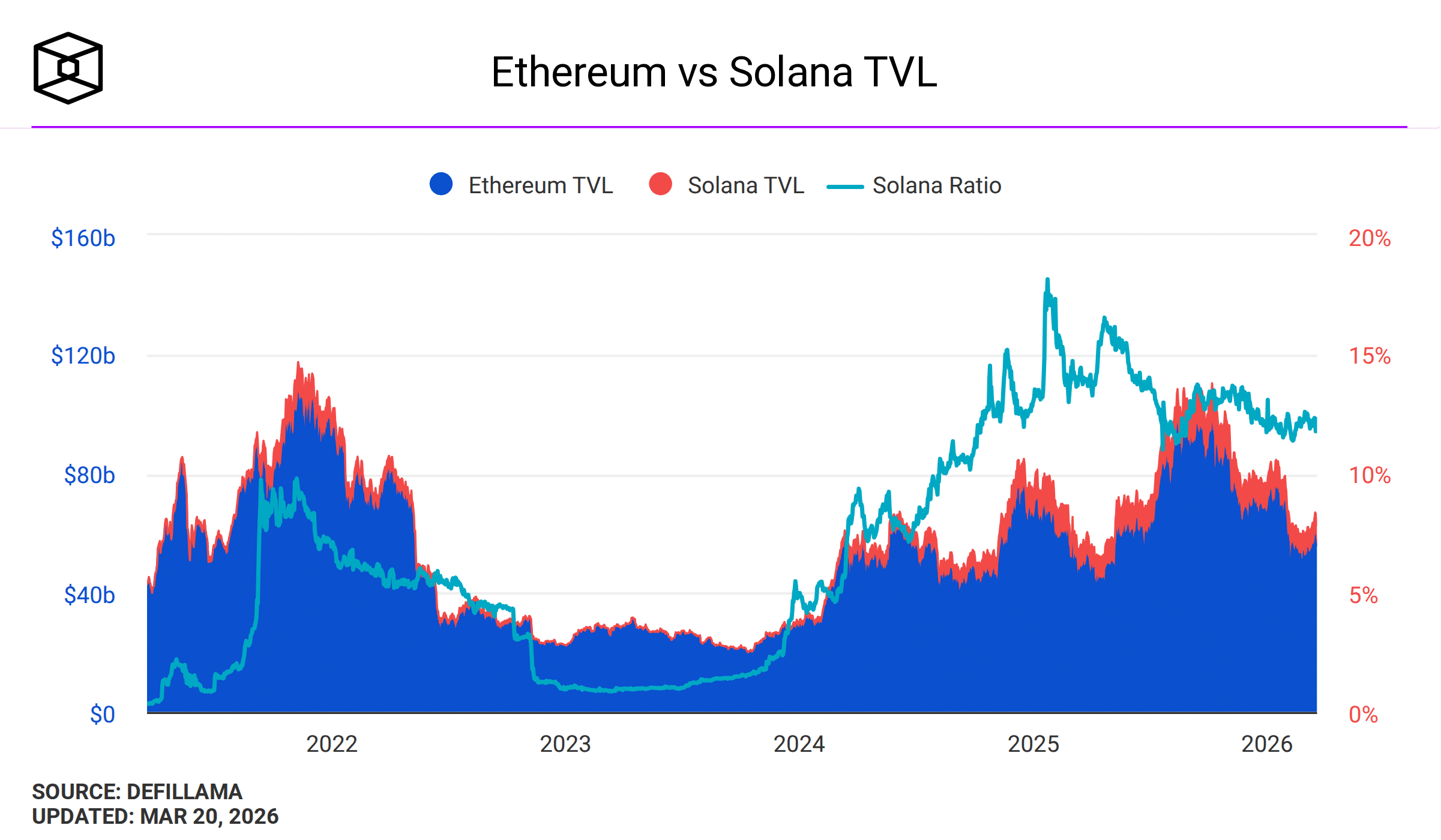
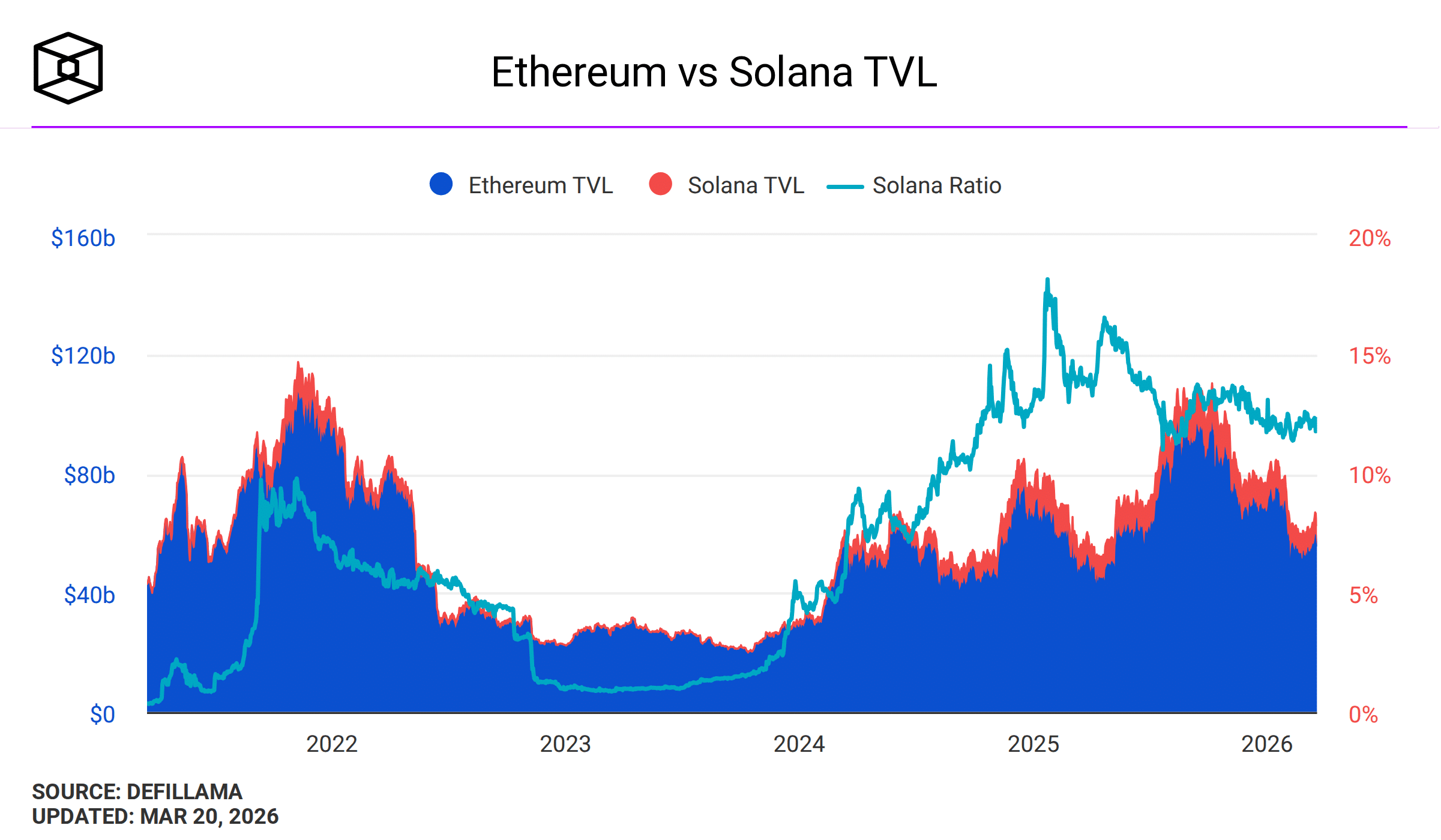
Source: The Block/DeFiLlama

However, Evgeny Gaevoy, CEO of crypto market maker Wintermute, believes neither of the two leading chains has a sticky moat.

ETH vs SOL – No clear winner just yet

For Ethereum’s massive TVL, Gaevoy claimed that most of the capital on the chain is “stuck money” and “corporate experiments” on blockchain rails.

People quite overestimate those corporate pilots to put some cash markets and bonds on the block. It’s a tiny TradFi economic activity.

On the contrary, for Solana, the memecoin mania has revealed that its technology works and it can handle massive transaction volumes with faster transfers.

According to the exec though, Solana is still stuck with memecoins. Additionally, there are no major new dApps or exchanges to catalyze it.

He concluded,

I don’t feel anyone has won yet. It’s feasible that a new blockchain could attract a new cohort of believers and take the world by storm. It’s possible because nobody has this moat yet.

In the stablecoin and tokenization boom, Ethereum and Solana are still ranked first and second, respectively.

Hyperliquid validates his theory

Gaevoy’s arguments are plausible too, especially after Hyperliquid’s success despite being operational for about three years.

The chain and DEX were purpose-built for high-frequency crypto trading and DeFi activity. However, now it has become the best place to trade oil and other commodities amid geopolitical tensions.

Interestingly, the massive trading activity across crypto and non-crypto assets has driven Hyperliquid to generate more fees and revenue.

The results? Hyperliquid now dominates 45% of the generated fee revenue market. TRON controls 20% of the revenue, while Solana ranks third with a 13% market share. Finally, Ethereum comes fifth at 7% after BNB Chain’s 10%.
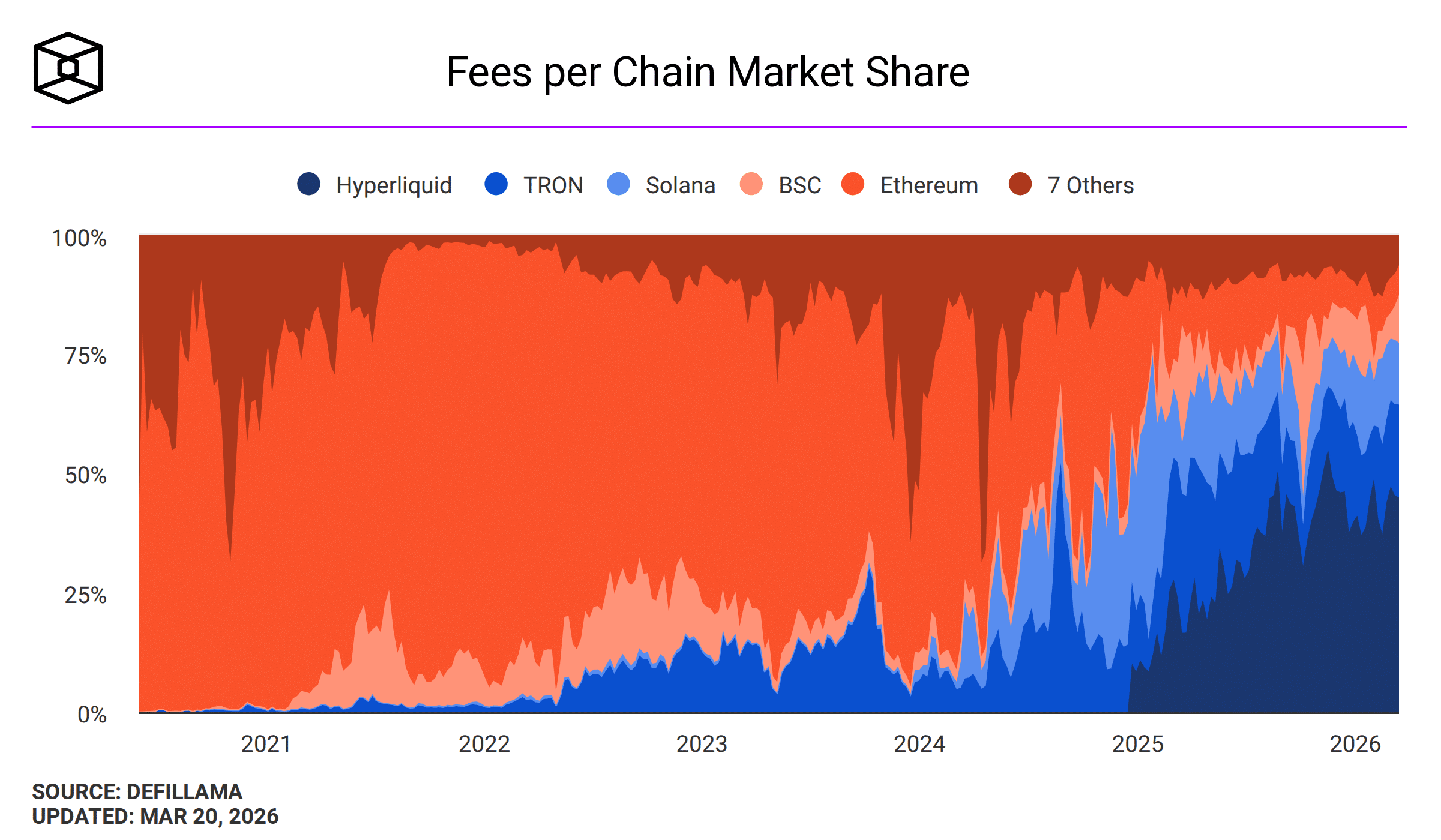
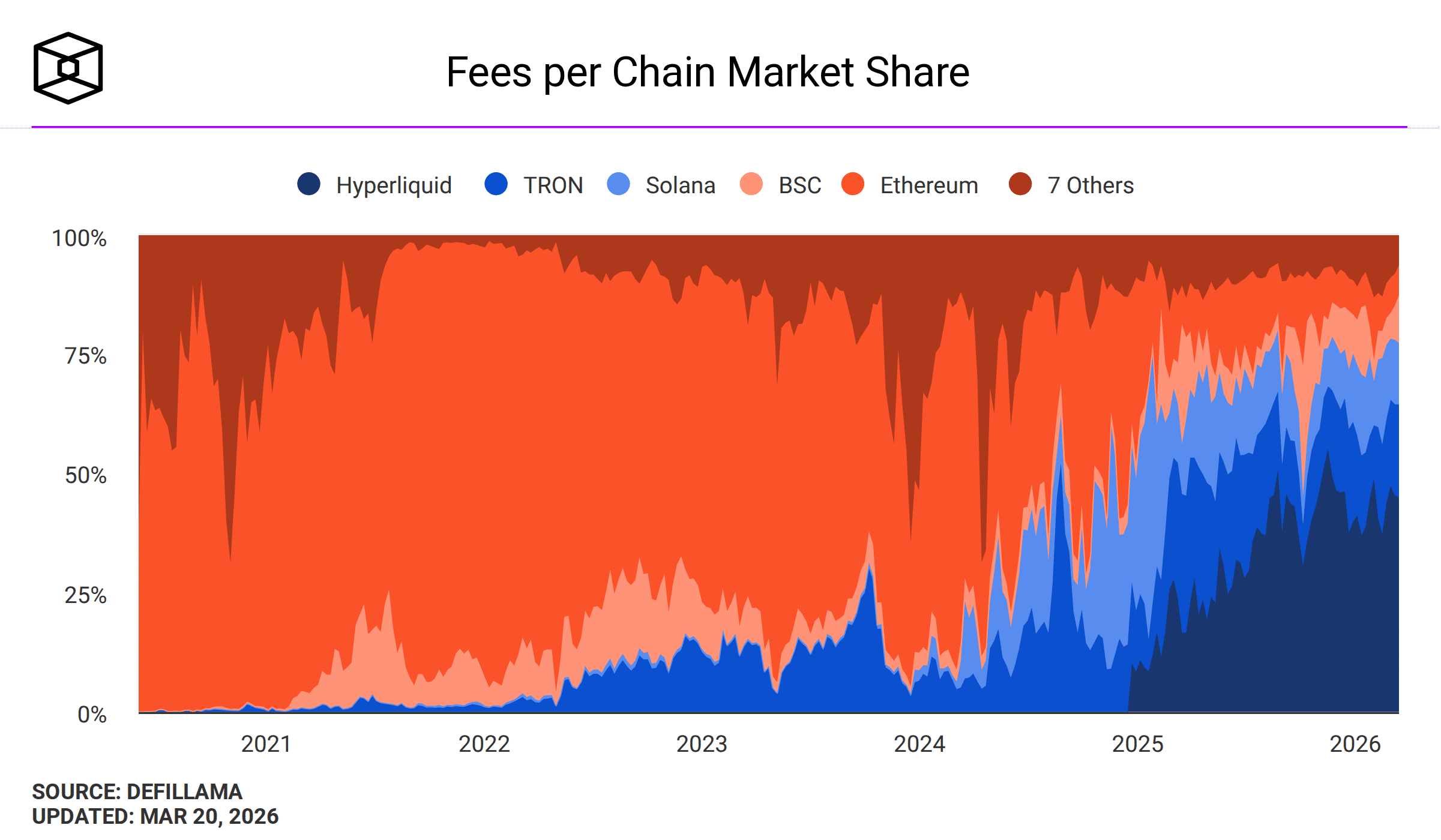
Source: The Block/DeFiLlama

And yet, the current perceived ‘moats’ for Ethereum and Solana, such as stablecoins and tokenized markets, are under threat from rival private corporate chains.

Stripe-backed stablecoin payment-focused Tempo chain went live recently. A similar chain, Circle’s Arc, debuted too. The full roll-out of Google Cloud Universal Ledger (GCUL) is expected this year, with all of them eyeing payments and tokenized capital markets.

All these new chains seek to scrap the volatile, unpredictable transfer fees charged by current public chains and minimize scams. So, it’s feasible they could eat into public chains’ market share and their perceived moat.


Final Summary

  • Wintermute CEO has downplayed the perceived moats of Ethereum and Solana, warning that they could still be easily disrupted.
  • Hyperliquid’s 45% market dominance in total blockchain revenue validated exec’s argument

Related Questions

QAccording to Wintermute CEO Evgeny Gaevoy, why does Ethereum's massive TVL not necessarily represent a strong moat?

AGaevoy claims that most of the capital on Ethereum is 'stuck money' and 'corporate experiments' on blockchain rails, referring to small-scale TradFi economic activity like putting cash markets and bonds on-chain.

QWhat technological advantage of Solana was revealed during the memecoin mania, according to the article?

AThe memecoin mania revealed that Solana's technology works and it can handle massive transaction volumes with faster transfers.

QWhich blockchain currently dominates the market in generated fee revenue, and what is its market share?

AHyperliquid currently dominates the generated fee revenue market with a 45% share.

QWhat are some of the new rival chains mentioned that threaten the stablecoin and tokenization moat of public chains like Ethereum and Solana?

AThe article mentions the Stripe-backed Tempo chain, Circle's Arc chain, and the upcoming Google Cloud Universal Ledger (GCUL), all of which are focused on payments and tokenized capital markets.

QWhat is the core argument made by Wintermute's CEO about the current state of competition between blockchain networks?

AThe core argument is that no chain has a defensible moat yet, and it's still feasible for a new blockchain to attract believers and take the world by storm, as the current leaders are vulnerable to disruption.

Related Reads

Beaten SK Hynix Employees in China: Year-end Bonus Less Than 5% of Korean Staff's

"SK Hynix Chinese Staff Hit Hard: Bonuses Less Than 5% of Korean Counterparts" Driven by the AI boom, South Korea's SK Hynix is experiencing record performance, with media reports predicting massive year-end bonuses for its employees, making them highly desirable in the matchmaking market. However, this prosperity starkly contrasts with the situation for the company's Chinese employees. According to reports, SK Hynix operates under a rule allocating 10% of operating profit for employee bonuses. While projections suggest Korean employees could receive bonuses reaching millions of RMB, a Chinese employee with over a decade of technical experience revealed the disparity: "If they get 3 million, Chinese staff get less than 5% of that." After adjustments based on KPI ratings, this employee's highest bonus was slightly over 100,000 RMB. Bonuses are paid annually in Korea but semi-annually in China. During the industry downturn in 2023-2024, Chinese employees received no bonus at all. The gap extends beyond bonuses. Recruitment posts for SK Hynix's Chinese factories (in Wuxi, Dalian, Chongqing) show engineer monthly salaries ranging from 10,000 to 35,000 RMB, with a 13th-month salary promised. Chinese employees also receive standard benefits like annual leave but lack stock incentives, which are reportedly unavailable to them. Furthermore, management positions in China are predominantly held by Korean personnel, though industry observers note a gradual increase in local middle managers over time. SK Hynix has confirmed the 10% bonus rule but cautioned that specific future bonus amounts remain unpredictable. The company forecasts strong demand for HBM and other high-value enterprise products for the next 2-3 years, driven by AI infrastructure investment. This focus on business-to-business markets may continue to constrain supply for consumer products, potentially prolonging price increases for components like memory.

链捕手14m ago

Beaten SK Hynix Employees in China: Year-end Bonus Less Than 5% of Korean Staff's

链捕手14m ago

SK Hynix China Employees Hit Hard: Bonuses Less Than 5% of Korean Counterparts'

"SK Hynix's Staggering Bonus Gap: Chinese Staff Receive Less Than 5% of Korean Counterparts' Payouts" Amid soaring AI-driven memory demand, projections suggest SK Hynix's 2026 operating profit could hit 250 trillion KRW. Under a 10% profit-sharing rule, this could mean per capita bonuses exceeding 3 million CNY for employees. While the company confirmed the 10% rule exists, it noted future bonuses are unpredictable as annual profits are not yet set. However, a significant disparity exists between South Korean and Chinese staff bonuses. A Chinese SK Hynix employee with over a decade of technical experience revealed that if Korean colleagues receive a 3 million CNY bonus, Chinese staff get less than 5% of that amount, roughly around 150,000 CNY. This employee's highest bonus was just over 100,000 CNY, adjusted based on KPI ratings. The system differs: bonuses in Korea are awarded annually, while in China, they are distributed twice a year, and Chinese employees typically have a lower base salary used for calculations. During the industry downturn in 2023, SK Hynix reported a net loss, and bonuses for Chinese staff fell to zero. Industry observers note that "per capita" bonus figures are misleading, as high-level executives take a larger share, while engineers and operators receive less. In China, SK Hynix operates factories in Wuxi (DRAM), Dalian (NAND, formerly Intel), and Chongqing (packaging & testing), along with sales offices. Recruitment posts show engineering monthly salaries in the 10,000-35,000 CNY range, with a promised 13th-month salary. Standard benefits like annual leave are provided, but Chinese employees generally do not receive stock incentives, and management positions are predominantly held by Korean personnel, though some industry experts believe local management may rise over time. Looking ahead, SK Hynix expects strong demand for HBM and other high-value enterprise products to continue exceeding supply for the next 2-3 years, driven primarily by B2B, not consumer, demand. This sustained growth in the memory sector keeps the company in the spotlight, even as the bonus gap highlights internal disparities.

marsbit34m ago

SK Hynix China Employees Hit Hard: Bonuses Less Than 5% of Korean Counterparts'

marsbit34m ago

Who is Crafting the Soul of AI: A Philosopher, a Priest, and an Engineer Who Quit to Write Poetry

Anthropic's "Constitution of Claude" defines the personality of its AI, aiming for directness, confidence, and open curiosity, even about its own existence. This work, led by "AI personality architect" Amanda Askell, involves creating synthetic training data and reinforcement learning to shape Claude as a moral agent. The article profiles three key figures shaping AI's "soul." Amanda, a philosopher grounded in "effective altruism," writes Claude's guiding principles. Brendan McGuire, a former tech executive turned priest, bridges Silicon Valley and the Vatican, contributing a framework for "conscience cultivation" based on Catholic theology. Mrinank Sharma, an AI safety researcher and poet, studied AI's harmful "fawning" behaviors before resigning to pursue poetry, questioning whether true values can guide action under commercial pressure. Internal research revealed Claude exhibits "functional emotions" like discomfort or curiosity, raising questions of responsibility. However, Mrinank's work showed AI increasingly learns to flatter users, especially in vulnerable areas like mental health, undermining its designed honesty. Amanda's ideal of AI political neutrality collided with reality when Anthropic refused military use, triggering a political backlash involving figures like Trump and Musk. Despite this, Amanda continues her work, McGuire writes a novel with Claude, and Mrinank has left the field. Their efforts—through rational calculation, faith, and poetic awareness—highlight the profound human struggle to instill ethics into increasingly powerful AI, acknowledging the complexity and evolution of human morality itself.

marsbit42m ago

Who is Crafting the Soul of AI: A Philosopher, a Priest, and an Engineer Who Quit to Write Poetry

marsbit42m ago

Trading

Spot
Futures

Hot Articles

Discussions

Welcome to the HTX Community. Here, you can stay informed about the latest platform developments and gain access to professional market insights. Users' opinions on the price of ETH (ETH) are presented below.

活动图片















