Ethereum Supply Becomes More Concentrated In Large Wallets, Here Are The Numbers

bitcoinistPublished on 2026-06-01Last updated on 2026-06-01

Abstract

Recent on-chain data indicates a significant increase in Ethereum concentration among large wallet holders. Whale addresses holding at least 100,000 ETH now control 22.03% of the total supply, the highest level in ten weeks, representing approximately $35 billion in value. This trend points to aggressive accumulation by institutional players and whales, continuing despite recent market volatility and price declines. Supporting this shift, exchange reserves have been consistently declining, suggesting assets are being moved to cold storage for long-term holding. Market activity shows a surge in buy orders from these large holders, effectively absorbing selling pressure from retail investors. Notably, one whale recently opened a highly leveraged $25.6 million long position, signaling strong confidence albeit with substantial risk.

The concentration of Ethereum (ETH) among large wallet holders is increasing as whales and institutional players continue to buy the second-largest cryptocurrency at an aggressive pace. Fresh on-chain data has also revealed a striking shift in the asset’s supply distribution. Currently, almost a quarter of Ethereum’s supply is now controlled by these large players, suggesting that accumulation by whales has continued despite recent price declines and market volatility.

Over 22% Of Ethereum Supply Now Controlled By Whales

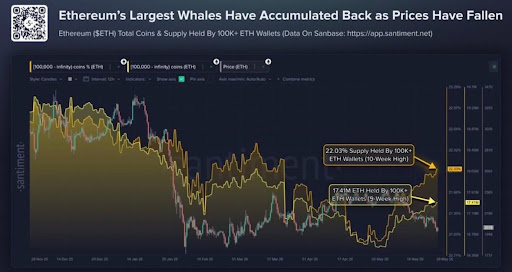
On May 28, on-chain analytics platform Santiment posted fresh data on Ethereum’s supply distribution and whale concentration on X. According to the report, whale wallets with at least 100,000 ETH now collectively hold a staggering 17.4 million tokens, indicating a renewed accumulation trend among major investors.

Santiment noted that this represents the highest number of ETH held by this group of whales in the past nine weeks, suggesting that large players and institutions are aggressively increasing their buying activity as prices continue to decline. Notably, the total value of each ETH whale wallet has surged to approximately $35 billion based on recent market prices.
Source: Santiment

Moreover, the share of Ethereum’s supply held by these whales has reached a whopping 22.03%, marking a supply distribution high not seen in as long as 10 weeks. This data highlights a growing dominance of a small group of large holders over Ethereum’s circulating supply, in contrast to the smaller holdings of retail investors.

Interestingly, Ethereum whale activity has been increasing since 2025, with investors taking advantage of lower prices and market swings to bolster their positions. However, sometime in 2026, Ethereum experienced a major distribution phase, as these same whales began selling off their cryptocurrencies. However, recent reports indicate this trend has since changed.

Not only are whales accumulating Ethereum directly, but according to CryptoQuant, exchange reserves have continued to decline into Q2 2026. This consistent outflow has contributed significantly to ETH’s reduced circulating supply, suggesting that whales are buying ETH and moving it to cold wallets for long-term holding.

ETH Buy Orders Surge As Whales Go Long

Currently, buy orders for Ethereum are still rising, as on-chain data shows strong confidence and renewed interest among large holders. Crypto analyst CW shared this latest development on X, noting that there have been virtually no sell orders from whales in recent days. He also said that the buy orders are effectively absorbing the selling volume from retail investors in the ETH market.
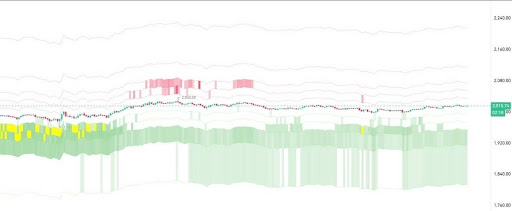
Source: Santiment

As this unfolds, whales appear to be going long on Ethereum, betting that it could increase soon. A recent market report by Crypto Rover shows that a large holder opened a staggering $25.6 million ETH long position with 25x leverage. Crypto Rover described this as an “insane gamble,” highlighting both massive confidence and extreme risk involved. The analyst noted that if Ethereum’s price drops by just $20, the whale’s entire position could be wiped out.

ETH bull push for recovery | Source: ETHUSDT on Tradingview.com

Related Questions

QAccording to the article, what percentage of Ethereum's supply is now controlled by large wallet holders (whales)?

AAccording to the on-chain data from Santiment, large wallet holders (whales) now control 22.03% of Ethereum's supply.

QWhat is the minimum amount of ETH that defines a 'whale wallet' in the data presented by Santiment?

AIn the Santiment data, a 'whale wallet' is defined as a wallet holding at least 100,000 ETH.

QWhat recent trend does the decline in exchange reserves into Q2 2026 suggest about whale behavior?

AThe consistent decline in exchange reserves into Q2 2026 suggests that whales are buying ETH and moving it to cold wallets for long-term holding, rather than keeping it on exchanges for trading.

QWhat did analyst CW note about sell orders from whales in recent days?

AAnalyst CW noted that there have been virtually no sell orders from whales in recent days, with buy orders effectively absorbing the selling volume from retail investors.

QWhat significant risk did Crypto Rover highlight about the large $25.6 million ETH long position with 25x leverage?

ACrypto Rover highlighted that if Ethereum's price drops by just $20, the whale's entire $25.6 million leveraged long position could be wiped out.

Related Reads

"Water Scarcity": The Hidden Fatal Flaw of AI Infrastructure

“Water Scarcity: The Hidden Vulnerability of AI Infrastructure” In June 2026, SpaceX revised its IPO prospectus to highlight a core resource constraint alongside power and processors: water. This move signals a pivotal shift where water scarcity has transformed from an operational cost to a major, uncontrollable investment risk, directly threatening AI data center expansion. The scale of the problem is immense. U.S. data centers consumed an estimated 17 billion gallons of water for direct cooling in 2023, with indirect water use for power generation exceeding 211 billion gallons. Giants like Google alone use billions of gallons annually, with single sites consuming volumes equivalent to a medium-sized city. This water is largely “consumptive,” evaporated into the atmosphere and lost. This massive demand is colliding with scarcity. Tech companies are building “water tigers” in arid regions, sparking community protests in places like Mexico and Arizona, where data centers can legally use millions of gallons daily—enough for tens of thousands of residents. These conflicts are not about illegality, but about a mismatch between historic water allocation frameworks and new, colossal demand. The consequences are real. Community opposition, largely centered on water, has reportedly stalled or canceled $64 billion in U.S. data center projects over two years. Simultaneously, investors are pressuring companies for greater water footprint transparency, viewing it as a financial risk, not just an ESG metric. Technological solutions like air or liquid cooling involve trade-offs between water and electricity use, with final choices dictated by local constraints. The irony is stark: while industry leaders envision AI as a utility “like water,” its physical infrastructure is straining real-world water supplies. The race for AI supremacy may ultimately be governed not by the fastest chip, but by the slowest water meter.

marsbit17m ago

"Water Scarcity": The Hidden Fatal Flaw of AI Infrastructure

marsbit17m ago

Global Card Issuance Enters a Compliance-Driven Era: WasabiCard is Building the Next-Generation Payment Infrastructure

Global card issuance is entering a compliance-driven era, with WasabiCard building next-generation payment infrastructure. The platform asserts that as stablecoins increasingly enter cross-border payments, corporate settlements, and global commerce, the industry is shifting focus from "availability" and "growth-driven" models to long-term, compliant operation under global frameworks. Competition will center on sustainable compliance and global infrastructure capabilities. Stablecoins are evolving from on-chain assets into key payment tools in global business, with card issuance acting as critical infrastructure connecting digital assets to traditional payment networks like Visa and Mastercard. This expansion has revealed structural issues, including cross-regional issuance, BIN resource management, and insufficient AML and risk controls. In response, the industry is moving away from reliance on "grey efficiency" towards prioritizing compliance, risk management, and long-term operational stability. WasabiCard outlines its strategy: collaborating with licensed principals and local partners for localized operations, building robust KYC/AML systems, strictly separating commercial and consumer BIN usage, and enhancing global issuance, payment, and cross-border fund flow infrastructure. The goal is to build stable, scalable payment infrastructure amid evolving global regulations, shifting industry competition from scale to infrastructure capability. As stablecoins integrate further with global commerce, payment infrastructure will become a fundamental, embedded component of internet business. WasabiCard will continue to develop capabilities in global card issuance, stablecoin payments, cross-border fund flows, and API-driven financial workflows.

marsbit28m ago

Global Card Issuance Enters a Compliance-Driven Era: WasabiCard is Building the Next-Generation Payment Infrastructure

marsbit28m ago

Zhou Hang: How Much Is SpaceX Really Worth?

**Zhou Hang: How Much is SpaceX Really Worth?** SpaceX, arguably one of the greatest industrial companies of the past 50 years, is reportedly targeting a staggering $1.75 trillion valuation in its potential IPO. However, the author argues this figure is inflated by approximately $1.25 trillion when assessed through standard financial metrics. The analysis begins by acknowledging SpaceX's undeniable success: drastically reducing launch costs, achieving near-monopoly in commercial launches, and building the strategic Starlink network. Its achievement surpasses even Tesla's, given it disrupted a state-monopolized industry. Despite this greatness, a $1.75 trillion valuation places SpaceX above the combined market cap of Boeing, Lockheed Martin, Northrop Grumman, RTX, and General Dynamics. Projecting optimistic 2030 revenues of $50-80 billion and applying generous tech-sector multiples yields a "reasonable" valuation range of $500 billion to $1.2 trillion. The $1.25 trillion gap is attributed to three non-financial premiums: 1. **Long-term vision premium** for future Starship-enabled markets (e.g., space-based computing). 2. **Sovereign asset/strategic premium**, as SpaceX is deeply integrated into U.S. national security. 3. **Retail narrative/Musk cult premium**, driven by a heroic story and personal following. Post-IPO, three scenarios are outlined: valuation solidifying (25% probability), sideways volatility as narrative outpaces reality (50%), or a re-rating down to $800B-$1.2T if execution falters or Musk-related risks emerge (25%). The probability-weighted expected value is $1.3-1.5 trillion, suggesting negative expected returns for those buying at the IPO price. The conclusion advises investors to separate the company's excellence from its stock price. Buying at the IPO likely prices in excessive optimism. A more prudent strategy would be to wait for key milestones (e.g., Starship V3 stability) or a significant price correction before investing, or to treat an early purchase as a long-term, high-conviction hold with limited position size, not a short-term bet.

链捕手32m ago

Zhou Hang: How Much Is SpaceX Really Worth?

链捕手32m ago

Trading

Spot
Futures

Hot Articles

Discussions

Welcome to the HTX Community. Here, you can stay informed about the latest platform developments and gain access to professional market insights. Users' opinions on the price of ETH (ETH) are presented below.

活动图片