Ethereum Shows Signs Of Strength With Stronger Network Activity Supporting Growth

bitcoinistPublished on 2026-05-14Last updated on 2026-05-14

Abstract

Despite a slight price pullback, Ethereum's fundamentals show strength, driven by robust network activity and transaction growth. The altcoin has broken out of a multi-year consolidation phase, suggesting potential for significant upward movement. Over 7.33 million ETH (6% of supply) is locked on corporate balance sheets, and Ethereum's inflation rate is now lower than Bitcoin's post-Merge. Network performance is surging, with transaction volumes on the mainnet and Layer 2 solutions reaching all-time highs. Ethereum maintains a dominant 55-60% share of the Total Value Locked (TVL) in DeFi since mid-2022, reinforced by deep collateral markets and proven resilience. It hosts 50% of all stablecoin market capitalization and over 60% of tokenized real-world assets, indicating strong institutional trust and sticky capital. Experts note the fundamentals are aligning with the positive technical chart setup, strengthening investor conviction in Ethereum's long-term value.

While the price of Ethereum may have slightly pulled back, the underlying structure and fundamentals continue to show signs of strength. At the same time, the ETH network is demonstrating robust performance as transaction activity sees a steady increase across the blockchain.

Growing Network Strength Pushes Ethereum Back Into Focus

Ethereum’s recent upward momentum in the past few days is not only seen in its price action. This renewed strength is being observed across the ETH ecosystem as the network’s performance surges, which is triggering fresh momentum in the market.

During the period, there has been rising transaction activity, stronger on-chain engagement, and continued growth in key sectors that appear to be strengthening investors’ conviction in the network’s long-term value.

After examining the ETH chart in the monthly time frame, Leon Waidmann, a market expert and head of research at Lisk, revealed that the altcoin is currently exhibiting a trend that has caught the attention of the market. The chart shows a three-year sideways consolidation in a clean range supported by a breakout. Specifically, the momentum indicator at the bottom just broke out of its multi-year base.

ETH has been ranging since 2023, and building energy at the base of the structure. After a period of building strength, the altcoin has broken above the multi-year resistance, which has created a classic accumulation before a major move.
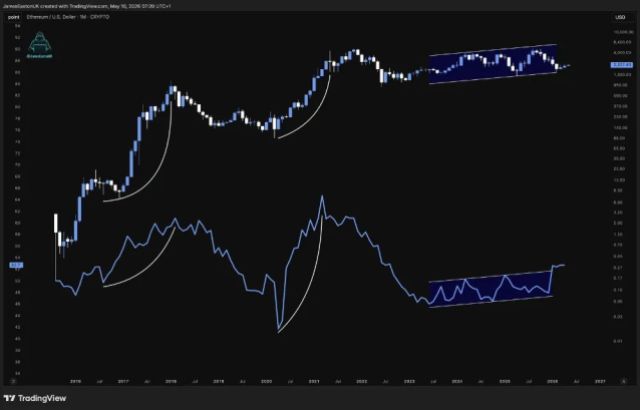
Source: Chart from Leon Waidmann on X

Consolidation phases are sometimes a positive reaction as they can precede upside movement. Waidmann noted that the longer the consolidation phase, the bigger the move out of it will be. What makes this period interesting is the increased network performance that is coinciding with the current momentum.

As stated by the expert, over 7.33 million ETH, representing 6% of all ETH supply, are locked on corporate balance sheets. Furthermore, inflation across the ETH ecosystem is currently lower than that of Bitcoin since the introduction of the Merge update. Other significant achievements include the surge in transactions on the ETH mainnet and layer 2 solutions, reaching new all-time highs. “The fundamentals are catching up, and the chart is setting up,” Waidmann added.

ETH Dominating DeFi And Lending

Etherealize has shared a recent report from Galaxy Research regarding Ethereum. In the report, the platform’s VP Research noted that ETH’s TVL market share has held remarkably steady at roughly 55% to 60% since mid-2022. The ETH network is witnessing notable liquidity, reinforcing its dominance in lending and DeFi.

This is due to the depth of its collateral markets, oracle infrastructure, and surviving multiple market crashes. Such development leads to the creation of a trust premium that newer chains cannot quickly replicate, particularly for the largest allocators whose risk tolerance is the lowest.

Also, stablecoin issuance on the network has skyrocketed to 50% of all stablecoin market cap, and over 60% of all tokenized real-world assets are issued on ETH. According to the platform, this is possibly some of the stickiest capital on Ethereum because institutional RWA issuers select a chain after months of legal examination, custodian integration, and compliance sign-off.

ETH trading at $2,301 on the 1D chart | Source: ETHUSDT on Tradingview.com

Related Questions

QDespite a slight price pullback, what shows signs of strength for Ethereum according to the article?

AThe underlying structure and fundamentals of Ethereum, particularly the robust network performance and steady increase in transaction activity, show signs of strength.

QWhat key on-chain metrics are strengthening investor conviction in Ethereum's long-term value?

ARising transaction activity, stronger on-chain engagement, and continued growth in key sectors are strengthening investor conviction.

QWhat did analyst Leon Waidmann note about Ethereum's multi-year consolidation phase on the monthly chart?

AHe noted that the longer the consolidation phase, the bigger the move out of it will be, describing it as a classic accumulation before a major move.

QWhat is Ethereum's approximate TVL (Total Value Locked) market share in DeFi since mid-2022, as cited in the Galaxy Research report?

AEthereum's TVL market share has held remarkably steady at roughly 55% to 60% since mid-2022.

QWhat specific achievements highlight Ethereum's dominance in stablecoins and tokenized real-world assets (RWAs)?

AStablecoin issuance on Ethereum is 50% of the total market cap, and over 60% of all tokenized real-world assets are issued on the network.

Related Reads

AI Benefits Senior Staff? 40% of CEOs Plan to Cut Junior Positions, Young People's Jobs Are More at Risk

The traditional assumption that senior employees are first in line during layoffs is being inverted in the AI era. A survey of 415 CEOs by Oliver Wyman and the NYSE reveals 43% plan to cut entry-level positions in the next 1-2 years to shift towards a mid-to-senior talent structure, a sharp rise from 17% last year. The logic is that AI excels at automating routine, cognitive tasks typically handled by junior staff (e.g., coding, data review), while the experience and judgment of senior employees remain harder to replicate. Research indicates this shift primarily manifests as a hiring freeze for junior roles rather than mass layoffs. Goldman Sachs estimates AI currently nets a loss of about 16,000 US jobs monthly, disproportionately impacting Generation Z concentrated in highly automatable white-collar roles. This raises long-term concerns about a broken talent pipeline, as companies risk having no future senior managers trained internally. Despite the dominant trend, a minority of successful AI adopters, like IBM and Salesforce, are expanding junior hiring, arguing these employees are adept at using and building AI tools. However, most companies are still in early AI deployment phases, with 67% in planning/pilot stages and many reporting returns below expectations. The overarching reality is a weakening of job security across all levels, as organizations reshape for an AI-augmented, leaner future.

marsbit51m ago

AI Benefits Senior Staff? 40% of CEOs Plan to Cut Junior Positions, Young People's Jobs Are More at Risk

marsbit51m ago

Physical AI is Hot, Some New Thoughts from Me

The term "Physical AI" is gaining significant traction, marking a shift from AI that processes information to AI that understands and interacts with the physical world. Unlike traditional AI confined to screens, Physical AI involves integrating intelligence into robotic bodies to perform tasks in environments governed by gravity, friction, and inertia. The concept, formally defined in a 2020 paper, focuses on creating embodied systems that can complete perception-to-action cycles. 2026 is identified as a pivotal "deployment year," where the focus moves from demonstrations to practical utility. Companies like China's Zhiyuan Robotics have transitioned to live, unscripted factory deployments and announced mass production targets. Internationally, Figure AI, after a major funding round, shifted to its own neural system, while NVIDIA partnered with major industrial robot firms to upgrade millions of existing units with AI capabilities. A key trend is the crossover from the automotive supply chain. Companies like Aptiv and Valeo are entering the Physical AI space, leveraging their expertise in sensors, control systems, and mass production from the autonomous vehicle sector. This "technology spillover" is accelerating development, as seen with Tesla's plans to repurpose automotive production lines for its Optimus robot. The technical breakthrough enabling this progress is the engineering maturity of "world models." Previously theoretical, these AI models can now simulate physical interactions and generate vast, realistic synthetic training data for robots. Innovations from NVIDIA's Cosmos, Ant's LingBot-World, and others have made this capability more accessible, drastically reducing the cost and time needed for real-world data collection. This is driving a fundamental architectural shift in robotics: from the traditional "sense-plan-act" model, reliant on pre-programmed rules, to a "sense-reason-act" paradigm where neural networks reason and make decisions. This change represents a new paradigm where machines understand the world's physics. The competition is intense, with the landscape still forming. While the direction is clear, success will depend not just on AI algorithms but on manufacturing scalability, supply chain resilience, and efficient data strategies, with infrastructure providers potentially capturing significant value in this new era.

marsbit1h ago

Physical AI is Hot, Some New Thoughts from Me

marsbit1h ago

Trading

Spot
Futures

Hot Articles

Discussions

Welcome to the HTX Community. Here, you can stay informed about the latest platform developments and gain access to professional market insights. Users' opinions on the price of ETH (ETH) are presented below.

活动图片















