Ethereum price rallied 260% the last time this happened: Can ETH reach $5K?

cointelegraphPublished on 2025-12-12Last updated on 2025-12-12

Abstract

Ethereum (ETH) price is approaching a historically significant support level known as the "realized price" of large holders (whales with over 100,000 ETH), which has previously marked major market bottoms. After a 45% decline to $2,621, ETH rebounded 23.5% to $3,238. Analysts suggest this level has triggered substantial rallies in the past, including a 260% surge earlier this year. Technical patterns like a V-shaped recovery and a falling wedge formation indicate a potential bullish breakout, with price targets reaching $5,000. This optimism is further supported by potential spot ETF inflows and increased demand from institutional treasury holdings.

Ether (ETH) traded close to a level that has previously marked market bottoms, as classic chart patterns suggested a possible rally to $5,000.

Key takeaways:

  • Ethereum price traded closer to its realized price, historically a buying opportunity that has led to major rallies.

  • V-shaped recovery and falling wedge patterns emerge, targeting $5,000 ETH price.

Ether price poised for a parabolic rally

The ETH/USD pair dropped 45% to multimonth lows of $2,621 on Nov. 21 from a high of $4,758 reached on Oct. 7.

This drawdown saw the price drop close to the realized price of whales holding more than 100,000 ETH, as shown in the chart below.

This refers to the average price that all current holders of more than 100,000 ETH have paid to buy Ether.

Related: Ethereum network sees 62% drop in fees: Is ETH price at risk?

“Only four times in the last five years has ETH traded very close to the realized price of whales holding at least 100k ETH,” said CryptoQuant analyst Onchain in its latest Quicktake analysis, adding:

“Two occurred during the 2022 bear market, while the remaining two took place this year.”

In April, the ETH price bounced off this level, staging a 260% rally to its current all-time high of $5,000.
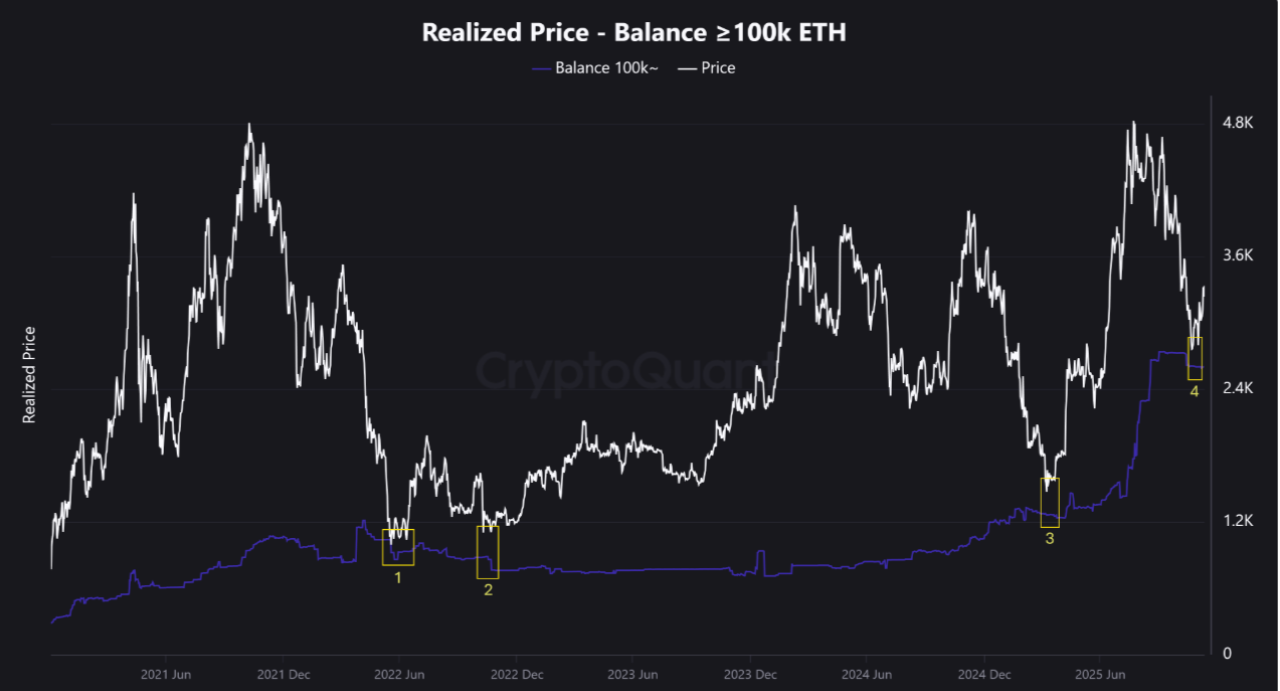
Realized price of whales holding over 100K ETH. Source: CryptoQuant

“$ETH is currently trading at realized price of the biggest holders,” said analyst Quentin Francois in a recent X post, adding:

“This is historically a buying opportunity.”

Ether’s price rebounded from this trendline on Nov. 22, and now trades 23.5% higher at $3,238 on Friday.

If history repeats itself, ETH could rally to as high as $5,000, fueled by increased demand from Ethereum treasury companies and the return of spot ETF inflows.

Ether’s technical charts target $5,000 ETH price

Ether’s price technicals are painting a V-shaped recovery chart pattern on the weekly chart, as shown below.

ETH is retesting the 50-week simple moving average (SMA) at $3,300. Bulls need to push the price above this level to increase the chances of the price rising to the neckline at $4,955 and completing the V-shaped pattern.

Such a move would represent a 53% increase from the current price.
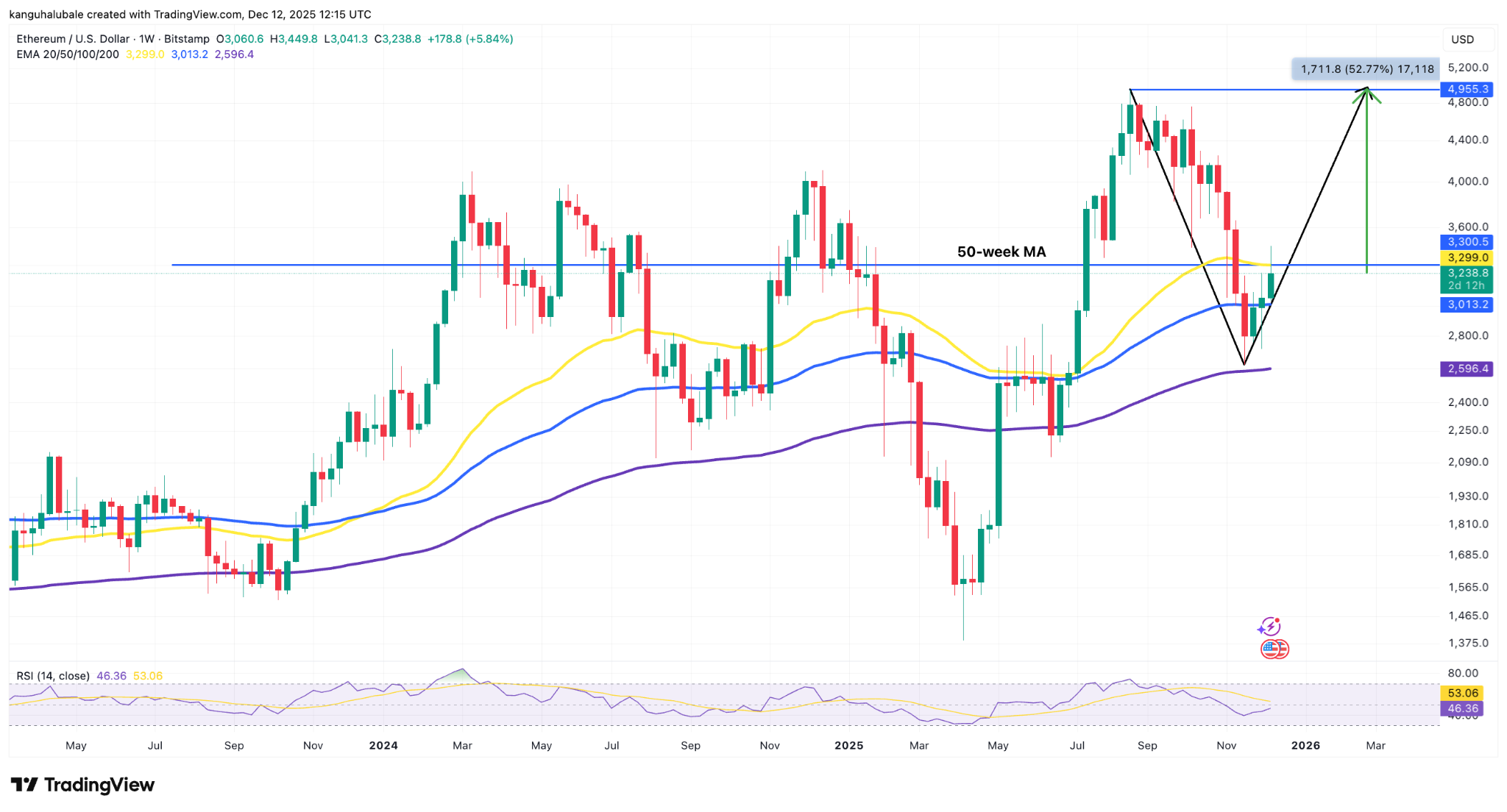
ETH/USD weekly chart. Source: Cointelegraph/TradingView

Several analysts believe that ETH has the potential to rally to $5,000 in 2026, with Satoshi Flipper saying a falling wedge pattern projects a massive breakout for the altcoin.

“$4800 $ETH is closer than most think.”
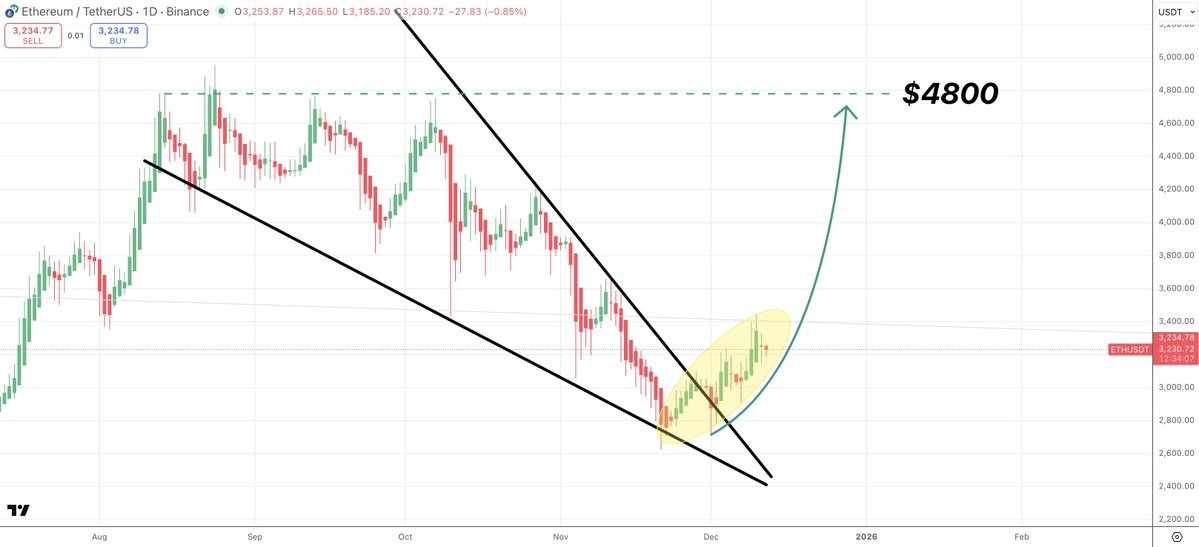
ETH/USD daily chart. Source: Satoshi Flipper

As Cointelegraph reported, Ether’s inverse head-and-shoulders (IH&S) formation against Bitcoin (BTC) points to a potential 80% rally in 2026, translating to an ETH price above $5,800.

This article does not contain investment advice or recommendations. Every investment and trading move involves risk, and readers should conduct their own research when making a decision. While we strive to provide accurate and timely information, Cointelegraph does not guarantee the accuracy, completeness, or reliability of any information in this article. This article may contain forward-looking statements that are subject to risks and uncertainties. Cointelegraph will not be liable for any loss or damage arising from your reliance on this information.



Related Reads

Oracle Plunges 40%, Will Excessive AI Infrastructure Overbuild Drag Down Giants?

Oracle's stock has plummeted 40% from its September peak, despite securing over $500 billion in AI infrastructure orders, signaling that massive backlogs alone no longer assure investor confidence. Similarly, Broadcom, with a $73 billion AI order backlog, and CoreWeave, which recently landed $36 billion in deals with OpenAI and Meta, have also faced stock declines. The market is growing skeptical of the AI infrastructure boom, concerned not only about suppliers' ability to fund and deliver these projects but also about the financial health and commitment of their major clients—primarily tech giants like Meta, Alphabet, Microsoft, Amazon, Apple, and Nvidia, alongside AI startups like OpenAI and Anthropic. While giants have robust finances, they are increasingly relying on debt to fuel AI capex, with soaring expenditures on data centers straining cash reserves and free cash flow. For instance, Microsoft, Alphabet, and Amazon are projected to collectively invest $1 trillion over four years. However, AI still contributes minimally to their overall revenue, raising questions about the sustainability of using profits from core businesses to fund speculative AI expansions. Execution challenges—such as power grid limitations, cooling issues, and community opposition—further complicate timely deployment. The critical uncertainty remains: if exponential AI demand fails to materialize and monetize quickly enough, these vast investments could lead to underutilized infrastructure, massive losses, and a fundamental weakening of these tech titans. The race between AI infrastructure build-out and actual market payoff will determine whether this bet becomes a triumph or a disastrous overreach.

marsbit12m ago

Oracle Plunges 40%, Will Excessive AI Infrastructure Overbuild Drag Down Giants?

marsbit12m ago

a16z Bets on Energy Tokenization Experiment: How Will DayFi Use DeFi to Restructure the Power Grid? Jae 2025/12/13 12:00

a16z Backs Energy Tokenization Experiment: How DayFi Aims to Restructure the Grid with DeFi As global tech giants compete for computing power, electricity has become a critical resource. DayFi, a decentralized energy capital markets protocol under the Daylight ecosystem, is launching a $50 million pre-deposit event on December 16. Backed by a16z Crypto and Framework Ventures, DayFi tokenizes future electricity revenue into tradable crypto assets. The protocol allows users to deposit stablecoins to mint GRID—a fully collateralized stablecoin—and then stake it to receive sGRID, a yield-bearing token representing a share in energy asset revenue. This creates a flywheel effect: liquidity funds distributed energy projects, which generate tokenized returns for holders. However, DayFi faces significant regulatory challenges. sGRID may be classified as a security by the SEC, requiring strict disclosures. Additionally, FERC’s restrictions on disclosing critical energy infrastructure data conflict with DeFi’s transparency requirements. Technical solutions like zero-knowledge proofs may be needed to verify收益 without exposing sensitive data. Valuation of the underlying energy assets—solar panels, batteries—also remains uncertain, with risks of depreciation and potential manipulation. Despite these hurdles, DayFi represents an ambitious attempt to bridge DeFi with physical energy grids, transforming electricity into a dynamic, tradable asset amid growing AI-driven power demand.

marsbit35m ago

a16z Bets on Energy Tokenization Experiment: How Will DayFi Use DeFi to Restructure the Power Grid? Jae 2025/12/13 12:00

marsbit35m ago

Trading

Spot
Futures
活动图片