Ethereum needs simple explanation to see true trustlessness: Buterin

cointelegraphPublished on 2025-12-18Last updated on 2025-12-18

Abstract

Ethereum co-founder Vitalik Buterin emphasizes the need for the blockchain to simplify its protocol to achieve true trustlessness. He argues that if only a small group can understand the system, users must still trust that group, undermining decentralization. Buterin advocates for fewer features to improve accessibility. The article notes that complexity and jargon deter average users, a challenge echoed by other projects like privacy layer INTMAX. Ethereum’s roadmap includes upgrades like smart contract wallets and node accessibility to enhance user experience, alongside educational initiatives to broaden understanding.

The Ethereum blockchain needs to better explain its features to users in order to achieve true trustlessness, a challenge common across blockchain protocols, says its co-founder Vitalik Buterin.

Trustlessness would see a protocol work without the oversight of developers, as it enforces rules automatically with code. However, if a protocol is so complex that only a small group can work on it, then in practice, others still have to trust that group.

Ethereum is already trustless as transactions and smart contracts are enforced by open-source code and a decentralized network of validators, but Buterin said in a X post on Wednesday, the network still needs to improve user understanding.

“An important and underrated form of trustlessness is increasing the number of people who can actually understand the whole protocol from top to bottom. Ethereum needs to get better at this by making the protocol simpler.”

Asked how realistic the notion is, given the tradeoff between technological features and user understanding, Buterin said, “we should be willing to have fewer features sometimes.”
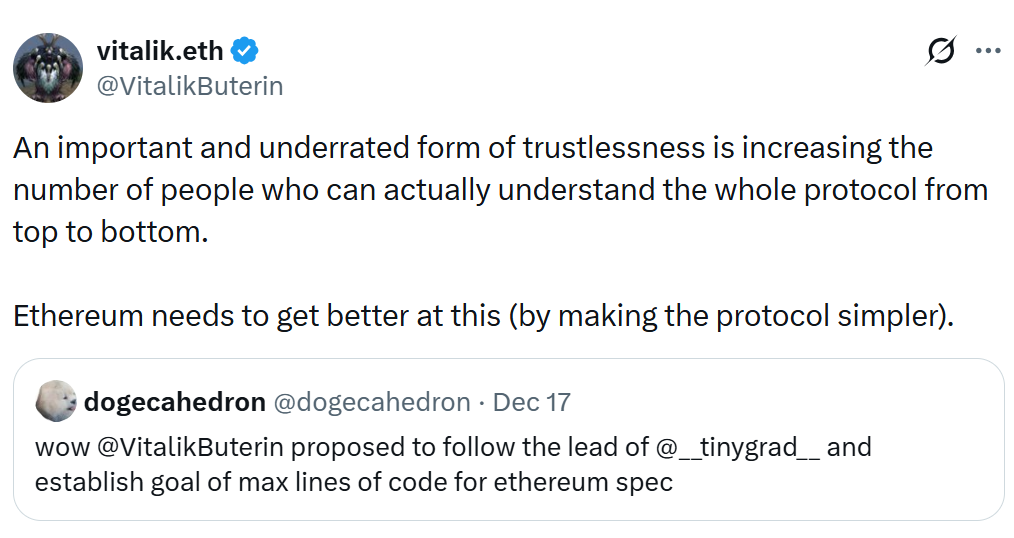
Source: Vitalik Buterin

Last year, crypto executives told Cointelegraph that confusion around crypto storage, regulations, and other factors tech-savvy people take for granted could be keeping average users on the sidelines and away from the technology.

Better understanding needed across all protocols

INTMAX, a privacy layer 2 built on Ethereum, agreed with Buterin, and said the same principle applies to privacy infrastructure.

“If only five people can understand how your privacy protocol works, you haven’t achieved trustlessness, you’ve just changed who you trust. Simple, auditable privacy architecture > complex black boxes,” INTMAX said.

Other remarked that deciphering tech-heavy jargon used by some protocols can feel like a full-time job, or outright repel users from an otherwise promising project.
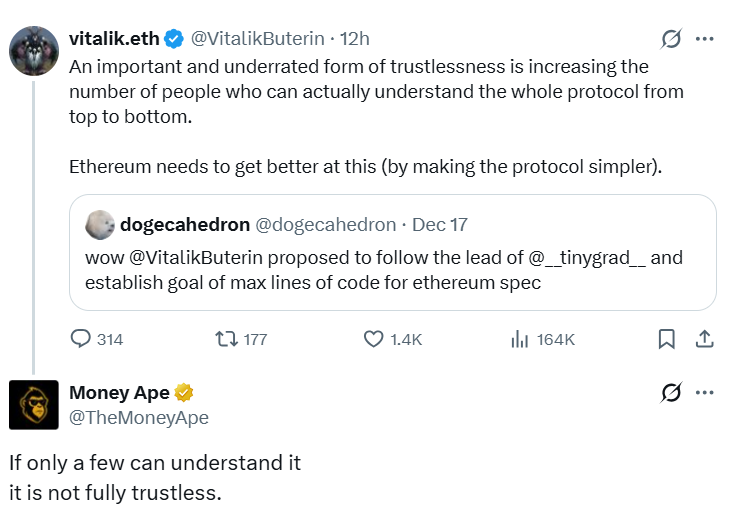
Source: Money Ape

Ethereum aiming for better user experience

Ethereum’s roadmap acknowledges it can still be “too complex to use Ethereum for most people,” and outlines plans to “drastically lower its barriers to entry,” and become “as frictionless as using a traditional Web2 app.”

Related: Ethereum could get faster in January with gas limit rise to 80M

Some of the flagged upgrades aimed at creating a better user experience include smart contract wallets, which streamline complex blockchain details such as gas fees and key management and reducing the barriers to running a node by making them accessible on devices like a phone or browser apps.

The Ethereum Foundation also funds a wide range of educational courses and programs to help people learn more about blockchain development and related technologies.

Magazine: Big questions: Would Bitcoin survive a 10-year power outage?

Related Reads

Lowering Expectations for BTC's Next Bull Market

The author, Alex Xu, explains his decision to significantly reduce his Bitcoin holdings (from full to ~30% of his portfolio) during the current bull cycle, citing a lowered long-term outlook for BTC's price appreciation in the next cycle. He outlines six key reasons for this reduced expectation: 1. **Diminished Growth Drivers:** The narrative of exponential user adoption has largely played out with institutional ETF adoption. The next major growth phase—adoption by sovereign national reserves or central banks—seems unlikely in the near future. 2. **Personal Opportunity Cost:** More attractive investment opportunities have emerged in other assets, such as undervalued companies. 3. **Industry-Wide Contraction:** The broader crypto industry is struggling, with most Web3 business models (SocialFi, GameFi, DePIN) failing. This overall萧条 (depression) reduces the fundamental demand and consensus for Bitcoin. 4. **Strain on Major Buyer:** MicroStrategy, a major corporate buyer of BTC, faces rising financing expenses for its debt, which could slow its purchasing rate and create significant marginal pressure on the market. 5. **Increased Competition from Gold:** The emergence of "tokenized gold" has closed the functional gap (portability, divisibility) between physical gold and Bitcoin, offering a strong competitor in the non-sovereign store-of-value space. 6. **Security Budget Concerns:** The block reward halving continues to exacerbate the long-standing issue of funding Bitcoin's network security, with new fee source explorations like Ordinals and L2s largely failing. The author's decision to hold a significant (though reduced) position reflects a cautious, not bearish, outlook. He remains open to increasing his exposure if the fundamental reasons for his skepticism change or if new positive catalysts emerge.

marsbit15m ago

Lowering Expectations for BTC's Next Bull Market

marsbit15m ago

Can Iran 'Control' the Strait of Hormuz?

Iran has announced a comprehensive plan to assert control over the strategic Strait of Hormuz, a critical global oil shipping chokepoint. The proposed measures include requiring all vessels to obtain Iranian permission for passage, imposing fees for security, environmental protection, and navigation management—preferably paid in Iranian rials—and absolutely banning Israeli ships. Vessels from countries deemed hostile by Iran’s top security bodies may also be barred. Analysts suggest Iran’s motives are multifaceted: increasing pressure on the U.S. and Israel by leveraging control over oil transit to influence global prices and inflation; creating a new revenue stream, potentially exceeding $7.7 billion annually, to counter Western sanctions and support postwar reconstruction; and using transit permissions as bargaining chips in future negotiations, notably with the U.S. However, the plan faces significant practical and diplomatic challenges. Enforcing comprehensive interception and fee collection in the busy waterway, patrolled by international military forces, would be difficult. The U.S. has already countering with a blockade of Iranian ports and threats to intercept any ship paying fees, potentially strangling Iran’s oil exports and fee revenue. Broad international opposition, led by European and Gulf states, and legal controversies further complicate implementation. The proposal may ultimately serve more as a negotiating tactic than a feasible policy, with its execution remaining highly uncertain.

marsbit1h ago

Can Iran 'Control' the Strait of Hormuz?

marsbit1h ago

Trading

Spot
Futures

Hot Articles

Discussions

Welcome to the HTX Community. Here, you can stay informed about the latest platform developments and gain access to professional market insights. Users' opinions on the price of ETH (ETH) are presented below.

活动图片















