Ethereum Leverage Climbs After Historic Liquidation Event – New Cycle Starting?

bitcoinistPublished on 2026-03-17Last updated on 2026-03-17

Abstract

Ethereum has reclaimed the $3,200 level amid renewed buying activity, signaling a potential shift in market sentiment after months of downward pressure. Over the past week, Bitcoin rose 8.6%, while Ethereum surged 13.9%, reflecting stronger speculative demand. Analysts attribute the rally to institutional inflows into crypto ETFs and improved risk appetite. A key development is the recovery in leverage within Ethereum's derivatives market. Following the historic liquidation event on October 10—where over $19 billion in positions were liquidated—the Estimated Leverage Ratio (ELR) on Binance dropped 27%. Since then, leverage has steadily rebuilt, with the ELR climbing to 0.69 by mid-March, indicating renewed trader confidence and risk-taking. This leverage reset may support further upward momentum, though it could also increase volatility.

Ethereum has reclaimed the $2,300 level as renewed buying activity begins to push the market higher after months of persistent downward pressure. The move marks a notable shift in short-term sentiment, with traders increasingly pointing to growing bullish momentum across the broader cryptocurrency sector.

Over the past seven days, Bitcoin has climbed approximately 8.6%, reinforcing the perception that the market may be transitioning out of the corrective phase that dominated recent months.

Ethereum, which often behaves as a higher-beta asset within the crypto ecosystem, has responded even more aggressively to the improving sentiment. Over the same period, ETH has surged roughly 13.9%, outperforming Bitcoin and signaling stronger speculative demand from traders.

Analysts note that the move higher is also being supported by strong inflows into crypto-related exchange-traded funds, reflecting continued institutional appetite for digital assets. As liquidity begins to return and risk tolerance improves, Ethereum’s ability to reclaim the $2,300 level is now being closely monitored as a potential pivot point that could determine whether the recovery can extend further in the coming weeks.

Ethereum Leverage Recovers After Historic Liquidation Reset

A recent analysis from CryptoQuant highlights how the Ethereum derivatives market has undergone a significant structural reset following the dramatic liquidation event that occurred on October 10. According to the report, the flash crash triggered one of the largest deleveraging events in the history of the cryptocurrency market.

During that event, the Ethereum Estimated Leverage Ratio (ELR) on Binance dropped sharply from 0.56 to 0.41, representing a 27% contraction in market leverage. The “10/10” event is now widely recognized as the largest 24-hour liquidation cascade in crypto history, with more than $19 billion in leveraged positions forcibly liquidated across the market.
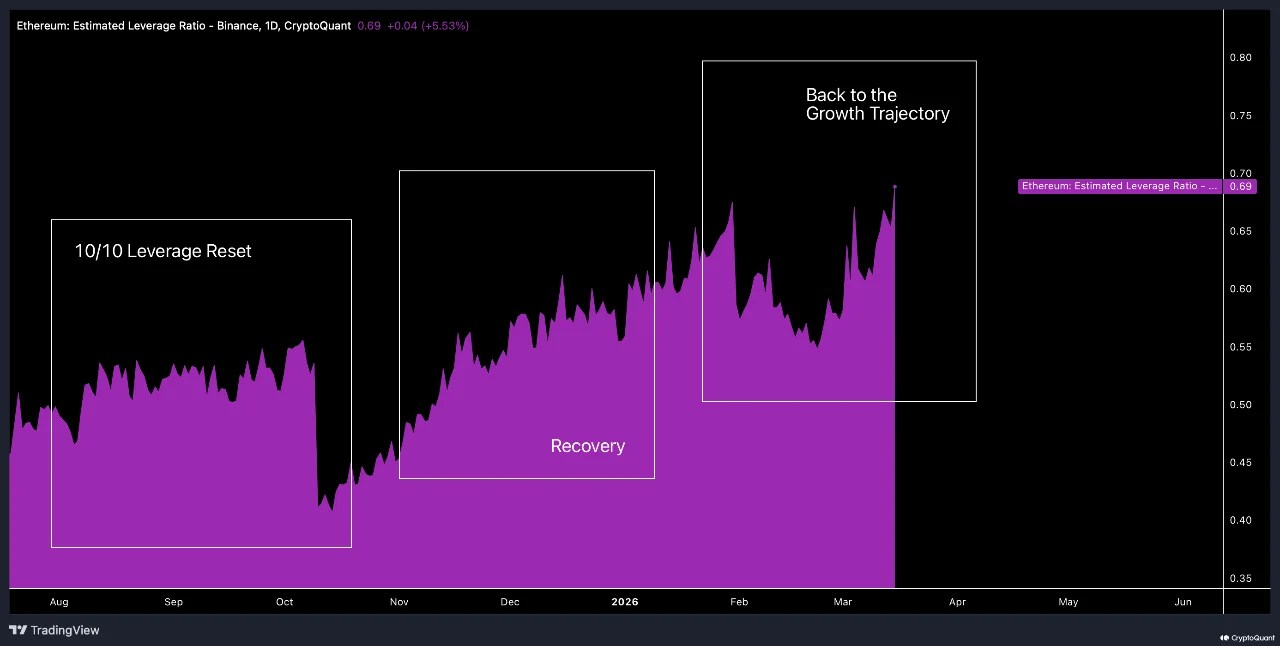
Ethereum Estimated Leverage Ratio Binance | Source: CryptoQuant

Since that reset, leverage levels have gradually rebuilt as confidence returned. The report notes that Ethereum’s ELR has climbed to approximately 0.69 in mid-March, signaling that traders are once again increasing their use of leverage as sentiment improves.

The Estimated Leverage Ratio is calculated by dividing open interest by the amount of ETH reserves held on exchanges. In practical terms, it measures how aggressively traders are using leverage relative to the collateral available in the system.

Higher ELR readings typically indicate growing risk appetite and increased speculative positioning, which can amplify both upward price momentum and market volatility.

As sentiment improves, Ethereum and Bitcoin continue to act as high-beta risk-on assets, while more defensive investors may rotate toward tokenized gold instruments such as PAXG and XAUT.


Related Questions

QWhat key price level has Ethereum reclaimed, signaling a shift in short-term market sentiment?

AEthereum has reclaimed the $2,300 level.

QAccording to the article, what was the approximate percentage increase for Ethereum (ETH) over the past seven days?

AETH surged roughly 13.9% over the past seven days.

QWhat major event on October 10th is cited as causing a historic deleveraging in the crypto market?

AThe flash crash on October 10th, referred to as the '10/10' event, triggered the largest 24-hour liquidation cascade in crypto history.

QWhat does the Ethereum Estimated Leverage Ratio (ELR) measure, according to the article?

AThe Estimated Leverage Ratio measures how aggressively traders are using leverage relative to the collateral available in the system, calculated by dividing open interest by the amount of ETH reserves held on exchanges.

QTo what level had Ethereum's Estimated Leverage Ratio on Binance climbed by mid-March, according to the CryptoQuant report?

AEthereum's Estimated Leverage Ratio had climbed to approximately 0.69 by mid-March.

Related Reads

From Theft to Re-entry: How Was $292 Million "Laundered"?

A sophisticated crypto laundering operation was executed following the $292 million hack of Kelp DAO on April 18. The attack, attributed to the North Korean Lazarus group, began with anonymous infrastructure preparation using Tornado Cash to fund wallets untraceably. The hacker exploited a vulnerability in Kelp’s cross-chain bridge, stealing 116,500 rsETH. To avoid crashing the market, the attacker used Aave and Compound as laundering tools—depositing the stolen rsETH as collateral to borrow $190 million in clean, liquid ETH. This move triggered a bank run on Aave, causing an $8 billion drop in TVL. After consolidating funds, the attacker fragmented them across hundreds of wallets to evade detection. A major breakpoint was THORChain, where over $460 million in volume—30 times its usual activity—was processed in 24 hours, converting ETH into Bitcoin. This shift to Bitcoin’s UTXO model exponentially increased tracing complexity by shattering funds into countless untraceable fragments. The final destination was Tron-based USDT, the primary channel for illicit crypto flows. From there, funds were cashed out via OTC brokers in China and Southeast Asia, using unlicensed underground banks and UnionPay networks outside Western sanctions scope. Ultimately, the laundered money supports North Korea’s weapons programs, which rely heavily on crypto hacking for foreign currency. The incident underscores structural challenges in DeFi: its openness, composability, and lack of central control make such laundering not just possible, but inherently difficult to prevent.

marsbit1h ago

From Theft to Re-entry: How Was $292 Million "Laundered"?

marsbit1h ago

Google and Amazon Simultaneously Invest Heavily in a Competitor: The Most Absurd Business Logic of the AI Era Is Becoming Reality

In a span of four days, Amazon announced an additional $25 billion investment, and Google pledged up to $40 billion—both direct competitors pouring over $65 billion into the same AI startup, Anthropic. Rather than a typical venture capital move, this signals the latest escalation in the cloud wars. The core of the deal is not equity but compute pre-orders: Anthropic must spend the majority of these funds on AWS and Google Cloud services and chips, effectively locking in massive future compute consumption. This reflects a shift in cloud market dynamics—enterprises now choose cloud providers based on which hosts the best AI models, not just price or stability. With OpenAI deeply tied to Microsoft, Anthropic’s Claude has become the only viable strategic asset for Google and Amazon to remain competitive. Anthropic’s annualized revenue has surged to $30 billion, and it is expanding into verticals like biotech, positioning itself as a cross-industry AI infrastructure layer. However, this funding comes with constraints: Anthropic’s independence is challenged as it balances two rival investors, its safety-first narrative faces pressure from regulatory scrutiny, and its path to IPO introduces new financial pressures. Globally, this accelerates a "tri-polar" closed-loop structure in AI infrastructure, with Microsoft-OpenAI, Google-Anthropic, and Amazon-Anthropic forming exclusive model-cloud alliances. In contrast, China’s landscape differs—investments like Alibaba and Tencent backing open-source model firm DeepSeek reflect a more decoupled approach, though closed-source models from major cloud providers still dominate. The $65 billion bet is ultimately about securing a seat at the table in an AI-defined future—where missing the model layer means losing the cloud war.

marsbit7h ago

Google and Amazon Simultaneously Invest Heavily in a Competitor: The Most Absurd Business Logic of the AI Era Is Becoming Reality

marsbit7h ago

Trading

Spot
Futures

Hot Articles

Discussions

Welcome to the HTX Community. Here, you can stay informed about the latest platform developments and gain access to professional market insights. Users' opinions on the price of ETH (ETH) are presented below.

活动图片