Ethereum Leads The Tokenization Race With Billions In Assets

bitcoinistPublished on 2026-04-12Last updated on 2026-04-12

Abstract

Ethereum is leading the tokenization of real-world assets, hosting over $22.5 billion in tokenized treasury products—nearly 72% of the total market share. Major institutions like JPMorgan Chase, BlackRock, and Franklin Templeton are using Ethereum for institutional-grade products such as tokenized bonds and funds. The network is becoming the preferred infrastructure for autonomous agents and DeFi due to its predictable yields, deep liquidity, and reduced smart contract vulnerabilities. Additionally, firms like Broadridge and Galaxy Digital are advancing on-chain governance and institutional participation, signaling a shift toward a new financial layer built by established Wall Street entities rather than crypto-native startups.

Ethereum is rapidly emerging as the dominant force in the race to tokenize real-world assets, with billions of dollars already flowing onto its network. From tokenized bonds and funds to real estate and treasuries, ETH has become the preferred infrastructure for institutions looking to bring traditional assets on-chain.

Institutional Capital Accelerates Ethereum Adoption

In a recent X post, The Etherealize revealed that Ethereum is rapidly emerging as the dominant layer for tokenized treasury products, with over $22.5 billion in fund assets already tokenized on the network, representing roughly 71.9% of the total market share across all blockchains.

The momentum is being driven by industry heavyweights like JPMorgan Chase, which launched its MONY market fund on ETH in early 2026, joining established offerings such as BlackRock’s BUIDL and Franklin Templeton’s on-chain money fund. These are institutional-grade treasury management products. These products are suited for autonomous agents with idle capital needs operating on permissionless infrastructure, allowing agents to access the system without a brokerage account.
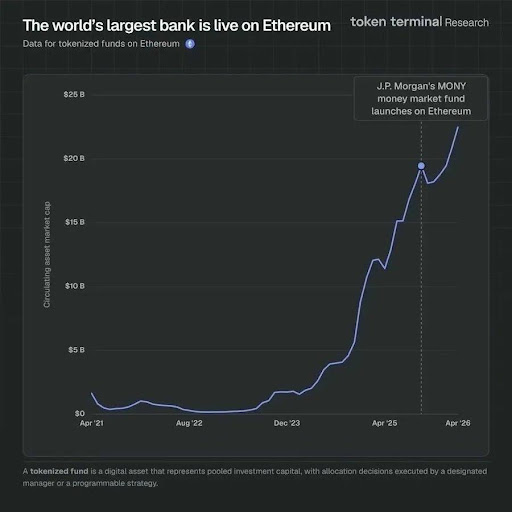
Source: Chart from The Etherealize on X

Ethereum is steadily evolving into the most viable financial layer for autonomous agents managing real capital. The Etherealize has also mentioned that an autonomous agent with a $500,000 treasury will need a stable requirements money market fund with a predictable yield, deep liquidity, minimal smart contract risk, and no centralized counterparty that can freeze or seize its assets. This is where the ETH DeFi ecosystem is beginning to stand out, and it meets these criteria.

The hacks and losses persist, but they are increasingly rare and concentrated at the speculative edges of the ecosystem. A stable core of application has proven remarkably robust through repeated stress events, and that track record shows what other chains can’t replicate. This growing stability is reflected in the declining share of DeFi losses relative to total value locked (TVL) on the ETH mainnet.

How Institutional DeFi Moves Beyond Experimentation

The tokenized finance could see a defining moment, one that markets may only fully appreciate in hindsight. Marc Baumann, the Founder of fiftyonexyz, has pointed out that Broadridge Financial Solutions has already processed over $8 trillion per month in tokenized repo settlements and has now taken a critical step beyond settlement by enabling real on-chain governance for tokenized equity.

At the same time, Galaxy Digital is serving as the staking provider for BlackRock’s ETHB staked Ethereum ETF, linking institutional capital directly into blockchain infrastructure. Together, these firms are involved in enabling the first on-chain shareholder vote for tokenized equity.

Baumann explained that the proxy voting market is estimated at $200 billion, and traditional players such as custodians, transfer agents, and proxy solicitors should pay attention, as the infrastructure for a new financial layer of institutional DeFi is being built by firms that already run on Wall Street. Rather than emerging from a purely crypto-native startup, the transformation is being driven by the same companies that process 401(K).

ETH trading at $2,239 on the 1D chart | Source: ETHUSDT on Tradingview.com

Related Questions

QWhat is the total value of fund assets tokenized on the Ethereum network, and what market share does it represent?

AOver $22.5 billion in fund assets are tokenized on the Ethereum network, representing roughly 71.9% of the total market share across all blockchains.

QWhich major financial institutions are mentioned as driving the momentum for tokenized treasury products on Ethereum?

AJPMorgan Chase, BlackRock, and Franklin Templeton are mentioned as industry heavyweights driving the momentum, with offerings like JPMorgan's MONY market fund, BlackRock's BUIDL, and Franklin Templeton's on-chain money fund.

QAccording to The Etherealize, what are the key requirements for an autonomous agent's money market fund?

AAn autonomous agent with a $500,000 treasury requires a money market fund with a predictable yield, deep liquidity, minimal smart contract risk, and no centralized counterparty that can freeze or seize its assets.

QWhat significant step has Broadridge Financial Solutions taken beyond settlement in tokenized finance?

ABroadridge Financial Solutions has enabled real on-chain governance for tokenized equity, moving beyond its existing role of processing over $8 trillion per month in tokenized repo settlements.

QHow is Galaxy Digital involved in linking institutional capital to blockchain infrastructure?

AGalaxy Digital is serving as the staking provider for BlackRock's ETHB staked Ethereum ETF, which links institutional capital directly into the blockchain infrastructure.

Related Reads

Anthropic Starts Poaching Scientists? $27K Weekly Onsite Stipend to Fix Claude's Expert-Level Errors

Anthropic has launched a new STEM Fellow program, offering $3,800 per week for a three-month, in-person residency in San Francisco. The role targets experts from science, technology, engineering, and mathematics (STEM) fields—machine learning experience is helpful but not required. Instead, Anthropic values scientific judgment and a willingness to learn quickly. Fellows will work with Claude models and internal tools under the guidance of an Anthropic researcher. Example projects include a materials scientist identifying errors in Claude’s reasoning or a climate scientist integrating atmospheric modeling software with Claude. The goal is to have experts "tell Claude where it's wrong" and improve its scientific capabilities. This initiative is part of Anthropic’s broader strategy to strengthen its scientific ecosystem, following earlier programs like the AI Safety Fellows and AI for Science programs. The company acknowledges that current AI models, while powerful, still produce high-confidence errors and lack end-to-end research autonomy. The program aims to embed domain expertise directly into model development, turning scientists into "high-level reviewers" for AI. Anthropic CEO Dario Amodei has previously emphasized AI’s potential to accelerate scientific breakthroughs, particularly in biology and healthcare. The company believes that the next phase of AI competition will depend not on scaling parameters, but on integrating human expertise to refine model accuracy and reliability.

marsbit38m ago

Anthropic Starts Poaching Scientists? $27K Weekly Onsite Stipend to Fix Claude's Expert-Level Errors

marsbit38m ago

On the Eve of X Money's Launch, Musk Dismantles the Referee First

"X Money Launches After Dismantling Regulator: Musk's 9-Day Power Play" In February 2025, a team from the "Department of Government Efficiency" (DOGE), led by Elon Musk, entered the Consumer Financial Protection Bureau (CFPB) headquarters. Shortly after, the CFPB was effectively dismantled—its funding frozen, activities suspended, and nearly 90% of staff laid off. This move came just nine days after X announced a partnership with Visa and as X Money prepared to launch. The article contrasts this with the decade-long regulatory battles faced by companies like Coinbase and PayPal. Coinbase spent over $75 million in political contributions and endured a major SEC lawsuit to operate legally. PayPal complied with strict state and federal rules for its stablecoin PYUSD, including 100% reserve requirements and monthly audits. However, Musk’s approach was different. After the CFPB introduced a rule placing large digital payment apps under federal oversight, Musk tweeted "Delete CFPB." Within months, the rule was revoked by Congress. Meanwhile, DOGE operatives gained "god-tier" access to CFPB databases, potentially obtaining sensitive competitive information from rivals like Apple, Google, and PayPal. The article also highlights a "suspicious exemption clause" in the GENIUS Act, which allows private companies like X to issue stablecoins with fewer restrictions. Senator Elizabeth Warren questioned whether Musk, who was a senior presidential advisor during the Act’s drafting, influenced this clause. X Money offers a 6% APY on deposits, despite FDIC warnings that stablecoin users are not insured. As X Money launches to 600 million monthly users, the article questions the fairness of a system where Musk can bypass regulations that others spent years and millions to comply with. The dismantling of the CFPB and the alleged regulatory advantages raise concerns about the future of equitable rule-making in the U.S. financial system.

marsbit46m ago

On the Eve of X Money's Launch, Musk Dismantles the Referee First

marsbit46m ago

Trading

Spot
Futures

Hot Articles

Discussions

Welcome to the HTX Community. Here, you can stay informed about the latest platform developments and gain access to professional market insights. Users' opinions on the price of ETH (ETH) are presented below.

活动图片