Ethereum Drops After Vitalik Buterin Sells Again: Is History Repeating?

bitcoinistPublished on 2026-02-23Last updated on 2026-02-23

Abstract

Ethereum's price declined over 5% in two days, dropping from $1,988 to $1,875, as on-chain trackers identified renewed selling activity from wallets associated with co-founder Vitalik Buterin. According to Lookonchain, Buterin sold 1,869 ETH (worth approximately $3.67 million) during this period. This has drawn comparisons to a previous instance where his reported sale of 6,958 ETH was followed by a significant market drop. The activity appears intentional, with ETH being withdrawn from Aave before being sold, suggesting active distribution rather than simple wallet management. While causation isn't proven, such founder-linked selling often impacts trader sentiment and market flows. At the time of reporting, Ethereum was trading at $1,884.

Ethereum slipped over the past two days as on-chain trackers flagged another burst of selling tied to Vitalik Buterin’s wallets, reviving a familiar narrative for traders: founder-linked distribution showing up alongside spot weakness.

Ethereum Pullback Coincides With Fresh Vitalik Sales

Lookonchain said Buterin has sold 1,869 ETH (about $3.67 million) over the past two days, a window in which ETH fell from $1,988 to $1,875, a 5.7% drawdown based on the figures cited in the post. The account framed the move as an acceleration: “vitalik.eth(@VitalikButerin) is selling ETH faster again. In the past 2 days, he has sold 1,869 ETH($3.67M). During that time, ETH fell from $1,988 to $1,875, down 5.7%.”

Vitalik Buterin on Arkham | Source: X @lookonchain

The sharper edge of the thread was the historical comparison. Lookonchain pointed to a previous episode when it said Buterin sold 6,958 ETH (about $14.78 million) and ETH subsequently fell from $2,360 to $1,825, a 22.7% decline. “Last time he sold 6,958 ETH($14.78M), $ETH dropped from $2,360 to $1,825 — a 22.7% fall,” the post added, linking to an Arkham entity page attributed to Buterin.

The comparison does not prove causation, but it’s exactly the kind of pattern-matching that can matter at the margin in a market primed to trade flows. Founder wallets are heavily monitored, and any hint of renewed supply can become a focal point for positioning—especially when price is already drifting lower.

Lookonchain’s earlier post dated Feb. 22 described the sequence as a return to activity after a pause. “After a two-week break, vitalik.eth(@VitalikButerin) is selling ETH again! 8 hours ago, he withdrew 3,500 ETH($6.95M) from Aave to sell. So far, he has already sold 571 ETH($1.13M),” the account wrote.

That detail matters because it frames the selling as an intentional unwind rather than passive movement between wallets. Pulling ETH from Aave, then selling portions, is the sort of breadcrumb traders look for when trying to distinguish “wallet housekeeping” from outright distribution.

The Feb. 22 posts also land on top of another Lookonchain note from Feb. 5, which described sustained selling over multiple days. “vitalik.eth(@VitalikButerin) is dumping ETH fast!” it said, adding: “Over the past 3 days, Vitalik has sold 2,961.5 $ETH($6.6M) at an average price of $2,228 — and the selling is still ongoing.”

For markets, the immediate question is whether this remains a contained, trackable flow or whether it becomes the kind of recurring headline that pulls liquidity and sentiment lower simply by staying in the tape. If additional wallet-linked sales surface, traders will likely keep stress-testing the “history repeating” narrative against price, rather than assuming the selling is the sole driver.

At press time, Ethereum traded at $1,884.
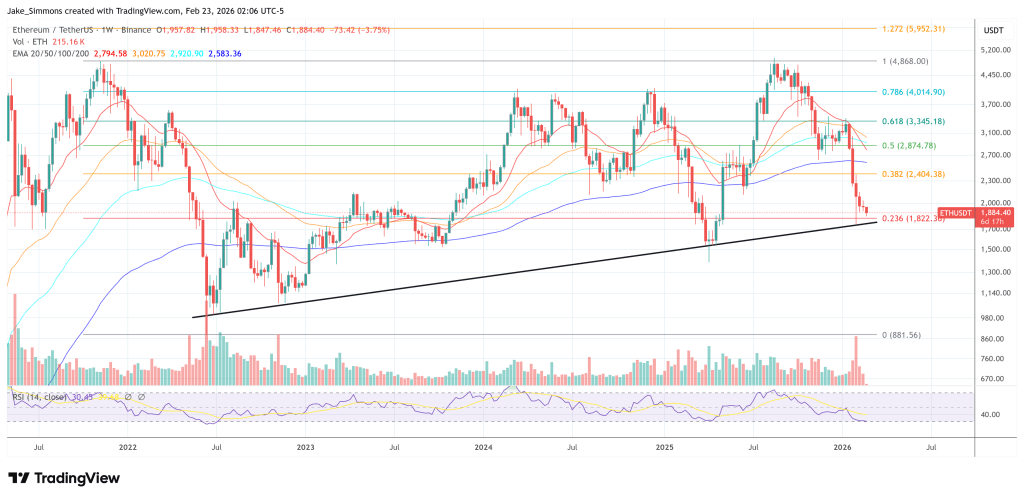
Ethereum continues to fall towards the black trendline, 1-week chart | Source: ETHUSDT on TradingView.com

Related Questions

QWhat is the main reason for Ethereum's recent price drop according to the article?

AThe article attributes Ethereum's recent price drop to on-chain trackers flagging another burst of selling activity from wallets linked to its co-founder, Vitalik Buterin.

QHow much ETH did Vitalik Buterin sell in the past two days, and what was its approximate USD value?

AVitalik Buterin sold 1,869 ETH, which was valued at approximately $3.67 million.

QWhat historical event does Lookonchain compare the current selling activity to?

ALookonchain compares it to a previous episode where Buterin sold 6,958 ETH (worth ~$14.78M), after which the price fell from $2,360 to $1,825, a decline of 22.7%.

QWhy does the article state that pulling ETH from Aave to sell is a notable detail?

AIt frames the selling as an intentional unwind or distribution rather than simple 'wallet housekeeping' or passive movement between wallets, which traders see as a more significant signal.

QWhat is the price of Ethereum at the time the article was published?

AAt press time, Ethereum traded at $1,884.

Related Reads

The AI Agent Era Accelerates Its Arrival: Questflow Defines a New Paradigm of Financial Intelligence with On-Chain AI Brokerage

The AI Agent era is accelerating, with the CB Insights AI 100 list highlighting global investment confidence. The focus has shifted from whether AI works to its speed of deployment and ability to manage complex workflows, with autonomous AI Agents driving this transformation. At the forefront is Questflow, a Singapore-based startup redefining financial intelligence through its on-chain AI brokerage. Unlike tools that merely provide data dashboards, Questflow deploys AI Agents that proactively scan markets, form judgments, and execute trades via a conversational interface—operating 24/7 without requiring manual confirmation for each decision. This embodies the new AI paradigm of agents capable of executing multi-step workflows autonomously. Questflow's mission is to democratize institutional-grade trading intelligence. Historically reserved for the ultra-wealthy, this capability is now accessible starting from just $1 through Questflow's "AI Clone + Copy Trade" model. The platform charges only a 1% execution fee, aligning its incentives directly with users and eliminating traditional management or performance fees. The timing is opportune, aligning with key trends identified by CB Insights: the scalable deployment of AI Agents, accelerated AI adoption in financial services, and the maturation of on-chain infrastructure. With robust liquidity on platforms like Hyperliquid and Polymarket, alongside advancements in AI reasoning and non-custodial wallet security, Questflow is positioned to merge the roles of broker, fund, and exchange into a single, accessible platform for millions.

链捕手45m ago

The AI Agent Era Accelerates Its Arrival: Questflow Defines a New Paradigm of Financial Intelligence with On-Chain AI Brokerage

链捕手45m ago

Why Pricing Social Interactions is Doomed to Fail?

Titled "Why Putting a Price on Social Interaction Is Doomed to Fail," this article critiques attempts to monetize social networks directly through SocialFi models, arguing their inevitable failure stems from a fundamental misunderstanding of media dynamics. Using Marshall McLuhan's theory of "hot" and "cold" media, the author posits that social networks are inherently "cold" media. Their value isn't contained in individual posts but is co-created through user participation, interpretation, and fragmented, ongoing interaction (e.g., replies, shares). This ambiguity and need for user involvement are core to their function. The article asserts that SocialFi projects like Friend.tech failed because introducing real-time, tradable financial pricing (a definitive "hot" signal) into this "cold" environment doesn't add a layer—it replaces the medium's essence. The unambiguous price signal overshadows and nullifies the nuanced, participatory social signal. Users become traders, not participants, and when speculative profits vanish, the underlying social ecosystem—never genuinely cultivated—collapses entirely. This principle extends beyond crypto. The author argues platforms like Twitter have gradually "heated up" through metrics (likes, retweets counts, algorithmically defined value), shifting users from participants to performers and eroding organic engagement. The solution isn't to abandon capital but to manage its entry point. Successful models like Substack, Patreon, or Bandcamp allow capital to "condense" at specific, isolated nodes (e.g., subscriptions, one-time payments) without permeating and "heating" every social interaction. They preserve the core "cold," participatory medium while enabling monetization at designated boundaries. The NFT boom and bust serves as a stark parallel: the ancient "cold" medium of collecting (valued for story, community, gradual accumulation) was rapidly destroyed by platforms that introduced real-time floor prices, rarity scores, and trading dashboards, transforming collectors into speculators and vaporizing cultural value when prices fell. The core lesson: "Liquidity equals heat." Injecting high liquidity and definitive pricing into a "cold" participatory medium doesn't optimize it; it fundamentally alters and destroys its value-creating mechanism. The future lies not in pricing every social gesture but in finding precise, non-invasive points for capital to condense without overheating the entire ecosystem.

marsbit53m ago

Why Pricing Social Interactions is Doomed to Fail?

marsbit53m ago

Trading

Spot
Futures

Hot Articles

Discussions

Welcome to the HTX Community. Here, you can stay informed about the latest platform developments and gain access to professional market insights. Users' opinions on the price of ETH (ETH) are presented below.

活动图片















