Ethereum Approaches A “Never Broken” Support Line: Accumulators Step In

bitcoinistPublished on 2026-01-23Last updated on 2026-01-23

Ethereum is once again under pressure as it struggles to regain solid ground around the $3,000 level, reflecting a broader wave of uncertainty across the crypto market. With sentiment turning increasingly fragile, many altcoins remain stuck in corrective mode, and bulls are now forced to defend key support zones to prevent deeper downside. In this environment, Ethereum’s ability to push higher is becoming a critical signal for whether the market can stabilize or if the current bearish trend will extend.

Despite the weakness, on-chain data suggests that ETH may be nearing an important turning point. According to CryptoQuant, Ethereum is approaching a major support line that has historically acted as a strong floor during periods of heavy volatility.

The report highlights that the realized price of Ethereum accumulation addresses continues to climb and is now approaching the current market price, indicating that long-term accumulation remains active even as short-term traders hesitate.

This dynamic matters because accumulation-based cost levels often represent zones where large investors defend their positions aggressively. If ETH holds above this rising support range, the market may be setting the foundation for a broader recovery.

CryptoQuant’s report suggests Ethereum may be approaching one of its most important structural support zones, anchored by the realized price of accumulation addresses. This metric tracks the average on-chain cost basis of entities that consistently accumulate ETH, and it often behaves as a “defense line” for whales who build long-term positions.

According to the analysis, this realized price level has historically acted as a reliable floor, with Ethereum never breaking below this range during prior drawdowns, even when broader market conditions turned sharply risk-off.

That historical behavior matters because it implies that accumulation whales tend to protect their cost basis aggressively, either by adding exposure near support or by reducing sell pressure when the price approaches their entry zone. In practice, this can limit downside momentum and create a stabilization area where volatility compresses before the next trend decision.
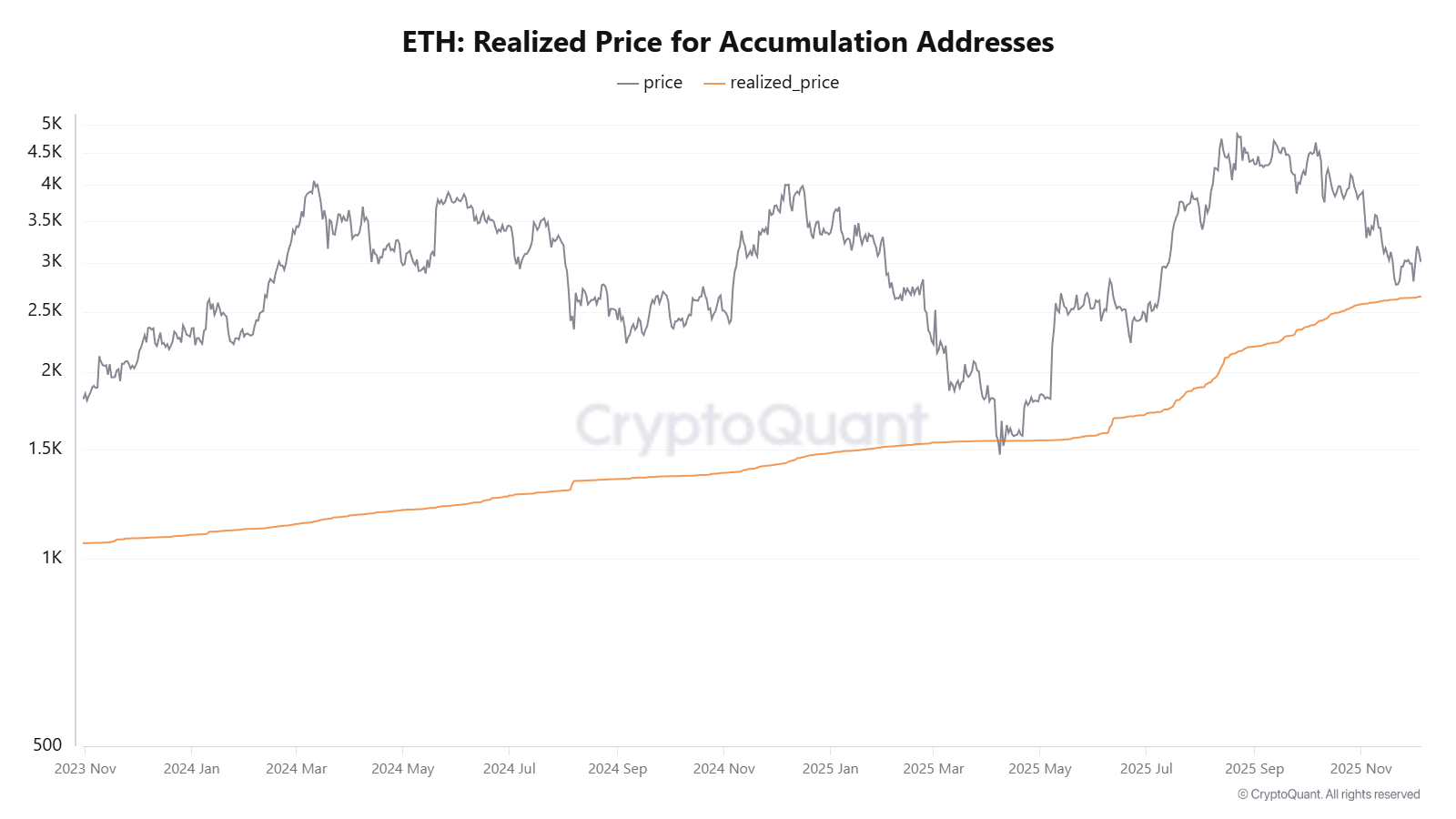
Ethereum Realized Price For Accumulation Addresses | Source: CryptoQuant

Based on the current trajectory, the report argues that even if ETH sees another leg down, the most probable “bottom zone” sits near $2,720. From current levels, that would represent an additional pullback of roughly 7%, keeping the move within a controlled correction rather than a full breakdown. If buyers defend this area, Ethereum could begin rebuilding a base for a renewed push back above $3,000.


Related Questions

QWhat is the current key support level that Ethereum is struggling to hold, according to the article?

AEthereum is struggling to regain solid ground around the $3,000 level.

QWhat on-chain metric does the article cite as a major historical support line for Ethereum?

AThe realized price of Ethereum accumulation addresses, which tracks the average on-chain cost basis of entities that consistently accumulate ETH.

QAccording to the analysis, what is the most probable 'bottom zone' or price level for Ethereum if it sees another leg down?

AThe most probable bottom zone sits near $2,720.

QHow does the behavior of 'accumulation whales' typically affect the price when it approaches their cost basis?

AThey tend to protect their cost basis aggressively by adding exposure near support or reducing sell pressure, which can limit downside momentum and create a stabilization area.

QWhat does the climbing realized price of accumulation addresses indicate about market activity, despite short-term weakness?

AIt indicates that long-term accumulation remains active even as short-term traders hesitate.

Related Reads

a16z: AI's 'Amnesia', Can Continuous Learning Cure It?

The article "a16z: AI's 'Amnesia' – Can Continual Learning Cure It?" explores the limitations of current large language models (LLMs), which, like the protagonist in the film *Memento*, are trapped in a perpetual present—unable to form new memories after training. While methods like in-context learning (ICL), retrieval-augmented generation (RAG), and external scaffolding (e.g., chat history, prompts) provide temporary solutions, they fail to enable true internalization of new knowledge. The authors argue that compression—the core of learning during training—is halted at deployment, preventing models from generalizing, discovering novel solutions (e.g., mathematical proofs), or handling adversarial scenarios. The piece introduces *continual learning* as a critical research direction to address this, categorizing approaches into three paths: 1. **Context**: Scaling external memory via longer context windows, multi-agent systems, and smarter retrieval. 2. **Modules**: Using pluggable adapters or external memory layers for specialization without full retraining. 3. **Weights**: Enabling parameter updates through sparse training, test-time training, meta-learning, distillation, and reinforcement learning from feedback. Challenges include catastrophic forgetting, safety risks, and auditability, but overcoming these could unlock models that learn iteratively from experience. The conclusion emphasizes that while context-based methods are effective, true breakthroughs require models to compress new information into weights post-deployment, moving from mere retrieval to genuine learning.

marsbit3h ago

a16z: AI's 'Amnesia', Can Continuous Learning Cure It?

marsbit3h ago

Trading

Spot
Futures

Hot Articles

Discussions

Welcome to the HTX Community. Here, you can stay informed about the latest platform developments and gain access to professional market insights. Users' opinions on the price of ETH (ETH) are presented below.

活动图片