ETFs Attract $100 Million, DAT Included in Russell 3000: Hyperliquid's "Wall Street Moment"

marsbitPublished on 2026-05-29Last updated on 2026-05-29

Abstract

ICE CEO Jeff Sprecher publicly praised Hyperliquid, calling it "larger than Nasdaq" and expressing admiration for its team. This praise comes just 12 days after ICE and CME reportedly lobbied the CFTC to scrutinize the platform. Sprecher clarified the lobbying was aimed at securing a level regulatory playing field for traditional exchanges, not shutting Hyperliquid down. He highlighted Hyperliquid's role as a potential "shadow pricing" venue for SpaceX's upcoming IPO, noting its pre-IPO derivatives trading. Meanwhile, Hyperliquid is experiencing significant mainstream adoption. Two U.S. spot HYPE ETFs launched in mid-May have attracted over $1 billion in inflows within 10 days. Furthermore, Hyperliquid Strategies (PURR), a major HYPE holder, is set to join the Russell 3000 index in June. Facing regulatory pressure, Hyperliquid founder Jeff Yan and the platform's policy arm are engaging directly with policymakers in Washington to advocate for a clear regulatory path for on-chain derivatives. HYPE token recently hit a new all-time high above $64.

Author: Claude, TechFlow News

TechFlow Insights: ICE (parent company of NYSE) founder and CEO Jeff Sprecher publicly praised Hyperliquid at the Bernstein Investor Conference on May 27, saying it is "bigger than Nasdaq" and "I wish I was younger to get involved personally." This statement came just 12 days after ICE and CME jointly lobbied the CFTC to "crack down" on Hyperliquid. Sprecher also revealed that the NYSE has secretly integrated a blockchain settlement system. HYPE token hit a new all-time high of $64 this week, with two spot ETFs raising over $100 million in 10 days after launch, and its DAT company PURR was included in the Russell 3000 index.

On May 27, Intercontinental Exchange (ICE) founder and CEO Jeff Sprecher gave a rare and explicitly personal appraisal of Hyperliquid during an interview at the Bernstein Annual Strategic Decisions Conference.

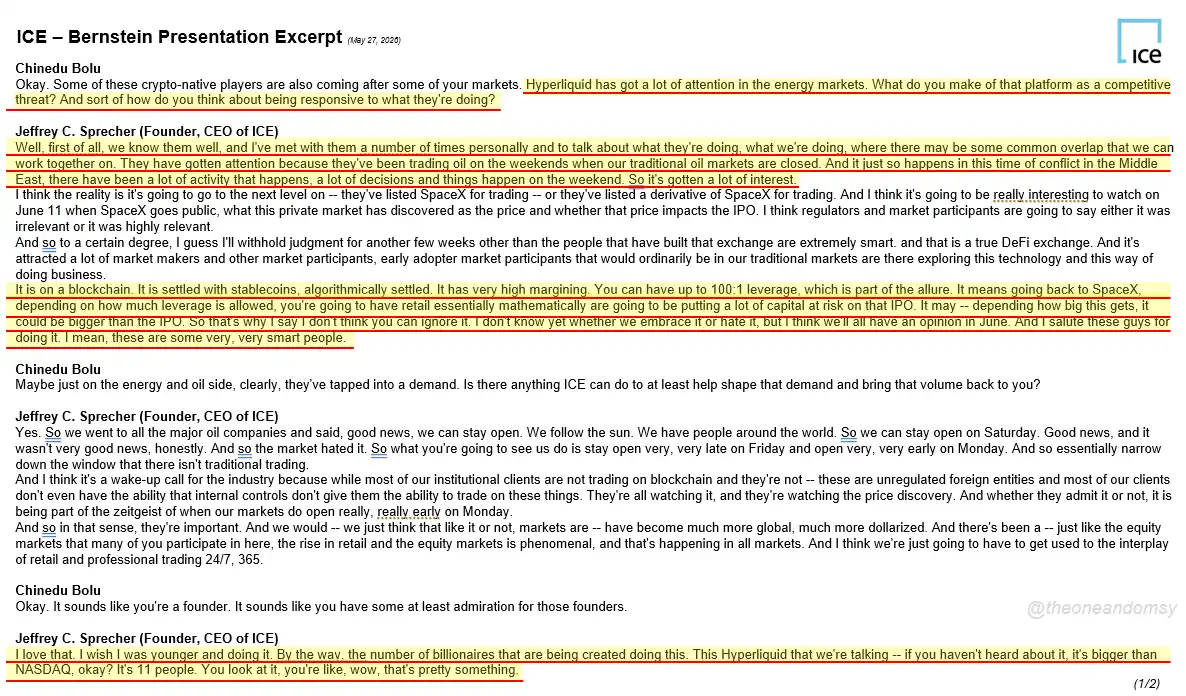
"This thing we're talking about, Hyperliquid, if you haven't heard about it, it's bigger than Nasdaq, OK? Eleven people. You look at this, you say, wow, that's amazing," Sprecher said. He added immediately: "I love this. I wish I was younger so I could go do this personally. By the way, the people doing this are becoming billionaires in droves."

ICE is the parent company of the New York Stock Exchange and also operates one of the world's largest energy futures markets. Sprecher's comments represent the most direct public endorsement of Hyperliquid by the highest levels of traditional finance to date.
From Joint Lobbying for a "Crackdown" 12 Days Ago to CEO's Change of Tone

The reason Sprecher's praise caused a stir is the timeline.

On May 15, Bloomberg reported that CME and ICE executives had warned CFTC and Capitol Hill officials, arguing that Hyperliquid's decentralized perpetual contract trading could pose risks of market manipulation and sanctions evasion, and demanding it be brought under traditional financial regulation. After the news broke, HYPE fell nearly 9%.

Just 12 days later, the head of ICE expressed admiration publicly at one of Wall Street's most important investor conferences.

At the Bernstein conference, Sprecher directly addressed this contradiction: "There was a headline of a story that made it sound like we were freaked out. We're not freaked out. We're actually in dialogue with these people, learning what they're doing. They're learning our world, we're learning their world. In that sense, it's a mutual admiration society."

But he quickly turned to the core regulatory demand: "What we said to regulators is, can we do that, too? Why are you telling us we can't do it when this is happening? Can we have a level playing field? This administration is very pro-digital. If you think it's legal, let us do it; if you think it's illegal, why aren't they getting the nasty letters you're sending us?"

This statement reveals the real logic behind ICE's lobbying of the CFTC: not to shut down Hyperliquid, but to ask regulators to loosen restrictions on themselves, allowing traditional exchanges to participate in the on-chain derivatives market as well.

On the Eve of SpaceX's IPO: Hyperliquid Becomes a "Shadow Pricing Market"

Sprecher's interest in Hyperliquid isn't casual; he has a very specific observation window: SpaceX is set to list on Nasdaq on June 12 with a valuation of about $1.75 trillion, and Hyperliquid is already trading SpaceX derivatives contracts.

"I think what really puts it on the map is SpaceX. They've already listed SpaceX derivatives for trading. It's going to be very interesting on June 11th when SpaceX is officially priced, to see what price this private market discovers, and whether that price will influence the IPO itself," Sprecher said. "Regulators and market participants will say, this is either completely irrelevant or highly relevant."

He then calculated an extreme scenario: Considering Hyperliquid allows up to 100:1 leverage, if retail investors flood into SpaceX derivatives, the notional exposure size on-chain "could be larger than the IPO itself."

"So I say you can't ignore it. I don't know yet whether we should embrace it or hate it, but I think by June we'll all have the answer."

HYPE ETFs Raise $100 Million in 10 Days, PURR Included in Russell 3000

Sprecher's comments came as Hyperliquid experienced a wave of intensive mainstreaming catalysts.

On May 12 and 15, 21Shares and Bitwise launched the first US spot HYPE ETFs (tickers THYP and BHYP) on Nasdaq and NYSE, respectively. According to bitcoin.com, the two funds saw cumulative net inflows exceeding $100 million in the first 10 trading days, absorbing 1.04% of HYPE's total market cap. On a market cap proportion basis, this outperformed the initial launch performance of Bitcoin and Ethereum ETFs over the same period. Bitwise recorded a single-day net inflow of $19.05 million on May 27, becoming the world's largest HYPE ETF.

On May 22, FTSE Russell announced the preliminary list for the 2026 Russell US Indexes reconstitution. Hyperliquid Strategies (Nasdaq ticker PURR) appeared on the addition list for the Russell 3000 Index, expected to take effect on June 26.
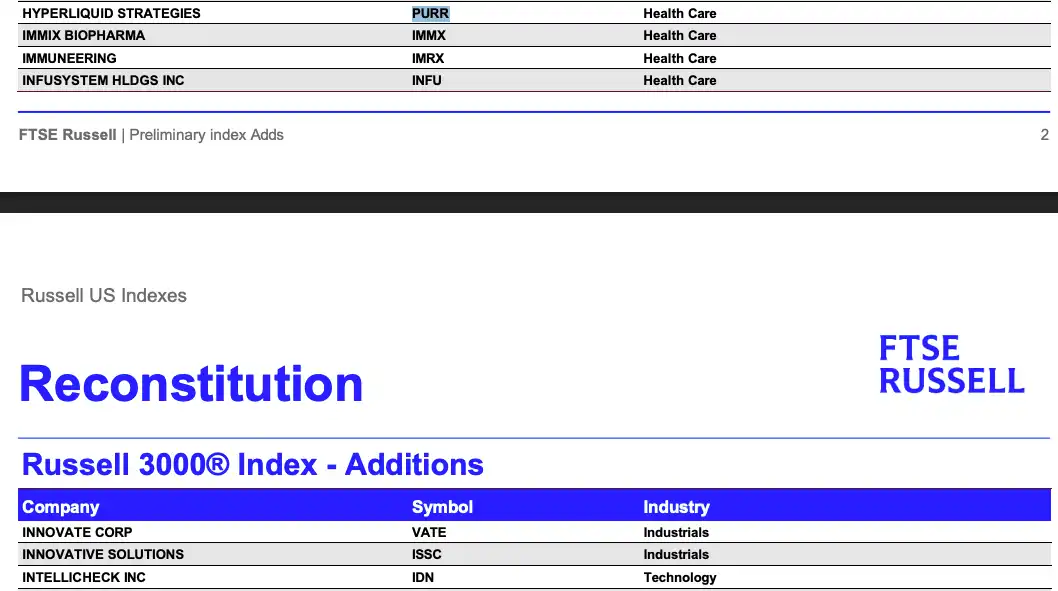
PURR is currently the largest HYPE token treasury company, holding approximately 20 million HYPE (valued at about $799 million as of April 29) and an additional $103 million in cash, with no debt. Inclusion in the Russell 3000 means passive funds tracking the index will be forced to buy PURR, further opening a transmission channel for HYPE into traditional capital markets.

The HYPE token briefly surpassed $64 this week to reach a new all-time high, with a year-to-date gain of about 150%, far outpacing Bitcoin's performance over the same period. According to CoinGecko data, HYPE's current market cap is approximately $12.7 billion, ranking 10th among crypto assets.

Jeff Yan Goes to Washington, Hyperliquid Policy Center Meets the Challenge Head-On

Faced with lobbying pressure from CME and ICE, Hyperliquid chose to respond directly.

Hyperliquid founder Jeff Yan revealed on May 15 that he and the Hyperliquid Policy Center (HPC) had met with policymakers in Washington. HPC is an independent research and advocacy institute established in February 2026, led by Jake Chervinsky, former Head of Policy at the Blockchain Association and former Chief Legal Officer at Variant. It was launched with funding of 1 million HYPE allocated by the Hyper Foundation.

On platform X, Yan stated that the meetings discussed "how on-chain trading, as a financial innovation, has a clear global user demand" and "regulatory pathways for bringing on-chain derivatives markets to the US."

Responding to Bloomberg's report on CME and ICE lobbying, HPC stated that the market provided by Hyperliquid is "more beneficial and less risky than traditional centralized exchanges" and expects the CFTC to establish a specialized regulatory framework for on-chain derivatives platforms.

An interesting detail: CME and ICE themselves are currently facing parallel investigations by the CFTC and the Justice Department due to "perfectly timed" oil futures trades on their respective platforms ahead of federal policy announcements.


Related Questions

QWhat was the remarkable comment made by ICE founder and CEO Jeff Sprecher about Hyperliquid at the Bernstein conference?

AHe stated that Hyperliquid is 'bigger than Nasdaq' and expressed admiration, saying 'I love this. I wish I was younger so I could go do it myself.'

QHow much capital did the two HYPE spot ETFs raise within 10 days of their launch, and how does this compare to the performance of other crypto ETFs?

AThe two HYPE ETFs raised over $100 million in 10 trading days. This capital inflow accounted for 1.04% of HYPE's total market cap, a rate that exceeded the debut performance of Bitcoin and Ethereum ETFs on a proportional basis.

QWhy is the upcoming SpaceX IPO a significant event for observing Hyperliquid's market influence according to Jeff Sprecher?

ASprecher noted that Hyperliquid is already trading SpaceX derivatives. He is interested to see if the price discovered on this private market will influence the official IPO price on June 12, especially considering the high leverage (up to 100:1) on Hyperliquid could create enormous notional exposure.

QWhich Hyperliquid-associated company is set to be added to the Russell 3000 Index, and what is its primary asset?

AHyperliquid Strategies, with the Nasdaq ticker PURR, is on the preliminary addition list for the Russell 3000. Its primary asset is approximately 20 million HYPE tokens, valued at around $799 million as of April 29, alongside $103 million in cash.

QWhat was the apparent contradiction in ICE's actions regarding Hyperliquid within a 12-day period in May, and how did Jeff Sprecher explain it?

AOn May 15, ICE and CME reportedly lobbied the CFTC about potential risks from Hyperliquid. Twelve days later, on May 27, Sprecher publicly praised it. He explained that the lobbying was not out of fear but to request a 'level playing field' where traditional exchanges like ICE could also operate under the same rules if the activity is deemed legal.

Related Reads

Blocked Its Own Treasure, WeChat AI Steps Up

Tencent's stock surged over 10% on June 2nd amid reports that WeChat, with 1.43 billion monthly users, is finalizing tests for a native AI Agent. The reported feature, accessible by swiping right from the main interface, allows users to issue commands in natural language. The AI then decomposes tasks and automatically calls upon relevant Mini Programs within WeChat to complete actions like ordering food, booking tickets, or making payments, creating a closed-loop service execution system. This strategic shift follows the internal conflict and subsequent "blocking" of Tencent's standalone AI app, Yuanbao, by WeChat for violating sharing rules during a 2026 Spring Festival promotion. The incident highlighted a lack of internal consensus and exposed the weakness of competing in the standalone AI assistant arena against rivals like ByteDance's Doubao (345M MAU) and Alibaba's Qianwen. The new WeChat AI Agent aims to leverage WeChat's unique assets—its massive user base, standardized Mini Program APIs, WeChat Pay, and identity system—to move from simple content generation to actual task execution. Analysts note this changes the competitive landscape from model benchmarks to which AI can connect to more real-world services. However, success depends on key variables: the capability of Tencent's underlying Hunyuan model, managing massive inference costs, and redesigning incentives for Mini Program developers whose traffic might be bypassed. The move is seen as an attempt to keep user service intent within WeChat's ecosystem as AI begins to redefine how users access services.

marsbit17m ago

Blocked Its Own Treasure, WeChat AI Steps Up

marsbit17m ago

ByteDance Adopts Arm CPUs, Jensen Huang: So Sad I Didn't Buy Arm

**Summary:** At Computex 2026, Arm CEO Rene Haas announced that ByteDance and Oracle have adopted Arm's self-designed Arm AGI data center CPU. The company expects significant revenue growth from this product, projecting $20 billion in demand for the 2027/2028 fiscal years. Haas noted that restricting AI-capable CPUs from the US to China is nearly impossible due to their widespread applications. Arm's stock has surged dramatically this year, notably rising 16% after NVIDIA's Arm-based Vera CPU and RTX Spark announcements. A highlight was the informal, humorous on-stage conversation between Haas and NVIDIA CEO Jensen Huang. Huang joked about NVIDIA's failed attempt to acquire Arm and playfully lamented selling his Arm shares. Both executives showed a clear sense of camaraderie and shared regret over the missed merger. Key technical topics were discussed: 1. **AI PC Design:** Huang explained NVIDIA's RTX Spark superchip (with a 20-core Arm CPU) is designed for future AI agents that will autonomously run and use tools on PCs, blending local and cloud processing. 2. **Agent vs. OS:** Huang emphasized the operating system remains crucial, as AI agents rely on its APIs and tools to function. 3. **Growth Constraints:** He identified the shift to "useful AI" that generates profitable tokens as a primary driver for immense, almost limitless, computational demand. Haas outlined Arm's strategy across PC and data centers. For PCs, Arm collaborates with partners like NVIDIA and MediaTek, offering its compute subsystem (CSS) for custom SoCs. In data centers, its Arm AGI CPU (built on TSMC's 3nm process) has gained major partners including OpenAI, Meta, and now ByteDance and Oracle. Arm presented a multi-year roadmap for its in-house CPU line. The article concludes that while GPUs dominated the AI training race, the explosion of AI agents is shifting significant focus to CPUs for inference, state management, and tool orchestration. The industry is trending towards vertical integration, with companies like cloud providers designing chips and chip/IP firms offering full solutions, all competing to deliver more efficient computing per watt.

marsbit37m ago

ByteDance Adopts Arm CPUs, Jensen Huang: So Sad I Didn't Buy Arm

marsbit37m ago

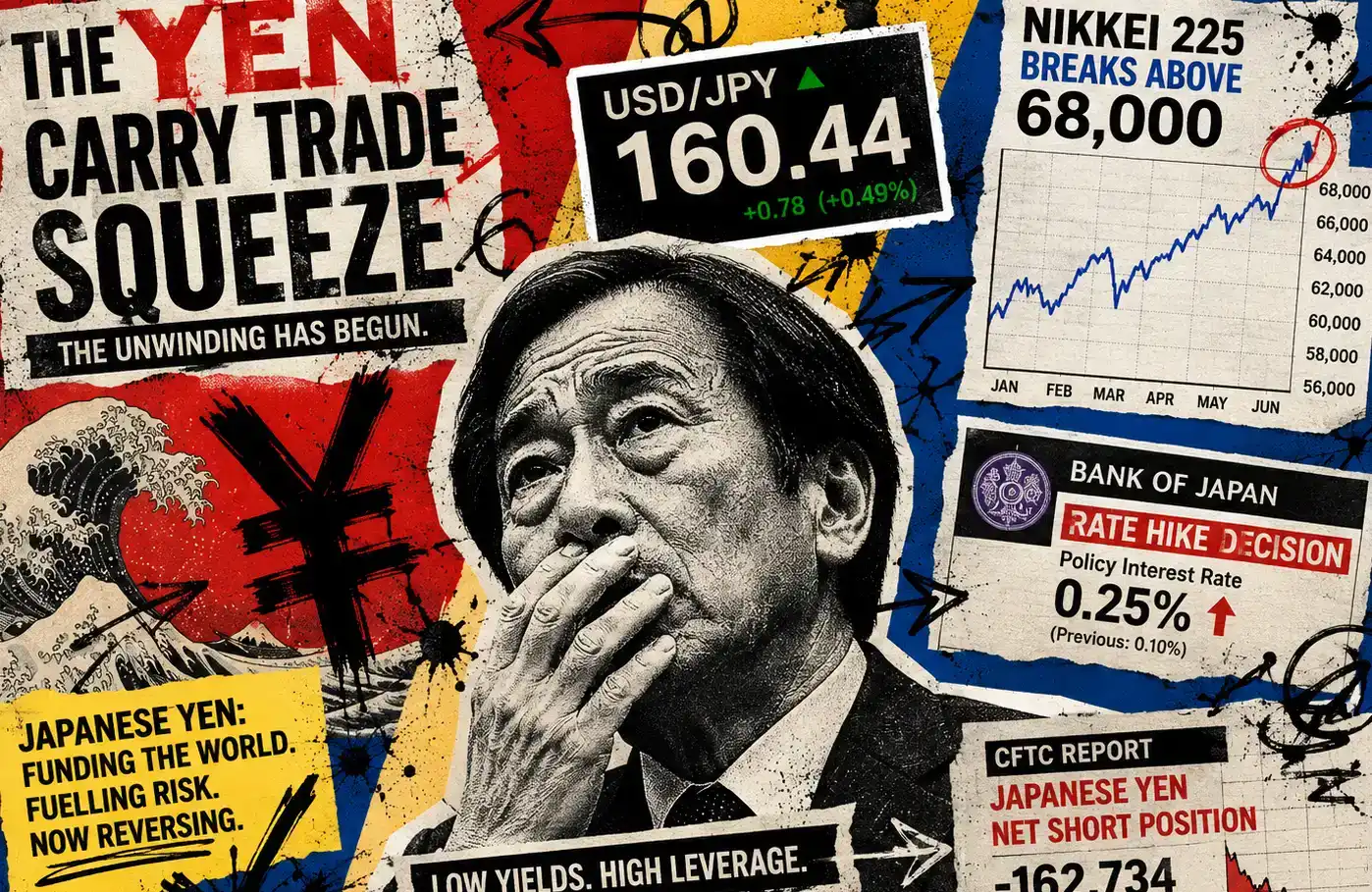
New Wall Street Play: Yen Shorts Still Adding, But Japan Stocks Don't Rely on Carry Trade Unwinding

On June 3rd, USD/JPY hit 160.44, its highest level since July 2024, while the Nikkei 225 surged past 68,000 points. Contrary to popular narratives of an imminent "carry trade unwind" akin to August 2024, data reveals a more complex picture. Speculative net short positions in yen futures have actually increased, reaching -114,667 contracts by late May, suggesting traders are doubling down rather than retreating. Meanwhile, Japan's Finance Ministry conducted its largest-ever single-round FX intervention (11.73 trillion yen) in April-May but failed to hold the 160 yen line. The Nikkei's rally is not driven by carry trade dynamics. Foreign investors are aggressively buying Japanese stocks, with net purchases in 2026 running nearly 16 times higher than 2025 levels. This inflow is concentrated in AI and semiconductor-related stocks like SoftBank and Socionext, fueled by positive sector outlooks, rather than being a flight from unwinding yen shorts. Furthermore, the Nikkei has continued climbing despite the Bank of Japan's (BOJ) rate hikes to 0.75%. This disconnect exists because the current equity boom is fueled by AI-driven foreign investment, not reliant on cheap yen funding. However, this relationship remains fragile. Should the BOJ hike rates further (e.g., to 1.0%) while dollar weakness increases carry trade costs, the trajectories of the yen and Japanese stocks could reconverge, potentially triggering volatility.

marsbit42m ago

New Wall Street Play: Yen Shorts Still Adding, But Japan Stocks Don't Rely on Carry Trade Unwinding

marsbit42m ago

Broadcom's Q3 Guidance Misses Expectations by $12 Billion, After-Hours Trading Plummets Over 13%, AI Narrative "Cooling"?

On June 3, Broadcom released record Q2 FY26 results with revenue of $22.19B, up 48% YoY, and AI chip sales of $10.8B, up 143%. Adjusted EPS of $2.44 beat estimates. However, its Q3 AI semiconductor revenue guidance of $16B, while up over 200% YoY, fell roughly $1.2B (7%) short of analyst consensus expectations of $17.2B. This miss, coupled with slightly weaker-than-expected software revenue, triggered a severe market reaction. CEO Hock Tan maintained the FY26 AI revenue outlook of over $100B but did not raise it, disappointing investors who had priced in more robust growth. The stock plummeted over 13% in after-hours trading, erasing roughly $270B in market cap. The sell-off extended to peers like Marvell. A key concern for markets, particularly for Chinese optical module suppliers, was Tan's comment that the contribution of AI networking (e.g., Ethernet switches, optical interconnect chips) to AI revenue, currently near 40%, is expected to normalize to around 30% over time, signaling a potential peak in growth for that segment. Despite the guidance shortfall, Tan reiterated that AI demand remains "insatiable" and reaffirmed the long-term target of exceeding $100B in AI revenue by FY27. The reaction highlights the heightened sensitivity and premium valuation placed on AI-exposed stocks, where anything less than stellar guidance can prompt significant profit-taking. The broader question is whether this represents a cooling AI narrative or a correction in overstretched valuations.

marsbit42m ago

Broadcom's Q3 Guidance Misses Expectations by $12 Billion, After-Hours Trading Plummets Over 13%, AI Narrative "Cooling"?

marsbit42m ago

Trading

Spot
Futures
活动图片