‘Elite’ traders hunt dopamine-seeking retail on prediction markets: 10x Research

cointelegraphPublished on 2025-12-09Last updated on 2025-12-09

Abstract

Prediction markets are becoming a new arena in crypto where elite, well-equipped traders are systematically profiting from retail participants who often treat trading like gambling, driven by dopamine and narratives rather than discipline. According to 10x Research, a small, informed minority accurately prices probabilities and hedges exposure to extract value from retail-driven longshots. Data shows that on Polymarket, only 16.7% of wallets are profitable, while 83% have lost money. Concerns about insider trading are growing, with some users showing near-perfect win rates. Additionally, a bug was discovered that double-counts trading volume on third-party dashboards, though this is due to data errors rather than illegal wash trading.

Prediction markets are emerging as a new battleground in the crypto economy, where the best-informed traders are competing against casual retail bettors for profits.

Most users are behaving more like sports bettors than disciplined traders, according to a Tuesday report from research firm 10x Research, which said they are trading “dopamine and narrative for discipline and edge.” “Accuracy and profit are driven not by the crowd, but by a tiny, informed elite who price probability, hedge exposure, and extract premium from retail-driven longshots.”

The rising liquidity and retail participation are incentivizing professional trading desks to increase their prediction market activity and capture the spread and “misinformation asymmetry” arising from this market structure, 10x added.
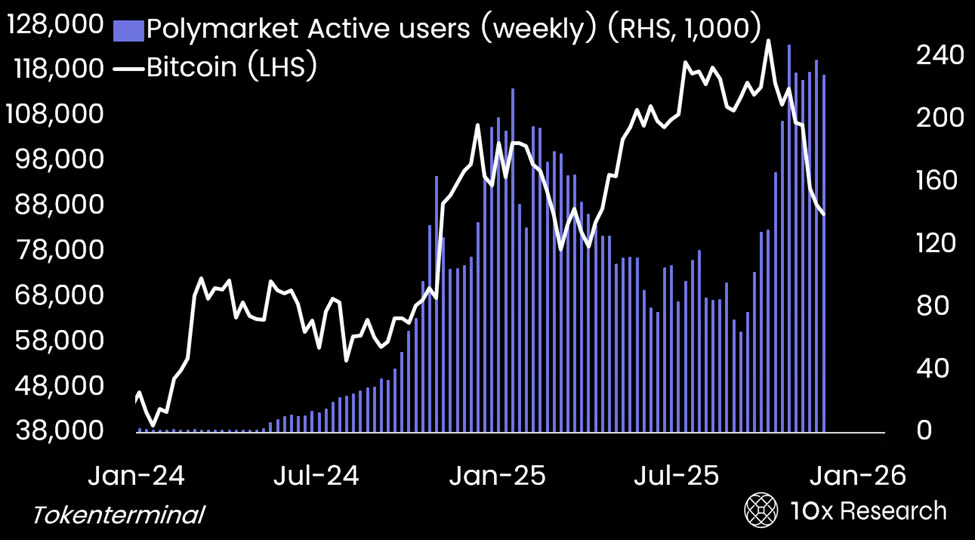
Polymarket active users, weekly, Bitcoin left-hand-side price, year-to-date chart. Source: 10x Research

Related: Bitcoin now settles Visa-scale volumes, but most is for wholesale, not coffee

The report is a concerning sign for casual traders looking to make easy money on prediction markets, as blockchain data suggests that most users lose their initial investment.
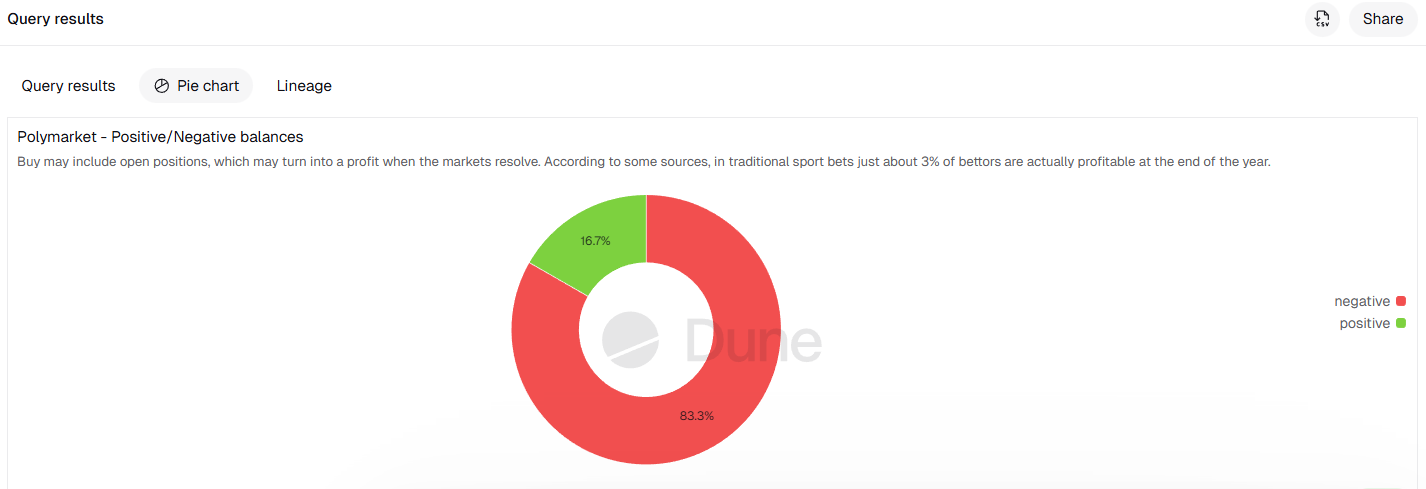
Polymarket, positive/negative wallet balances. Source: Dune.com

Only about 16.7% of wallets on Polymarket are in profit, while the remaining 83% have incurred losses, according to blockchain data from Dune.

Related: Prediction markets emerge as speculative ‘arbitrage arena’ for crypto traders

Perfect win rates fuel insider concerns

The flawless track record of some prediction market accounts is stoking concerns about possible insider trading, as certain users appear to win every time.

Polymarket user “pony-pony” boasts a 100% win rate with over $77,000 in realized profit by betting on events related to the artificial intelligence development company, OpenAI, prediction market data aggregator Polymarket Money said in a Monday X post.

Another user, “AlphaRaccoon,” also triggered insider allegations after generating over $1 million in a single day by successfully winning 22 out of 23 bets related to Google search trends.
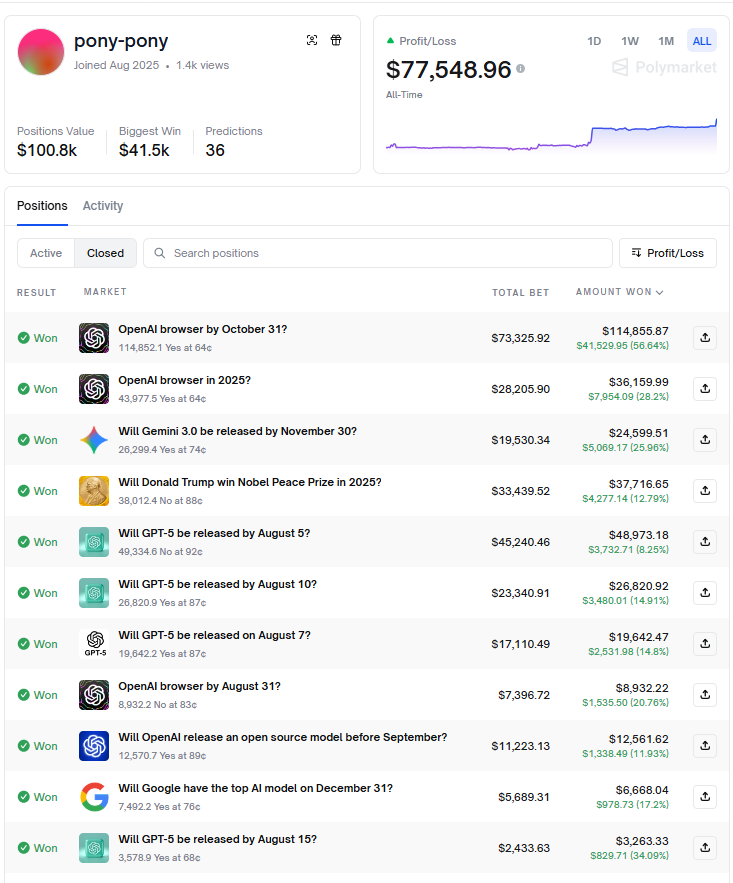
Source: Polymarket Money

Meanwhile, concerns are brewing over the reliability of Polymarket data on third-party data dashboards after a Paradigm researcher discovered a bug that double-counts the prediction market’s trading volume, Cointelegraph reported earlier on Tuesday.

The bug is inflating the primary volume metrics used to gauge prediction market activity, including the notional volume, which counts the number of contracts traded, and the cashflow volume, which measures the dollar value traded at the time of each trade, wrote Paradigm researcher Storm in a Tuesday X post.

However, the inflated volumes on data dashboards are due to errors in data interpretation, not wash trading, which is a deceptive and illegal practice in which entities buy and trade the same instrument to create a false impression of growing market activity.

Paradigm’s newly discovered bug was “validated” by multiple data dashboards, including AlliumLabs and DefiLlama, which are now updating their Polymarket dashboards to eliminate the double-counting error.

Magazine: Train AI agents to make better predictions... for token rewards

Related Reads

Global Stock Market's Storm Center: South Korea's Stock Market De-leveraging Is Largely Complete

Storm's Eye: South Korean Market De-leveraging Nears Completion The recent sharp correction in South Korean equities, with the KOSPI index dropping 32% from its June high, has been a key trigger for global tech stock volatility. The core driver was not a fundamental shift but a forced de-leveraging process within the market's unique structure, which is now largely complete. Two main leverage channels amplified the sell-off: 1. **Leveraged ETFs:** Their size, proportionally four times larger than in the U.S., peaked near $50 billion. Their mandatory daily rebalancing mechanism created a vicious cycle of "price drop → forced selling → further drop." Approximately 75% of this excess has been unwound, shrinking to $26 billion, with regulatory curbs now blocking new inflows. 2. **Hedge Fund Leverage:** Using swaps to magnify exposure, hedge funds saw their net long positioning fall by over 50% from peak levels. The most intense phase of this institutional de-leveraging is over. In contrast, **retail margin debt** poses minimal systemic risk. At 0.5% of market cap, it is far lower than in the U.S. or China, lacks automatic triggers, and is concentrated in smaller stocks. The conclusion: the high-leverage structures most prone to "chain-reaction selling" have been substantially cleared. The market is transitioning from a liquidity-driven crash to one priced more on fundamentals. The article argues that the AI trend—centered on Korean memory chips—remains intact. This episode represents a painful but necessary clearing of crowded trades, not the end of the AI revolution. For investors, the key question is conviction in the long-term AI direction; if the trend is real, current volatility is a cost of entry, not a terminal risk.

链捕手2h ago

Global Stock Market's Storm Center: South Korea's Stock Market De-leveraging Is Largely Complete

链捕手2h ago

Trading

Spot
活动图片




