Eight Years of Turbulence in Web3 Phones: From 'Geek Toy' to Xiaomi's 'Factory Standard'

marsbitPublished on 2025-12-11Last updated on 2025-12-11

Abstract

Web3 Smartphones: An 8-Year Evolution from 'Geek Toy' to Xiaomi's 'Standard Feature' On December 10th, high-performance blockchain Sei announced a partnership with Xiaomi, the world's third-largest smartphone manufacturer. The Sei Foundation will develop a next-gen crypto wallet and DApp discovery platform, which will be pre-installed on Xiaomi's new smartphones for global markets (excluding mainland China and the US). Utilizing MPC technology, the collaboration aims to allow users to log in directly via Google or Xiaomi accounts, eliminating intimidating seed phrases. A pilot stablecoin payment system is also slated for 2026, enabling purchases at Xiaomi's retail stores with tokens like USDC. The journey of Web3 phones began around 2018 with devices like Sirin Labs' Finney and HTC's Exodus 1, which focused on "hardware sovereignty" and extreme security, often featuring physical safeguards or trusted execution environments (TEE). These early attempts, including niche projects like Pundi X's communication-focused BOB phone and Electroneum's low-cost "cloud mining" M1, were commercially unsuccessful due to high costs and poor user experience, remaining confined to tech enthusiasts. Mainstream manufacturers like Samsung cautiously entered the space around 2019, integrating features like the Samsung Blockchain Keystore into flagship models. A notable early example was the "KlaytnPhone" edition of the Galaxy Note 10, which included free KLAY, prefiguring the later "airdrop" mod...

On December 10th, the high-performance public chain Sei announced a partnership with Xiaomi, the world's third-largest smartphone manufacturer. The Sei Foundation will develop a new generation of crypto wallets and a decentralized application (DApp) discovery platform, which will be pre-installed directly on Xiaomi's new smartphones targeting the global market (excluding Mainland China and the United States).

The two parties plan to utilize Multi-Party Computation (MPC) technology, allowing users to log into the wallet directly via their Google or Xiaomi accounts, eliminating the intimidating 'seed phrases' for average users. They also plan to pilot a stablecoin payment system in regions like Hong Kong and the European Union in the second quarter of 2026, enabling users to directly use tokens like USDC to purchase electronics at Xiaomi's over 20,000 offline retail stores.


Retrospective: The Seven-Year Evolution of Web3 Phones


First-Generation Attempts (2018–2020): Hardcore Security and Wild Imagination
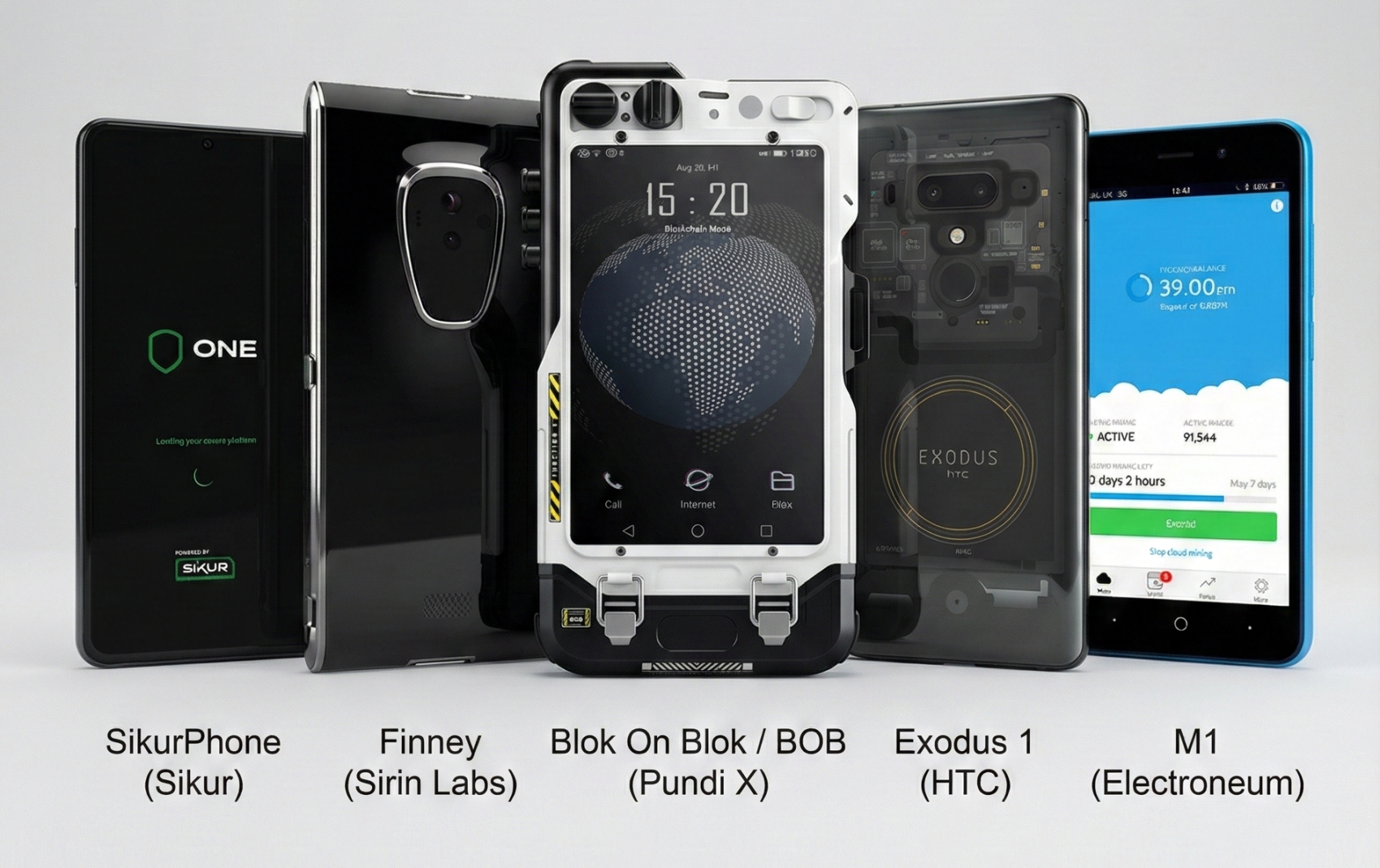

Image source: Internet, compiled by AI


Around 2018, alongside the first major crypto market bull run, the first batch of 'blockchain phones' was born. The representatives of this era were Sirin Labs' Finney and HTC's Exodus 1, whose design philosophies were 'hardware sovereignty' and 'ultimate security'.


Taking Sirin Labs' Finney as an example, this phone featured a unique slide-out 'security screen' that used physical isolation specifically for displaying transaction details and entering passwords, ensuring funds remained safe even if the main system was compromised. HTC, in collaboration with Binance, developed the Exodus 1, introducing the 'Zion Vault', which utilized the phone chip's Trusted Execution Environment (TEE) to store private keys.


Besides Sirin and HTC, another device worth mentioning is the SikurPhone, which represented an attempt at a 'closed system' at the time. Launched by a Brazilian security company, the SikurPhone focused on being 'hacker-proof' and having a built-in cold wallet. Its extreme approach was running the highly closed SikurOS, which did not allow users to install third-party applications themselves (requiring manufacturer evaluation), thereby reducing the attack surface.


Beyond secure storage, entrepreneurs of the time had even more cyberpunk imaginations. Pundi X launched the Blok On Blok (BOB) phone, attempting to solve the problem of decentralized communication. This modular phone allowed users to switch between 'Android mode' and 'blockchain mode', claiming to enable calls and data transmission over a decentralized network without going through mobile carriers.


During this phase, Electroneum released the M1 phone priced at just $80. It targeted developing countries, allowing users to perform 'cloud mining' on the phone to earn tokens for paying phone bills. Although it didn't gain traction at the time due to poor user experience, it was actually the precursor to the later 'phone-as-a-miner' and JamboPhone models.


However, these devices ultimately could not escape commercial failure. The Finney was priced as high as $999 and had dismal sales, while Pundi X's decentralized communication failed to take off due to a lack of user base. The technological features of the time overly emphasized turning the phone into a 'cold wallet' or 'full node', which posed too high a barrier for ordinary users, resulting in products that only circulated within geek circles.


Mainstream Manufacturers Testing the Waters (2019–2022): Cautious Exploration


Image source: Internet, compiled by AI


Seeing the attempts of early startups, mainstream phone manufacturers began testing the waters in a more cautious manner. Samsung integrated the Samsung Blockchain Keystore into its Galaxy S10 series, theoretically giving tens of millions of flagship phone users a hardware-level encrypted wallet.


It is worth noting that Samsung actually laid the groundwork for 'buy a phone, get tokens' as early as 2019. In its 'KlaytnPhone' special edition of the Galaxy Note 10, Samsung partnered with the Korean internet giant Kakao to randomly include 2,000 KLAY tokens. This can be seen as the earliest雏形 (prototype) of the later successful Solana Saga model, although it was confined to the Korean market at the time and did not cause a global sensation.


This period also saw attempts targeting specific niche markets. For example, Vertu launched the Metavertu, priced at tens of thousands of dollars, promoting 'dual-system' switching and luxury services, aiming to attract crypto tycoons. HTC also pivoted to launch the Desire 22 Pro, focusing on the metaverse concept.


Although the involvement of major manufacturers brought better hardware experiences, the limitations of this stage were still evident: Web3 functions were often hidden in deep menus or used merely as marketing gimmicks, failing to fundamentally change user habits.


Besides the 'hardware wallet' attempts by big manufacturers (Samsung) and 'luxury gimmicks' (Vertu), this stage also saw a lightweight path of 'software-defined membership' with the Nothing Phone. Nothing Phone partnered with Polygon to establish a decentralized membership loyalty program through the 'Black Dot' NFT.


The New Wave (2023–2025): Ecosystem Binding and Infrastructure-ization
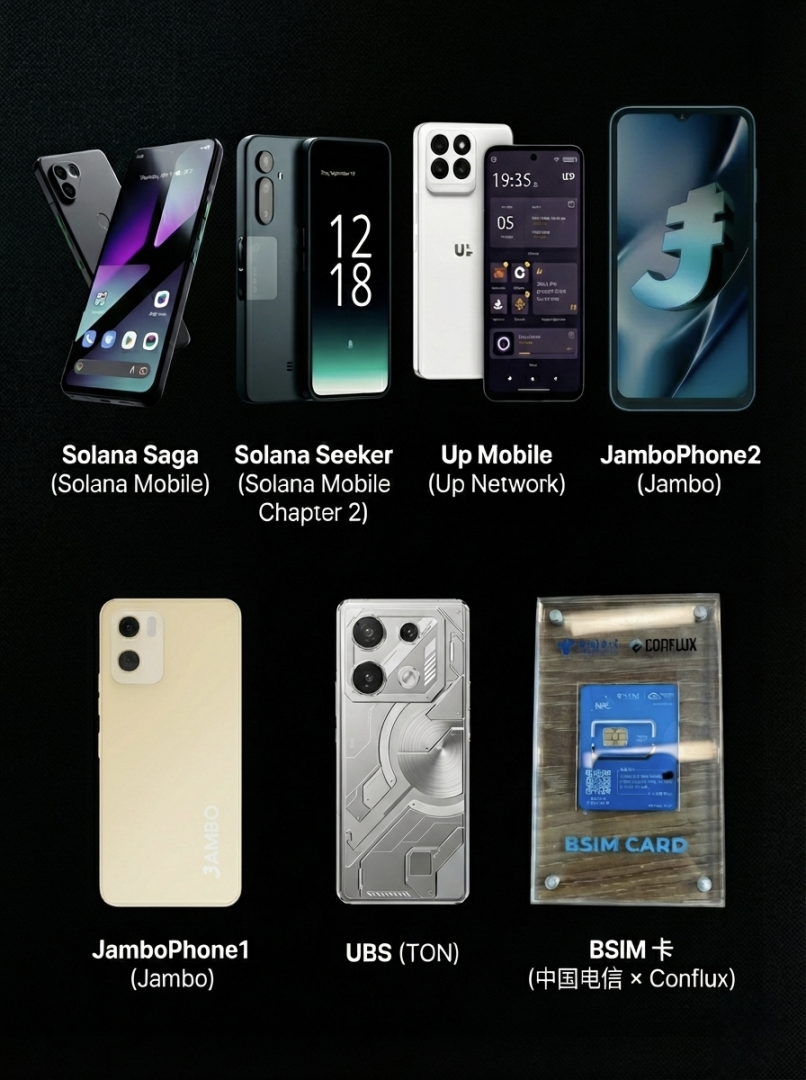

Image source: Internet, compiled by AI


Entering 2023, the Web3 phone market was completely activated by the Solana Saga, ushering in a new era of 'ecosystem binding' and 'token incentives'. The Solana Saga initially had stagnant sales due to poor cost-performance, but after the value of the included BONK token airdrop exceeded the phone's price, it sold out instantly, earning the nickname 'dividend phone'.


The subsequent Solana Seeker (Chapter 2) continued this airdrop logic, using 'Soulbound Tokens' (SBT) to prevent scalping and introducing the TEEPIN architecture to support decentralized infrastructure networks.


Meanwhile, ecosystem competition intensified. The TON ecosystem launched the Universal Basic Smartphone (UBS), also priced at $99, directly challenging the JamboPhone. The TON phone leverages Telegram's massive user base, focusing on 'data dividends', allowing users not only to earn money by completing tasks but also to profit from selling their own data. Binance Labs-incubated Coral Phone also joined the fray, aiming to build a dedicated hardware entry point for the BNB Chain ecosystem, focusing on multi-chain aggregation and AI functions.


In the low-end market, the JamboPhone entered the arena with an ultra-low price of $99, serving as an entry point for 'super apps' and attracting users in Africa and Southeast Asia through a 'Learn to Earn' model. New players like Up Mobile also began to get a piece of the pie by combining AI and Move language technology. Jambo has already launched its second-generation product. While maintaining the $99 price, it upgraded the RAM to 12GB (although the processor remains entry-level), which is already capable of handling more Web3 tasks and 'super app' demands in emerging markets.


The BSIM card launched by China Telecom and Conflux showcased another path: a SIM card with a built-in high-performance security chip. Users simply need to replace their SIM card to transform any ordinary Android phone into a higher-security Web3 device. This 'Trojan Horse' strategy provides a new approach for large-scale adoption in compliant markets.


Trends: Shifts in Five Directions


Looking at the development over these eight years, we can clearly see five key shifts happening with Web3 phones.


Hardware capabilities and security architectures are upgrading. Early security relied mainly on software or simple TEE isolation, whereas now, technology is evolving towards more complex directions. Solana Seeker introduced the TEEPIN (Trusted Execution Environment Platform Infrastructure Network) architecture, enabling the phone to act as a trusted node participating in DePIN network construction. The BSIM card launched by China Telecom and Conflux integrates private key generation and storage directly into the SIM card, achieving telecom-grade hardware security. The collaboration between Xiaomi and Sei employs MPC technology, allowing users to log in with one click via their Google account, enabling secure management without seed phrases.


Ecosystem binding has become standard. Today's Web3 phones are not just generic crypto devices but entry points to specific public chain ecosystems. Saga is bound to Solana, Up Mobile is bound to Movement Labs, while JamboPhone, based on Aptos, further aggregates the Solana and Tether payment ecosystems, becoming a super app entry point for emerging markets. The phone has become a channel for public chains to distribute applications and retain users.


Airdrops or incentives dominate user growth. The motivation for users to buy Web3 phones has shifted from 'secure storage' to 'obtaining收益 (returns/profits)'. Saga's success proved that hardware can be used as a 'loss-leading' tool, compensating users with subsequent token airdrops or other incentives. This economic model of 'phone-as-a-miner' or 'phone-as-a-golden-shovel' has become the strongest driving force in the current market.


Application scenarios take precedence over technical concepts. Early products were obsessed with geeky functions like 'running a full node', while the current focus has shifted to practical applications. The core of the Xiaomi-Sei collaboration is stablecoin payments, and JamboPhone focuses on流量变现 (monetizing traffic) through built-in apps. Solving real payment and application distribution problems is more attractive than pure technological stacking.


Channel and scale effects are beginning to show. Selling 20,000 Solana Saga units was considered a huge success, but it's a drop in the bucket compared to Xiaomi's annual shipment volume of 168 million units. When a major manufacturer like Xiaomi starts pre-installing wallets via system updates, the growth scale of Web3 users will leap from 'ten-thousands' to 'hundreds of millions'. This scale effect is unmatched by any vertical crypto phone manufacturer.


Conclusion: Tearing Down the Walls, Integrating into the Mainstream


Throughout this eight-year evolution, we attempted to build expensive, closed Web3 phones as secure fortresses. But reality has proven that the real 'wall' hindering Web3 adoption is not security, but the complexity of seed phrases and the fragmented user experience.


Truly valuable Web3 phones will eventually no longer need to label themselves as 'Web3 phones'. They should be like today's 5G phones; you don't need to understand the underlying communication protocols, you just enjoy the high-speed experience they bring.


Solana Mobile proved that breaking through driven by利益 (interest/profit) is feasible, while SEI's partnership with Xiaomi is attempting to prove that integration driven by experience is the long-term solution. In this evolution from 'hardcore toy' to 'mass tool', whoever lowers the technical barrier of Web3 the most, whoever彻底推倒 (completely tears down) this cognitive wall, will hold the ticket to the next hundred-million user base.


Related Questions

QWhat is the significance of the recent partnership between Sei and Xiaomi in the Web3 phone market?

AThe partnership signifies a major shift towards mainstream adoption, as Sei will develop a next-gen crypto wallet and DApp discovery platform pre-installed on Xiaomi's global smartphones (excluding China and the US). It leverages MPC technology for seamless login via Google or Xiaomi accounts, eliminating seed phrases, and plans to pilot a stablecoin payment system (e.g., USDC) in Xiaomi's retail stores by 2026.

QHow did the early Web3 phones (2018-2020) differ from the current generation in terms of focus and user experience?

AEarly Web3 phones like Sirin Finney and HTC Exodus 1 focused on 'hardware sovereignty' and 'extreme security' through features like physical isolation screens and trusted execution environments (TEE). They were expensive, complex, and targeted at tech-savvy users, whereas current models prioritize user incentives (e.g., airdrops), practical applications (e.g., payments), and seamless integration, lowering barriers for mainstream users.

QWhat role did Solana Saga play in revitalizing the Web3 phone market in 2023?

ASolana Saga activated the market by introducing an 'ecosystem binding' and 'token incentive' model. Initially slow-selling, it gained massive popularity when the included BONK token airdrop exceeded the phone's price, making it a 'dividend phone.' This success demonstrated that hardware could be used as a loss-leading tool for user acquisition through future airdrops and rewards.

QWhat are the five key shifts in Web3 phone development highlighted in the article?

AThe five shifts are: 1) Upgraded hardware security (e.g., TEEPIN, MPC, BSIM cards); 2) Ecosystem binding (phones as entry points for specific chains like Solana or Aptos); 3) Airdrop/incentive-driven user growth; 4) Focus on practical applications (e.g., payments) over technical concepts; 5) Emergence of scale and channel effects, with major manufacturers like Xiaomi enabling billion-user reach.

QHow does the BSIM card developed by China Telecom and Conflux represent an alternative approach to Web3 phone integration?

AThe BSIM card is a 'Trojan horse' strategy that embeds a high-performance security chip into a SIM card. By simply replacing the SIM, any standard Android phone can be transformed into a Web3 device with enhanced security for private key storage and management, offering a compliant and scalable solution for mass adoption without requiring specialized hardware.

Related Reads

KOL's Perspective: Why Is SOL Set to Rise from This Point?

**Summary: Why SOL is Positioned for Growth at This Level** The article argues that SOL is poised for an upward move from its current price point, citing several key factors. Primarily, SOL has just broken out of a 4-month consolidation phase. This breakout signals a return of risk appetite to the broader crypto market, as SOL is seen as a key indicator of overall crypto health. The token's ownership has reportedly shifted from short-term traders and tourists to long-term accumulators, leading to low volume. Any meaningful increase in trading activity could thus trigger significant upward momentum. Fundamental strengths include strong institutional adoption, integration with DeFi and RWAs (Real-World Assets), and the potential benefits from the Clarity Act. Despite its high volatility—having dropped 70% from its all-time high but still up 12x from its bear market low—SOL is highlighted as one of the few tokens from the last cycle to reach new highs. It boasts a robust ecosystem of applications, users, and protocols. Future catalysts include the expected influx of AI developers following the Miami Accelerate conference, which focused on AI on Solana. Furthermore, Solana is positioned as the premier chain for memecoin activity, a trend expected to continue and drive network usage and fees. The article concludes that recent price action reflects a healthy transfer to long-term holders, setting the stage for growth.

marsbit44m ago

KOL's Perspective: Why Is SOL Set to Rise from This Point?

marsbit44m ago

Those Pre-Bitcoin PoW Protocols Have Recently Been Reimplemented

This article details a recent surge in replicating pre-Bitcoin Proof-of-Work (PoW) protocols, specifically focusing on Hal Finney's 2004 RPOW (Reusable Proofs of Work). Within five days in May 2026, multiple independent builders in the Bitcoin/cypherpunk community launched projects inspired by this early electronic cash proposal. The initiative began with Fred Krueger's `rpow2.com`, a centralized but auditable system that replaced RPOW's original IBM 4758 hardware with Ed25519 signatures. Initially a faithful replica, it later adopted Bitcoin-like features (21M supply cap, difficulty adjustment) and a controversial 5.24% founder allocation. This sparked rapid forks, including `rpow4.com` which incorporated full Bitcoin parameters, a prediction market (`rpowmarket.com`), and a DEX (`rpow2swap.com`). Concurrently, Mike In Space created a prototype of Wei Dai's 1998 b-money proposal (`b-money.replit.app`), pushing the historical exploration even further back. The article contrasts these centralized, server-dependent experiments with Bitcoin's core innovation of decentralized, trustless consensus. It also highlights a parallel development: the `HASH` project on Ethereum, which uses smart contract hooks to enable a purely fair-launch, browser-mineable PoW token with 0% allocations to team or VCs. The collective activity is framed as a meme-driven, educational exploration of cypherpunk history rather than a serious financial movement, with all projects heavily disclaiming any investment value.

marsbit49m ago

Those Pre-Bitcoin PoW Protocols Have Recently Been Reimplemented

marsbit49m ago

South Korean Exchanges 'Battle' Regulators, Challenging the Boundaries of Enforcement and Legislation

South Korea's cryptocurrency industry is engaged in a rare, direct confrontation with regulators. The Financial Intelligence Unit (FIU), the primary anti-money laundering (AML) watchdog, has recently imposed heavy penalties on major exchanges like Upbit and Bithumb for alleged violations involving unregistered overseas VASPs and AML procedures. However, exchanges are now actively challenging these actions in court and through industry associations. In a significant shift, the Seoul Administrative Court ruled in favor of Upbit's operator, Dunamu, overturning part of an FIU-ordered business suspension. The court found the FIU's penalty criteria and justification insufficiently clear. Similarly, the court suspended the enforcement of a six-month business suspension against Bithumb pending a final ruling, citing potential irreversible harm to the exchange. Beyond legal battles, the industry is contesting proposed legislative amendments. The Digital Asset eXchange Alliance (DAXA) strongly opposes a draft rule that would mandate Suspicious Transaction Reports (STRs) for all crypto transfers over 10 million KRW (~$6,800). DAXA argues this "poison pill" clause violates legal principles and would overwhelm the STR system, increasing reports from 63,000 to an estimated 5.45 million annually for major exchanges, thereby crippling effective AML monitoring. This conflict highlights a structural tension in South Korea's crypto governance: comprehensive digital asset laws are still developing, while regulators rely heavily on AML enforcement. The industry's move from passive compliance to active legal and legislative challenges signifies a new phase, pressing for clearer rules and more proportionate enforcement. While short-term disputes may intensify, this clash could ultimately lead to a more mature and sustainable regulatory framework for South Korea's vibrant crypto market.

marsbit1h ago

South Korean Exchanges 'Battle' Regulators, Challenging the Boundaries of Enforcement and Legislation

marsbit1h ago

After 50x Storage Surge, Justin Sun Always Looks to the Next Decade

Sun Yuchen, known for his controversial stunts like a $30 million lunch with Warren Buffett (canceled due to a kidney stone) and eating a $6.2 million duct-taped banana, is often overshadowed by a significant fact: his decade-long track record of spotting major investment trends. In 2016, he famously advised young people to invest in Bitcoin, Nvidia, Tesla, and Tencent instead of buying property. A hypothetical $20,000 investment in Nvidia and Tesla from that list would now be worth over 50 million RMB. His latest major call was on November 6, 2025, predicting a "50x storage opportunity" tied to the AI boom, which materialized with Sandisk's stock surging nearly 50-fold by 2026. Looking ahead, Sun now focuses on the next frontier: Physical AI. He identifies four key areas: 1. **Embodied AI/Robotics**: He sees this reaching its "iPhone moment," with companies like UBTech and Galaxy General leading in commercialization. 2. **Drones**: Viewed as the first commercially viable form of Physical AI, revolutionizing sectors from warfare (e.g., AeroVironment's Switchblade) to logistics. 3. **Spatial Computing**: Beyond VR, it's about AI understanding physical space, a foundational technology for robotics and autonomous systems, exemplified by Apple's Vision Pro. 4. **Space Exploration**: After a 2025 suborbital flight with Blue Origin, Sun advocates for space as the ultimate frontier, discussing blockchain's potential role in space asset management and data transactions. His investment philosophy involves betting on entire, inevitable trends rather than single companies. For robotics, he sees Tesla (the body/manufacturer) and Nvidia (the brain/AI platform) as complementary plays. In defense drones, he highlights companies making tanks obsolete (AeroVironment) and those augmenting fighter jets (Kratos). For space, he participated in Blue Origin's flight and anticipates SpaceX's potential IPO to redefine the sector's valuation. Sun Yuchen's vision frames the next two decades not as a revolution in information flow (like the internet), but in the fundamental operation of the physical world through AI-powered robots, autonomous systems, and spatial intelligence, ultimately extending human and AI activity into space. While many still focus on conventional assets, he continues to look toward the next technological horizon.

marsbit2h ago

After 50x Storage Surge, Justin Sun Always Looks to the Next Decade

marsbit2h ago

Trading

Spot
Futures

Hot Articles

What is SONIC

Sonic: Pioneering the Future of Gaming in Web3 Introduction to Sonic In the ever-evolving landscape of Web3, the gaming industry stands out as one of the most dynamic and promising sectors. At the forefront of this revolution is Sonic, a project designed to amplify the gaming ecosystem on the Solana blockchain. Leveraging cutting-edge technology, Sonic aims to deliver an unparalleled gaming experience by efficiently processing millions of requests per second, ensuring that players enjoy seamless gameplay while maintaining low transaction costs. This article delves into the intricate details of Sonic, exploring its creators, funding sources, operational mechanics, and the timeline of significant events that have shaped its journey. What is Sonic? Sonic is an innovative layer-2 network that operates atop the Solana blockchain, specifically tailored to enhance the existing Solana gaming ecosystem. It accomplishes this through a customised, VM-agnostic game engine paired with a HyperGrid interpreter, facilitating sovereign game economies that roll up back to the Solana platform. The primary goals of Sonic include: Enhanced Gaming Experiences: Sonic is committed to offering lightning-fast on-chain gameplay, allowing players and developers to engage with games at previously unattainable speeds. Atomic Interoperability: This feature enables transactions to be executed within Sonic without the need to redeploy Solana programmes and accounts. This makes the process more efficient and directly benefits from Solana Layer1 services and liquidity. Seamless Deployment: Sonic allows developers to write for Ethereum Virtual Machine (EVM) based systems and execute them on Solana’s SVM infrastructure. This interoperability is crucial for attracting a broader range of dApps and decentralised applications to the platform. Support for Developers: By offering native composable gaming primitives and extensible data types - dining within the Entity-Component-System (ECS) framework - game creators can craft intricate business logic with ease. Overall, Sonic's unique approach not only caters to players but also provides an accessible and low-cost environment for developers to innovate and thrive. Creator of Sonic The information regarding the creator of Sonic is somewhat ambiguous. However, it is known that Sonic's SVM is owned by the company Mirror World. The absence of detailed information about the individuals behind Sonic reflects a common trend in several Web3 projects, where collective efforts and partnerships often overshadow individual contributions. Investors of Sonic Sonic has garnered considerable attention and support from various investors within the crypto and gaming sectors. Notably, the project raised an impressive $12 million during its Series A funding round. The round was led by BITKRAFT Ventures, with other notable investors including Galaxy, Okx Ventures, Interactive, Big Brain Holdings, and Mirana. This financial backing signifies the confidence that investment foundations have in Sonic’s potential to revolutionise the Web3 gaming landscape, further validating its innovative approaches and technologies. How Does Sonic Work? Sonic utilises the HyperGrid framework, a sophisticated parallel processing mechanism that enhances its scalability and customisability. Here are the core features that set Sonic apart: Lightning Speed at Low Costs: Sonic offers one of the fastest on-chain gaming experiences compared to other Layer-1 solutions, powered by the scalability of Solana’s virtual machine (SVM). Atomic Interoperability: Sonic enables transaction execution without redeployment of Solana programmes and accounts, effectively streamlining the interaction between users and the blockchain. EVM Compatibility: Developers can effortlessly migrate decentralised applications from EVM chains to the Solana environment using Sonic’s HyperGrid interpreter, increasing the accessibility and integration of various dApps. Ecosystem Support for Developers: By exposing native composable gaming primitives, Sonic facilitates a sandbox-like environment where developers can experiment and implement business logic, greatly enhancing the overall development experience. Monetisation Infrastructure: Sonic natively supports growth and monetisation efforts, providing frameworks for traffic generation, payments, and settlements, thereby ensuring that gaming projects are not only viable but also sustainable financially. Timeline of Sonic The evolution of Sonic has been marked by several key milestones. Below is a brief timeline highlighting critical events in the project's history: 2022: The Sonic cryptocurrency was officially launched, marking the beginning of its journey in the Web3 gaming arena. 2024: June: Sonic SVM successfully raised $12 million in a Series A funding round. This investment allowed Sonic to further develop its platform and expand its offerings. August: The launch of the Sonic Odyssey testnet provided users with the first opportunity to engage with the platform, offering interactive activities such as collecting rings—a nod to gaming nostalgia. October: SonicX, an innovative crypto game integrated with Solana, made its debut on TikTok, capturing the attention of over 120,000 users within a short span. This integration illustrated Sonic’s commitment to reaching a broader, global audience and showcased the potential of blockchain gaming. Key Points Sonic SVM is a revolutionary layer-2 network on Solana explicitly designed to enhance the GameFi landscape, demonstrating great potential for future development. HyperGrid Framework empowers Sonic by introducing horizontal scaling capabilities, ensuring that the network can handle the demands of Web3 gaming. Integration with Social Platforms: The successful launch of SonicX on TikTok displays Sonic’s strategy to leverage social media platforms to engage users, exponentially increasing the exposure and reach of its projects. Investment Confidence: The substantial funding from BITKRAFT Ventures, among others, emphasizes the robust backing Sonic has, paving the way for its ambitious future. In conclusion, Sonic encapsulates the essence of Web3 gaming innovation, striking a balance between cutting-edge technology, developer-centric tools, and community engagement. As the project continues to evolve, it is poised to redefine the gaming landscape, making it a notable entity for gamers and developers alike. As Sonic moves forward, it will undoubtedly attract greater interest and participation, solidifying its place within the broader narrative of blockchain gaming.

1.4k Total ViewsPublished 2024.04.04Updated 2024.12.03

What is SONIC

What is $S$

Understanding SPERO: A Comprehensive Overview Introduction to SPERO As the landscape of innovation continues to evolve, the emergence of web3 technologies and cryptocurrency projects plays a pivotal role in shaping the digital future. One project that has garnered attention in this dynamic field is SPERO, denoted as SPERO,$$s$. This article aims to gather and present detailed information about SPERO, to help enthusiasts and investors understand its foundations, objectives, and innovations within the web3 and crypto domains. What is SPERO,$$s$? SPERO,$$s$ is a unique project within the crypto space that seeks to leverage the principles of decentralisation and blockchain technology to create an ecosystem that promotes engagement, utility, and financial inclusion. The project is tailored to facilitate peer-to-peer interactions in new ways, providing users with innovative financial solutions and services. At its core, SPERO,$$s$ aims to empower individuals by providing tools and platforms that enhance user experience in the cryptocurrency space. This includes enabling more flexible transaction methods, fostering community-driven initiatives, and creating pathways for financial opportunities through decentralised applications (dApps). The underlying vision of SPERO,$$s$ revolves around inclusiveness, aiming to bridge gaps within traditional finance while harnessing the benefits of blockchain technology. Who is the Creator of SPERO,$$s$? The identity of the creator of SPERO,$$s$ remains somewhat obscure, as there are limited publicly available resources providing detailed background information on its founder(s). This lack of transparency can stem from the project's commitment to decentralisation—an ethos that many web3 projects share, prioritising collective contributions over individual recognition. By centring discussions around the community and its collective goals, SPERO,$$s$ embodies the essence of empowerment without singling out specific individuals. As such, understanding the ethos and mission of SPERO remains more important than identifying a singular creator. Who are the Investors of SPERO,$$s$? SPERO,$$s$ is supported by a diverse array of investors ranging from venture capitalists to angel investors dedicated to fostering innovation in the crypto sector. The focus of these investors generally aligns with SPERO's mission—prioritising projects that promise societal technological advancement, financial inclusivity, and decentralised governance. These investor foundations are typically interested in projects that not only offer innovative products but also contribute positively to the blockchain community and its ecosystems. The backing from these investors reinforces SPERO,$$s$ as a noteworthy contender in the rapidly evolving domain of crypto projects. How Does SPERO,$$s$ Work? SPERO,$$s$ employs a multi-faceted framework that distinguishes it from conventional cryptocurrency projects. Here are some of the key features that underline its uniqueness and innovation: Decentralised Governance: SPERO,$$s$ integrates decentralised governance models, empowering users to participate actively in decision-making processes regarding the project’s future. This approach fosters a sense of ownership and accountability among community members. Token Utility: SPERO,$$s$ utilises its own cryptocurrency token, designed to serve various functions within the ecosystem. These tokens enable transactions, rewards, and the facilitation of services offered on the platform, enhancing overall engagement and utility. Layered Architecture: The technical architecture of SPERO,$$s$ supports modularity and scalability, allowing for seamless integration of additional features and applications as the project evolves. This adaptability is paramount for sustaining relevance in the ever-changing crypto landscape. Community Engagement: The project emphasises community-driven initiatives, employing mechanisms that incentivise collaboration and feedback. By nurturing a strong community, SPERO,$$s$ can better address user needs and adapt to market trends. Focus on Inclusion: By offering low transaction fees and user-friendly interfaces, SPERO,$$s$ aims to attract a diverse user base, including individuals who may not previously have engaged in the crypto space. This commitment to inclusion aligns with its overarching mission of empowerment through accessibility. Timeline of SPERO,$$s$ Understanding a project's history provides crucial insights into its development trajectory and milestones. Below is a suggested timeline mapping significant events in the evolution of SPERO,$$s$: Conceptualisation and Ideation Phase: The initial ideas forming the basis of SPERO,$$s$ were conceived, aligning closely with the principles of decentralisation and community focus within the blockchain industry. Launch of Project Whitepaper: Following the conceptual phase, a comprehensive whitepaper detailing the vision, goals, and technological infrastructure of SPERO,$$s$ was released to garner community interest and feedback. Community Building and Early Engagements: Active outreach efforts were made to build a community of early adopters and potential investors, facilitating discussions around the project’s goals and garnering support. Token Generation Event: SPERO,$$s$ conducted a token generation event (TGE) to distribute its native tokens to early supporters and establish initial liquidity within the ecosystem. Launch of Initial dApp: The first decentralised application (dApp) associated with SPERO,$$s$ went live, allowing users to engage with the platform's core functionalities. Ongoing Development and Partnerships: Continuous updates and enhancements to the project's offerings, including strategic partnerships with other players in the blockchain space, have shaped SPERO,$$s$ into a competitive and evolving player in the crypto market. Conclusion SPERO,$$s$ stands as a testament to the potential of web3 and cryptocurrency to revolutionise financial systems and empower individuals. With a commitment to decentralised governance, community engagement, and innovatively designed functionalities, it paves the way toward a more inclusive financial landscape. As with any investment in the rapidly evolving crypto space, potential investors and users are encouraged to research thoroughly and engage thoughtfully with the ongoing developments within SPERO,$$s$. The project showcases the innovative spirit of the crypto industry, inviting further exploration into its myriad possibilities. While the journey of SPERO,$$s$ is still unfolding, its foundational principles may indeed influence the future of how we interact with technology, finance, and each other in interconnected digital ecosystems.

54 Total ViewsPublished 2024.12.17Updated 2024.12.17

What is $S$

What is AGENT S

Agent S: The Future of Autonomous Interaction in Web3 Introduction In the ever-evolving landscape of Web3 and cryptocurrency, innovations are constantly redefining how individuals interact with digital platforms. One such pioneering project, Agent S, promises to revolutionise human-computer interaction through its open agentic framework. By paving the way for autonomous interactions, Agent S aims to simplify complex tasks, offering transformative applications in artificial intelligence (AI). This detailed exploration will delve into the project's intricacies, its unique features, and the implications for the cryptocurrency domain. What is Agent S? Agent S stands as a groundbreaking open agentic framework, specifically designed to tackle three fundamental challenges in the automation of computer tasks: Acquiring Domain-Specific Knowledge: The framework intelligently learns from various external knowledge sources and internal experiences. This dual approach empowers it to build a rich repository of domain-specific knowledge, enhancing its performance in task execution. Planning Over Long Task Horizons: Agent S employs experience-augmented hierarchical planning, a strategic approach that facilitates efficient breakdown and execution of intricate tasks. This feature significantly enhances its ability to manage multiple subtasks efficiently and effectively. Handling Dynamic, Non-Uniform Interfaces: The project introduces the Agent-Computer Interface (ACI), an innovative solution that enhances the interaction between agents and users. Utilizing Multimodal Large Language Models (MLLMs), Agent S can navigate and manipulate diverse graphical user interfaces seamlessly. Through these pioneering features, Agent S provides a robust framework that addresses the complexities involved in automating human interaction with machines, setting the stage for myriad applications in AI and beyond. Who is the Creator of Agent S? While the concept of Agent S is fundamentally innovative, specific information about its creator remains elusive. The creator is currently unknown, which highlights either the nascent stage of the project or the strategic choice to keep founding members under wraps. Regardless of anonymity, the focus remains on the framework's capabilities and potential. Who are the Investors of Agent S? As Agent S is relatively new in the cryptographic ecosystem, detailed information regarding its investors and financial backers is not explicitly documented. The lack of publicly available insights into the investment foundations or organisations supporting the project raises questions about its funding structure and development roadmap. Understanding the backing is crucial for gauging the project's sustainability and potential market impact. How Does Agent S Work? At the core of Agent S lies cutting-edge technology that enables it to function effectively in diverse settings. Its operational model is built around several key features: Human-like Computer Interaction: The framework offers advanced AI planning, striving to make interactions with computers more intuitive. By mimicking human behaviour in tasks execution, it promises to elevate user experiences. Narrative Memory: Employed to leverage high-level experiences, Agent S utilises narrative memory to keep track of task histories, thereby enhancing its decision-making processes. Episodic Memory: This feature provides users with step-by-step guidance, allowing the framework to offer contextual support as tasks unfold. Support for OpenACI: With the ability to run locally, Agent S allows users to maintain control over their interactions and workflows, aligning with the decentralised ethos of Web3. Easy Integration with External APIs: Its versatility and compatibility with various AI platforms ensure that Agent S can fit seamlessly into existing technological ecosystems, making it an appealing choice for developers and organisations. These functionalities collectively contribute to Agent S's unique position within the crypto space, as it automates complex, multi-step tasks with minimal human intervention. As the project evolves, its potential applications in Web3 could redefine how digital interactions unfold. Timeline of Agent S The development and milestones of Agent S can be encapsulated in a timeline that highlights its significant events: September 27, 2024: The concept of Agent S was launched in a comprehensive research paper titled “An Open Agentic Framework that Uses Computers Like a Human,” showcasing the groundwork for the project. October 10, 2024: The research paper was made publicly available on arXiv, offering an in-depth exploration of the framework and its performance evaluation based on the OSWorld benchmark. October 12, 2024: A video presentation was released, providing a visual insight into the capabilities and features of Agent S, further engaging potential users and investors. These markers in the timeline not only illustrate the progress of Agent S but also indicate its commitment to transparency and community engagement. Key Points About Agent S As the Agent S framework continues to evolve, several key attributes stand out, underscoring its innovative nature and potential: Innovative Framework: Designed to provide an intuitive use of computers akin to human interaction, Agent S brings a novel approach to task automation. Autonomous Interaction: The ability to interact autonomously with computers through GUI signifies a leap towards more intelligent and efficient computing solutions. Complex Task Automation: With its robust methodology, it can automate complex, multi-step tasks, making processes faster and less error-prone. Continuous Improvement: The learning mechanisms enable Agent S to improve from past experiences, continually enhancing its performance and efficacy. Versatility: Its adaptability across different operating environments like OSWorld and WindowsAgentArena ensures that it can serve a broad range of applications. As Agent S positions itself in the Web3 and crypto landscape, its potential to enhance interaction capabilities and automate processes signifies a significant advancement in AI technologies. Through its innovative framework, Agent S exemplifies the future of digital interactions, promising a more seamless and efficient experience for users across various industries. Conclusion Agent S represents a bold leap forward in the marriage of AI and Web3, with the capacity to redefine how we interact with technology. While still in its early stages, the possibilities for its application are vast and compelling. Through its comprehensive framework addressing critical challenges, Agent S aims to bring autonomous interactions to the forefront of the digital experience. As we move deeper into the realms of cryptocurrency and decentralisation, projects like Agent S will undoubtedly play a crucial role in shaping the future of technology and human-computer collaboration.

662 Total ViewsPublished 2025.01.14Updated 2025.01.14

What is AGENT S

Discussions

Welcome to the HTX Community. Here, you can stay informed about the latest platform developments and gain access to professional market insights. Users' opinions on the price of S (S) are presented below.

活动图片












