Duan Yongping's Bottom-Fishing in CoreWeave Is Turning into a Battleground for Bulls and Bears

marsbitPublished on 2026-05-11Last updated on 2026-05-11

Abstract

CoreWeave's Q1 2026 earnings report has intensified the ongoing bull-bear battle over the AI infrastructure stock. While revenue doubled year-over-year to $2.08B and the firm's remaining performance obligation (RPO) surged to nearly $100B, its net loss more than doubled to $740M. The critical point of contention is profitability: while adjusted EBITDA margin was a robust 56%, the adjusted operating margin collapsed to just 1% due to soaring infrastructure and sales costs. A weaker-than-expected Q2 revenue guidance further triggered an 11.4% single-day stock drop. The bull thesis hinges on CoreWeave's massive order backlog, deep strategic ties with NVIDIA (as a customer, investor, and key supplier), and a diversified client base now including Anthropic and Meta. The bear case focuses on the "scale at all costs" model, where expanding revenue leads to wider losses, ballooning debt ($25B), and massive capital expenditures ($6.8B in Q1). Insider selling by executives contrasts with a notable new investor: Chinese investor Duan Yongping initiated a small position (0.12% of his portfolio) in Q4 2025 near the stock's lows. The coming Q2 report is seen as a key test for management's promise of a profit margin recovery.

Author: Deep Tide TechFlow

On May 8, AI cloud computing power supplier CoreWeave (CRWV) plunged 11.4% in a single day, closing at $114.15. This marked another "earnings day decline" since the company's IPO in March last year. However, unlike previous drops, this decline coincided with a more dramatic contrast: Duan Yongping, widely known in the Chinese-speaking community as a disciple of Warren Buffett, had just established his first position in CoreWeave in Q4 2025, with an allocation of approximately $20 million. Based on the position size and the Q4 average price, the entry point was close to CoreWeave's lowest level for the year in December 2025.

CoreWeave is currently one of the most divisive AI assets in the US stock market. On one side lies the narrative of being the "picks and shovels" seller with nearly $100 billion in order backlog and deep ties to Nvidia; on the other side is the financial reality of widening losses despite scale expansion and continuous insider selling. The Q1 earnings report acted like a prism, making this divergence exceptionally clear.

Q1 Earnings: Revenue Doubles but Losses Widen, Q2 Guidance Punctures Valuation

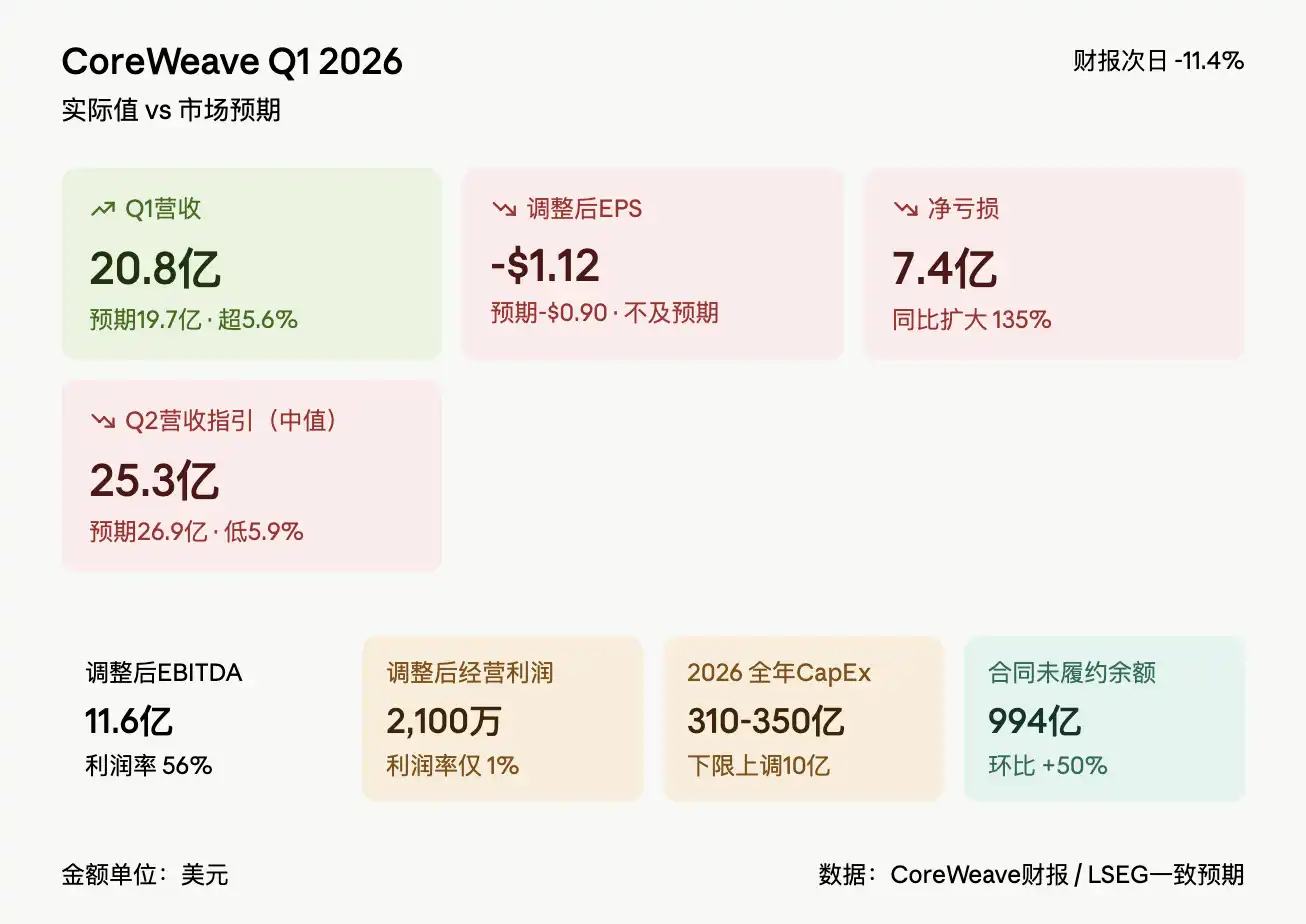
CoreWeave's Q1 revenue was $2.08 billion, a 112% year-over-year increase and a 32% sequential increase, surpassing the LSEG market expectation of $1.97 billion. However, adjusted loss per share was $1.12, worse than the expected loss of $0.90. Net loss expanded to $740 million, more than doubling from $315 million in the same period last year.

What truly ignited the sell-off was the forward guidance. The company provided a Q2 revenue range of $2.45 billion to $2.6 billion, with a midpoint of $2.53 billion, far below the market expectation of $2.69 billion. Simultaneously, the lower limit of full-year 2026 capital expenditure was raised from $30 billion to $31 billion, which CFO Nitin Agrawal attributed to rising component costs.

The fragility of the profit structure was exposed. Q1 adjusted EBITDA reached $1.16 billion (a 56% margin), seemingly impressive, but adjusted operating profit was only $21 million, with the operating margin compressed to 1%. The reason lies in technology and infrastructure costs soaring 127% year-over-year to $1.27 billion, and sales & marketing expenses skyrocketing over 6 times year-over-year to $69 million. Revenue is growing, but costs are growing faster.

CEO Michael Intrator emphasized on the earnings call: "We have reached hyperscale." He disclosed that the company now has 10 customers committed to spending over $1 billion each. Compared to 2024 when 62% of revenue relied on Microsoft as a single customer, concentration risk has significantly improved. Intrator also expects CoreWeave's annualized revenue to exceed $30 billion by the end of 2027.
Bull Narrative: $100 Billion Order Backlog, Deep Ties with Nvidia

The core supporting the bull case is the order backlog. As of the end of Q1, CoreWeave's remaining performance obligations (RPO) amounted to $99.4 billion, a net increase of approximately $33 billion sequentially and nearly quadrupling year-over-year. Intrator stated that new contracts signed in Q1 alone exceeded $40 billion.

The client list is also reshaping market perceptions. In Q1, Anthropic was added as a customer, providing computing power for its Claude series models; a $2.1 billion AI cloud agreement was signed with Meta; trading firm Jane Street committed to approximately $6 billion in orders and separately completed a $1 billion equity investment. Nvidia again purchased $2 billion worth of CoreWeave Class A common stock this quarter. This global largest GPU supplier is simultaneously an investor and a major customer of CoreWeave. This triple-role binding relationship is referred to as Nvidia's "favored son."

Regarding financing structure, CoreWeave completed an $8.5 billion investment-grade HPC (High-Performance Computing) secured delayed draw term loan (DDTL) in Q1, priced below 6%, hailed by management as "groundbreaking." Year-to-date, the company has secured over $20 billion in debt and equity financing, with the weighted average cost of debt decreasing by approximately 80 basis points. S&P Global Ratings concurrently revised CoreWeave's credit rating outlook from "stable" to "positive."

Bear Logic: Less Profitable as it Scales, Debt Snowball Growing Larger

However, another set of numbers in the earnings report is causing anxiety. Q1 capital expenditure reached $6.8 billion, and the company expects Q2 capital expenditure to further climb to between $7 billion and $9 billion. The Q2 interest expense guidance range is $650 million to $730 million, reflecting the rapid swelling of debt.

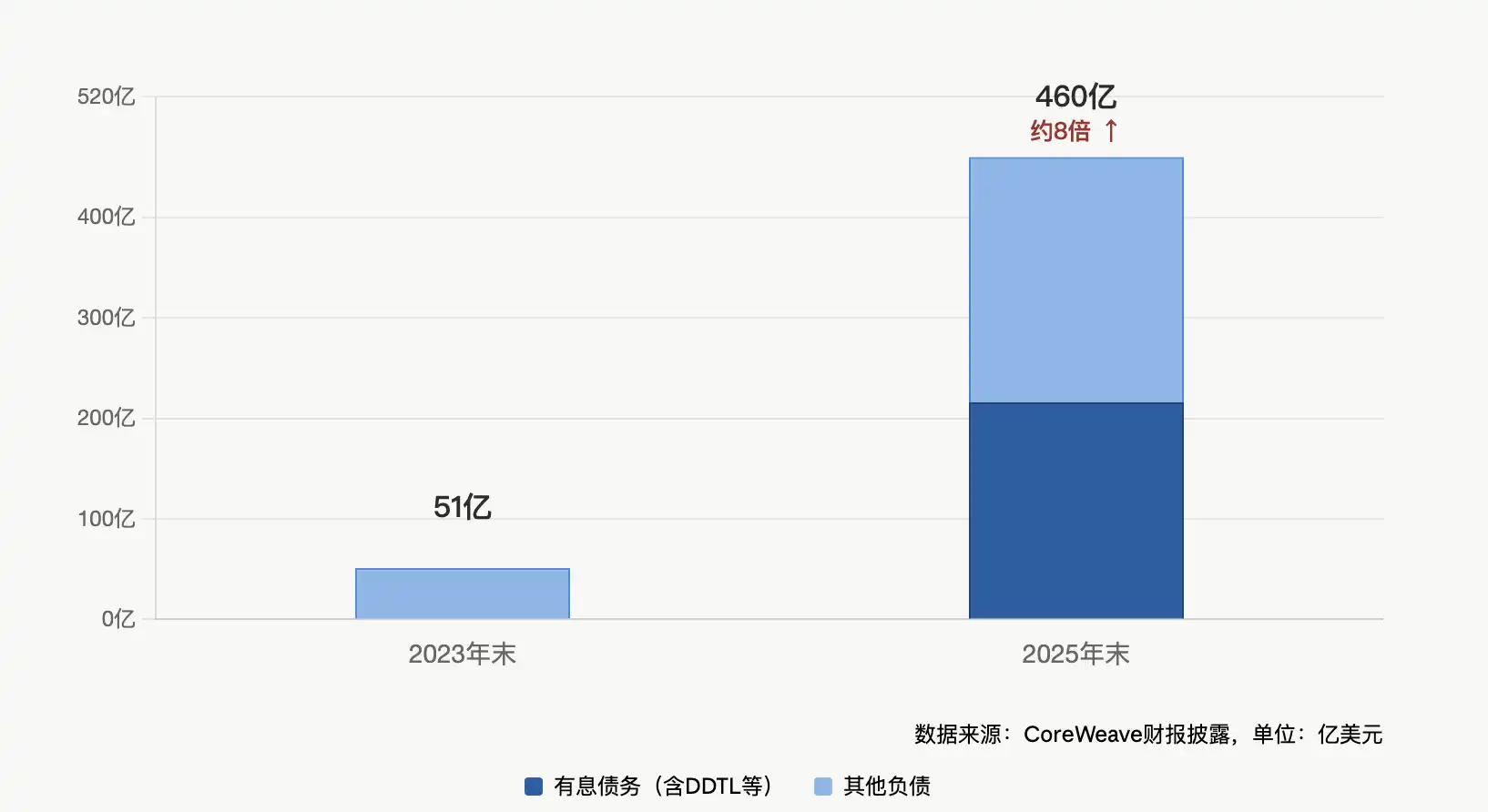
The total debt is already staggering. As of the end of Q1, CoreWeave's total debt stood at approximately $25 billion. Relative to the company's current annualized revenue level, this leverage is significantly higher than that of traditional cloud service providers. Morgan Stanley data shows that CoreWeave's debt financing for the full year 2025 amounted to about $11.8 billion, far exceeding its equity financing of about $1.5 billion. The company's core expansion tool is the DDTL, a "book first, finance later" model that uses order contracts as collateral to secure bank financing for GPU procurement.

The sharpest criticism comes from profit quality. Although management repeatedly emphasized the 56% EBITDA margin, the adjusted operating margin was only 1%. The "real" gross margin after deducting technology and infrastructure costs was about 4%, showing compression both sequentially and against market expectations. Intrator attributed this on the earnings call to the temporary effect of rapid scaling, where the dilution effect on margins from newly added capacity is immense when a company expands dramatically from a 1-gigawatt operational scale. He promised this was the "margin low point" and that margins would gradually recover in future quarters.

But the market is currently unwilling to pay for this promise. While analysts from Morgan Stanley and Jefferies gave positive reviews, CoreWeave has experienced short-term pullbacks after each earnings report previously, with this decline being one of the steeper post-earnings drops.
Insider Selling Continues, Mirroring Duan Yongping's Bottom-Fishing

Around the earnings release, CoreWeave insiders maintained their selling pace. CEO Mike Intrator sold 307,693 shares in late April; co-founders Brian Venturo and Chen Goldberg also recorded sales; institutional shareholder Magnetar Financial had previously sold over $300 million worth. Latest disclosures show that another major shareholder recently sold approximately 1.2 million shares.

This forms a stark contrast with Duan Yongping's position-building in Q4. According to a 13F filing disclosed by H&H International Investment in February 2026, Duan Yongping established his first position in CoreWeave of 299,900 shares in Q4 2025, at a time when the stock had retreated more than 65% from its highs, and market concerns over its debt structure had peaked.

It's noteworthy that CoreWeave accounts for only 0.12% of Duan Yongping's total H&H holdings, constituting a "small pilot" position. In the same quarter, Duan massively increased his stake in Nvidia by over 1110% and established new positions in Credo Technology (high-speed connectivity) and Tempus AI (AI healthcare). These three new AI positions combined account for less than 0.3% of his portfolio. This indicates Duan's true heavy bet is Nvidia itself, with CoreWeave being more like a small extension of his bet on the downstream AI computing power supply chain.

The Crucial Question Now: Inflection Point or Trap?

Intrator posed a somewhat emotional rhetorical question during the Q&A session: "I've always felt that everyone is staring at the stock price tree and missing the entire forest."

This statement aptly summarizes the current bull-bear standoff. Bulls see a forest of nearly $100 billion in contract backlog, a diversified customer base, a triple-binding relationship with Nvidia, and an upgraded credit rating. Bears see a tree of 1% operating margins, widening net losses, aggressive capital expenditures, and persistent insider selling.

CoreWeave's stock price is still up nearly 80% year-to-date and has gained over 200% since its IPO. But when the bull case for a stock rests on a distant narrative and the bear case on current numbers, every earnings report becomes a battleground for these two narratives. Duan Yongping previously stated in an interview with Fang Sanwen: "AI is a massive revolution brought about by a qualitative leap in computing power, with an impact potentially exceeding that of the internet and the industrial revolution. There is a clear AI bubble now, and 90% of companies may be eliminated, but the survivors will become the next-generation giants." His 0.12% light position itself acknowledges the uncertainty of this gamble.

The next test is already clear: the Q2 earnings report. If the operating margin does not recover as promised by management, the credibility of the "forest" narrative will face a genuine stress test.


Related Questions

QWhat were the key highlights and concerns from CoreWeave's Q1 2026 earnings report?

ACoreWeave's Q1 2026 revenue was $2.08 billion, up 112% year-over-year and exceeding expectations. However, the company's net loss widened to $740 million and it provided weaker-than-expected Q2 revenue guidance. A major concern was the adjusted operating profit margin collapsing to just 1%, despite a high adjusted EBITDA margin of 56%, due to surging technology and infrastructure costs.

QWhat are the main arguments of the bulls (optimists) and bears (pessimists) on CoreWeave?

ABulls are optimistic due to CoreWeave's massive $99.4 billion Remaining Performance Obligations (RPO), deep strategic and financial ties with NVIDIA, a diversified and growing client base including Anthropic and Meta, and recent credit rating upgrades. Bears are pessimistic because the company is scaling unprofitably, with operating margins near zero, rapidly escalating capital expenditures and debt (now ~$25 billion), and persistent insider selling by executives and major shareholders.

QWhat is the significance of Duan Yongping's (段永平) investment in CoreWeave, and how does it contrast with insider activity?

ADuan Yongping, a well-known value investor in China, initiated a small position in CoreWeave (worth ~$20 million, ~0.12% of his portfolio) in Q4 2025 when the stock was near its yearly low. This 'dip-buying' action contrasts sharply with recent and ongoing insider selling by CoreWeave's CEO, co-founders, and major institutional shareholders like Magnetar Financial. Duan's position is seen as a high-conviction, speculative bet on the AI infrastructure theme, while insider sales raise questions about near-term confidence.

QHow is CoreWeave financing its aggressive expansion, and what are the associated risks?

ACoreWeave is financing its massive GPU procurement and data center build-out primarily through debt, specifically a novel 'Delayed Draw Term Loan (DDTL)' structure secured by its customer contracts. The company raised $8.5 billion in such debt in Q1 alone. The major risk is the rapid ballooning of its total debt to approximately $25 billion, leading to high interest expenses. This 'asset-light, contract-heavy' model creates significant financial leverage, making the company highly sensitive to execution risks and potential slowdowns in AI demand.

QWhat is the critical test for CoreWeave's investment narrative according to the article?

AThe next critical test is the Q2 2026 earnings report. Management, particularly CEO Michael Intrator, has promised that Q1 represented the 'low point' for operating margins and that profitability should improve in subsequent quarters. If the Q2 report fails to show a meaningful rebound in operating profit margins, the company's long-term growth narrative (the 'forest') will face severe credibility pressure from the current poor financial metrics (the 'tree'), potentially leading to further significant stock price volatility.

Related Reads

A Nation Blocks Chips, a Giant Buys a Nuclear Power Plant: Why It's Time to Seriously Consider DeAI

**Title: Great Powers Blockade Chips, Giants Buy Nuclear Plants: Why It's Time to Seriously Consider DeAI** In May 2026, the US closed loopholes for Chinese firms to acquire advanced NVIDIA chips via overseas subsidiaries. That same month, Kenya halted a $1B geothermal data center project involving Microsoft, fearing its immense energy consumption. Meanwhile, Huawei announced mass production of its Ascend AI chip. These disparate events underscore a new reality: the competition for computing power ("compute") has escalated beyond the tech industry, becoming a geopolitical and infrastructural battleground. A new era of oligopoly is forming, with control over the AI stack—from GPU chips (NVIDIA) and cloud platforms (AWS, Azure, Google Cloud) to foundational models (OpenAI, Anthropic)—concentrating in a few Western "AI Octopus" corporations. This centralization creates systemic risks: pricing power and platform lock-in for users, infrastructure fragility, and a widening "compute divide" that threatens to marginalize nations without independent AI capacity. An "AI Iron Curtain" is deepening through export controls. In response, some nations like Saudi Arabia and the UAE are investing heavily to buy compute power, aiming to transition from oil to AI economies. The EU seeks to triple its compute capacity by 2030 to reduce dependency. However, the spending gap is vast, with four US tech giants alone planning ~$750B in AI capex for 2026. The race is increasingly constrained by energy, with AI tasks consuming up to 1000x more power than web searches, pushing firms to even acquire nuclear plants. This landscape is fueling interest in Decentralized AI (DeAI). It proposes a third way: using open protocols to coordinate a global network of idle GPUs, independent developers, and data centers, creating an AI infrastructure without a single controlling entity. Leveraging blockchain and cryptographic verification, DeAI aims to break market concentration, disperse energy demands, reduce geopolitical dependencies, and enhance transparency. While still nascent in performance and stability, DeAI's core promise is not immediate superiority but providing a crucial alternative architecture to resist monopoly, censorship, and centralized power. As specialized AI hardware costs fall and open-source models flourish, the window to build this foundation is open. The very existence of such competition serves as a vital check against the inevitable abuse of concentrated power.

marsbit34m ago

A Nation Blocks Chips, a Giant Buys a Nuclear Power Plant: Why It's Time to Seriously Consider DeAI

marsbit34m ago

Outpoll Review: A Prediction Market Platform Built for Active Traders

Outpoll Review: A Prediction Market Platform Built for Active Traders In recent years, prediction markets have grown from a niche sector to a mainstream arena, attracting billions in trading volume and institutional capital. However, the user experience and tools for traders have not kept pace. Outpoll, a new global prediction market platform, aims to fill this gap by providing enhanced trading infrastructure for active and professional traders. Built on standard prediction market principles, Outpoll allows users to trade on the outcome of specific events. It uses fully collateralized contracts with USDC settlement, charges a competitive 0.1% fee per trade, and provides clear settlement rules upfront to minimize disputes. A key focus for Outpoll is its professional-grade trading tools. The platform supports limit and market orders, as well as take-profit and stop-loss orders for open positions—features uncommon in prediction markets. For automated trading, Outpoll offers comprehensive REST and WebSocket APIs, enabling portfolio management, price arbitrage, and integration with existing tools. The platform also features a creator-led market model, where approved experts and community leaders can create and manage markets for niche topics under platform supervision. Its integrated interface combines news feeds directly with trading functions, allowing users to monitor events and manage positions seamlessly. Outpoll launched with a native Android app (available on Google Play) and plans an iOS version later this year. In summary, Outpoll distinguishes itself with trader-focused tools, practical APIs, transparent and collateralized markets, integrated news, and an expanding creator program. For active traders, its advanced order types and API access alone make it a platform worth watching. Outpoll is now globally accessible via outpoll.com and Google Play.

marsbit43m ago

Outpoll Review: A Prediction Market Platform Built for Active Traders

marsbit43m ago

Bitwise: Crypto Becomes a Contrarian Investment, Three Logics to Understand the Current Market

**Summary** Matt Hougan, Bitwise's CIO, analyzes the current crypto market through three key lenses, arguing it has shifted from a momentum-driven to a contrarian investment. **1) Crypto Becomes a Contrarian Play:** The market is weak, with major assets like Bitcoin and Ethereum down significantly. Capital has moved to hot sectors like AI, leaving crypto as an "unloved" asset class. This transforms crypto investing from trend-following to a test of patience and fundamental analysis. Investors now favor projects with solid fundamentals (e.g., Hyperliquid) over speculative ones. **2) Regulatory Overhang:** The uncertain fate of the U.S. CLARITY Act, a major crypto regulatory framework, is a key headwind. With its passage in 2024 seen as far from guaranteed (estimates range from 30-55%), institutional capital remains on the sidelines, choosing less risky alternatives like AI stocks. The market needs clarity—whether the bill passes or fails—more than any specific outcome to move decisively. **3) Capital Rotates to New Fundamentals:** This cycle differs from past bear markets where money fled to Bitcoin. Now, capital seeks smaller assets with strong use cases. While major cryptos fell in May 2024, tokens like Hyperliquid (+72%), Zcash (+50%), and XLM (+44%) rallied on their specific fundamentals. This rotation confirms the new contrarian, fundamentals-driven logic and signals the bear market may be in its later stages. **Conclusion:** Short-term pressure persists due to regulatory uncertainty and competition from AI narratives. Investing in crypto now requires a contrarian mindset—acting against the crowd and focusing on fundamental value. Patience and targeting high-quality projects based on their merits are essential for capturing long-term gains.

marsbit1h ago

Bitwise: Crypto Becomes a Contrarian Investment, Three Logics to Understand the Current Market

marsbit1h ago

ChatGPT Might Be Disappearing Soon

OpenAI announced at its "Intelligence at Work" event that its coding assistant, Codex, will be fully integrated into the ChatGPT app within weeks. This move marks a strategic shift from a conversational AI (Chat) towards a unified "agentic" platform capable of execution. Codex, originally launched to compete with Anthropic's Claude Code, has grown rapidly to 5 million weekly active users, with 20% being non-developers like analysts and designers. Its enterprise revenue now constitutes 40% of OpenAI's total. The integration is the first step in creating a super-app combining ChatGPT (interface), Codex (execution engine), and the Atlas browser (web access). OpenAI also unveiled new Codex features: specialized Agent plugins for six professional roles, an "Annotations" tool for direct document editing, and a "Sites" function to turn work into shareable web apps. Internally, this reflects a power shift; the Codex team now leads core product strategy. While the ChatGPT brand remains for its vast user base, the platform's future is focused on autonomous agents that perform tasks, not just chat. The article notes that competition with Claude Code pushed OpenAI's development, with Codex competing on cost-effectiveness and accessibility rather than raw coding quality. It concludes that the essence of "ChatGPT" is evolving from a chatbot into an AI agent platform, with the name potentially becoming a legacy symbol of its original function.

marsbit1h ago

ChatGPT Might Be Disappearing Soon

marsbit1h ago

Trading

Spot
Futures
活动图片




