Circle Author: Hu Tao, ChainCatcher
H&H International Investment LLC, the family wealth management firm of renowned investor Duan Yongping, often referred to as the "Chinese Buffett," recently filed its Q1 13F holdings report with the U.S. SEC for the period ending March 31, 2026.
According to the report, the total market value of Duan Yongping's investment portfolio grew significantly from $17.49 billion last quarter to $20.004 billion. While continuing to hold heavy positions in Apple (AAPL), Berkshire Hathaway (BRK.B), and NVIDIA (NVDA), a new name has drawn the joint attention of both the crypto industry and value investors: stablecoin giant Circle (NYSE: CRCL).
Although the initial purchase amount of $19.08 million represents only 0.2% of Duan Yongping's vast portfolio, the signal it sends is highly symbolic. For a veteran value investor who has always invested only in businesses that are "understandable, have a moat, and generate good cash flow," the logic behind buying Circle is worth pondering.
From Exclusion to Acceptance
It is well known that Duan Yongping is one of China's most successful entrepreneur-investors and one of the very few Chinese investors who have truly practiced Buffett-style value investing long-term with great success.
However, Duan Yongping has long maintained a cautious attitude towards blockchain and Web3. Over the past few years, he has rarely publicly participated in the Web3 frenzy and has not frequently discussed concepts like NFTs, DeFi, or public blockchains as some tech investors have. He has also shown no significant interest in Bitcoin during its multiple boom-and-bust cycles.
This is actually not surprising. Duan Yongping's core investment framework is essentially closer to the Buffett system: it emphasizes long-term cash flow, understandability of the business model, brand and channel moats, and management quality. He particularly favors companies with strong consumer mindshare, high free cash flow, and long-term compounding ability, such as Apple, Kweichow Moutai, and Berkshire Hathaway.
However, most crypto projects in the past have found it difficult to meet these criteria.
Many Web3 projects have been highly dependent on token price movements, with fragile business models and unsustainable cash flows; the industry has long been accompanied by regulatory uncertainty, governance chaos, and cyclical bubbles. These characteristics are almost inherently at odds with the "certainty" emphasized by traditional value investors.
But Circle is an exception. Compared to many crypto projects that rely on "storytelling" or speculation to sustain valuations, Circle is more like a typical financial infrastructure company.
Why Circle?
Circle's core business is not "speculating on crypto," but issuing the stablecoin USDC and earning interest income through reserve assets like U.S. Treasuries. Its profit model is actually closer to that of a money market fund, a payment clearing platform, or even a "digital dollar bank."
This also means its revenue source is highly predictable. And Circle's latest Q1 2026 earnings report further reinforces this point.
The report shows that Circle's total Q1 revenue reached $694 million, a 20% year-on-year increase, with 94% coming from reserve interest income; adjusted EBITDA reached $151 million, a 24% year-on-year increase.
More crucially, its core business metrics are still expanding rapidly: USDC circulation reached $77 billion, up 28% year-on-year; USDC on-chain transaction volume reached $21.5 trillion, a staggering 263% year-on-year surge.
This means Circle has formed a relatively complete "stablecoin interest machine." Under the U.S. high-interest-rate cycle, the interest income generated from USDC reserves is growing rapidly, making Circle one of the few large companies in the crypto industry that truly has stable cash flow and can sustain profitability.
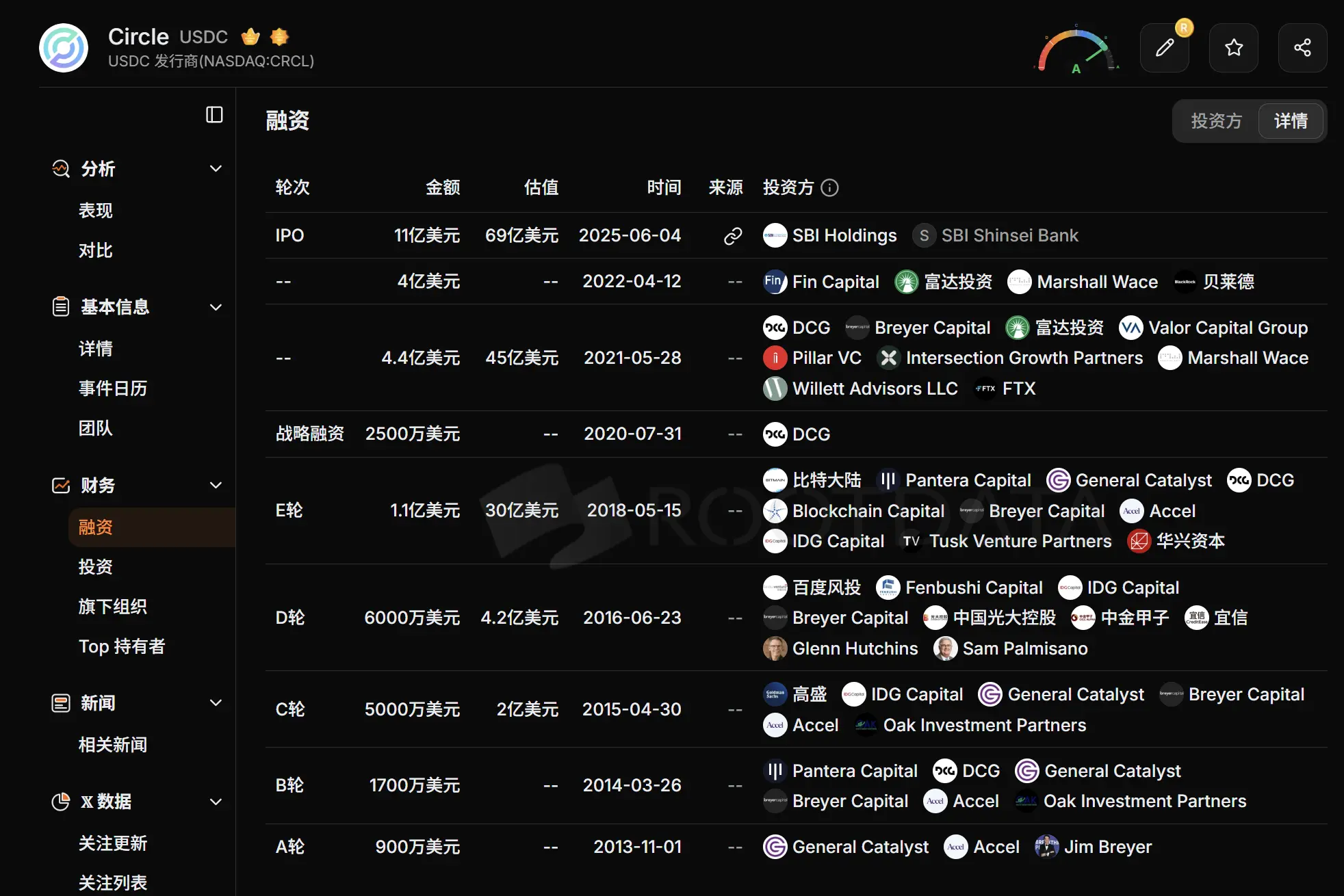
Circle's Financing History Source: RootData
For an investor like Duan Yongping who emphasizes the "essence of business," Circle has finally begun to take on a "understandable" form.
At the end of April, Circle also announced that its Layer 1 network, Arc, completed a token pre-sale financing round of $222 million, valuing it at $3 billion. a16z led a $75 million investment, with participation from more than ten institutions including BlackRock, Apollo Funds, Intercontinental Exchange (ICE), Standard Chartered Ventures, ARK Invest, and Bullish.
The expansion into the public chain network and the issuance of a native token have further opened the ceiling for Circle's business, and its stock price has risen accordingly. In May, Circle's stock price surged nearly 3 times from its yearly low ($50), briefly breaking through $140, and has since retreated slightly to around $111.
Traditional Finance is Increasingly Accepting Crypto Assets
Today, more and more crypto companies are attempting IPOs. From exchanges and stablecoin issuers to on-chain payment and custody infrastructure, many crypto enterprises are actively entering traditional capital markets, hoping to gain more stable financing channels, a broader institutional shareholder base, and stronger regulatory legitimacy.
At the same time, traditional financial giants are also entering the crypto space at an unprecedented pace. Whether it's BlackRock promoting Bitcoin ETFs, traditional banks exploring stablecoin settlement and on-chain asset custody, or payment institutions integrating with the USDC network, it essentially illustrates one thing:
The crypto industry is no longer just an independently existing "alternative market," but is beginning to integrate deeply with the global financial system.
In this process, stablecoin companies like Circle are becoming the bridge most easily understood and accepted by traditional capital.
The significance of Duan Yongping's purchase of Circle lies precisely here. It may not mean he is fully bullish on Web3, nor does it mean the value investing system is embracing all crypto assets. But at the very least, it shows that stablecoins and the on-chain dollar system have begun to enter the "circle of competence" of some traditional top-tier investors.
From a broader perspective, Circle is just one of the pioneers being "translated" by traditional mainstream capital from the crypto industry. As regulatory frameworks gradually become clearer, infrastructure matures, and profit models are continuously validated, more crypto-native enterprises like Circle will likely enter the view of traditional capital markets in the future.






