Duan Yongping, CZ, Mar-a-Lago... What Have Crypto KOLs Been Talking About in the Past 24 Hours?

比推Published on 2026-02-19Last updated on 2026-02-19

Abstract

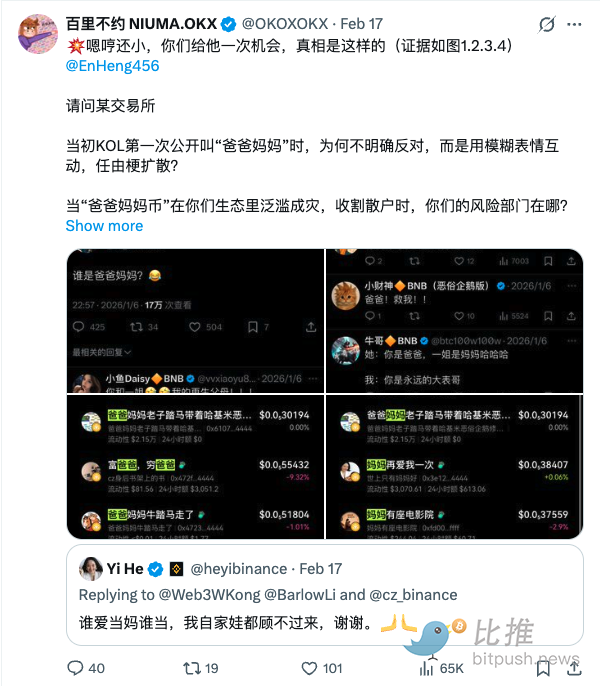
Over the past 24 hours, Chinese crypto KOLs on X (formerly Twitter) have been actively discussing several key topics. Legendary investor Duan Yongping’s investment moves drew significant attention. His fund, H&H International Investment, held a portfolio worth approximately $17.5 billion at the end of 2025. In Q4, he made a major 11x increase in his Nvidia position, signaling strong confidence in AI computing demand. He also added to his holdings in Pinduoduo and Berkshire Hathaway, while reducing exposure to Apple, Alibaba, and Occidental Petroleum. A controversy emerged around Binance founder CZ (Changpeng Zhao) unfollowing a well-known KOL, "Enheng." Their relationship, which began with CZ helping Enheng profit in early 2025, reportedly soured due to the latter's "bootlicking" and other controversial actions, highlighting the fragile, interest-driven nature of relationships within the crypto circle. Amid the bear market, a common sentiment among discussions was the strategy of "buying when there is silence" and practicing dollar-cost averaging (DCA) into assets like Bitcoin. Many expressed belief that patience and faith in the long-term value of crypto would eventually be rewarded. Finally, the exclusive, invitation-only World Liberty Forum (WLFI) summit, held at Mar-a-Lago and supported by the Trump family, was a hot topic. High-profile attendees included executives from Goldman Sachs, Nasdaq, Coinbase, and Binance. The native token of the event's organizer, WLFI, su...

Sleep in on the third day of the Lunar New Year, then catch up on some reading.

What have the KOLs in the crypto space been talking about in the past 24 hours—

Note: The following content is compiled from the X platform and represents personal opinions. It does not represent the stance of this platform and should not be considered investment advice.

Details of Legendary Investor Duan Yongping's Holdings

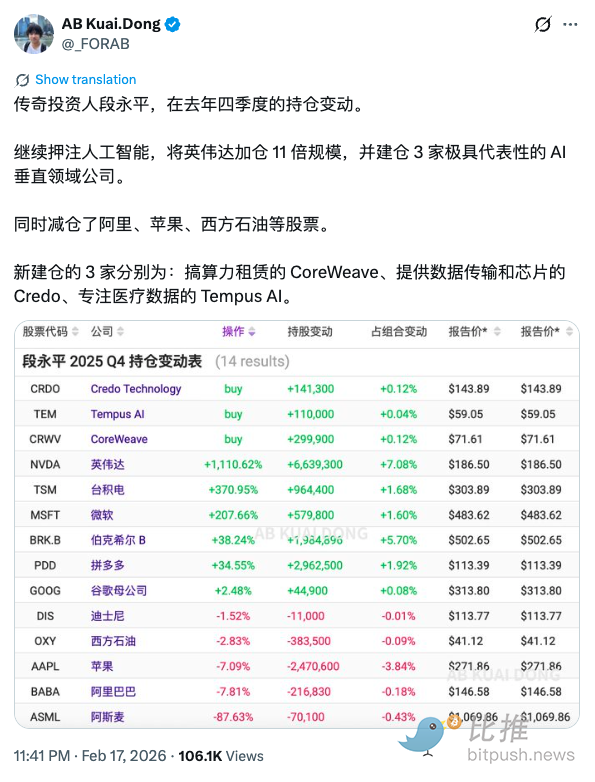
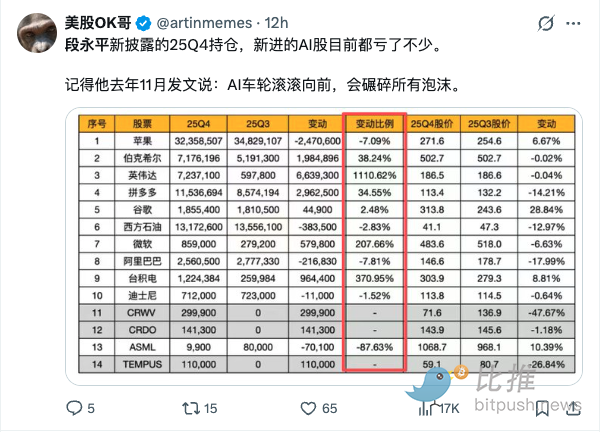
Editor's Note: As of the end of 2025, the total market value of holdings managed by Duan Yongping's H&H International Investment was approximately $17.489 billion, equivalent to over RMB 120 billion. Overall, H&H International Investment holds 14 companies, including Apple, Berkshire Hathaway, NVIDIA, Pinduoduo, and others.

In the fourth quarter of 2025, Duan Yongping significantly increased his holdings in NVIDIA, as well as added to his positions in Pinduoduo and Berkshire Hathaway, while also taking new small positions in three AI-related companies. Meanwhile, he reduced his holdings in Apple, Alibaba, Occidental Petroleum, and others.
Popular replies:

Unlike Buffett, Duan Yongping has a very open mindset towards new tech trends;

Judging from the 13F and stock price, Duan Yongping's investment in Occidental Petroleum (OXY) is likely at a floating loss and not yet profitable;

As someone who's in San Francisco every day, he really dared to invest in corewave;

Duan Yongping increased his NVIDIA holdings by 11 times—this signal is clear enough. He has always had a concentrated, non-diversified style, showing strong confidence in AI computing demand;

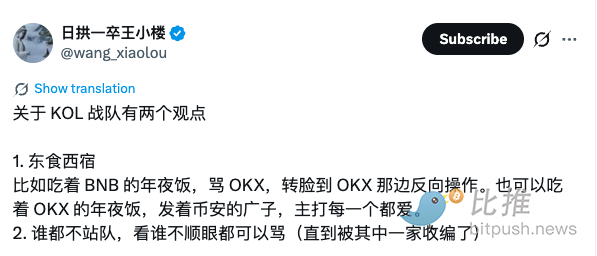
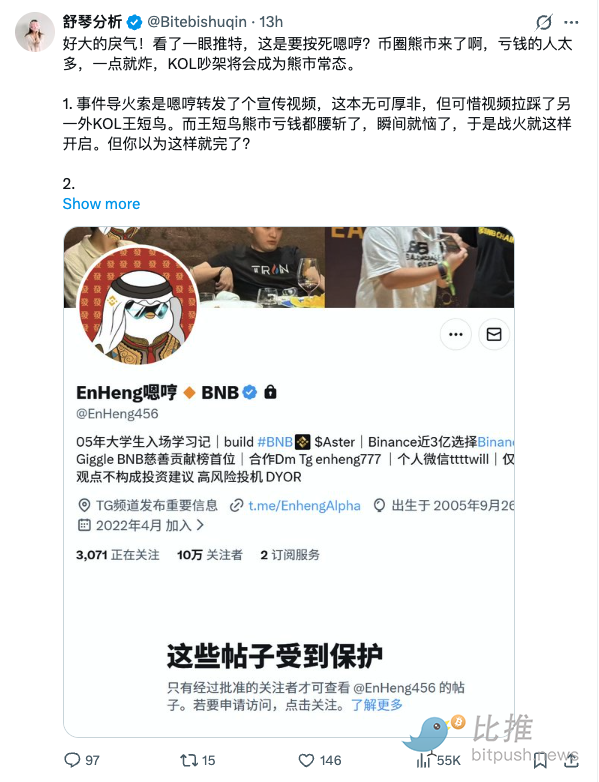
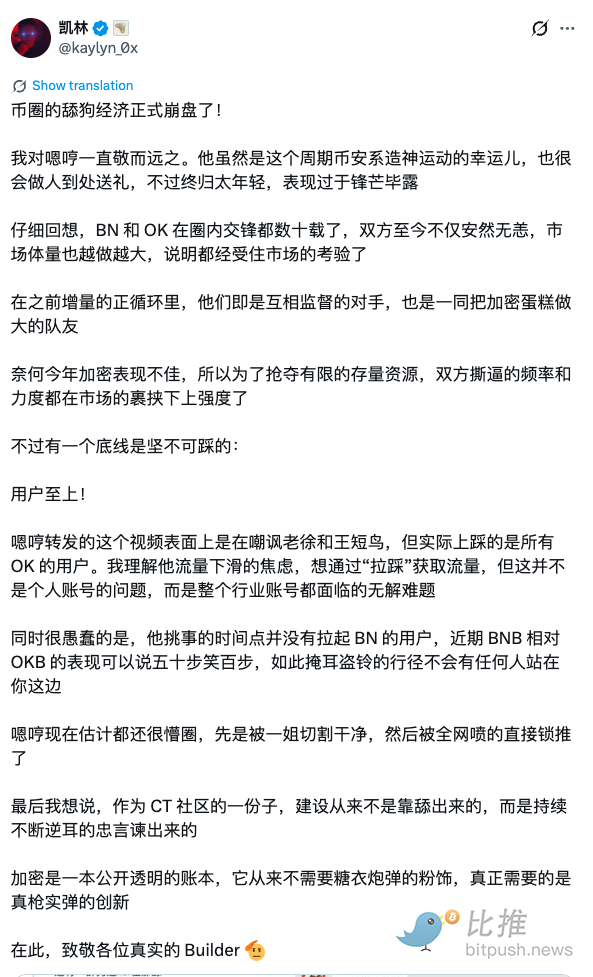
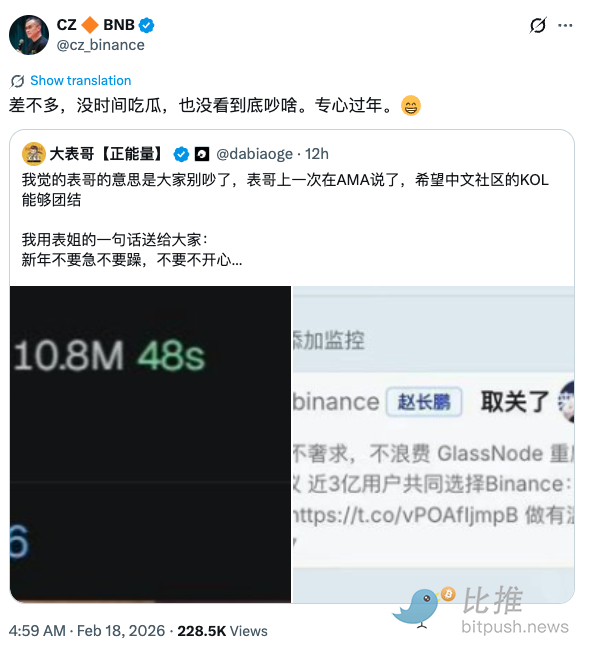
CZ Unfollows a "Well-Known" KOL, Sparking Controversy

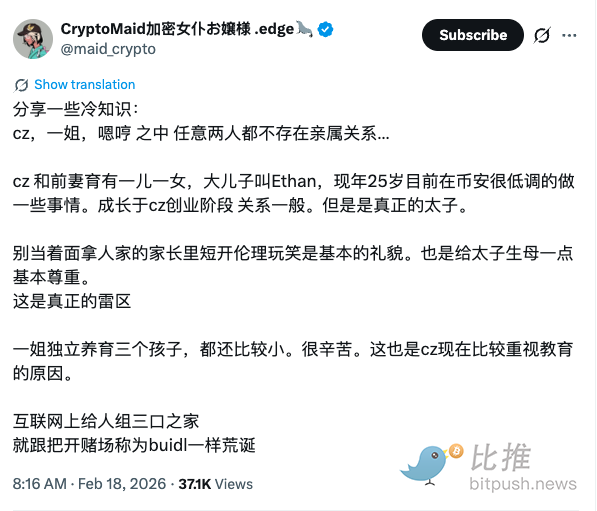
Editor's Note: The shift from CZ's interactions with Enheng in early 2025 (CZ reposting to help him profit) to the current split (unfollowing due to Enheng's bootlicking and a series of puzzling actions) reflects the fragile relationships driven by interests in the crypto circle. Enheng's rise relied on CZ's halo, but controversy and失控的舆论 accelerated the collapse of his "crown prince" aura.
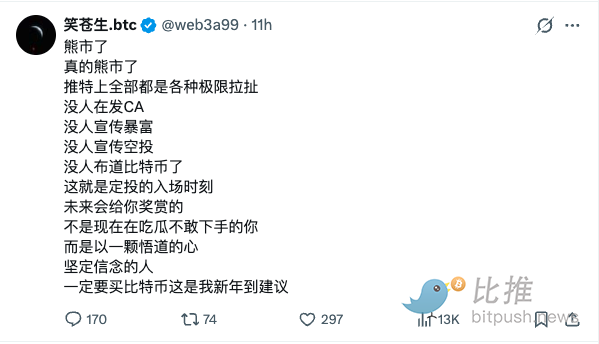
Bear Market Reflection: Buy When No One is Interested?
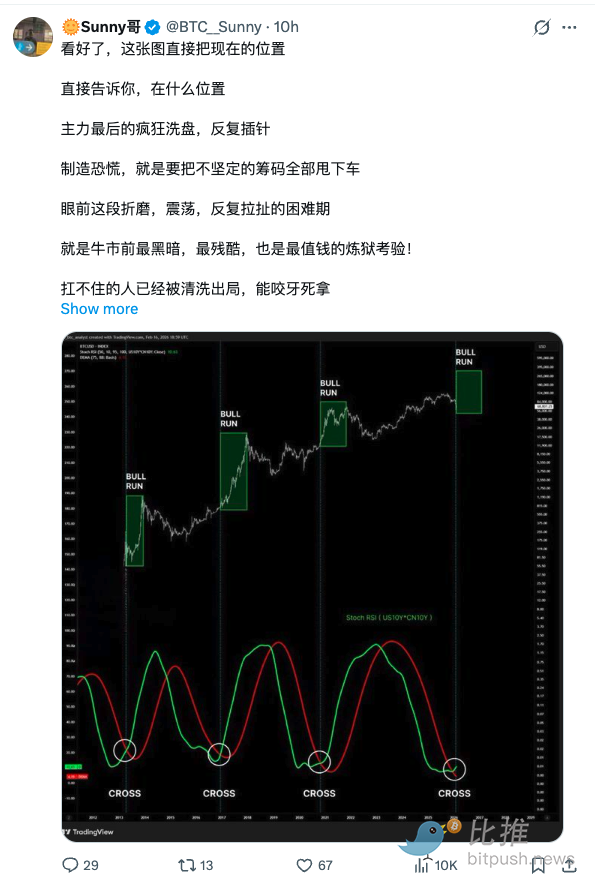
Popular replies:

It's a bear market. Unless it's a project with certain outcomes, it's really better to DCA into BTC at the right price. The power of belief will eventually bring you returns and not辜负 your efforts.

DCA slowly, be friends with time, and good results will follow.

Mar-a-Lago WLFI Summit

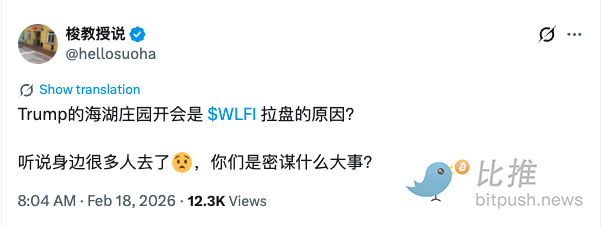
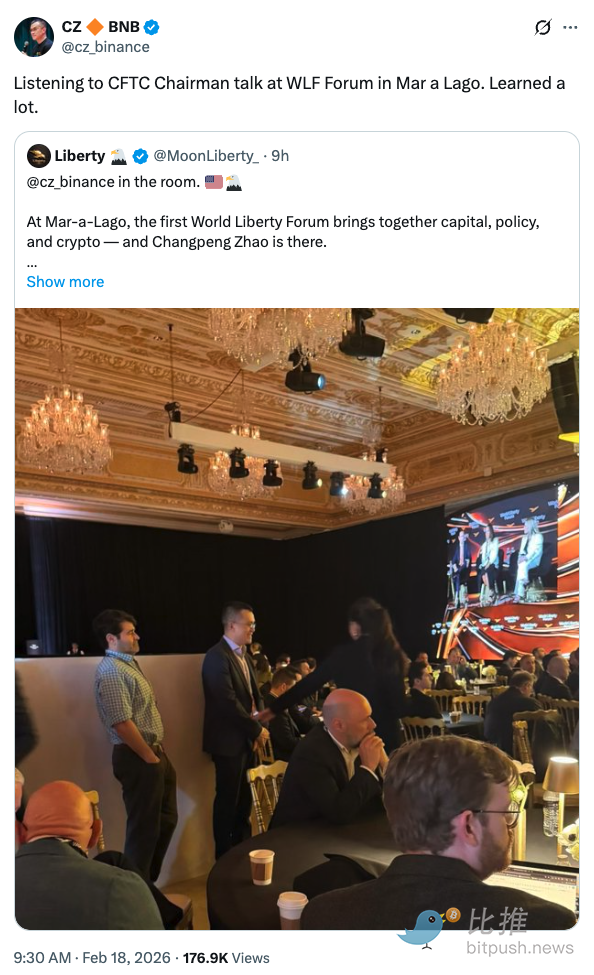
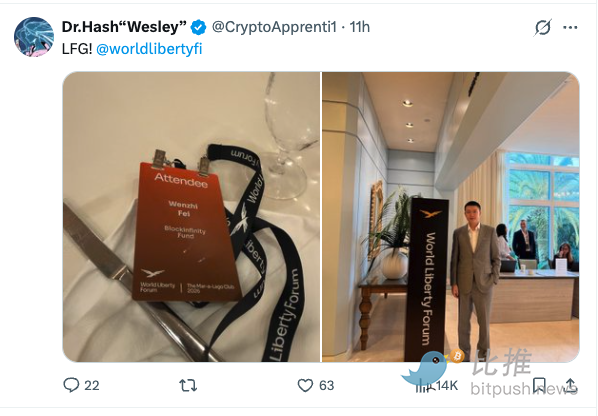
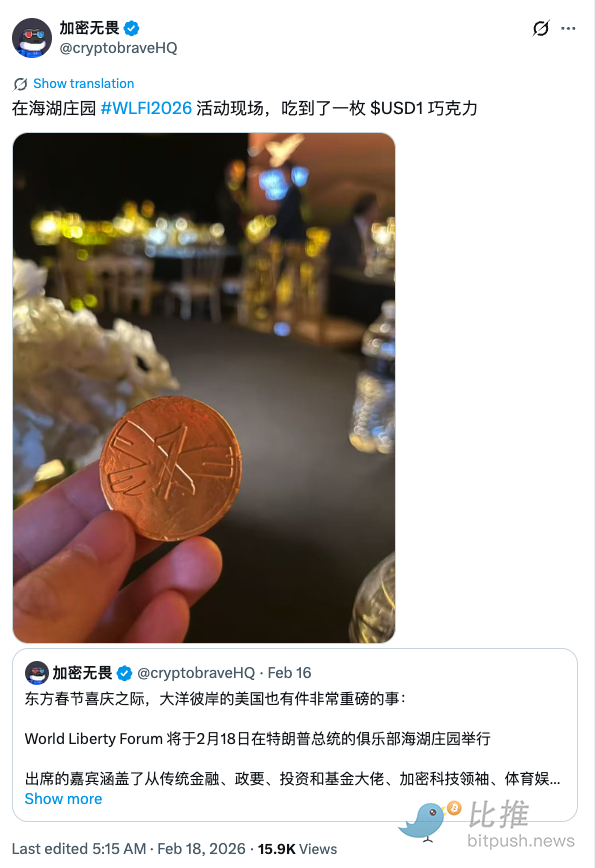
The World Liberty Forum is an invitation-only closed-door summit hosted by the Trump family-supported DeFi protocol World Liberty Financial (WLFI). Attendees included Goldman Sachs CEO David Solomon, Nasdaq Chair Adena Friedman, Coinbase founder Brian Armstrong, Binance's CZ, and others. Many Chinese-speaking KOLs were also invited and shared from the scene. Possibly influenced by this news, WLFI rose over 22% in 24 hours.
Twitter:https://twitter.com/BitpushNewsCN

BitPush TG Discussion Group:https://t.me/BitPushCommunity

BitPush TG Subscription: https://t.me/bitpush

Original link:https://www.bitpush.news/articles/7612948

Related Questions

QWhat were the key changes in Duan Yongping's investment portfolio in Q4 2025?

AIn Q4 2025, Duan Yongping significantly increased his holdings in NVIDIA, Pinduoduo, and Berkshire Hathaway. He also made small new investments in three AI-related companies. Meanwhile, he reduced his positions in Apple, Alibaba, and Occidental Petroleum.

QWhy did CZ unfollow the well-known KOL 'Enheng' on social media?

ACZ unfollowed the KOL 'Enheng' due to a series of controversial actions, including excessive flattery, which led to a breakdown in their previously beneficial relationship that had helped Enheng gain profits and prominence earlier in 2025.

QWhat investment strategy is suggested for a bear market according to the crypto KOLs discussed?

AThe suggested strategy for a bear market is to gradually dollar-cost average into Bitcoin (BTC) at appropriate price levels, emphasizing patience and long-term faith in its value rather than chasing uncertain projects.

QWhat is the World Liberty Forum (WLFI) and who were some notable attendees?

AThe World Liberty Forum is an invitation-only closed-door summit supported by the Trump family and hosted by the DeFi protocol World Liberty Financial (WLFI). Notable attendees included David Solomon (CEO of Goldman Sachs), Adena Friedman (Chair of Nasdaq), Brian Armstrong (Founder of Coinbase), and CZ (Binance).

QHow did the WLFI token perform following the announcement of the summit, and why?

AThe WLFI token increased by over 22% in 24 hours, likely influenced by the announcement of the high-profile summit and the attendance of prominent financial and crypto industry leaders.

Related Reads

Gensyn AI: Don't Let AI Repeat the Mistakes of the Internet

In recent months, the rapid growth of the AI industry has attracted significant talent from the crypto sector. A persistent question among researchers intersecting both fields is whether blockchain can become a foundational part of AI infrastructure. While many previous AI and Crypto projects focused on application layers (like AI Agents, on-chain reasoning, data markets, and compute rentals), few achieved viable commercial models. Gensyn differentiates itself by targeting the most critical and expensive layer of AI: model training. Gensyn aims to organize globally distributed GPU resources into an open AI training network. Developers can submit training tasks, nodes provide computational power, and the network verifies results while distributing incentives. The core issue addressed is not decentralization for its own sake, but the increasing centralization of compute power among tech giants. In the era of large models, access to GPUs (like the H100) has become a decisive bottleneck, dictating the pace of AI development. Major AI companies are heavily dependent on large cloud providers for compute resources. Gensyn's approach is significant for several reasons: 1) It operates at the core infrastructure layer (model training), the most resource-intensive and technically demanding part of the AI value chain. 2) It proposes a more open, collaborative model for compute, potentially increasing resource utilization by dynamically pooling idle GPUs, similar to early cloud computing logic. 3) Its technical moat lies in solving complex challenges like verifying training results, ensuring node honesty, and maintaining reliability in a distributed environment—making it more of a deep-tech infrastructure company. 4) It targets a validated, high-growth market with genuine demand, rather than pursuing blockchain integration without purpose. Ultimately, the boundaries between Crypto and AI are blurring. AI requires global resource coordination, incentive mechanisms, and collaborative systems—areas where crypto-native solutions excel. Gensyn represents a step toward making advanced training capabilities more accessible and collaborative, moving beyond a niche controlled by a few giants. If successful, it could evolve into a fundamental piece of AI infrastructure, where the most enduring value in the AI era is often created.

marsbit10h ago

Gensyn AI: Don't Let AI Repeat the Mistakes of the Internet

marsbit10h ago

Why is China's AI Developing So Fast? The Answer Lies Inside the Labs

A US researcher's visit to China's top AI labs reveals distinct cultural and organizational factors driving China's rapid AI development. While talent, data, and compute are similar to the West, Chinese labs excel through a pragmatic, execution-focused culture: less emphasis on individual stardom and conceptual debate, and more on teamwork, engineering optimization, and mastering the full tech stack. A key advantage is the integration of young students and researchers who approach model-building with fresh perspectives and low ego, prioritizing collective progress over personal credit. This contrasts with the US culture of self-promotion and "star scientist" narratives. Chinese labs also exhibit a strong "build, don't buy" mentality, preferring to develop core capabilities—like data pipelines and environments—in-house rather than relying on external services. The ecosystem feels more collaborative than tribal, with mutual respect among labs. While government support exists, its scale is unclear, and technical decisions appear driven by labs, not state mandates. Chinese companies across sectors, from platforms to consumer tech, are building their own foundational models to control their tech destiny, reflecting a broader cultural drive for technological sovereignty. Demand for AI is emerging, with spending patterns potentially mirroring cloud infrastructure more than traditional SaaS. Despite challenges like a less mature data industry and GPU shortages, Chinese labs are propelled by vast talent, rapid iteration, and deep integration with the open-source community. The competition is evolving beyond a pure model race into a contest of organizational execution, developer ecosystems, and industrial pragmatism.

marsbit12h ago

Why is China's AI Developing So Fast? The Answer Lies Inside the Labs

marsbit12h ago

3 Years, 5 Times: The Rebirth of a Century-Old Glass Factory

Corning, a 175-year-old glass company, is experiencing a dramatic revival as a key player in AI infrastructure, driven by surging demand for high-performance optical fiber in data centers. AI data centers require vastly more fiber than traditional ones—5 to 10 times as much per rack—to handle high-speed data transmission between GPUs. This structural demand shift, coupled with supply constraints from the lengthy expansion cycle for fiber preforms, has created a significant supply-demand gap. Nvidia has invested in Corning, along with Lumentum and Coherent, in a $4.5 billion total commitment to secure the optical supply chain for AI. Corning's competitive edge lies in its expertise in producing ultra-low-loss, high-density, and bend-resistant specialty fiber, which is critical for 800G+ and future 1.6T data rates. Its deep involvement in co-packaged optics (CPO) with partners like Nvidia further solidifies its position. While not the largest fiber manufacturer globally, Corning's revenue from enterprise/data center clients now exceeds 40% of its optical communications sales, and it has secured multi-year supply agreements with major hyperscalers including Meta and Nvidia. Financially, Corning's optical communications revenue has surged, doubling from $1.3 billion in 2023 to over $3 billion in 2025. Its stock price has risen nearly 6-fold since late 2023. Key future catalysts include the rollout of Nvidia's CPO products and the scale of undisclosed customer agreements. However, risks include high current valuations and potential disruption from next-generation technologies like hollow-core fiber. The company's long-term bet on light over electricity, maintained even through the telecom bubble crash, is now being validated by the AI boom.

marsbit12h ago

3 Years, 5 Times: The Rebirth of a Century-Old Glass Factory

marsbit12h ago

Trading

Spot
Futures
活动图片