Don't Just Focus on Yi Lihua, These Whales' Moves During the Crash Are More Worth Watching

Odaily星球日报Published on 2026-02-06Last updated on 2026-02-06

Abstract

Amid a sharp crypto market downturn, Bitcoin fell over 15% in 24 hours, dropping below $60,000, while altcoins suffered even steeper losses. Market fear spiked, with the Crypto Fear & Greed Index hitting 9, indicating extreme fear. The article highlights key whale activities during the sell-off. Notable sellers included Aave founder Stani Kulechov, who sold 4,504 ETH, and Ethereum co-founder Vitalik Buterin, who sold 6,899.5 ETH from a planned donation. Prominent ETH bull Yi Lihua (Trend Research) sold approximately 250,000 ETH, citing risk management. Data also showed whales dumped 81,068 BTC in just eight days. On the buying side, despite the panic, some large players accumulated. "Machi Big Brother" aggressively opened leveraged long positions on ETH and other assets, though some were liquidated. MicroStrategy, a major corporate BTC holder, purchased an additional 855 BTC, reaffirming its long-term strategy and stating it would only face real threat if BTC stayed at $8,000 for years. Similarly, Bitmine, led by Tom Lee, continued buying ETH, adding over 60,000 ETH recently despite significant unrealized losses. On-chain whales were also active, with one entity withdrawing 55,483 ETH from an exchange, indicating strong accumulation during the dip. The contrast between panic selling and strategic buying underscores the divided sentiment among large holders during the market turmoil.

Original | Odaily Planet Daily (@OdailyChina)

Author | Golem (@web3_golem)

Blockchain is killing people again. Bitcoin has been falling for days, dropping over 15% in the past 24 hours at one point, quickly sliding to $60,000, down more than 40% from the October 2025 high, hitting a new low for the phase, and potentially recording its largest single-day drop since the FTX incident in 2022. Altcoins have been hit even harder, with a river of blood. (Related reading: Plunging nearly 20% in a single day, how long has it been since you saw Bitcoin at $60,000?)

Regarding the reasons behind this decline, the market mostly links it to macro-level factors, such as the "Warsh effect" triggered by the new Fed Chair Warsh taking office, the AI capital race sucking liquidity from other global assets, and the escalation of US-Iran tensions.

In addition, there have been many baseless speculations. Because this decline was so smooth, almost without pause, and lacked specific event drivers, many voices speculate whether a major institution has exploded, and a hidden black swan may surface soon. It's like watching a pile of explosives detonate without knowing who lit the fuse. According to Alternative.me data, today's crypto market Fear and Greed Index dropped to 9, in the "Extreme Fear" zone, further declining from the previous day's 12 and last week's 16. Last month, this index was still 42.

"The peak produces虚伪的拥护 (hypocritical supporters), the twilight witnesses the true believers".

The more it is this kind of moment where "analysis fails", the more one can see investors' true thoughts from their positions. While we fear the deep bear is coming, which whales in the market are selling, and who is truly buying the dip on a large scale?

Who is Selling Valuable Coins?

Vitalik and Aave Founder Sell ETH to Cash Out

During the market drop in the early hours of February 6th, Aave founder Stani Kulechov (0x803...c78d) sold 4,504 ETH on-chain at a price of $1,855, converting it into 8.36 million USDC. ETH fell to a low of $1,747 in the early hours of February 6th.
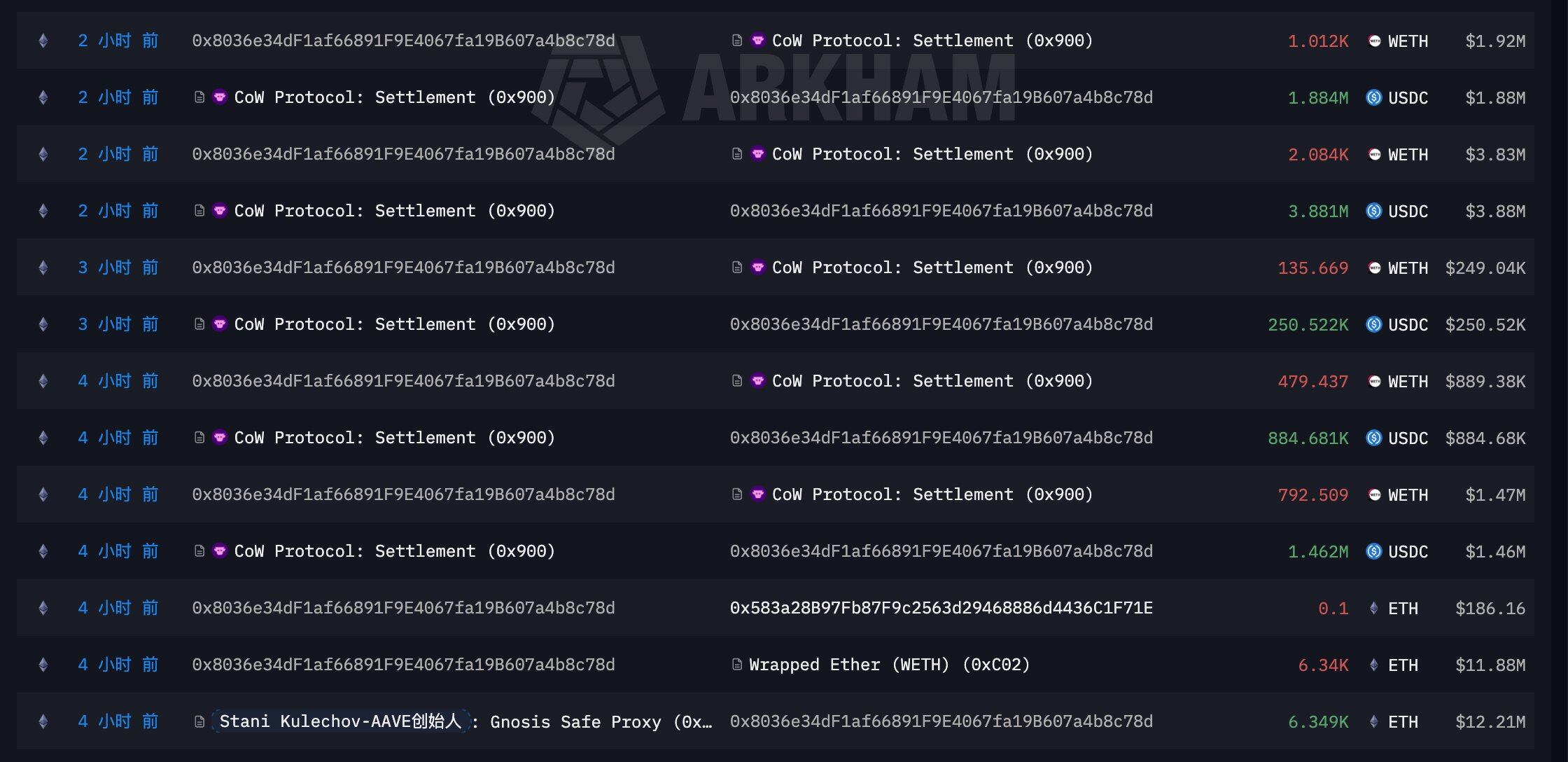
Aave Founder Sells ETH

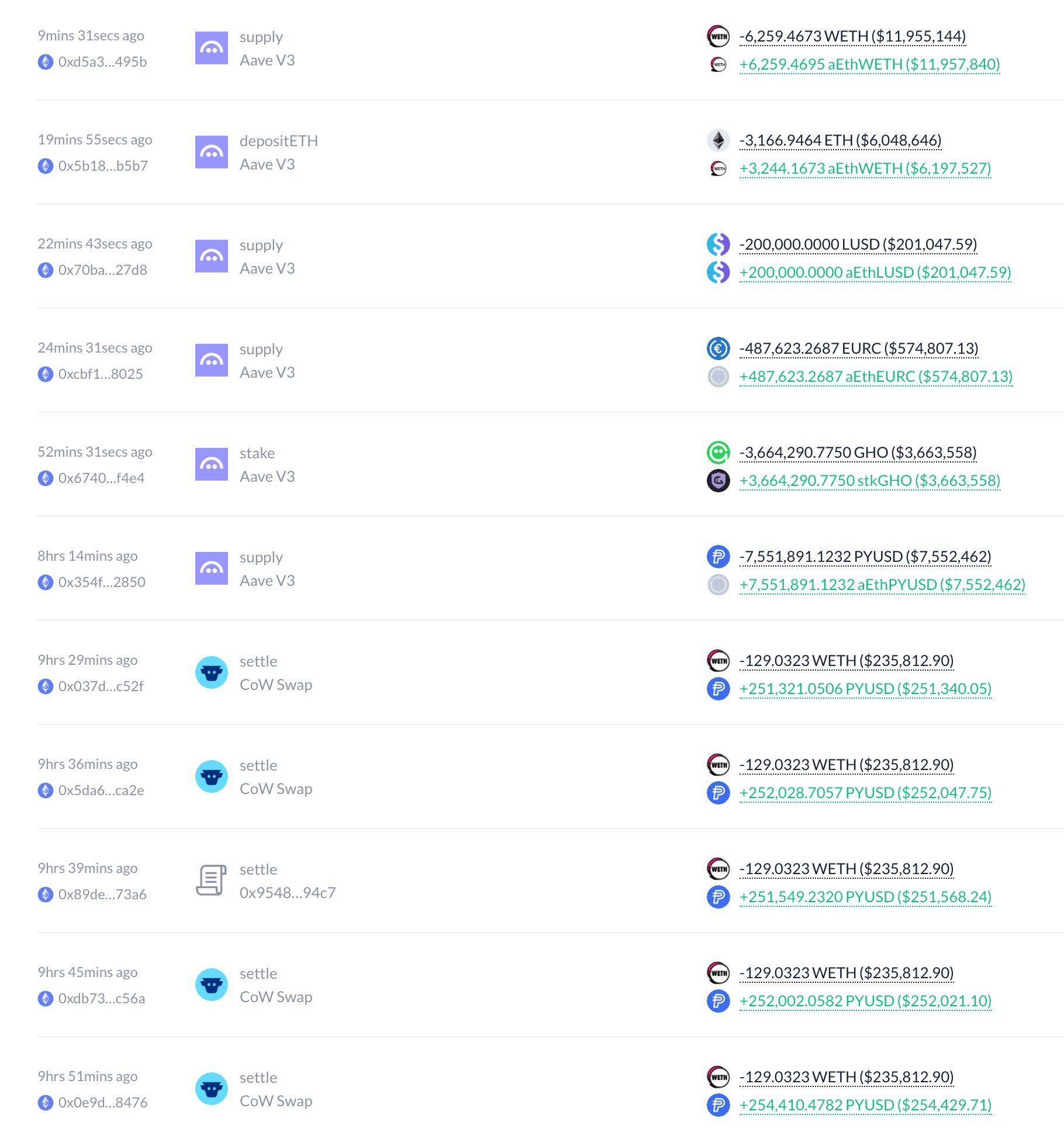
Besides the Aave founder, Ethereum founder Vitalik has also been frequently selling ETH recently. On January 30th, Vitalik posted that he had withdrawn 16,384 ETH for a multi-year donation plan, focusing on supporting an open, verifiable, end-to-end software and hardware technology stack to protect personal life and the public environment.

On February 3rd, Vitalik began selling these ETH, selling 493 ETH that day, worth about $1.16 million. As of February 6th, the sale progress of the 16,384 ETH planned for donation had reached 42.1%, with a cumulative sale of 6,899.5 ETH, totaling $14.15 million, at an average selling price of $2,052. However, Vitalik has deposited the remaining 9,484.5 ETH into Aave, which may mean he does not plan to sell in the short term.
"ETH Mega-Bull" Yi Lihua Falls, Sells About 250,000 ETH

Yi Lihua's Trend Research was one of the most watched ETH bulls in this cycle, and he himself often publicly sang the praises of the bull market on social media, with the community drawing the analogy "Tom Lee in the West, Yi Lihua in the East".

However, as ETH fell, Yi Lihua couldn't hold on either. On February 1st, according to monitoring, Yi Lihua's Trend Research began depositing over 10,000 ETH into Binance. On February 2nd, Yi Lihua posted on platform X admitting that he was indeed too early in being bullish on ETH, the profits from the previous top's sell-off had been wiped out, and he decided to continue waiting for the market to go up while controlling risks.

On February 3rd, he posted again, saying he still看好 (is optimistic about) the new bull market performance, expecting ETH to reach over $10,000 and BTC to exceed $200,000, but recently adjusted some positions to control risks.

This statement may have paved the way for subsequent ETH transfers. As of now, the six publicly known addresses of Trend Research hold only about 396,000 ETH. On February 1st, Trend Research publicly held 650,000 ETH, meaning they sold about 250,000 ETH, worth $554 million. Simultaneously, Yi Lihua's latest liquidation range is between $1,509 and $1,800.

But from firmly buying long to being forced to "cut losses", Yi Lihua's heart must be full of helplessness (无奈).

Whales Sold 81,068 BTC in the Past 8 Days

Besides these celebrities selling their公开 (public) positions, hidden on-chain are also纷纷 "fleeing". According to Santiment statistics, whales holding 10 to 10,000 BTC currently hold 68.04% of the total BTC supply, a new low in 9 months, having sold 81,068 BTC in just the past 8 days.

After the market fell, whales also began to stop losses and卸杠杠 (deleverage). According to monitoring, during yesterday's market drop, a certain whale deposited 10,128 ETH into Galaxy and FalconX, worth $20.44 million. A whale (0xfdd...6a92) holding an ETH lending position on Spark also began selling ETH to stop losses when the ETH price fell to $2,050. This whale累计 (cumulatively) sold 27,800 ETH, repaying $44.14 million in loans.

However, unlike the whales, retail investors are more inclined to buy the dip at this time. According to Santiment statistics, addresses holding less than 0.01 BTC, the "shrimp addresses," hold 0.249% of the total BTC supply, hitting a 20-month high, reflecting retail investors buying on the dip. But it is important to be cautious, as this combination of whale selling and retail buying has historically created bear market cycles.

Who is Silently Buying the Dip

Besides retail investors buying the dip, some faithful large holders/institutions are also buying the dip. According to statistics, after the market fell, Bitfinex margin long positions rose to about 77,100 BTC, hitting a nearly two-year high. This trend shows that there is still明显的 (obvious) leveraged funds buying the dip during the decline. Additionally, the scale of Bitfinex margin longs has grown by about 64% in the past six months,通常被视为 (often seen as) large holders or high-risk preference funds continuously adding positions during periods of market stress.

Well-known trader Eugene Ng Ah Sio also posted on his personal channel, "Buy when there's blood in the streets, even if it's your own."

"Machi" Going Long with Unlimited Bullets

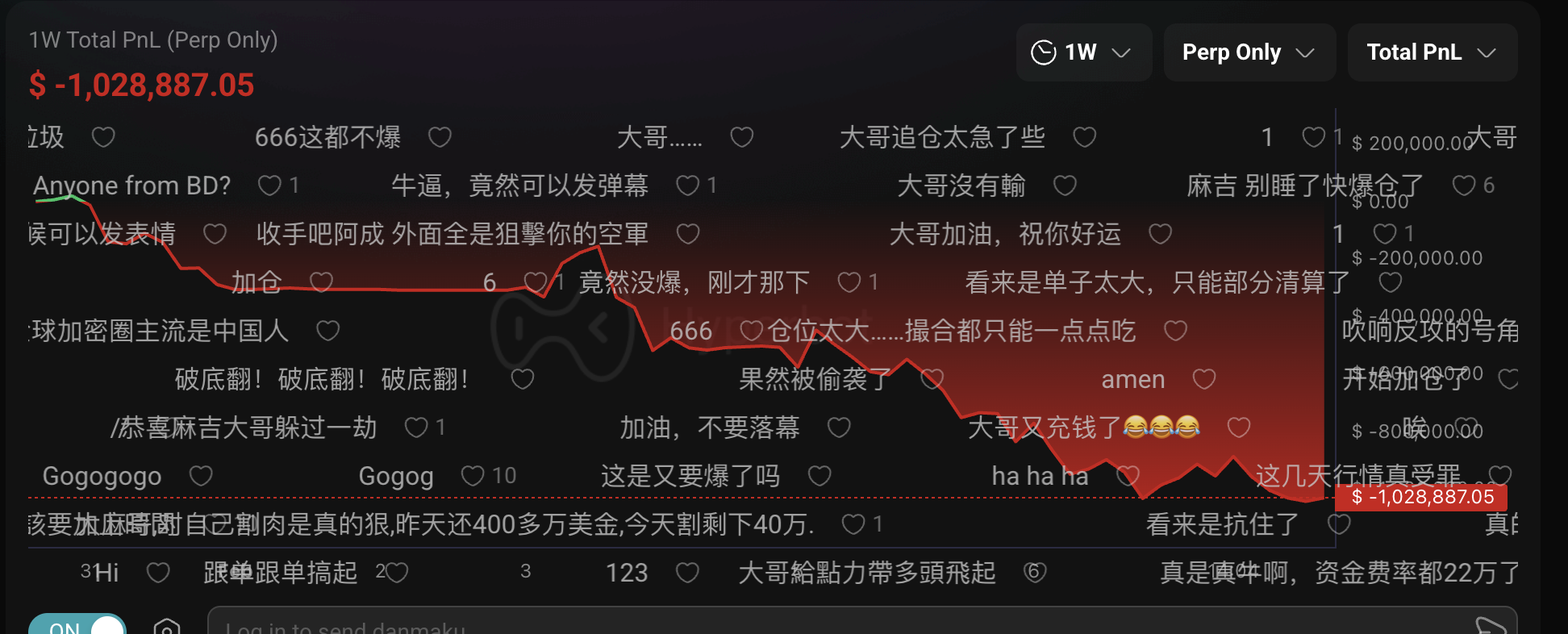
The iron-headed" Machi" is a representative of large holders who go long on the dip. According to monitoring, in the early hours of February 6th, during the market decline, Brother Machi insisted on going long, depositing 250,000 USDC into Hyperliquid, opening a 25x leveraged ETH long, a 40x leveraged BTC long, a 10x leveraged HYPE long, and a 10x leveraged PUMP long. However, the BTC and PUMP long positions were quickly liquidated in the subsequent market drop. The HYPE and ETH long positions were partially liquidated before adding more.

As of now, "Machi" still holds a 25x leveraged Ethereum long position, with a position of 320 ETH, liquidation price $1,841; he also holds a 10x leveraged HYPE long position, with a position of 14,720 HYPE, liquidation price about $31.

This week, Brother Machi had 11平仓 (position closures), of which 3 were profitable and 8 were losses, with a win rate of 27.27%, and a net loss of about $286,000 for the single week. In the hyperbot弹屏 (live screen) comments, there were all voices encouraging Machi.
BTC's Eternal "Backstop" MicroStrategy: Cost Basis $76,052

Fortunately, during the market crash, the largest BTC treasury, MicroStrategy, did not choose to sell. MicroStrategy CEO Phong Le said at the MicroStrategy Q4 financial results webinar that Bitcoin would need to fall to $8,000 and stay at that level for five to six years to pose a real threat to repaying its convertible debt. This means that only then might MicroStrategy sell BTC, which is somewhat reassuring for the market.

Meanwhile, during the market decline earlier this month, MicroStrategy bought another 855 BTC for approximately $75.3 million, at a unit price of about $87,974. As of now, MicroStrategy holds

713,502 BTC, with a total acquisition cost of approximately $54.26 billion, and an average acquisition price of about $76,052. Therefore, at the current Bitcoin price of $66,000, MicroStrategy has a floating loss of over $7.168 billion.

Besides MicroStrategy firmly holding and buying, Japan's largest BTC treasury company, Metaplanet, also expressed faith in BTC on February 6th. Its CEO Simon Gerovich posted on platform X, "Regarding the recent stock price movements and the severe situation faced by shareholders, Metaplanet's strategy remains unchanged. The company will continue to accumulate BTC." But data shows that Metaplanet has not purchased BTC for three consecutive weeks.

ETH's Staunch Supporter Tom Lee: $6.6 Billion Floating Loss is Just a "Small Problem"

Just from the perspective of holding ETH, Tom Lee is显然 (clearly) more resilient than Yi Lihua. His ETH treasury company, Bitmine, not only did not sell ETH but also continued to buy during the market decline.

In the last week of January, when ETH fell to a low of $2,200, Bitmine bought 41,788 ETH that week, worth $96.55 million. Subsequently, Tom Lee said on February 2nd, "The company currently has no debt. Given the strengthening fundamentals of Ethereum, the recent market pullback is极具吸引力 (extremely attractive)", which basically indicates Tom Lee's strategy of buying the dip. On February 3rd, Bitmine bought 20,000 ETH through FalconX, worth $46.04 million.

On February 4th, in response to外界称 (external claims that) Bitmine's ETH holdings had a floating loss of up to $6.6 billion, Tom Lee responded that this was normal. But as of now, Bitmine holds 4,285,125 ETH, with an average cost basis above $3,500. With ETH falling below $2,000, Bitmine's floating loss has exceeded $8 billion.

On-Chain Whales Still Bullish on ETH

For on-chain whales, the declining market is also a rare opportunity to buy the dip. According to monitoring, a whale dormant for 7 months (3M4p1i) began buying the dip after the sharp drop in BTC on February 6th. This whale bought 482 BTC, worth $32.5 million, and currently holds a total of 1,960 BTC, worth $128 million.

Compared to BTC, on-chain whales seem to prefer ETH more. A newly created wallet withdrew 55,483 ETH from WhiteBIT in the past 2 days, worth $115.16 million.

From the evening of February 5th to February 6th, several on-chain whales/institutions also continued to buy ETH. According to Lookonchain monitoring, a wallet associated with Longling Capital withdrew 8,500 ETH from Binance on the evening of February 5th, worth $17.51 million. The whale/institution "7 Siblings" added another 6,923.85 ETH in the early hours when ETH fell below $2,000, about $13.91 million, with an average cost of $2,009.8. The current ETH holding reached 318,508.07. Meanwhile, another whale account spent 28 million USDT to buy 13,837 ETH, with an average purchase price of $2,024, but this whale wallet is also believed to可能属于 (possibly belong to) "7 Siblings".


Related Questions

QWhat are the main reasons mentioned in the article for the recent sharp decline in the cryptocurrency market?

AThe article attributes the decline to macro factors such as the 'Warsh effect' from the new Fed Chair Warsh, AI capital competition draining liquidity from other global assets, and escalating US-Iran tensions. It also mentions unverified speculation about potential institutional failures or hidden black swan events.

QWhich major Ethereum figures sold ETH during the market downturn, and what were their reasons?

AVitalik Buterin sold 6,899.5 ETH (out of 16,384 ETH earmarked for a multi-year donation plan) at an average price of $2,052, and Aave founder Stani Kulechov sold 4,504 ETH at $1,855 to obtain 8.36 million USDC. Vitalik's sale was for a charitable initiative, while Kulechov's was likely a response to market conditions.

QHow did Yi Lihua (Trend Research) respond to the ETH price drop, and what was the impact on his holdings?

AYi Lihua, a prominent ETH bull, admitted to being overly optimistic and sold approximately 250,000 ETH (worth $554 million) to control risk. His public ETH holdings dropped from 650,000 to about 396,000 ETH, with a liquidation range between $1,509 and $1,800.

QWhat actions did some large investors or 'whales' take during the market crash, according to the article?

AWhales sold 81,068 BTC in eight days, reducing their holdings to a nine-month low. However, some, like the entity 7 Siblings, bought significant amounts of ETH (e.g., 69,23.85 ETH at $2,009.8). Retail investors (small addresses) increased their BTC holdings, while Bitfinex margin long positions hit a two-year high, indicating leveraged buying.

QWhich companies maintained or increased their cryptocurrency holdings despite the downturn, and what were their stated strategies?

AMicroStrategy continued buying BTC, adding 855 BTC at $87,974 each, and stated it would only sell if BTC fell to $8,000 for 5-6 years. Bitmine (Tom Lee's firm) bought 61,788 ETH during the dip, despite an $8 billion unrealized loss, citing strong fundamentals. Metaplanet also reaffirmed its commitment to accumulating BTC.

Related Reads

STAR 50 Soars 10.73%, Why Did A-Shares Stage a "V-Shaped Reversal"?

After a prolonged decline, the Chinese A-share market staged a strong rally on July 21. The STAR 50 index surged 10.73%, its largest single-day gain in nearly a year, leading a broad-based "V-shaped" reversal. The Shanghai Composite Index rose 1.79%, the Shenzhen Component Index gained 4.81%, and the ChiNext Index jumped 7.05%. Total market turnover reached 2.97 trillion yuan, an increase of 256.1 billion yuan from the previous session, with over 3,100 stocks advancing. The semiconductor sector spearheaded the rebound, with related ETFs posting significant gains. Analysts attribute the surge to three converging factors. First, coordinated capital inflows from "national team" institutions, insurance funds, listed company buybacks, and fund house self-purchases have bolstered market liquidity and confidence. Second, supportive policy signals, including commitments from regulators to ensure stable market operations, provided a favorable backdrop. Third, a stabilization and recovery in overseas markets, notably South Korea, created a positive external environment. Institutions suggest the most severe panic selling phase for the tech sector has likely passed, following a significant digestion of crowded positions and leveraged funds. While short-term volatility may persist, the medium to long-term outlook remains underpinned by enduring trends like AI computing demand expansion and semiconductor localization. The market's focus now shifts to the sustainability of supportive fund flows, earnings reports, and upcoming catalysts from the global AI industry chain.

marsbit8m ago

STAR 50 Soars 10.73%, Why Did A-Shares Stage a "V-Shaped Reversal"?

marsbit8m ago

U.S. Tech Momentum Stocks Post Largest Single-Day Gain Ever, But Is the Plunge Over?

US tech momentum stocks staged a sharp rebound on Tuesday (July 21st). Morgan Stanley's TMT Momentum Factor surged over 12%, marking its largest single-day gain on record, exceeding even peaks from the 2000 dot-com bubble. Key momentum indices from Goldman Sachs also posted their strongest daily performances in years. The rally was led by semiconductors, with the Philadelphia Semiconductor Index jumping 4.6%. This rebound followed three consecutive down days and a cumulative 33% plunge in momentum stocks, one of the steepest drawdowns since the dot-com era. Analysts attribute the surge largely to a short squeeze. Heavy selling had pushed high-beta momentum stocks into deeply oversold territory, forcing many short sellers, particularly in Asia, to cover their positions, creating a self-reinforcing buying spiral. However, the rebound's internals appear weak. Trading volume was notably low, and advancing stocks still lagged decliners on the S&P 500, indicating a narrow, concentrated rally rather than broad market participation. Diverging views emerge on the outlook. BTIG warns the bounce has hit key resistance and recommends selling into strength, citing extreme volatility and historical parallels to past market tops. Conversely, Goldman Sachs and UBS believe the momentum unwind is nearing its end, suggesting it may be time to gradually add exposure, as positioning has been significantly reduced. They caution, however, that high volatility warrants a measured approach, potentially using defined-risk strategies. The upcoming earnings season, particularly reports from major tech firms like Alphabet, is seen as a critical test for the rally's sustainability. Simultaneously, bond markets flashed a warning, with yields rising partly due to spiking oil prices. Analysts note that if long-term Treasury yields break decisively higher, it could pose a significant headwind for equities, especially growth stocks.

marsbit15m ago

U.S. Tech Momentum Stocks Post Largest Single-Day Gain Ever, But Is the Plunge Over?

marsbit15m ago

U.S. Tech Momentum Stocks Record Largest Single-Day Gain Ever, but Has the Rout Ended?

U.S. tech momentum stocks staged a dramatic rebound on Tuesday, July 21st. Key momentum indices like the Morgan Stanley TMT Momentum Factor and Goldman Sachs' High Beta Momentum Long Index posted historic or near-historic single-day gains, fueled largely by semiconductor stocks. This sharp rally followed a severe three-day sell-off that saw momentum stocks plunge 33%, marking one of the steepest pullbacks since the dot-com bubble. Analysts attribute the bounce primarily to a short squeeze, as forced covering from over-leveraged traders, particularly in Asia, created a buying spiral. However, the rally's health is questioned due to weak market breadth—overall trading volume was low, and decliners outnumbered advancers in the S&P 500 despite the index's gain—suggesting a narrow, concentrated surge rather than broad recovery. Opinions on the sustainability diverge. BTIG strategists warn the rebound has hit key resistance levels, citing extreme volatility and historic stock dispersion as signs of an ongoing broader correction, and recommend selling into strength. Conversely, Goldman Sachs and UBS view the aggressive momentum unwinding as nearing its end, noting reduced positioning and a lack of new fundamental catalysts. They suggest the sell-off presents a selective opportunity to add exposure, albeit cautiously and gradually using defined-risk strategies. The immediate trajectory hinges on the ongoing earnings season, with market focus on Alphabet's capital expenditure guidance for AI investment clarity. Meanwhile, bond markets present a risk, with rising Treasury yields—potentially heading toward 5.5%—and widening credit spreads for mega-cap tech companies posing a threat to equity valuations. The combination of technical factors, earnings results, and macro conditions leaves the durability of the rebound in doubt.

链捕手18m ago

U.S. Tech Momentum Stocks Record Largest Single-Day Gain Ever, but Has the Rout Ended?

链捕手18m ago

Long-Divided Must Unite, Long-United Must Divide: When L1 Becomes Its Own Rollup, What Is Ethereum's Endgame?

"The Inevitable Cycle: When L1 Becomes Its Own Rollup – What is Ethereum's Endgame?" For years, the Ethereum community grappled with concerns that L2s were fragmenting the ecosystem and eroding L1's value. While L2s provided cheaper execution, they also splintered liquidity and the unified user experience of a single chain. This has prompted a fundamental reassessment of the relationship between L1 and L2. Ethereum's roadmap is evolving. The "Scale" initiative merges L1 and L2 expansion into a holistic framework. L1 itself is advancing with higher gas limits, statelessness, and zkEVM verification, no longer content to be just a low-throughput settlement layer. Consequently, the primary value proposition of L2s is shifting from merely providing cheap blockspace to offering L1 cannot easily provide: application-specific optimizations, privacy features, and flexible governance models. L2s are becoming a spectrum of execution environments with varying degrees of security inheritance from Ethereum. A critical challenge in this multi-chain future is interoperability. The vision is to make Ethereum "feel like one chain again." This relies on advancements in native account abstraction (like EIP-7702) and intent-based architectures (Open Intents Framework), where users declare desired outcomes, and solvers handle the complex cross-chain execution. Furthermore, shortening Ethereum's finality time from minutes to seconds is crucial, as it underpins trust between chains for bridges, stablecoins, and cross-chain applications. Perhaps the most provocative idea is that Ethereum L1 itself could become a form of "its own Rollup." As zkEVM and proof systems mature, high-performance nodes could execute transactions and generate validity proofs. Regular validators would then verify these proofs instead of re-executing all transactions. This blurs the traditional L1/L2 hierarchy, making "Rollup" more of a general execution-verification architecture. Native Rollup aims to integrate L2 validation more directly into the Ethereum protocol, allowing L2s to inherit L1's security more fully and move away from reliance on security councils. In the end, L2s are not destined to replace L1 or be made obsolete by it. The likely future is a unified system where diverse execution environments—each optimized for specific use cases like DeFi, gaming, or privacy—coexist. They will share a common foundation of security, liquidity, and verifiable state, seamlessly connected to restore a cohesive user experience. The next phase for Ethereum is not just about scaling through separation, but about intelligently reintegrating what was separated back into a coherent whole.

链捕手34m ago

Long-Divided Must Unite, Long-United Must Divide: When L1 Becomes Its Own Rollup, What Is Ethereum's Endgame?

链捕手34m ago

Trading

Spot
活动图片




