Original | Odaily Planet Daily (@OdailyChina)
Author | Azuma (@azuma_eth)

On December 11th Eastern Time, the U.S. District Court for the Southern District of New York held a sentencing hearing for former Terraform Labs co-founder Do Kwon in Courtroom 1305. During the hearing, Judge Paul Engelmayer announced a sentence of 15 years imprisonment for Do Kwon.
Do Kwon has become another high-profile industry figure to receive a heavy sentence, following FTX founder Sam Bankman-Fried and Celsius Network founder Alex Mashinsky.
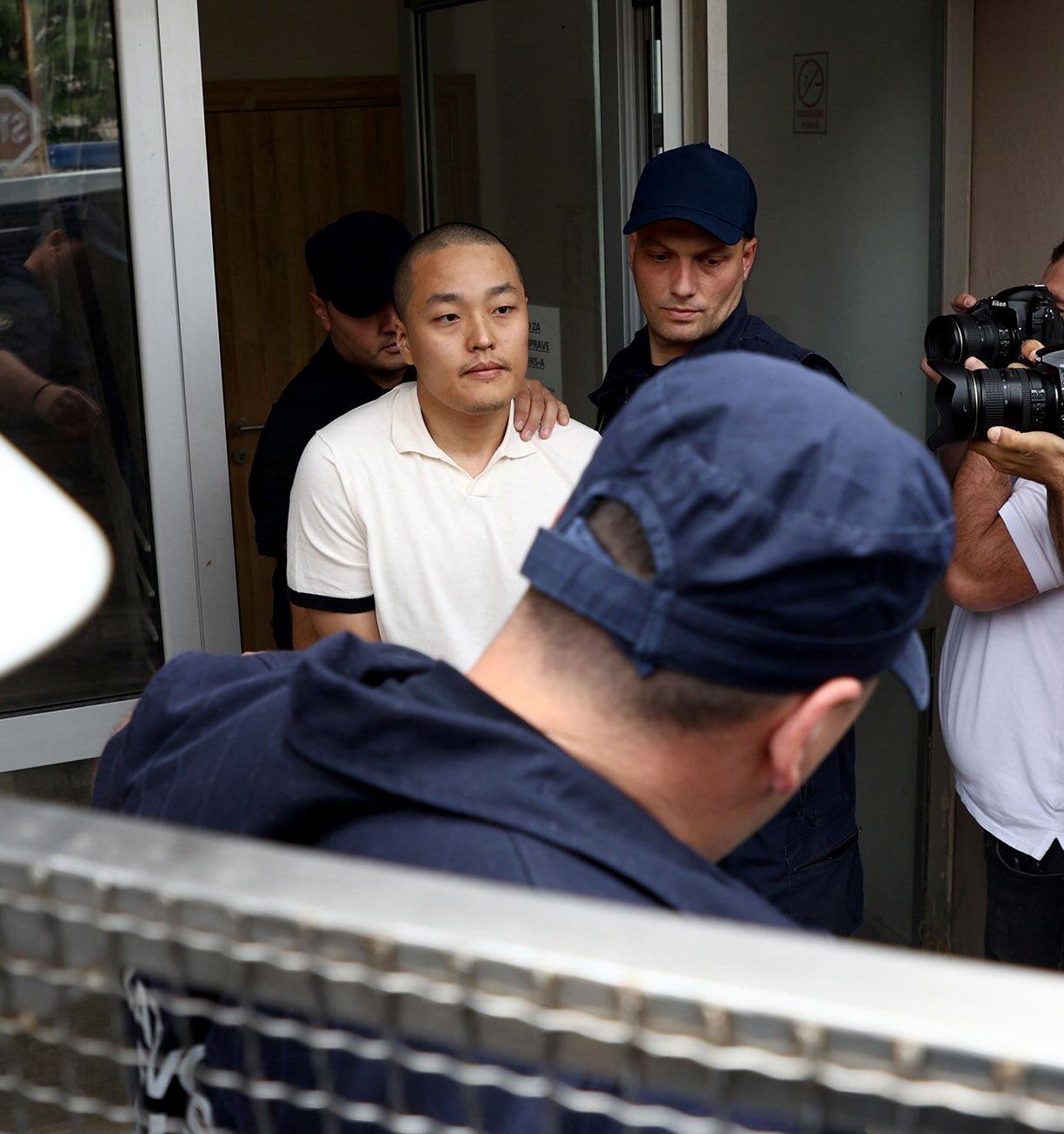
The Myth and Collapse of Terra
The algorithmic stablecoin project Terra (project token LUNA, stablecoin UST), developed by Terraform Labs, was once the brightest project in the last bull market.
Algorithmic mechanisms were a hot trend in stablecoin innovation during the last cycle. Different from the mainstream over-collateralization mechanism, algorithmic stablecoins do not require full collateral but are designed around market supply and demand to dynamically maintain the "peg" of the coin's price. Taking Terra as an example, the protocol allowed market participants to mint UST by burning an equivalent value of LUNA, or conversely, to burn UST to redeem an equivalent value of LUNA. When demand for UST increased and its price rose above $1, arbitrage opportunities would drive the market to burn LUNA to mint UST, profiting from the premium; conversely, if UST demand decreased and its price fell below $1, the market would be driven to burn UST and mint LUNA, profiting from the discount.
This "stepping on each other's feet to reach the sky" technique between LUNA and UST once forged Terra's growth miracle. The circulating supply of UST once reached $18.7 billion, posing a significant challenge to the stablecoin king USDT; the price of LUNA once approached $120, with a market capitalization as high as $41 billion, once ranking among the top five in the cryptocurrency market cap rankings.
However, history has proven that all stablecoin mechanisms without sufficient collateral are bubbles. They might operate temporarily in normal market conditions but have extremely poor resistance to extreme situations. In May 2022, Terra's bubble finally burst. Under collective panic, Terra's algorithmic stablecoin mechanism instead caused it to sink deeper into a death spiral. Within a few days, LUNA's tens of billions in market capitalization and UST's billions in "value" evaporated.
From a macro perspective, Terra's collapse is considered by many industry insiders to be one of the core events that caused the subsequent prolonged market downturn. From a micro perspective, Terra's crash caused countless investors to suffer huge losses, and some users even chose to commit suicide out of despair.
Flight, Hiding, Capture, and Extradition
After Terra's collapse, prosecutors in both South Korea and the U.S. brought charges against Do Kwon, including conspiracy to commit fraud, commodities fraud, wire fraud, securities fraud, and conspiracy to engage in market manipulation and money laundering. In September 2022, South Korean prosecutors issued a Red Notice through the global police agency Interpol, requesting police worldwide to assist in arresting Do Kwon.
Although Do Kwon remained active on social media and once responded by saying "I'm not on the run," no one knew his specific whereabouts. It wasn't until a year later that people learned Do Kwon had been hiding in Serbia and Montenegro to evade Interpol's pursuit.
On March 23, 2023, Do Kwon and Terraform's CFO Han Chang-joon attempted to fly from Podgorica, Montenegro, to Dubai using forged Costa Rican passports but were detained by local police at the airport. About two hours before Do Kwon's arrest, an informant told Montenegro's top police officer, Interior Minister Filip Adžić, that Do Kwon might be in the country. Adžić, describing the arrest process to the WSJ, said the informant sent Do Kwon's passport details to his phone, and when he called the border police chief, the police had just detained Do Kwon at the airport.
That interior minister said in the call to the border police chief: "Do you know who that person is? He is very famous and has a lot of money."
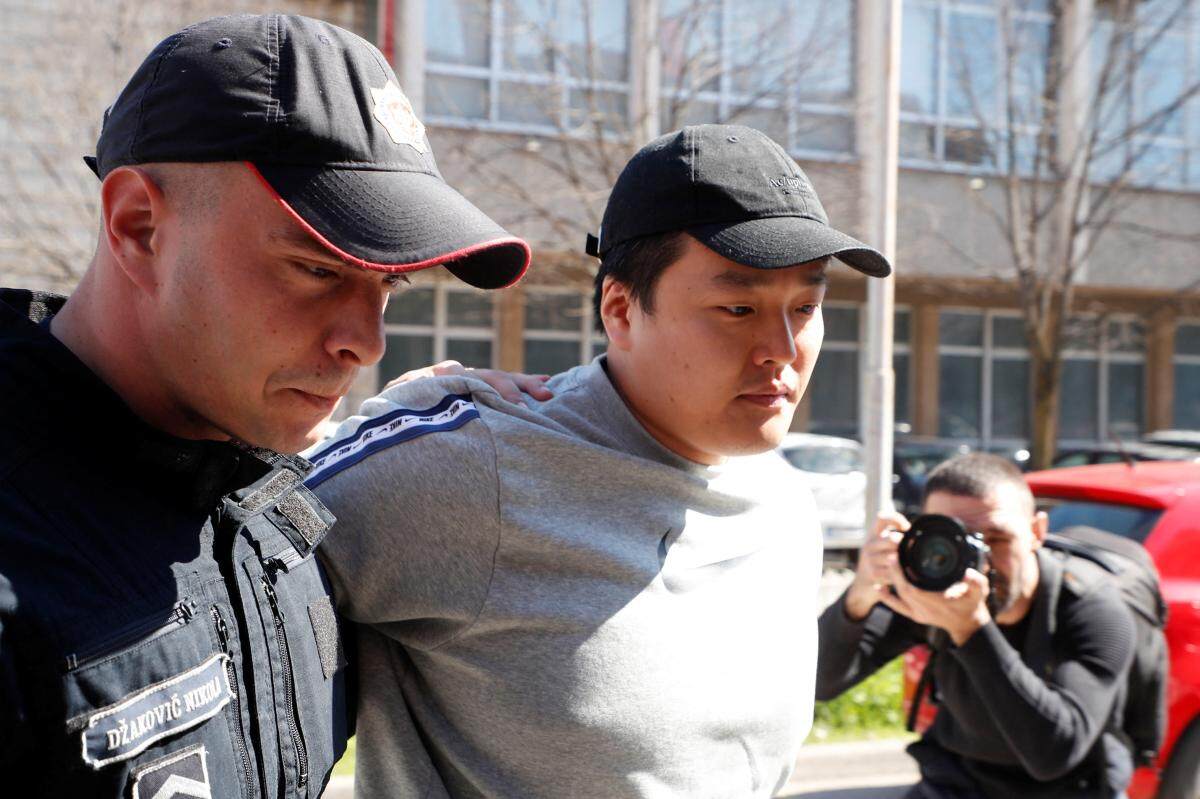
Odaily Note: Photo from the scene of Do Kwon's arrest.
After his arrest, Do Kwon was first held alone in the pre-trial detention area of Montenegro's Spuž Prison, and then on June 19, 2023, was sentenced to 4 months in prison by a Montenegrin court for passport forgery. At that time, both South Korea and the United States sought Do Kwon's extradition from Montenegro. At the request of U.S. and South Korean authorities, the High Court of Montenegro subsequently extended Do Kwon's detention period.
In March 2024, Do Kwon was allowed to leave prison, but considering he still faced criminal charges from several countries, the High Court of Montenegro ordered his passport confiscated to prevent him from leaving the country. At that time, the decision on Do Kwon's extradition was still pending. Montenegrin prosecutors opposed extraditing Do Kwon to South Korea, preferring him to be sent to the United States, where he could face a longer sentence if convicted.
The suspense was finally revealed on the last day of 2024, when the Prime Minister of Montenegro, Milojko Spajic, officially announced that the procedures for extraditing Do Kwon to the United States had been completed.
On January 2, 2025, Do Kwon first appeared in the public eye in a U.S. court. During a hearing at the Manhattan federal court that day, Do Kwon pleaded not guilty. However, as the case progressed, Do Kwon pleaded guilty in August of this year to two of the multiple charges (conspiracy to commit fraud and wire fraud).
Finally, on December 11, Judge Paul Engelmayer announced Do Kwon's fate.
Sentencing Controversy
Regarding Do Kwon's sentencing, the prosecution and the defense each had their say.
Last Thursday, U.S. federal prosecutors submitted a request to the judge of the Southern District of New York, asking for a 12-year prison sentence for Do Kwon.
On the other hand, Do Kwon's defense team requested a five-year sentence, citing that Do Kwon had already served time in Montenegro and might face further prosecution in South Korea. But U.S. officials argued that only a long prison term could reflect the scale of the fraud and deter similar behavior.
The prosecution argued that only a long prison sentence could reflect the scale of Do Kwon's fraud and deter similar behavior. For reference, the losses related to Terraform's collapse exceeded the combined losses from SBF's FTX, Alex Mashinsky's Celsius, and OneCoin. SBF is serving a 25-year sentence, while Mashinsky has been sentenced to 12 years in prison for fraud.
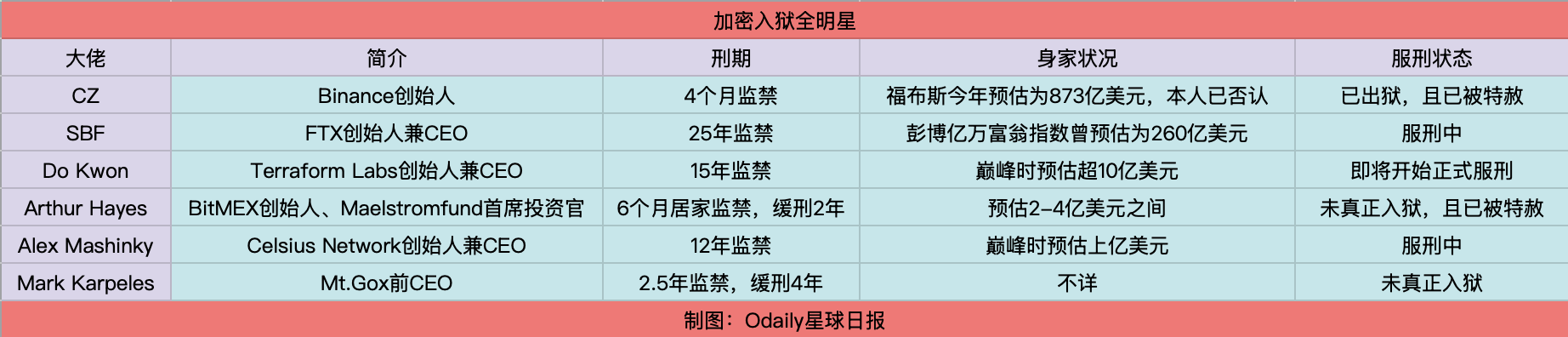
Odaily Note: Representative cryptocurrency figures sentenced in recent years.
The prosecution wrote in the filing: "The collapse of Terraform triggered a series of crises that swept through the cryptocurrency market, indirectly causing the subsequent industry winter. Do Kwon fled from this crisis. While in hiding, he was evasive in interviews and tweets, shifting blame to others, and after being captured, he resisted extradition...... Do Kwon's misconduct, the criminal consequences, and his reaction to the exposure of the plot are all sufficient to warrant a heavy sentence. In fact, the criminal circumstances alone are enough to support the maximum penalty."
Surprisingly, the sentence finally handed down by the judge even exceeded the prosecution's request for a 12-year term. Judge Paul Engelmayer stated that Do Kwon "chose to lie" and "made the wrong choices."
The Messy End of an Era That Has Already Concluded
From SBF to Do Kwon, those names once admired by countless people are now ending in an extremely messy manner.
In the narrative of the last bull market, projects like Terra and FTX represented the most radical, ambitious, and blindly expansionist forces in the crypto world. They rapidly accumulated vast capital and prestige in the name of technological innovation, but under the multiple pulls of regulatory absence,失控的风险 (uncontrolled risk), and human greed, they ultimately fell into the abyss.
But the industry's development does not stop because of the downfall of individuals. The crypto market has long entered a new cycle. New stablecoin models, new financial primitives, and stricter regulatory requirements are redefining the underlying order of the industry. History will remember Terra's past glory, but it will remember even more the price it left behind — this is the reality and warning that all newcomers must face.


![Pudgy Penguins [PENGU] tanks 11% – But bulls are quietly reloading](https://d1x7dwosqaosdj.cloudfront.net/images/2025-12/c7166193492f475697fe99d622d72ea8.jpg)