Dissecting 290,000 Data Points: We Uncovered 6 Secrets of Polymarket's Liquidity

比推Published on 2026-01-08Last updated on 2026-01-08

Abstract

Based on an analysis of 295,000 markets on Polymarket, this investigation uncovers six key truths about its liquidity. A significant finding is that 67.7% of markets have a lifespan of less than 7 days, with 63.16% of current short-term markets having zero trading volume, resembling the high failure rate of meme coins. These short-term markets, dominated by sports and crypto predictions, suffer from extremely low liquidity, often under $100. In contrast, long-term markets (over 30 days), though fewer in number, attract substantial capital, with an average liquidity of $450,000. U.S. politics is the most capitalized category. The platform exhibits a stark divide: sports markets are either ultra-short-term with high volume or long-term "season bets," with mid-term interest lacking. New, complex markets like U.S. real estate face a "cold start" problem due to high expertise requirements and low volatility, deterring participation. The market is highly polarized; a tiny fraction of high-value contracts (1,000+ with over $10M volume) capture 47% of all trading volume, while the vast majority of markets are illiquid. Finally, the "Geopolitics" category is the fastest-growing, indicating rising user interest. The core insight is that liquidity in prediction markets is not evenly distributed but concentrates around events that offer either instant gratification (sports/crypto) or deep macro bets (politics), transforming Polymarket into a specialized financial tool rather than a uni...

Author: Frank, PANews

Original Title: Delving into 290,000 Market Data Points: Revealing 6 Truths About Polymarket Liquidity


Previously, PANews conducted in-depth research on prediction market strategies, with one key finding being: the biggest obstacle to the effectiveness of many arbitrage strategies may not be the mathematical formula of the strategy itself, but rather the depth of liquidity in the prediction market.

Recently, after Polymarket announced the launch of its US real estate prediction market, this phenomenon seems to have become more apparent. Following the launch, the daily trading volume for this series was only a few hundred dollars, far from the anticipated buzz. The actual market activity is much lower than the discussion热度 on social media. This seems both滑稽 and反常, so it might be necessary to conduct a comprehensive investigation into prediction market liquidity to reveal several truths about it.

PANews extracted historical data from 295,000 markets on Polymarket to date and arrived at the following results.

1. Short-Term Markets: A PVP Battlefield Comparable to MEME Coins

Among the 295,000 markets, 67,700 have a cycle of less than 1 day, accounting for 22.9%, and 198,000 have a cycle of less than 7 days, accounting for 67.7%.

Among these ultra-short-term prediction events, 21,848 are currently active markets, of which 13,800 have a 24-hour trading volume of 0, accounting for approximately 63.16%. This means that on Polymarket, a large number of short-term markets are currently in a state of no liquidity.

Does this state seem familiar?

During the peak frenzy of MEME coins, tens of thousands of MEME coins were also issued on the Solana chain, and the vast majority of these tokens similarly went unnoticed or died out quickly.

Currently, this state is being replicated in prediction markets, except that compared to MEME coins, the event lifecycle in prediction markets is predetermined, whereas the lifecycle of a MEME coin is unknown.

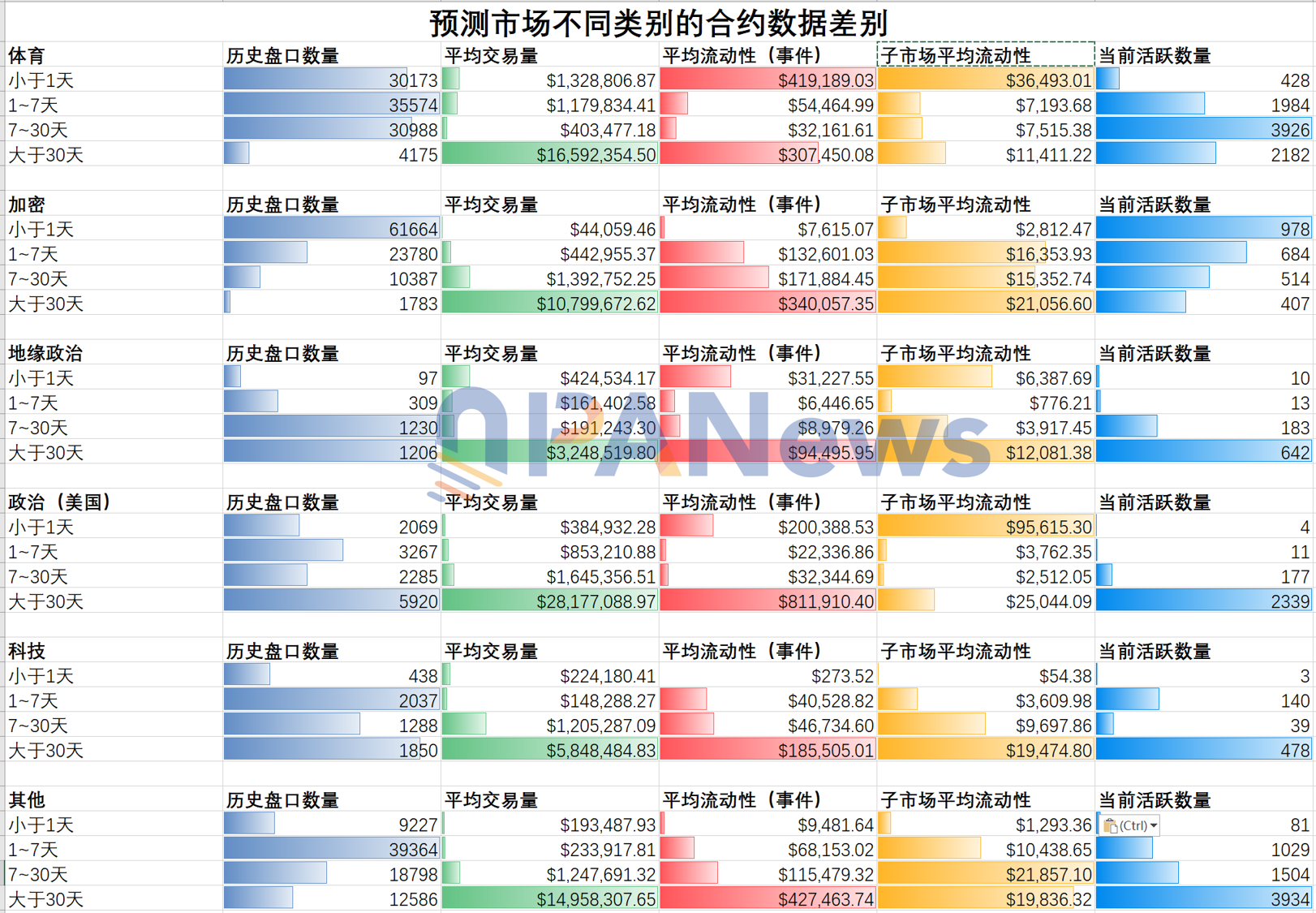
In terms of liquidity, more than half of these short-term events have less than $100 in liquidity.

In terms of categories, these short-term markets are almost entirely dominated by sports and crypto price predictions. The main reason is that the judgment mechanisms for these events are relatively simple and mature, typically involving questions like whether a certain token will rise or fall in 15 minutes, or whether a certain team will win. However, possibly because the liquidity is simply too poor compared to crypto derivatives, the crypto category is not the most popular "king of short-term."

Sports events hold absolute dominance. Analysis shows that the average trading volume for sports events with a prediction cycle of less than 1 day on Polymarket reaches $1.32 million, while for crypto it's only $44,000. This also means that if you hope to profit by predicting short-term cryptocurrency movements in prediction markets, there may not be enough liquidity to support it.

2. Long-Term Markets: The Sedimentation Pool for Big Money

Compared to the numerous short-term event contracts, the number of markets with longer time cycles is much smaller.

On Polymarket, markets with a 1~7 day cycle number 141,000, while markets greater than 30 days number only 28,700. However, these long-term markets have accumulated the most capital. The average liquidity for markets greater than 30 days is $450,000, while liquidity for markets under 1 day is only around $10,000. This also indicates that large funds prefer to position themselves in long-term predictions rather than participate in short-term speculation.

In long-term markets (greater than 30 days), aside from sports, other categories show higher average trading volumes and average liquidity. The category most favored by capital is US politics, where the average trading volume reaches $28.17 million and average liquidity reaches $811,000. The "Other" category also performs well in attracting capital沉淀, with average liquidity reaching $420,000 (here, "Other" covers topics like pop culture, social issues, etc.).

In the field of crypto market predictions, capital also leans towards long-termism, such as predicting "Will BTC break $150,000 by year-end?" or whether a certain token's price will fall below a certain level within a few months. In prediction markets, crypto predictions resemble a simple options hedging tool rather than a short-term speculative tool.
3. The Polarization of Sports Markets

Sports predictions are currently one of the main contributors to Polymarket's daily active users, with currently 8,698 active markets, about 40%. However, looking at the distribution of their trading volume, sports markets of different cycles show huge disparities. On one hand, the average trading volume for ultra-short-term predictions of less than 1 day reaches $1.32 million. On the other hand, the average trading volume for mid-term markets (7~30 days) is only $400,000, while the average trading volume for ultra-long-term markets (greater than 30 days) is as high as $16.59 million.

From this data, it appears that users participating in sports predictions on Polymarket either seek "instant results" or are making "season-long bets"; mid-term event contracts are反而 not very popular.

4. Real Estate Prediction Launch Faces "水土不服" (Difficulty Adapting)

After analyzing a large amount of data, a surface-level result suggests that prediction events with longer durations似乎 have better liquidity. But sometimes, when this logic is applied to specific or more细分 categories, this characteristic fails. For example, the real estate prediction mentioned earlier is a market with relatively high certainty and a time cycle greater than 30 days. Yet predictions like the outcome of the US 2028 election lead the entire market in both liquidity and trading volume.

This或许 reflects the "cold start困境" that new asset categories (especially niche, professionally demanding ones) might face. Unlike simple, intuitive event forecasts, participation in real estate markets requires higher专业性 and cognitive understanding. The market currently seems to be in a "strategy磨合期" where retail participation enthusiasm remains limited to spectating. Of course, the天然 low volatility of real estate markets also exacerbates this cold start issue. The lack of frequent event-driven volatility reduces the enthusiasm of speculative capital. Combined, these factors leave these relatively niche markets in an awkward state: professional players lack counterparties, while amateur players dare not enter.

5. "Short-Term" or "Sedimentation"?

Based on the above analysis, we can re-categorize the different classifications in prediction markets. Categories like cryptocurrency and sports, which are ultra-short-term, can be termed short-term markets. Categories like politics, geopolitics, and technology lean more towards long-term sedimentation markets.

Behind these two types of markets are different investor groups. Short-term markets are显然 more suitable for those with small capital or those requiring higher capital turnover rates. "Sedimentation" markets are more suitable for those with large capital seeking relatively higher certainty.

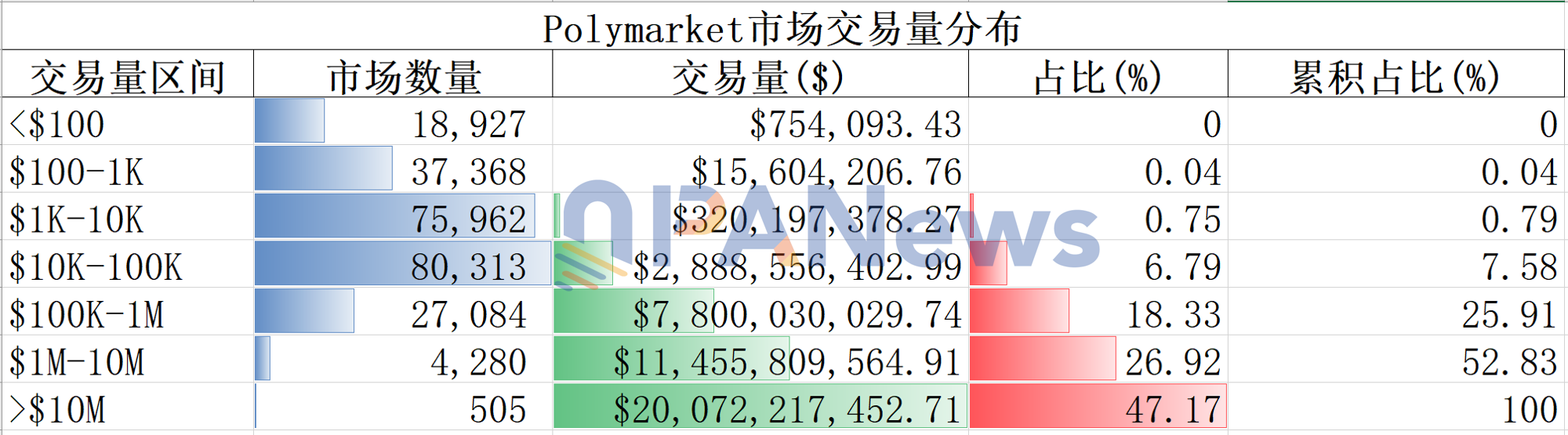
However, when markets are划分 based on trading amount, we see that markets with capital sedimentation capabilities (greater than $10 million) account for 47% of the total trading volume, even though their contract count is the smallest, at only 505. Markets with trading volumes between $1,000 and $100,000 constitute the vast majority in number, with total contracts reaching 156,000, but their trading volume is only 7.54%. For the vast majority of prediction contracts lacking top-tier narrative power, "listing即归零" (going to zero upon listing) is the norm. Liquidity is not evenly distributed sunlight, but rather a spotlight汇聚 around a very few super events.
6. The "Geopolitics" Sector is Rising

The ratio "Current Active Number / Historical Number" can indicate the growth momentum of a category. Currently, the sector with the highest growth efficiency is undoubtedly "Geopolitics". The total historical event contracts for geopolitics are only 2,873, but there are currently 854 active, an active ratio of 29.7%, the highest among all sectors.

This data indicates that the number of new contracts in the "Geopolitics" category is rapidly increasing, making it one of the topics prediction market users are most concerned about currently. This can also be glimpsed from the recent frequent exposure of insider addresses related to several "Geopolitics" contracts.

Overall, behind the liquidity analysis of prediction markets, whether it's the sports sector as a "high-frequency casino" or the politics sector as "macro hedging," the core of their ability to capture liquidity lies in either providing instant dopamine feedback or offering deep macro博弈 space. Those "鸡肋" (chicken rib - meaning unappealing) markets that lack narrative density, have excessively long feedback cycles, and lack volatility are注定难以 to survive in the decentralized order book.

For participants, Polymarket is evolving from a "predict anything" utopia into an extremely specialized financial tool. Recognizing this is more important than blindly searching for the next "100x prediction." In this track, value is only discovered where liquidity is abundant; where liquidity dries up, there are only traps.

This is perhaps the biggest truth the data tells us about prediction markets.


Twitter:https://twitter.com/BitpushNewsCN

Bitpush TG Discussion Group:https://t.me/BitPushCommunity

Bitpush TG Subscription: https://t.me/bitpush

Original Link:https://www.bitpush.news/articles/7600971

Related Questions

QWhat percentage of markets on Polymarket have a cycle of less than 1 day, and what is the state of liquidity for most of these short-term markets?

A22.9% of markets (67,700 out of 295,000) have a cycle of less than 1 day. Among the currently active short-term markets, approximately 63.16% have a 24-hour trading volume of $0, indicating a state of no liquidity.

QWhich category dominates the short-term markets on Polymarket in terms of trading volume, and how does it differ from the crypto category?

ASports events dominate the short-term markets, with an average trading volume of $1.32 million for events with a cycle of less than 1 day. In contrast, the crypto category has an average trading volume of only $44,000 for the same period.

QWhat is the average liquidity for markets with a cycle greater than 30 days, and which category attracts the most capital in these long-term markets?

AMarkets with a cycle greater than 30 days have an average liquidity of $450,000. The U.S. politics category attracts the most capital, with an average trading volume of $28.17 million and average liquidity of $811,000.

QAccording to the article, what are the two main types of markets based on liquidity patterns, and what investor profiles do they correspond to?

AThe two main types are 'short-term' markets (e.g., crypto and sports) and 'long-term沉淀' or沉淀 markets (e.g., politics, geopolitics, tech). Short-term markets suit investors with small capital or those needing high capital turnover, while long-term沉淀 markets are better for investors with large capital seeking higher certainty.

QWhich category is experiencing the highest growth momentum on Polymarket based on the 'currently active / historical number' ratio, and what does this indicate?

AThe 'Geopolitics' category has the highest growth momentum, with a ratio of 29.7% (854 currently active out of 2,873 historical contracts). This indicates that new contracts in geopolitics are rapidly increasing, making it one of the most concerned topics among prediction market users.

Related Reads

How Many Tokens Away Is Yang Zhilin from the 'Moon Chasing the Light'?

The article explores the intense competition between two leading Chinese AI companies, DeepSeek and Kimi (Moon Dark Side), and the mounting pressure on Yang Zhilin, the founder of Kimi. While DeepSeek re-emerged after 15 months of silence with its powerful V4 model—boasting 1.6 trillion parameters and low-cost, long-context capabilities—Kimi has been focusing on long-context processing and multi-agent systems with its K2.6 model. Yang faces a threefold challenge: technological rivalry, commercialization pressure, and investor expectations. Despite Kimi’s high valuation (reaching $18 billion), its revenue heavily relies on a single product with low paid conversion rates, while DeepSeek’s strategic silence and open-source influence have strengthened its market position and valuation prospects, now targeting over $20 billion. Both companies reflect broader trends in China’s AI ecosystem: Kimi aims for global influence through open-source contributions and agent-based advancements, while DeepSeek prioritizes foundational innovation and hardware independence, notably shifting to Huawei’s chips. Their competition is seen as vital for China’s AI progress, with the gap between top Chinese and U.S. models narrowing to just 2.7% on the Elo rating scale. Ultimately, the article argues that this rivalry, though anxiety-inducing for leaders like Zhilin, is essential for driving innovation and solidifying China’s role in the global AI landscape.

marsbit1h ago

How Many Tokens Away Is Yang Zhilin from the 'Moon Chasing the Light'?

marsbit1h ago

TechFlow Intelligence Bureau: ChatGPT Helps Amateur Mathematician Crack 60-Year-Old Problem, CFTC Sues New York Regulator Over Coinbase and Gemini

An amateur mathematician, with the assistance of ChatGPT, has solved a combinatorial mathematics puzzle originally proposed by Hungarian mathematician Paul Erdős in the 1960s. This marks another milestone in AI-aided mathematical research, demonstrating the evolving capabilities of large language models in formal reasoning. In other AI developments, OpenAI introduced a new privacy filter tool for enterprise API usage, automatically screening sensitive data. Meanwhile, the Qwen3.6-27B model achieved 100 tokens per second on a single RTX 5090 GPU using quantization, significantly lowering the cost barrier for local AI deployment. In crypto and Web3, the U.S. CFTC sued New York’s financial regulator, challenging its oversight of Coinbase and Gemini—a first-of-its-kind federal-state regulatory clash. Following a vulnerability, KelpDAO and major DeFi protocols established a recovery fund. Tether froze $344 million in assets linked to Iran’s central bank upon U.S. Treasury request, highlighting the centralized control risks in stablecoins. Separately, Litecoin underwent a 3-hour chain reorganization to undo a privacy-layer exploit. In the U.S., former President Trump invoked the Defense Production Act to address power grid bottlenecks affecting AI data centers and dismissed the entire National Science Board, raising concerns over research independence. A retail trader gained 250% on a $600k Intel options bet amid AI-related speculation. Xiaomi announced its first performance electric vehicle, targeting rivals like Tesla. Meanwhile, iPhone users reported devices automatically reinstalling a hidden app daily, suspected to be MDM-related. A Chinese securities report noted that A-share institutional crowding has reached its second-longest streak since 2007, signaling high valuations and potential style rotation. The day’s developments reflect a dual narrative: AI is enabling unprecedented individual breakthroughs, while centralized power structures—whether governmental or corporate—are becoming more assertive, underscoring that decentralization is as much a political-economic challenge as a technical one.

marsbit2h ago

TechFlow Intelligence Bureau: ChatGPT Helps Amateur Mathematician Crack 60-Year-Old Problem, CFTC Sues New York Regulator Over Coinbase and Gemini

marsbit2h ago

Trading

Spot
Futures

Hot Articles

What is SONIC

Sonic: Pioneering the Future of Gaming in Web3 Introduction to Sonic In the ever-evolving landscape of Web3, the gaming industry stands out as one of the most dynamic and promising sectors. At the forefront of this revolution is Sonic, a project designed to amplify the gaming ecosystem on the Solana blockchain. Leveraging cutting-edge technology, Sonic aims to deliver an unparalleled gaming experience by efficiently processing millions of requests per second, ensuring that players enjoy seamless gameplay while maintaining low transaction costs. This article delves into the intricate details of Sonic, exploring its creators, funding sources, operational mechanics, and the timeline of significant events that have shaped its journey. What is Sonic? Sonic is an innovative layer-2 network that operates atop the Solana blockchain, specifically tailored to enhance the existing Solana gaming ecosystem. It accomplishes this through a customised, VM-agnostic game engine paired with a HyperGrid interpreter, facilitating sovereign game economies that roll up back to the Solana platform. The primary goals of Sonic include: Enhanced Gaming Experiences: Sonic is committed to offering lightning-fast on-chain gameplay, allowing players and developers to engage with games at previously unattainable speeds. Atomic Interoperability: This feature enables transactions to be executed within Sonic without the need to redeploy Solana programmes and accounts. This makes the process more efficient and directly benefits from Solana Layer1 services and liquidity. Seamless Deployment: Sonic allows developers to write for Ethereum Virtual Machine (EVM) based systems and execute them on Solana’s SVM infrastructure. This interoperability is crucial for attracting a broader range of dApps and decentralised applications to the platform. Support for Developers: By offering native composable gaming primitives and extensible data types - dining within the Entity-Component-System (ECS) framework - game creators can craft intricate business logic with ease. Overall, Sonic's unique approach not only caters to players but also provides an accessible and low-cost environment for developers to innovate and thrive. Creator of Sonic The information regarding the creator of Sonic is somewhat ambiguous. However, it is known that Sonic's SVM is owned by the company Mirror World. The absence of detailed information about the individuals behind Sonic reflects a common trend in several Web3 projects, where collective efforts and partnerships often overshadow individual contributions. Investors of Sonic Sonic has garnered considerable attention and support from various investors within the crypto and gaming sectors. Notably, the project raised an impressive $12 million during its Series A funding round. The round was led by BITKRAFT Ventures, with other notable investors including Galaxy, Okx Ventures, Interactive, Big Brain Holdings, and Mirana. This financial backing signifies the confidence that investment foundations have in Sonic’s potential to revolutionise the Web3 gaming landscape, further validating its innovative approaches and technologies. How Does Sonic Work? Sonic utilises the HyperGrid framework, a sophisticated parallel processing mechanism that enhances its scalability and customisability. Here are the core features that set Sonic apart: Lightning Speed at Low Costs: Sonic offers one of the fastest on-chain gaming experiences compared to other Layer-1 solutions, powered by the scalability of Solana’s virtual machine (SVM). Atomic Interoperability: Sonic enables transaction execution without redeployment of Solana programmes and accounts, effectively streamlining the interaction between users and the blockchain. EVM Compatibility: Developers can effortlessly migrate decentralised applications from EVM chains to the Solana environment using Sonic’s HyperGrid interpreter, increasing the accessibility and integration of various dApps. Ecosystem Support for Developers: By exposing native composable gaming primitives, Sonic facilitates a sandbox-like environment where developers can experiment and implement business logic, greatly enhancing the overall development experience. Monetisation Infrastructure: Sonic natively supports growth and monetisation efforts, providing frameworks for traffic generation, payments, and settlements, thereby ensuring that gaming projects are not only viable but also sustainable financially. Timeline of Sonic The evolution of Sonic has been marked by several key milestones. Below is a brief timeline highlighting critical events in the project's history: 2022: The Sonic cryptocurrency was officially launched, marking the beginning of its journey in the Web3 gaming arena. 2024: June: Sonic SVM successfully raised $12 million in a Series A funding round. This investment allowed Sonic to further develop its platform and expand its offerings. August: The launch of the Sonic Odyssey testnet provided users with the first opportunity to engage with the platform, offering interactive activities such as collecting rings—a nod to gaming nostalgia. October: SonicX, an innovative crypto game integrated with Solana, made its debut on TikTok, capturing the attention of over 120,000 users within a short span. This integration illustrated Sonic’s commitment to reaching a broader, global audience and showcased the potential of blockchain gaming. Key Points Sonic SVM is a revolutionary layer-2 network on Solana explicitly designed to enhance the GameFi landscape, demonstrating great potential for future development. HyperGrid Framework empowers Sonic by introducing horizontal scaling capabilities, ensuring that the network can handle the demands of Web3 gaming. Integration with Social Platforms: The successful launch of SonicX on TikTok displays Sonic’s strategy to leverage social media platforms to engage users, exponentially increasing the exposure and reach of its projects. Investment Confidence: The substantial funding from BITKRAFT Ventures, among others, emphasizes the robust backing Sonic has, paving the way for its ambitious future. In conclusion, Sonic encapsulates the essence of Web3 gaming innovation, striking a balance between cutting-edge technology, developer-centric tools, and community engagement. As the project continues to evolve, it is poised to redefine the gaming landscape, making it a notable entity for gamers and developers alike. As Sonic moves forward, it will undoubtedly attract greater interest and participation, solidifying its place within the broader narrative of blockchain gaming.

1.1k Total ViewsPublished 2024.04.04Updated 2024.12.03

What is SONIC

What is $S$

Understanding SPERO: A Comprehensive Overview Introduction to SPERO As the landscape of innovation continues to evolve, the emergence of web3 technologies and cryptocurrency projects plays a pivotal role in shaping the digital future. One project that has garnered attention in this dynamic field is SPERO, denoted as SPERO,$$s$. This article aims to gather and present detailed information about SPERO, to help enthusiasts and investors understand its foundations, objectives, and innovations within the web3 and crypto domains. What is SPERO,$$s$? SPERO,$$s$ is a unique project within the crypto space that seeks to leverage the principles of decentralisation and blockchain technology to create an ecosystem that promotes engagement, utility, and financial inclusion. The project is tailored to facilitate peer-to-peer interactions in new ways, providing users with innovative financial solutions and services. At its core, SPERO,$$s$ aims to empower individuals by providing tools and platforms that enhance user experience in the cryptocurrency space. This includes enabling more flexible transaction methods, fostering community-driven initiatives, and creating pathways for financial opportunities through decentralised applications (dApps). The underlying vision of SPERO,$$s$ revolves around inclusiveness, aiming to bridge gaps within traditional finance while harnessing the benefits of blockchain technology. Who is the Creator of SPERO,$$s$? The identity of the creator of SPERO,$$s$ remains somewhat obscure, as there are limited publicly available resources providing detailed background information on its founder(s). This lack of transparency can stem from the project's commitment to decentralisation—an ethos that many web3 projects share, prioritising collective contributions over individual recognition. By centring discussions around the community and its collective goals, SPERO,$$s$ embodies the essence of empowerment without singling out specific individuals. As such, understanding the ethos and mission of SPERO remains more important than identifying a singular creator. Who are the Investors of SPERO,$$s$? SPERO,$$s$ is supported by a diverse array of investors ranging from venture capitalists to angel investors dedicated to fostering innovation in the crypto sector. The focus of these investors generally aligns with SPERO's mission—prioritising projects that promise societal technological advancement, financial inclusivity, and decentralised governance. These investor foundations are typically interested in projects that not only offer innovative products but also contribute positively to the blockchain community and its ecosystems. The backing from these investors reinforces SPERO,$$s$ as a noteworthy contender in the rapidly evolving domain of crypto projects. How Does SPERO,$$s$ Work? SPERO,$$s$ employs a multi-faceted framework that distinguishes it from conventional cryptocurrency projects. Here are some of the key features that underline its uniqueness and innovation: Decentralised Governance: SPERO,$$s$ integrates decentralised governance models, empowering users to participate actively in decision-making processes regarding the project’s future. This approach fosters a sense of ownership and accountability among community members. Token Utility: SPERO,$$s$ utilises its own cryptocurrency token, designed to serve various functions within the ecosystem. These tokens enable transactions, rewards, and the facilitation of services offered on the platform, enhancing overall engagement and utility. Layered Architecture: The technical architecture of SPERO,$$s$ supports modularity and scalability, allowing for seamless integration of additional features and applications as the project evolves. This adaptability is paramount for sustaining relevance in the ever-changing crypto landscape. Community Engagement: The project emphasises community-driven initiatives, employing mechanisms that incentivise collaboration and feedback. By nurturing a strong community, SPERO,$$s$ can better address user needs and adapt to market trends. Focus on Inclusion: By offering low transaction fees and user-friendly interfaces, SPERO,$$s$ aims to attract a diverse user base, including individuals who may not previously have engaged in the crypto space. This commitment to inclusion aligns with its overarching mission of empowerment through accessibility. Timeline of SPERO,$$s$ Understanding a project's history provides crucial insights into its development trajectory and milestones. Below is a suggested timeline mapping significant events in the evolution of SPERO,$$s$: Conceptualisation and Ideation Phase: The initial ideas forming the basis of SPERO,$$s$ were conceived, aligning closely with the principles of decentralisation and community focus within the blockchain industry. Launch of Project Whitepaper: Following the conceptual phase, a comprehensive whitepaper detailing the vision, goals, and technological infrastructure of SPERO,$$s$ was released to garner community interest and feedback. Community Building and Early Engagements: Active outreach efforts were made to build a community of early adopters and potential investors, facilitating discussions around the project’s goals and garnering support. Token Generation Event: SPERO,$$s$ conducted a token generation event (TGE) to distribute its native tokens to early supporters and establish initial liquidity within the ecosystem. Launch of Initial dApp: The first decentralised application (dApp) associated with SPERO,$$s$ went live, allowing users to engage with the platform's core functionalities. Ongoing Development and Partnerships: Continuous updates and enhancements to the project's offerings, including strategic partnerships with other players in the blockchain space, have shaped SPERO,$$s$ into a competitive and evolving player in the crypto market. Conclusion SPERO,$$s$ stands as a testament to the potential of web3 and cryptocurrency to revolutionise financial systems and empower individuals. With a commitment to decentralised governance, community engagement, and innovatively designed functionalities, it paves the way toward a more inclusive financial landscape. As with any investment in the rapidly evolving crypto space, potential investors and users are encouraged to research thoroughly and engage thoughtfully with the ongoing developments within SPERO,$$s$. The project showcases the innovative spirit of the crypto industry, inviting further exploration into its myriad possibilities. While the journey of SPERO,$$s$ is still unfolding, its foundational principles may indeed influence the future of how we interact with technology, finance, and each other in interconnected digital ecosystems.

54 Total ViewsPublished 2024.12.17Updated 2024.12.17

What is $S$

What is AGENT S

Agent S: The Future of Autonomous Interaction in Web3 Introduction In the ever-evolving landscape of Web3 and cryptocurrency, innovations are constantly redefining how individuals interact with digital platforms. One such pioneering project, Agent S, promises to revolutionise human-computer interaction through its open agentic framework. By paving the way for autonomous interactions, Agent S aims to simplify complex tasks, offering transformative applications in artificial intelligence (AI). This detailed exploration will delve into the project's intricacies, its unique features, and the implications for the cryptocurrency domain. What is Agent S? Agent S stands as a groundbreaking open agentic framework, specifically designed to tackle three fundamental challenges in the automation of computer tasks: Acquiring Domain-Specific Knowledge: The framework intelligently learns from various external knowledge sources and internal experiences. This dual approach empowers it to build a rich repository of domain-specific knowledge, enhancing its performance in task execution. Planning Over Long Task Horizons: Agent S employs experience-augmented hierarchical planning, a strategic approach that facilitates efficient breakdown and execution of intricate tasks. This feature significantly enhances its ability to manage multiple subtasks efficiently and effectively. Handling Dynamic, Non-Uniform Interfaces: The project introduces the Agent-Computer Interface (ACI), an innovative solution that enhances the interaction between agents and users. Utilizing Multimodal Large Language Models (MLLMs), Agent S can navigate and manipulate diverse graphical user interfaces seamlessly. Through these pioneering features, Agent S provides a robust framework that addresses the complexities involved in automating human interaction with machines, setting the stage for myriad applications in AI and beyond. Who is the Creator of Agent S? While the concept of Agent S is fundamentally innovative, specific information about its creator remains elusive. The creator is currently unknown, which highlights either the nascent stage of the project or the strategic choice to keep founding members under wraps. Regardless of anonymity, the focus remains on the framework's capabilities and potential. Who are the Investors of Agent S? As Agent S is relatively new in the cryptographic ecosystem, detailed information regarding its investors and financial backers is not explicitly documented. The lack of publicly available insights into the investment foundations or organisations supporting the project raises questions about its funding structure and development roadmap. Understanding the backing is crucial for gauging the project's sustainability and potential market impact. How Does Agent S Work? At the core of Agent S lies cutting-edge technology that enables it to function effectively in diverse settings. Its operational model is built around several key features: Human-like Computer Interaction: The framework offers advanced AI planning, striving to make interactions with computers more intuitive. By mimicking human behaviour in tasks execution, it promises to elevate user experiences. Narrative Memory: Employed to leverage high-level experiences, Agent S utilises narrative memory to keep track of task histories, thereby enhancing its decision-making processes. Episodic Memory: This feature provides users with step-by-step guidance, allowing the framework to offer contextual support as tasks unfold. Support for OpenACI: With the ability to run locally, Agent S allows users to maintain control over their interactions and workflows, aligning with the decentralised ethos of Web3. Easy Integration with External APIs: Its versatility and compatibility with various AI platforms ensure that Agent S can fit seamlessly into existing technological ecosystems, making it an appealing choice for developers and organisations. These functionalities collectively contribute to Agent S's unique position within the crypto space, as it automates complex, multi-step tasks with minimal human intervention. As the project evolves, its potential applications in Web3 could redefine how digital interactions unfold. Timeline of Agent S The development and milestones of Agent S can be encapsulated in a timeline that highlights its significant events: September 27, 2024: The concept of Agent S was launched in a comprehensive research paper titled “An Open Agentic Framework that Uses Computers Like a Human,” showcasing the groundwork for the project. October 10, 2024: The research paper was made publicly available on arXiv, offering an in-depth exploration of the framework and its performance evaluation based on the OSWorld benchmark. October 12, 2024: A video presentation was released, providing a visual insight into the capabilities and features of Agent S, further engaging potential users and investors. These markers in the timeline not only illustrate the progress of Agent S but also indicate its commitment to transparency and community engagement. Key Points About Agent S As the Agent S framework continues to evolve, several key attributes stand out, underscoring its innovative nature and potential: Innovative Framework: Designed to provide an intuitive use of computers akin to human interaction, Agent S brings a novel approach to task automation. Autonomous Interaction: The ability to interact autonomously with computers through GUI signifies a leap towards more intelligent and efficient computing solutions. Complex Task Automation: With its robust methodology, it can automate complex, multi-step tasks, making processes faster and less error-prone. Continuous Improvement: The learning mechanisms enable Agent S to improve from past experiences, continually enhancing its performance and efficacy. Versatility: Its adaptability across different operating environments like OSWorld and WindowsAgentArena ensures that it can serve a broad range of applications. As Agent S positions itself in the Web3 and crypto landscape, its potential to enhance interaction capabilities and automate processes signifies a significant advancement in AI technologies. Through its innovative framework, Agent S exemplifies the future of digital interactions, promising a more seamless and efficient experience for users across various industries. Conclusion Agent S represents a bold leap forward in the marriage of AI and Web3, with the capacity to redefine how we interact with technology. While still in its early stages, the possibilities for its application are vast and compelling. Through its comprehensive framework addressing critical challenges, Agent S aims to bring autonomous interactions to the forefront of the digital experience. As we move deeper into the realms of cryptocurrency and decentralisation, projects like Agent S will undoubtedly play a crucial role in shaping the future of technology and human-computer collaboration.

555 Total ViewsPublished 2025.01.14Updated 2025.01.14

What is AGENT S

Discussions

Welcome to the HTX Community. Here, you can stay informed about the latest platform developments and gain access to professional market insights. Users' opinions on the price of S (S) are presented below.

活动图片