Dialogue with Yihui Capital, SoundAI Technology, Ling Universe, and Zhongbo Jili: Opportunities and Challenges in the AI Smart Hardware Track

marsbitPublished on 2026-07-07Last updated on 2026-07-07

Abstract

On June 28, 2026, an event titled "New Opportunities in AI Hardware: The Battle for Interactive Entry Points Begins" was held in Beijing. It featured a report from ITJuzi and discussions with experts from SoundAI, Ling Universe, One Reed Capital, and Zhongbo Juli on the opportunities and challenges in China's AI hardware sector. Key report findings highlight the sector's intense activity: 327 out of 431 startups founded post-2023 have secured funding, with 179 investments in H1 2026 alone. The landscape is dominated by embodied intelligent robots, while wearable tech like smart rings and AI glasses shows rapid growth. Geographically, Shenzhen leads, leveraging its superior hardware supply chain, followed by Beijing and Shanghai. The overarching trend is for companies to focus on micro-innovations within specific scenarios rather than reinventing foundational technology. Industry leaders shared several critical insights: 1. **Balancing Innovation & Market Readiness**: Entrepreneurs face the "hammer looking for a nail" dilemma. Success requires balancing technical capability with user acceptance, cost control, and incremental design improvements rather than chasing disruptive innovation. 2. **Competitive Landscape**: The future interactive entry point may not be a single super-device but a mix of universal terminals and specialized, scenario-specific hardware. While large companies have ecosystem advantages, startups can win by deeply targeting vertical markets and specific...

On June 28, 2026, an event titled 'AI Smart Hardware's New Opportunities, The Battle for Interaction Entry Points Begins,' hosted by ITjuzi and co-organized by Yihui Capital and Zhongguancun Science City Company, was held in Beijing. The event gathered executives from institutions such as ITjuzi, Yihui Capital, SoundAI Technology, Ling Universe, and Zhongbo Jili.

I. Report Release:

Insight Report on Newly-Emerged Companies in the AI Hardware/Smart Hardware Track
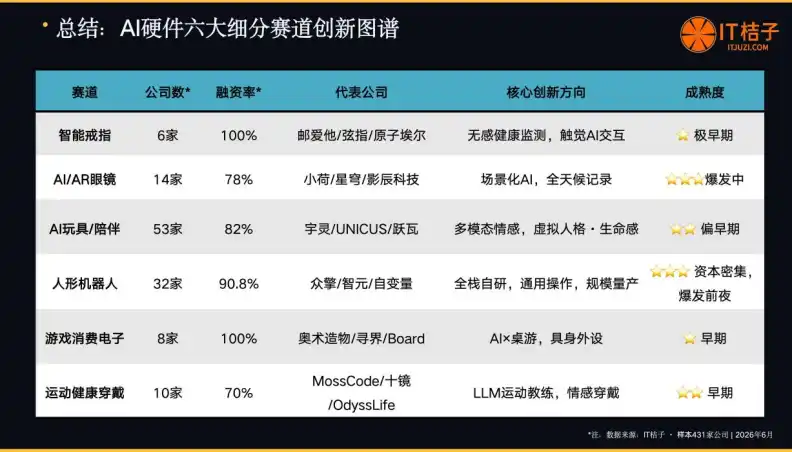
The event kicked off with a presentation by Ms. Wu Meimei, Senior Analyst at ITjuzi, who delivered ITjuzi's industry analysis report on smart hardware. The report indicated that in recent years, China's AI hardware and smart hardware sectors have experienced a wave of concentrated entrepreneurial activity.

By examining newly-established companies founded after 2023, the report summarized four major trends in this track:

1. Track heat exceeds expectations. Among 431 startup companies, 327 have already secured funding, with a financing rate as high as 75.9%. In the first half of 2026 alone, 179 companies received investment, an extremely rare consensus among capital.

2. Financing ecosystem dominated by intelligent robots, with diverse developments. Embodied intelligent robots stand out for attracting the most capital. Wearable tracks like smart rings, AI glasses, and sports/health wearables, though smaller in scale, show significant growth and considerable potential. In terms of financing structure, angel rounds account for more than half, indicating the sector is still in its early stages, the landscape is far from settled, and the window of opportunity remains open.

3. Geographical distribution: Shenzhen leads the pack, with Beijing-Shenzhen as the dual core. Shenzhen ranks first with 95 companies (22%), followed by Beijing with 44 and Shanghai with 50. China's Shenzhen possesses world-leading and unique advantages in its global-class hardware supply chain.

4. Typical cases: Micro-innovations across six sub-sectors. Smart rings are evolving from health monitoring to tactile AI interaction; AI glasses have multiple vertical scenarios like cultural/heritage guiding and outdoor imaging; AI toys incorporate emotional engines and virtual personality systems, emphasizing companionship attributes; these companies essentially apply new AI technologies to existing categories. Within humanoid robots, diverse approaches exist (interaction-focused, embodiment-focused, brain-focused), with companies like Zhiyuan taking the lead in mass production and commercialization, indicating the competition in this track has entered a fierce stage.

In summary: "The entire track is vast. As technology matures and becomes more accessible, entrepreneurs don't need to 'reinvent the wheel.' They can focus on micro-innovation, establishing barriers in specific scenarios and user groups."

II. SoundAI Technology:

Advancing Perception and Interaction through Acoustics

Ms. Huang Yunhe, Chief Product Officer of SoundAI Technology, in her keynote sharing session on 'AI Technology Penetration into Terminals Drives Perception and Interaction Intelligence Upgrade,' pointed out that AI hardware startups commonly face the dilemma of 'a hammer looking for a nail'—having the technology but struggling to find a mass-producible product carrier. She emphasized that product innovation must balance technical capabilities with market acceptance. Stage-by-stage success should be based on balancing current technological thresholds, user needs, cost control, and form-factor micro-innovation, rather than blindly pursuing disruptive innovation.

Current voice interaction still relies on wake-up commands, and true multi-turn natural interaction has not yet been fully realized. Ms. Huang Yunhe stated that future AI hardware needs to rely on sensor upgrades and the development of physical AI to achieve wake-up-free, proactive perception-based interaction. Furthermore, innovation should be rooted in local demands to create China's next-generation AI terminal products.

III. Roundtable Dialogue:

Observations and Insights from Smart Hardware Entrepreneurs and Investors

Ms. Huang Yunhe, CPO of SoundAI Technology; Ms. Liu Cuixue, Senior Product Manager at Ling Universe; and Ms. Liu Hongyan, Brand Strategy Head at Zhongbo Jili, participated in a roundtable discussion themed 'AI Smart Hardware's New Opportunities, The Battle for Interaction Entry Points Begins.' The discussion was moderated by Mr. Wang Simeng, Director at Yihui Capital.

The following is the content of the roundtable dialogue:

Wang Simeng, Director at Yihui Capital: In the past, when talking about interaction entry points, everyone would first think of smartphones, think of Apple, Samsung, HMOV (Huawei, Xiaomi, OPPO, vivo), and other major players. In the AI era, I'm curious to know everyone's thoughts: will future interaction entry points still converge towards a unified super-hardware, or will they fragment into more specialized, scenario-specific hardware? Against this new backdrop, what will be the competitive relationship between major players and startups?

Huang Yunhe, CPO of SoundAI Technology: Unified terminals will still occupy an important position, but vertical function carriers for specific scenarios will also continue to emerge. Currently, there are two development paths for AI terminals—matching hardware carriers for AI, or empowering scenario-specific hardware with AI capabilities. Startups can define their product form based on multiple factors such as target audience, technical capabilities, and market environment. When market demand is clear and user willingness to pay exists, there's no need to wait for technology to be perfect; they can enter the market first for validation.

Liu Cuixue, Senior Product Manager at Ling Universe: Startup teams can, in the short term, choose more niche scenarios and more vertical user groups to accumulate sufficient data for product iteration. Regarding hardware selection, they can examine whether a particular product category's user mindshare is already occupied by leading brands. If choosing forms like watches or rings where strong players already exist, users have high expectations for basic experience. It's necessary to first excel in basic functions and then layer AI capabilities as differentiation, rather than competing on intelligence from the outset.

Liu Hongyan, Brand Strategy Head at Zhongbo Jili: The future AI hardware field might form a multi-layered ecosystem. While major players have advantages in ecosystem, supply chain, and resource aggregation, their reach may not cover all vertical areas. Entrepreneurial companies can, based on their own resource endowments and core strengths, formulate medium- to long-term strategic plans. After selecting the right track, they can persistently deepen their efforts in hardware-software synergy and product commercialization. It is entirely possible to stand out through a single point of breakthrough.

Wang Simeng, Director at Yihui Capital: Currently, the competition for entry points appears on the surface to be a contest between hardware products, but at a deeper level, it's a competition of operating systems, interaction algorithms, and user data. Regarding the barriers for AI hardware, are they in software or hardware? From a commercialization perspective, is it better to first deploy hardware to capture user mindshare, or to refine interaction technology before mass-producing products?

Liu Cuixue, Senior Product Manager at Ling Universe: The main force in current AI hardware entrepreneurship comes from individuals with backgrounds in large central state-owned enterprises and ByteDance. Their financing logics differ, but they face common challenges in product implementation: one is a deep understanding of AI models, and the other is practical hardware experience—how to navigate non-transparent information like hardware selection and cost differences. Regarding business models, AI hardware can explore models where hardware isn't profitable but relies on subscription revenue. However, the prerequisite is simultaneously controlling hardware BOM (Bill of Materials) costs and model inference costs; otherwise, losing money on both ends is unsustainable.

Liu Hongyan, Brand Strategy Head at Zhongbo Jili: The core of investment lies in verifying the landing carrier and application scenarios for AI technology. While product perfection is important, whether the market will accept it, whether sales can take off, and whether cash flow can be sustained are fundamental. Currently, AI companies generally burn cash. The key is to find the right entry scenario, adapt to the market through edge-side computing power and hardware-software synergy, ultimately achieve sales growth and sustainable development, and complete the commercialization loop from technology to scenario—this is what truly matters.

Wang Simeng, Moderator from Yihui Capital: Ms. Huang mentioned return rates earlier. I'd like to ask Ms. Huang and Ms. Liu about the average return rate in our industry. What is the return rate range for a relatively successful hardware product?

Huang Yunhe, CPO of SoundAI Technology: Regarding the current return rate situation in the earphone industry, it's reported that the average return rate for AI earphones reaches 30% to 50%. Overseas, it might be lower due to concerns about return costs.

Wang Simeng, Director at Yihui Capital: As large language models are now moving to the edge side, many local hardware devices are upgrading from passive response to actively perceiving user needs. So, I'd like to ask everyone to envision: what new hardware categories will proactive human-computer interaction give rise to? In the next 2-3 years, where will the biggest industrial dividends for domestic AI smart hardware be concentrated?

Huang Yunhe, CPO of SoundAI Technology: Due to large model hallucinations, lack of physical constraints, and insufficient environmental perception, proactive interaction technology is not yet mature in actual user experience. Only health wearable devices have achieved limited proactive reminders. The industry should learn from the early internet experience: find specific user groups and amplify strengths rather than dwell on universally existing technological limitations. Chinese entrepreneurs possess unique advantages in marketing, product definition, etc. The core is to find target users, establish a coherent user experience, first achieve market traction and iterate gradually, patiently waiting for technological maturity and inflection points.

Liu Cuixue, Senior Product Manager at Ling Universe: Proactive interaction is an important evolution direction for AI hardware. Devices judge opportune moments through multimodal perception (visual, auditory, physiological signals, etc.) to initiate meaningful interactions and build user understanding and emotional connection. Achieving this capability requires solving two core problems. First is timing judgment: to "speak when it's time to speak," avoiding disturbance. Second is long-term memory: accumulating user preferences and interaction history to make interactions increasingly natural. Engineering implementation is a current challenge, especially in balancing edge-side inference capabilities and privacy protection. Hardware forms need to vary by user group; for example, women value appearance, while children need lightweight, easy-to-operate devices.

Wang Simeng, Director at Yihui Capital: I'd like to ask Ms. Liu from Zhongbo Jili: currently, the financing heat for AI hardware remains high, and trendy projects emerge one after another, but bubbles are also appearing simultaneously. From an investor's perspective, what core criteria would you focus on to select quality projects and avoid homogeneous bubbles?

Wang Simeng, Director at Yihui Capital: Please, three guests, summarize in one sentence: in this battle for interaction entry points, what is the most critical key to victory for a company to ultimately succeed?

Liu Cuixue, Senior Product Manager at Ling Universe: For hardware startups, team layout should be tailored to location. Brand, marketing, and financing teams are suitable for Beijing, Shanghai, and Guangzhou, but the supply chain team is recommended to be based in Shenzhen as a priority. From hardware selection, mold development to module procurement, Shenzhen's complete and mature industry chain offers outstanding advantages, significantly reducing trial-and-error costs during hardware implementation.

Liu Hongyan, Brand Strategy Head at Zhongbo Jili: Future AI companies that stand out must first select promising tracks and be able to execute a perfect closed loop from technology, product to commercial implementation. Although currently in a cash-burning phase, the key is whether they can burn their way to a sustainable and profitable model. Companies need their products to gain market recognition, forming a growth flywheel of revenue and profit, achieving long-term value enhancement. This is not only a key focus for investors but also fundamental to whether a company can develop steadily and sustainably.

This article is from the WeChat public account: ITjuzi , Author: ITjuzi

Related Questions

QAccording to the article, what are the four major trends in China's AI hardware and smart hardware startup sector summarized in the IT Orange report?

AThe four major trends are: 1) The sector's popularity is immense, with a 75.9% financing rate for startups. 2) The financing ecosystem is dominated by smart robots but features a wide variety (like smart rings and AI glasses), with the early-stage angel round accounting for over half. 3) Geographical distribution shows Shenzhen leading, forming a dual-core structure with Beijing. 4) Typical cases show micro-innovations across six sub-sectors, with companies using new AI technology on established product categories.

QWhat core challenge does SoundAI's Chief Product Officer, Huang Yunhe, mention that AI hardware startups commonly face, and what is her suggested approach to product innovation?

AShe mentions the 'hammer looking for a nail' dilemma, where startups possess technology but struggle to find a mass-producible product carrier. Her suggested approach is that product innovation should balance technological capability with market acceptance, focusing on the equilibrium between current technical thresholds, user needs, cost control, and form factor micro-innovation, rather than blindly pursuing disruptive innovation.

QDuring the roundtable, how did the participants generally view the future of interaction portals in the AI era in terms of unification versus fragmentation?

AThe participants generally believe that unified terminals (like phones) will remain important, but vertical, scenario-specific hardware carriers will also continuously emerge. They see two development paths: matching hardware for AI or adding AI capabilities to scenario-specific hardware. Startups can choose their product definition based on target users, technical capabilities, and market environment.

QWhat are the two core challenges for product implementation mentioned by Liu Cuitao from Ling Universe regarding current AI hardware entrepreneurs, and what business model possibility does he discuss?

AThe two core challenges are: 1) A deep understanding of AI models. 2) Practical hardware experience, including navigating non-transparent information like hardware selection and cost differences. He discusses the possibility of a business model where hardware is not profitable, and revenue comes from subscriptions, but this requires simultaneously controlling hardware BOM costs and model inference costs.

QAccording to the roundtable discussion, what is considered the most critical factor for an enterprise to ultimately succeed in the battle for interaction portals?

AThe consensus is that the most critical factor is selecting a promising sector and perfectly executing the closed loop from technology and product development to successful commercialization and market validation. While the sector is currently capital-intensive ('burning money'), the key is whether a sustainable and profitable model can be established, leading to market recognition, revenue growth, and long-term value enhancement.

Related Reads

Three Rounds in a Row, Shanghai Gives Birth to a $10 Billion Satellite Internet Unicorn

Shanghai-based semiconductor company Sixic has raised a new strategic investment round, securing backing from investors including Xinhuanet Venture Capital and Tongding Group, with continued support from existing investors. This marks the company's third disclosed financing this year, following a 1.5 billion RMB raise in February, officially cementing its status as a new Shanghai unicorn with a valuation exceeding 10 billion USD. The financing comes amid a dynamic period for China's commercial aerospace sector. Recent milestones include a successful controlled landing of a rocket first stage, signaling a path toward lower launch costs, and the establishment of a national Commercial Aerospace Innovation Consortium comprising 271 entities. Sixic stands out as the only 6G satellite internet baseband chip company within this consortium. The article highlights a market shift from a focus on rockets and satellites towards recognizing the value of the terminal and connectivity layer, essential for completing the commercial loop. Satellite internet, integral to 6G and commercial aerospace, is entering an industrial phase with clear policy support, including China's pioneering allocation of 6GHz spectrum for 6G R&D. Sixic specializes in 5G/6G satellite communication baseband chips, a highly complex segment. Unlike terrestrial communication, satellite chips must address challenges like high Doppler shift and signal loss. The company's technological validation is a key driver for investment. It has secured product certifications from leading global smartphone manufacturers, new energy vehicle makers, and communication module companies. A strategic partnership with ZTE was announced in March to collaborate on 6G NTN satellite internet. The company has achieved a full technical verification loop, from lab tests to in-orbit validation, including successfully demonstrating 5G NTN standard-based HD video calls via satellite in 2025. It maintains a 100% first-pass success rate for chip tape-outs and possesses full-stack in-house R&D capabilities. Sixic's strategy focuses on ASIC development for future commercial-scale, power-efficient consumer devices like smartphones. Its early and deep involvement in industry standards and constellation planning creates a significant competitive barrier. Looking ahead, Sixic's opportunity extends beyond chips into modules and terminal ecosystems. It has developed a full range of baseband SoC solutions and provides reference designs to help partners launch products quickly. The recent release of the CM7620 broadband satellite communication module at MWC Shanghai completes its "chip-module-terminal" portfolio. This latest funding round represents a strategic bet on the foundational communication capabilities that will underpin the next generation of 6G and satellite internet value chains.

marsbit32m ago

Three Rounds in a Row, Shanghai Gives Birth to a $10 Billion Satellite Internet Unicorn

marsbit32m ago

Is the iPhone Moment for Embodied AI Coming Soon?

Is the "iPhone moment" for embodied AI approaching? This article, based on a roundtable discussion, presents expert insights on the current state and future of embodied AI. The consensus is that the pivotal "iPhone moment" is still distant. The field is likened to the "brick phone" era, with technology paths—such as VLA and world models—not yet converging. While robotic "motor skills" (e.g., walking) have matured, the "brain" (decision-making, generalization) remains far from commercial readiness. A major bottleneck is data: an estimated tens of millions of data points are needed for a breakthrough, but only around 500,000 currently exist globally. Currently, cost remains prohibitive for widespread labor replacement, making the economic case challenging. However, experts see a three-tiered market potential: a billion-level market for emotional companionship (e.g., entertainment, basic care), a trillion-level market for commercial services (e.g., guides, receptionists), and a massive, long-term opportunity for physical labor in factories and homes. The discussion suggests that while humanoid robots face hurdles, non-humanoid embodied AI applications (like existing service robots) can be deployed sooner. The ultimate vision is for AI to operate seamlessly in the physical world, not just behind screens. Regarding AI tools, participants noted their widespread use for boosting efficiency in coding, research, and teaching. However, they warned against over-reliance due to risks of AI "deception" and the erosion of critical thinking, emphasizing that core judgment must remain with humans. In summary, embodied AI holds immense promise but requires significant progress in brain models, data collection, and cost reduction before achieving its transformative potential. Its development is expected to be gradual, advancing through specific use cases rather than a single explosive moment.

marsbit49m ago

Is the iPhone Moment for Embodied AI Coming Soon?

marsbit49m ago

Wall Street Morning Report: U.S. Stocks Suffer Collective Setback, Apple Hits New High Against the Trend, Tonight's CPI and Waller's Hearing to Determine Interest Rate Path

Wall Street Morning Report: U.S. stocks fell collectively, while Apple hit a new record high. Key events including tonight's CPI data and Fed Chair Walsh's testimony will set the direction for interest rates. Markets experienced a sharp "risk-off" move due to escalating Middle East tensions and unexpected hawkish signals from the Federal Reserve. Major indices declined, with the Nasdaq Composite leading losses, down 1.55%. The VIX fear index surged over 14%. Geopolitical tensions spiked as the U.S. conducted consecutive airstrikes on Iran and announced a maritime blockade of Iranian ports, set to begin on July 15. This triggered a panic-driven rally in oil, with WTI crude soaring over 9% to breach $80 per barrel. Safe-haven flows bolstered the U.S. dollar and Treasury yields, while gold plunged nearly 3%, losing its $4,000 level. Rate markets now price a nearly 50% chance of a Fed rate hike in July, up significantly from prior expectations, following hawkish commentary from Fed Governor Waller. The tech sector, particularly AI-related stocks, faced intense selling pressure. The Philadelphia Semiconductor Index plunged 4%. Notable decliners included SK Hynix (down 9% on its second trading day as an ADR), Nvidia, AMD, and Intel. In contrast, Apple shares rose 0.63% to a record high, viewed as a stable haven away from the costly AI data center arms race. Key events to watch include the U.S. June CPI inflation data and Fed Chair Walsh's Congressional testimony tonight, which will critically influence the Fed's policy path. Major bank earnings also begin today. The formal implementation of the U.S. maritime blockade against Iran on July 15 and upcoming events like TSMC's Q2 earnings and a SpaceX Starship test flight remain in focus.

marsbit1h ago

Wall Street Morning Report: U.S. Stocks Suffer Collective Setback, Apple Hits New High Against the Trend, Tonight's CPI and Waller's Hearing to Determine Interest Rate Path

marsbit1h ago

Crude Oil Surges 10% in Intraday Trading! US Military Restores Blockade on Iran, Trump Warns of 'Heavy Blows' Tonight and Tomorrow, Imposes 20% Fee on Strait Shipping

Crude oil prices surged up to 10% intraday as tensions between the US and Iran escalated sharply. President Trump announced the reinstatement of a maritime blockade against Iran, targeting its ships and their customers, while stating the Strait of Hormuz would remain open to all other nations. He further declared that the US, as the "guardian" of the strait, would impose a 20% fee on all cargo transiting the strategic waterway to compensate for security costs. The US Central Command confirmed the naval blockade would commence on July 14 (GMT). Following Trump's statements, reports emerged of explosions near Iran's Larak Island and the port of Bandar Abbas, though Iranian authorities did not confirm their nature. Iran's Foreign Minister criticized the proposed 20% fee as excessive, asserting Iran's role as the guardian of the strait. An Iranian military spokesperson warned of a strong response to any unauthorized US interference in the waterway. The United Nations' International Maritime Organization (IMO) expressed opposition to charging tolls for passage through international straits, stating such measures lack legal foundation. Market reactions were pronounced, with Brent crude briefly surpassing $83 and WTI above $78. The situation intensified as Trump notified Congress of renewed hostilities with Iran, following US airstrikes on Iranian targets.

marsbit1h ago

Crude Oil Surges 10% in Intraday Trading! US Military Restores Blockade on Iran, Trump Warns of 'Heavy Blows' Tonight and Tomorrow, Imposes 20% Fee on Strait Shipping

marsbit1h ago

Trading

Spot
活动图片