The broker-dealer license issued to Deribit by the Dubai Virtual Assets Regulatory Authority (VARA) means that the exchange's spot orders to buy, sell, and trade are now routed directly to the Coinbase exchange for execution. This integration provides Deribit's predominantly professional trader base with access to Coinbase's centralized order book—a significantly deeper pool of liquidity than the platform had on its own.
Furthermore, it opens up possibilities for expansion far beyond Deribit's traditional domain (that is, bitcoin and ether derivatives), with the new integration expected to eventually bring hundreds of additional assets onto the platform. Client funds can remain within Deribit's own ecosystem, even when being used as collateral for derivative trading.
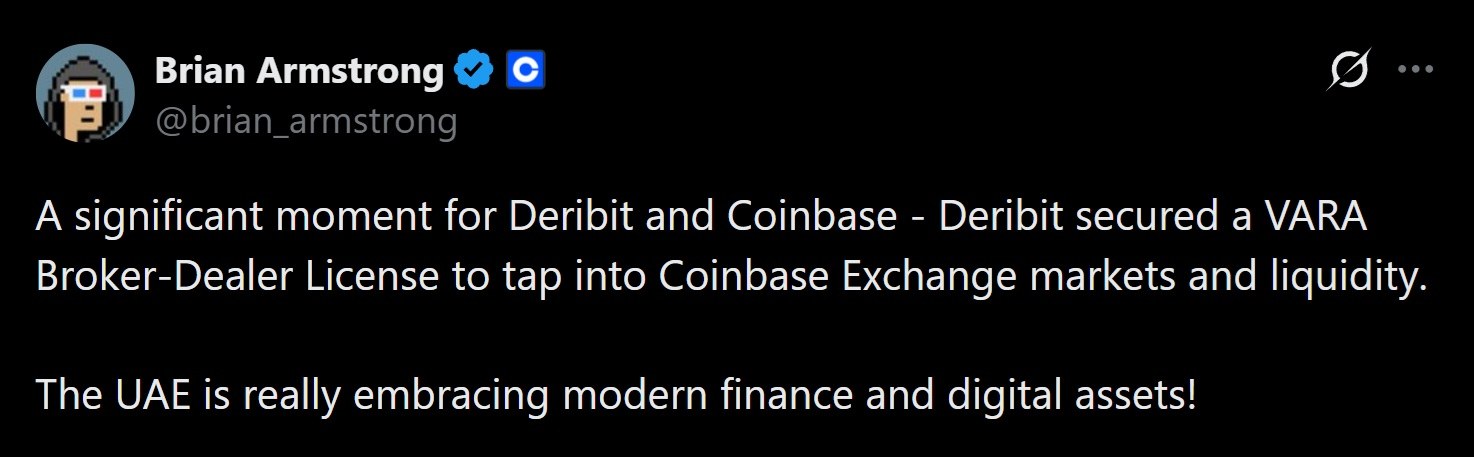
Coinbase co-founder and CEO Brian Armstrong called this a "significant moment for both Deribit and Coinbase," adding that the clearance demonstrates that "the UAE is truly embracing modern finance and digital assets."
This marks the second clearance Deribit has received from VARA in less than two years. The exchange became the first cryptocurrency derivatives platform to receive VARA approval when it opened its global headquarters in Dubai in early 2025, and it had already been offering spot trading since January of that year under a separate VARA exchange license.
Bitcoin.com News reported on Coinbase's initial agreement to acquire Deribit for roughly $2.9 billion, a deal structured as approximately $700 million in cash plus 11 million shares of Coinbase class A common stock, and later reported that Coinbase completed the deal in August 2025, becoming the undisputed leader in the global cryptocurrency derivatives market.
At the deal's close, Deribit was seeing a monthly trading volume of $185 billion and held an open interest of roughly $60 billion—figures that made the company a clear prize in the derivatives market, which Coinbase had been trying to enter for years.
A Big Bet on the UAE
VARA's approval comes as several other exchanges are also eyeing Dubai as a testing ground for regulated cryptocurrency derivatives and spot trading, significantly outpacing the adoption of similar comprehensive regulatory frameworks in the U.S. or Europe.
For Coinbase, connecting Deribit's liquidity directly to its own order book is also a step towards the "universal exchange" model the company has been building since completing the acquisition, bringing spot trading, futures, options, and now deeper access to offshore liquidity under one roof.
However, this integration does not change how Deribit operates in the U.S. market, as the VARA license is exclusively for activity regulated in Dubai. But it clearly signals where Coinbase sees its near-term growth, which is not in obtaining new U.S. clearances—a process still moving slowly and fraught with political debate—but in accumulating regulatory wins in jurisdictions like the UAE, which have already established clear digital asset licensing frameworks.
Every additional Deribit client connected to Coinbase liquidity also bolsters Coinbase's own trading volume metrics—a figure closely watched by investors as the company reports quarterly derivatives trading volume growth alongside its more mature spot business.