Delphi Digital: Three Major Trends in Prediction Markets

链捕手Published on 2026-01-19Last updated on 2026-01-19

Abstract

Delphi Digital outlines three key trends shaping the future of prediction markets, now a $600M+ sector. Major players like CME Group, Coinbase, and Robinhood are entering, while incumbents Polymarket and Kalshi aggressively expand. Polymarket focuses on CFTC-compliant crypto-native infrastructure, U.S. re-entry, and Web2 partnerships. Kalshi leverages regulatory advantages and orderbook liquidity for global growth. Layer 1 and Layer 2 networks now have economic incentives to capture prediction market activity. Verticalized markets for specific user groups will outperform generic platforms. Three predictions are highlighted: 1. **Perpetual-ized Options**: Prediction markets simplify options into binary, expiry-free formats (e.g., “Will BTC close above $150K on June 30?”), boosting accessibility. 2. **Native On-Chain Risk Markets**: These will provide DeFi-native insurance (e.g., short-term markets to hedge stETH depegging risks). 3. **Unbundling**: The stack will split to serve different users—professional tools (aggregators, advanced analytics) and social-first interfaces for mass adoption. AI agents may soon dominate arbitrage, pushing innovation toward new mechanisms like impact markets, sentiment prediction, virtual sports, futarchy, and coordination markets. Prediction markets are evolving into foundational infrastructure for options, insurance, and governance.

Compiled by: Ken, Chaincatcher

Prediction markets have leaped from a niche field to a sector with a scale exceeding $600 million. What are the development trends for the next phase?

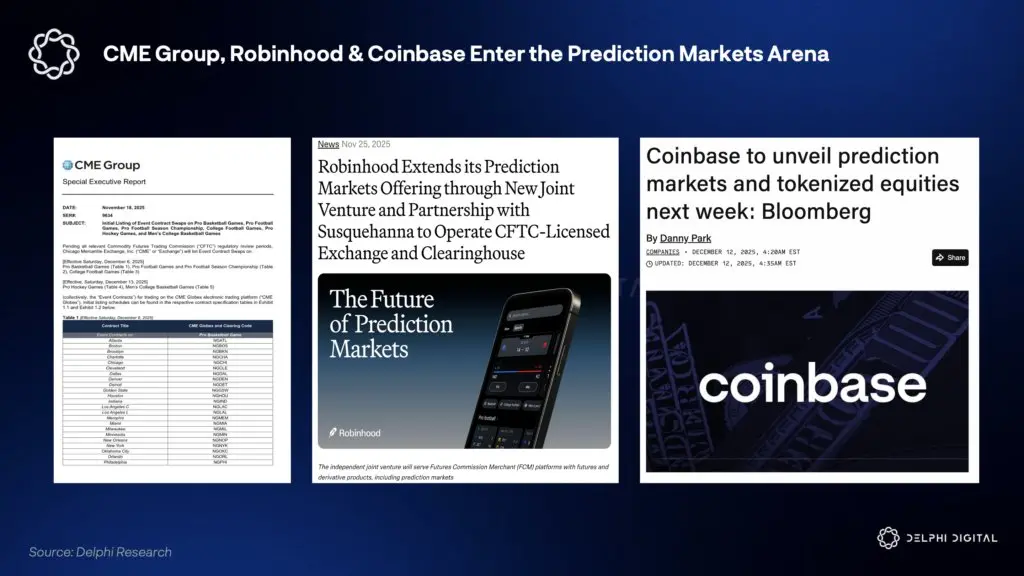
Giants are entering the arena: CME Group plans to launch sports markets, Coinbase is launching prediction markets, Robinhood acquired MIAXdx to offer in-house markets, thereby reducing reliance on Kalshi. Meanwhile, Polymarket and Kalshi are aggressively expanding to compete for market share.
Polymarket's Strategy: Build a crypto-native foundation with a CFTC-compliant architecture to aggregate the largest liquidity.

  • Return to the US Market: Through its acquired licensed exchange, it is about to regain CFTC approval and go live.

  • Web2 Expansion: Reaching entirely new audiences through partnerships with UFC, NFL, and Yahoo Finance.

  • On-Chain Moat: Consolidating dominance and improving user retention through potential airdrop expectations and wallet integrations.

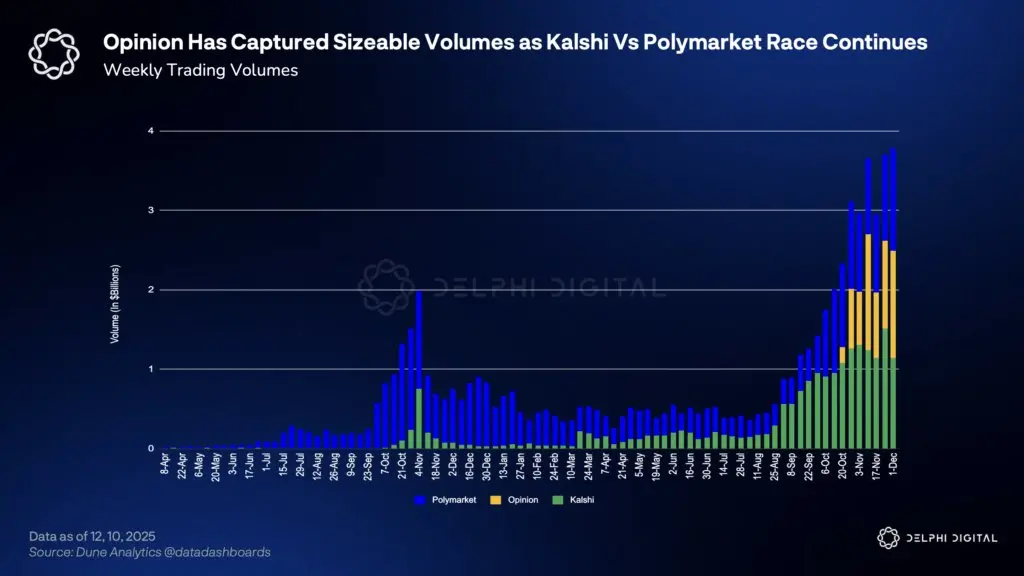
Kalshi's Strategy: Leverage compliance moat and order book liquidity to expand into global and on-chain markets.

  • Global Expansion: With $300 million in funding, Kalshi is expanding to 140 countries, challenging Polymarket's international advantage.

  • On-Chain Integration: Kalshi chooses not to compete directly with DeFi but instead provides liquidity to Jupiter and gains additional volume through high-traffic on-chain hubs like Phantom.

Kingmaker Effect

Layer 1 and Layer 2 now have real economic incentives to compete for prediction market share. Ecosystem grant programs targeting prediction market projects and their trading volume are expected to emerge.
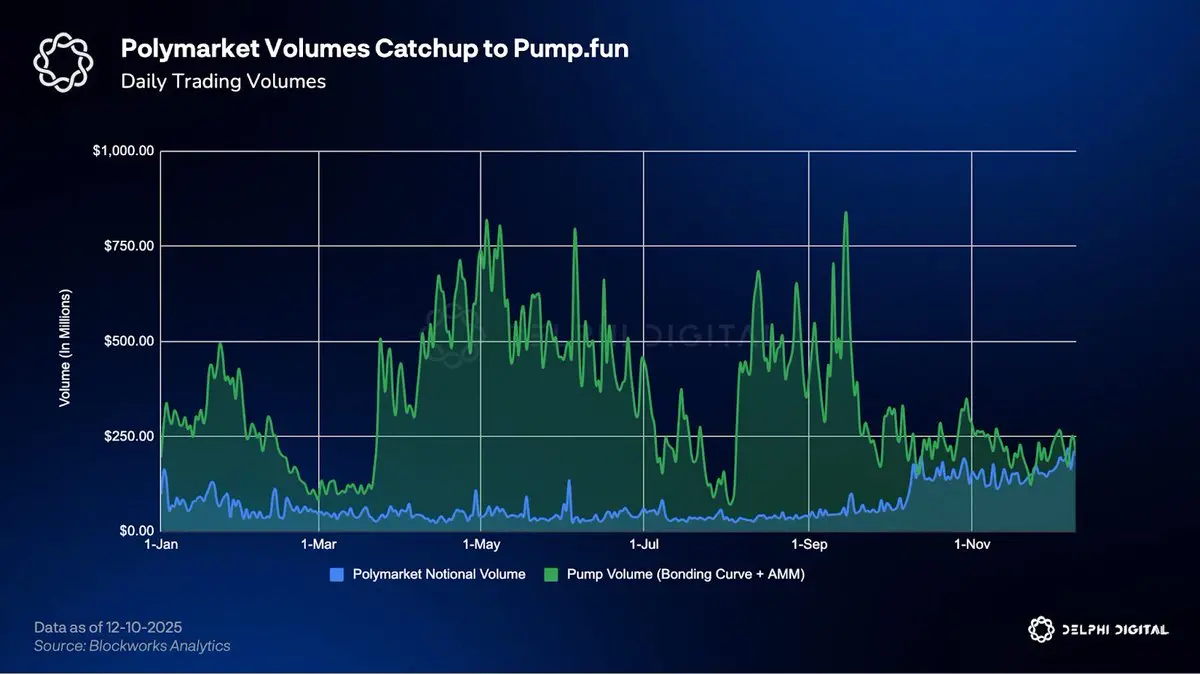
General-purpose prediction market platforms will struggle to compete with existing liquidity giants. The real opportunity lies in verticalized markets built for specific user groups.

Prediction 1: The "Perpetual-ization" of Options

Perpetual contracts simplified derivatives trading by removing expiration dates. Prediction markets can apply the same logic to options.

A market asking "Will Bitcoin close above $150,000 on June 30th?" is essentially a cash-settled binary option. There are no Greeks, no strike chains, no complex pricing models. Just a simple 0-100 probability that anyone can understand. Repackaging volatility into an easily digestible form through prediction markets will drive new demand for on-chain options.
Protocols like @Euphoria_fi are pushing this concept further with "click-to-trade" interfaces designed to feel more like gaming than operating a complex trading terminal.

Prediction 2: On-Chain Native Risk Markets

Prediction markets are poised to become core infrastructure by filling the gap for native insurance. Markets need tools to hedge DeFi risk exposures. To scale, DeFi needs native, trustless ways to规避 these risks.

Short-term (15/30 day rolling) markets like "Will stETH trade below 0.98 ETH for more than 1 hour in January?" allow users to precisely hedge specific risks.

Finding counterparties for these markets is very difficult. LPs can earn small premiums but face tail risk of being wiped out. Nonetheless, platforms that crack this nut will immediately gain favor with players who have massive sums locked in DeFi.

Prediction 3: Unbundling

The real opportunity is not to compete directly with Polymarket, but to unbundle the tech stack to serve different user types.

Professional users need tools to gain an edge and discover new opportunities in an expanding universe of markets.

  • Aggregators: Unified dashboards for trading across multiple platforms. Examples: @ConvergeMarkets, @KairosTradeX, @fireplacegg terminals.

  • Advanced Analytics: Risk modeling, alternative data sources, and wallet tracking. Examples: @hash_dive, @Polysights.

Financial speculation is a large market, but social娱乐 is even larger. Betting with friends is human nature,极其 natural. Today's interfaces are designed primarily for traders, not the broader mass market. An interface aimed at broad adoption should optimize for "social signaling," not just profit maximization.

The "super users" running these tools at scale may not be human. Funds managed by AI Agents will monitor data streams in real-time, discover mispriced markets, and execute arbitrage at speeds far exceeding humans. As these players enter, the easy arbitrage edges in binary markets are expected to disappear.

As the easy edges in prediction markets are arbitraged away, capital and users will shift to new mechanisms:

  • Impact Markets: Price the consequence (impact) of an outcome rather than its likelihood of happening. (e.g., @lightconexyz)

  • Sentiment Markets: Markets where participants predict group sentiment rather than real-world outcomes. (e.g., @meleemarkets)

  • Virtual Sports: Crypto-native versions (e.g., @footballdotfun) turn player cards into tradable liquid assets.

  • Futarchy: Governance decisions driven by market predictions on whether proposals will meet target metrics. (e.g., @MetaDAOProject)

  • Coordination Markets: A protocol sets a goal, participants buy tokens and take action to achieve it. If the goal is met, everyone profits through yields and token appreciation. (e.g., @hyperstiti0ns)

Prediction markets are becoming more than just speculation; they are evolving into infrastructure for options, insurance, and governance.

Recommended Reading:

RootData 2025 Web3 Industry Annual Report

Binance Power Shift: The Dilemma of a 300 Million User Empire

Beyond Stablecoins: Circle Releases 2026 Strategy Report, Internet Financial System Has Fully Emerged

InfoFi Narrative Collapses, Kaito, Cookie and Others Shut Down Related Products

Related Questions

QWhat are the three major trends in prediction markets identified by Delphi Digital?

AThe three major trends are: 1) The 'perpetualization' of options, which simplifies derivatives trading by removing expiration dates. 2) The rise of on-chain native risk markets to provide native, trustless ways to hedge DeFi risk exposure. 3) The unbundling of the tech stack to serve different user types, such as professional traders and the broader social entertainment market.

QHow is Polymarket strategizing to compete in the prediction market space?

APolymarket's strategy is to build a crypto-native base with a CFTC-compliant architecture to aggregate the largest liquidity. Its key moves include re-entering the US market through its acquired licensed exchange, expanding to Web2 audiences via partnerships with organizations like the NFL and Yahoo Finance, and solidifying its dominance through potential airdrop expectations and wallet integrations to improve user retention.

QWhat is Kalshi's approach to global expansion and its relationship with DeFi?

AKalshi is leveraging its compliance moat and order book liquidity to expand globally. With $300 million in funding, it is expanding into 140 countries to challenge Polymarket's international advantage. Instead of competing directly with DeFi, Kalshi is providing liquidity to platforms like Jupiter and acquiring additional trading volume through high-traffic on-chain hubs like Phantom.

QWhat new market mechanisms are expected to emerge as simple arbitrage opportunities in binary markets diminish?

AAs simple arbitrage advantages in binary markets are exhausted, new mechanisms are expected to gain traction. These include impact markets (pricing the consequence of an outcome), sentiment markets (predicting group sentiment rather than real-world outcomes), virtual sports (crypto-native versions that turn player cards into tradable assets), futarchy (governance decisions driven by market predictions), and coordination markets (where participants buy tokens and take actions to achieve a protocol-set goal for collective profit).

QHow are prediction markets evolving beyond mere speculation according to the article?

APrediction markets are evolving to become core infrastructure for options, insurance, and governance. They are being used to create simplified, easy-to-understand derivatives, provide native hedging tools for DeFi risks, and drive governance decisions through futarchy and other novel coordination mechanisms.

Related Reads

First Batch of Keynote Speakers and Partners Announced! Web2+3 Summit: Defining the Next Generation of Digital Economy

Web2+3 Summit: Defining the Next Generation of Digital Economy The 6th BEYOND International Technology Innovation Expo (BEYOND Expo 2026), Asia's largest tech and ecosystem exhibition, is launching a dedicated Web2+3 stage for the first time. Co-hosted by BEYOND Expo and ChainNeXT Group, the Web3 Summit will take place from May 28–30, 2026. Against the backdrop of accelerating global tech integration, the boundaries between Web2 and Web3 are rapidly blurring. With clearer global regulations for blockchain-driven internet (Web3) and the special issuance of a Hong Kong dollar stable币 license by the Hong Kong SAR government on April 10, 2026, Web3's decentralized principles are quickly merging with traditional industries (Web2) such as e-commerce, finance, and artificial intelligence. Focused on blockchain-driven digital economy elements, the summit will center on three core principles—implementability, commercial viability, and compliance. It will bring together top Web3 experts to discuss key integration areas like stablecoin payment finance (PayFi), real-world asset tokenization (RWA), and decentralized AI (DeAI), unveiling new opportunities for industrial innovation. The first wave of confirmed speakers includes Jack Kong (Director of Hong Kong Cyberport, Chairman of Nano Labs), Yat Siu (Chairman of Animoca Brands), Michael Wu (Co-founder & CEO of Amber Group), Michael Heinrich (Co-founder & CEO of 0G), and Art Abal (Co-founder of Vana). More Web3 ecosystem pioneers, AI, and fintech experts will be announced soon. Core forum topics include: - Web2+DeAI: New AI Paradigms Driven by Decentralized Infrastructure - Web2+RWA: Real-World Asset Tokenization and Global Liquidity - Web2+PayFi: Cross-Border Payments and Financial Innovation Powered by Crypto Infrastructure - Web2+3 AI: Autonomous Agents and the Crypto Economy - Web2+3 Wealth: On-Chain and Off-Chain Integrated Investment Ecosystems - Web2+3 Commerce: A New Landscape for Global Trade Driven by Stablecoins Additional agenda details will be released in the near future.

marsbit4h ago

First Batch of Keynote Speakers and Partners Announced! Web2+3 Summit: Defining the Next Generation of Digital Economy

marsbit4h ago

Trading

Spot
Futures
活动图片