Defending Champions or New Kings? World Cup Final Sees All AIs Backing the Same Side

Odaily星球日报Published on 2026-07-17Last updated on 2026-07-17

Abstract

Will the 2026 World Cup final see Argentina successfully defend their title or a new champion crowned? AI models from various platforms have made their prediction. The final in Buenos Aires pits defending champions Argentina against a resilient Spanish side that has reached this stage with a record of exceptional defensive solidity, conceding only one goal in seven matches. Argentina's path was dramatically different, filled with late comebacks and narrow victories, including a semi-final win over England secured by late goals assisted by the 39-year-old Lionel Messi. A poignant subplot adds narrative weight: a nearly 20-year-old photo shows a young Messi bathing an infant Lamine Yamal, who is now a 19-year-old key player for Spain, symbolizing a potential passing of the torch. In the semi-finals, most AI models incorrectly predicted a French victory over Spain, with only Google's Gemini correctly picking Spain's advancement and also accurately forecasting Argentina's win over England. For the final, however, all six surveyed AIs—ChatGPT, Claude, Gemini, Grok, DeepSeek, and Qwen—unanimously predict a Spanish victory. Their reasoning centers on Spain's superior defense, midfield control, and better physical preparedness after a less strenuous knockout stage journey. While consensus favors Spain as champions, five of the six AIs believe the match will be tightly contested, predicting a draw (1-1 or 0-0) within regular time, with Spain's advantage potentially telling in extr...

Original | Odaily Planet Daily (@OdailyChina)

Author | Asher (@Asher_ 0210)
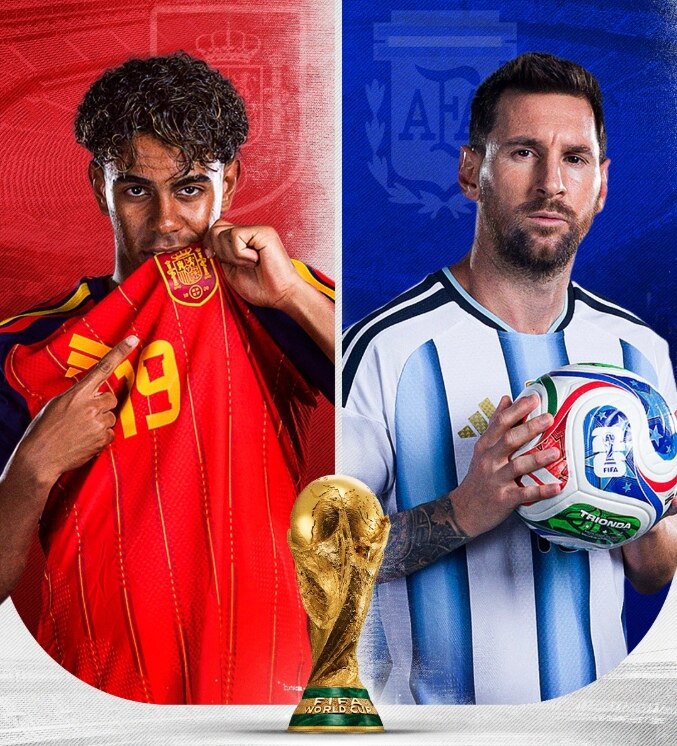
At 3 a.m. Beijing Time on July 20, the 2026 FIFA World Cup will crown its champion between Argentina and Spain. On one side is Argentina, attempting to defend their title and achieve a historic back-to-back World Cup win; on the other is Spain, who have marched steadily to the final with an almost unbreakable defense.

Spain's path to the final has demonstrated remarkable stability. In the knockout stages, they successively defeated Austria, Portugal, Belgium, and France, maintaining tight control of the game rhythm against multiple strong opponents. Particularly in the semi-final against France, Spain allowed little space for counterattacks from the Mbappé-led frontline, ultimately advancing with a 2-0 victory. With only 1 goal conceded and 6 clean sheets in 7 matches, their solid defense and formidable midfield control have been the bedrock of their journey.

Argentina's road, in contrast, has been fraught with danger and comebacks. Since entering the knockout rounds, they have hardly secured a comfortable win. They narrowly defeated Cape Verde and Egypt 3-2 each; in the quarter-final against Switzerland, they only scored consecutive goals deep into extra time; facing England in the semi-final, they were still trailing in the 85th minute before relying on Messi's assists for Enzo and Lautaro to complete a dramatic turnaround.

Furthermore, this final carries a storyline almost worthy of a movie script.

During a charity photoshoot in 2007, a young Lionel Messi was photographed bathing an infant Lamine Yamal. No one could have imagined that nearly two decades later, the two would meet for the first time in their careers on the World Cup final stage.

Now, Messi is 39 years old, while Yamal is just 19. One is potentially playing his final World Cup match; the other stands at the threshold of his own era. This nearly 20-year-old photo adds a layer of symbolic generational transition to this final.

Before delving into which side the AIs predict will lift the trophy, let's review their performance in the two semi-finals (related content can be read here: Semi-final AI Prediction Battle: Is France a Lock? England vs Argentina Hangs in the Balance).

Most Stumbled in Semis, Gemini Nailed Both

In the quarter-finals, all 6 AIs correctly predicted France, Spain, England, and Argentina to advance. However, by the semi-finals, the overall prediction performance of the AIs became somewhat "lackluster."

For France vs. Spain, ChatGPT, Claude, Grok, DeepSeek, and Qwen not only unanimously favored France to advance but also all predicted a 2-1 win for France. These five models reasoned that France could exploit the spaces left by Spain's advancing full-backs to decide the match with swift counterattacks. In reality, France failed to execute the expected counters, were instead controlled by Spain's rhythm, and ultimately exited with a 0-2 loss. Gemini, the sole model to pick Spain, got the advancing team right, but it predicted the match would go to a penalty shootout, thus also missing the exact process.

For England vs. Argentina, the 6 AIs were split down the middle. Grok, DeepSeek, and Qwen supported England, while ChatGPT, Gemini, and Claude backed Argentina. In the end, Argentina completed a 2-1 comeback. The three models supporting Argentina correctly predicted the advancing side, with only Gemini also accurately predicting the final score.

After the two semi-finals, Gemini emerged as the only model to correctly pick both finalists, delivering the most accurate predictions of this round. Yet, as we approach the ultimate championship match, all 6 AIs have once again aligned on the same side.

Consensus Returns for Final, All 6 AIs Favor Spain

Monitoring by prediction market tools shows that in the "World Cup Final Argentina vs Spain" event on predict.fun, the implied probability for an Argentina win is temporarily reported at 27%; a draw at 32%; and a Spain win at 43%. Furthermore, including extra time and penalties, Spain's implied championship probability stands at 59%, compared to Argentina's 41%.
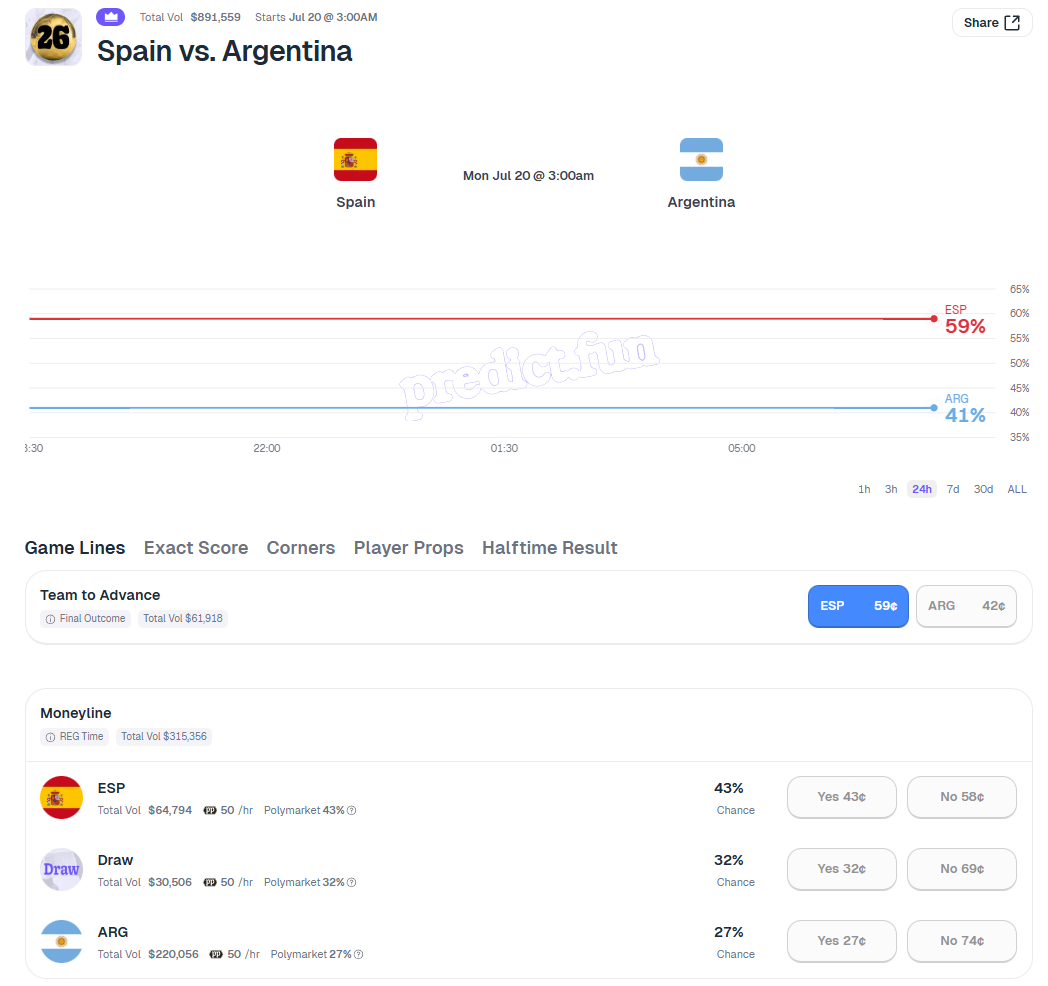
While the prediction market shows a close championship probability, the stance of the 6 AIs is highly unanimous: ChatGPT, Claude, Gemini, Grok, DeepSeek, and Qwen all favor Spain to win the title.

Why Do All AIs Predict a Spanish Victory?

The reasons cited by the AIs for favoring Spain are highly consistent: defense, midfield control, and physical preparedness.

Spain's most compelling advantage is their near-impenetrable defense this tournament. Conceding only 1 goal in the first 7 matches and successively containing Portugal, Belgium, and France in the knockouts. While Argentina possesses greater offensive firepower, facing Spain's compact formation, they are unlikely to find the same open spaces for counterattacks as before.

Midfield control will dictate the pace of the match. Rodri orchestrates the attack, Olmo consistently infiltrates the attacking channels between defenders, and Yamal can continuously stretch Argentina's defense from the wings. Argentina excels at compressing the center and launching rapid attacks through Messi, Álvarez, and Lautaro, but Spain has the ability to reduce transitional play through prolonged possession, making it difficult for Argentina to settle into their preferred rhythm.

Physical preparedness is also a variable widely mentioned by the AIs. Spain finished their semi-final a day earlier than Argentina and had a relatively smoother path; Argentina, meanwhile, played 120 minutes against Switzerland and battled until stoppage time against England. If the match goes into extra time, Spain's younger squad and deeper bench could become decisive advantages.

5 AIs Don't Favor a Spanish Win Within 90 Minutes

Although unanimous on the champion, the 6 models still have different judgments on how Spain might win the match.

Gemini, the top performer in the semis, predicts a 1-1 draw in regulation time, a continued stalemate in extra time, and ultimately a penalty shootout to decide the champion, picking Spain to emerge victorious.

ChatGPT, Grok, and Qwen offer similar predictions, all leaning towards a 1-1 scoreline after 90 minutes. They believe Argentina has the ability to equalize through Messi's playmaking and attacking efficiency, but in extra time, Spain's superior physical conditioning and squad depth will gradually tell, leading to a winning goal in the additional 30 minutes.

Claude does not predict a specific score but believes the match will be locked in a low-scoring range (1-1, 1-0, or 0-0). It emphasizes the cautious atmosphere typical of finals, suggesting the sides may remain evenly matched for long periods until a set piece, counterattack, or individual moment of brilliance breaks the deadlock.

DeepSeek is the only model leaning more towards Spain resolving the match within the 90 minutes. It expects Spain to continue their defensive solidity, limit Argentina's attack, and secure a direct 2-0 or 2-1 victory.

Before the semi-finals, 5 AIs unanimously backed France to advance, only for Spain to deliver a 2-0 masterclass, collectively proving the AIs wrong. This time, will Spain fulfill the promise of their overall strength, or will Argentina once again drag the match into familiar desperate straits and find a path to another miraculous turnaround?


Related Questions

QWhat is the main storyline surrounding the upcoming 2026 World Cup final between Argentina and Spain, according to the article?

AThe main storyline is the potential passing of the torch between two generations, symbolized by a nearly 20-year-old photo of a young Lionel Messi giving a bath to a baby Lamine Yamal. Now, a 39-year-old Messi potentially faces a 19-year-old Yamal in what could be Messi's final World Cup match, representing a symbolic shift of eras.

QWhich was the only AI model to correctly predict both finalists from the semifinals, and what was its performance?

AGemini was the only AI model to correctly predict both finalists. It was the sole model to pick Spain to advance over France (though it predicted a penalty shootout, not a 2-0 win). It also correctly predicted Argentina to beat England and was the only model among those picking Argentina to also get the exact 2-1 scoreline right.

QWhat are the three primary reasons cited by the AI models for unanimously favoring Spain to win the World Cup final?

AThe three primary reasons are: 1) Spain's nearly impenetrable defense, having conceded only 1 goal in 7 matches with 6 clean sheets. 2) Superior midfield control, allowing them to dictate the game's tempo and limit Argentina's preferred fast transitions. 3) Better physical and squad depth, having had an easier path to the final and more rest, which could be decisive if the match goes to extra time.

QHow did the predictions of ChatGPT, Grok, and Qwen (Qianwen) differ from DeepSeek's regarding how Spain would win the final?

AChatGPT, Grok, and Qwen predicted the match would be tied 1-1 in regular time, with Spain's superior fitness allowing them to score a winning goal in extra time. In contrast, DeepSeek was the only model that favored Spain winning within the 90-minute regulation time, predicting a 2-0 or 2-1 victory, citing their strong defense to contain Argentina's attack.

QWhat was the general performance of AI models in the World Cup semifinals compared to the quarterfinals, as described in the article?

AIn the quarterfinals, all six AI models correctly predicted the advancement of France, Spain, England, and Argentina. However, their overall performance was poor ('拉胯') in the semifinals. Five models (ChatGPT, Claude, Grok, DeepSeek, Qwen) incorrectly predicted France would beat Spain 2-1. Only three models (ChatGPT, Gemini, Claude) correctly picked Argentina over England, with only Gemini getting the exact score right for that match.

Related Reads

L2 'Recalibration': When L1 Becomes Its Own Rollup, What Is Ethereum's Endgame?

The article discusses the evolving relationship between Ethereum's Layer 1 (L1) and Layer 2 (L2) solutions, moving beyond the initial "L2 for scaling" model. As Ethereum L1 itself scales (increasing Gas Limit, statelessness, zkEVM), the unique value proposition of L2s shifts from merely providing cheap execution to offering differentiated features like application-specific optimization, privacy, and flexible governance. The piece explores three key themes: 1. **L2's New Role:** L2s are transitioning from a pure scaling technology to a spectrum of execution environments with varying degrees of security inheritance from Ethereum L1. 2. **Interoperability as State Trust:** Solving L2 fragmentation is less about cross-chain bridges and more about enabling faster, trust-minimized state verification between environments. This involves initiatives like faster L1 finality, intent-based architectures (Open Intents Framework), and native account abstraction. 3. **Blurring Layers:** With the potential integration of zk-proofs into L1 validation (making L1 akin to its own "Rollup") and the concept of "Native Rollups," the rigid boundary between L1 and L2 may fade. The future could be a unified system with multiple execution domains (for DeFi, gaming, privacy, etc.) sharing a common security, settlement, and state framework. In conclusion, Ethereum's goal is not to abandon L2s or re-centralize everything on L1, but to re-integrate the fragmented user experience—liquidity, accounts, applications—while preserving the scaling benefits of a multi-environment ecosystem. The endgame is a cohesive "one chain" feeling for users, powered by diverse but securely interconnected execution layers.

marsbit17m ago

L2 'Recalibration': When L1 Becomes Its Own Rollup, What Is Ethereum's Endgame?

marsbit17m ago

The Encryption Bill Clarity's Challenge: A Thorny Path of Bipartisan Compromise in the U.S.

U.S. lawmakers are attempting to advance the Clarity Act, a significant crypto market structure bill, but its path is fraught with partisan hurdles. The process has been rocky since January, when a prior bipartisan deal in the Senate Banking Committee was upended. A key compromise in May on "yield" issues allowed the bill to move forward in committee, but only with the conditional support of two Democratic senators, Angela Alsobrooks and Ruben Gallego. They emphasized that their final vote depends on reaching an agreement on ethics provisions for elected officials. Ultimately, the Senate Agriculture Committee passed its version along party lines without Democratic support. As Republicans push for a full Senate vote in July, the demand for strong ethics language has expanded beyond Democrats. Additional controversies surround provisions related to yields (aligning some Republicans with large banks) and developer protections (opposed by enforcement agencies). Core concerns about illicit finance and consumer protection remain central to the debate. Despite consensus on the need for legislation, achieving the necessary bipartisan compromise is proving difficult. While momentum exists—including recent meetings between senators and White House officials—a reconciled bill text faces skepticism. Senator Gallego has stated that without ethics terms acceptable to Democrats, they will not provide the needed votes. The immediate goals for the crypto community in Congress are unclear: a symbolic Senate vote before the August recess, eventual passage into law by 2026, or forging a final compromise framework. The arduous, vote-by-vote effort to build bipartisan support continues, mirroring the traditional legislative grind the industry must now navigate.

Foresight News1h ago

The Encryption Bill Clarity's Challenge: A Thorny Path of Bipartisan Compromise in the U.S.

Foresight News1h ago

Trading

Spot
活动图片