Deconstructing Smart-Cashtags: How X Is Entering Web3 Financial Infrastructure?

marsbitPublished on 2026-01-14Last updated on 2026-01-14

Abstract

X, formerly Twitter, is launching "Smart-Cashtags," a feature that integrates real-time financial data directly into its platform, marking a significant step in its evolution into an "Everything App." This update aims to eliminate the friction users face when switching between X for market information, charting tools like TradingView, and exchanges to execute trades. The core innovation is the binding of a cashtag (e.g., $SOL) to a specific on-chain smart contract address, combating the widespread issue of scam tokens with identical names. This provides a layer of verification and security for users. Beyond fraud prevention, Smart-Cashtags will display a financial dashboard with real-time price, volume, and on-chain data when a user clicks a tag. This transforms X into a "Bloomberg Terminal for retail," enabling near-instant decision-making without leaving the app and accelerating the platform's influence on asset pricing. This move is also a strategic play in the "Web3 traffic入口" war against Telegram, which has captured mobile trading demand via its trading bots. With the recent acquisition of payment licenses and an in-app wallet in development, X is positioned to eventually integrate "Buy/Sell" buttons, potentially becoming the world's largest social trading platform. Scheduled for a global rollout, Smart-Cashtags represent X's ambition to move beyond being a source of information to becoming the central hub for social finance (Social-Fi), capturing value directly with...

Author: BlockWeeks

In the world of crypto, attention is currency, and X (formerly Twitter) has long been the world's largest wholesale market for attention.

For a long time, users here have been accustomed to a fragmented existence: searching for "Alpha" (excess return information) on X, quickly switching to TradingView to check charts, and then jumping to an exchange to place an order. This "friction cost" caused by app switching is often the key factor determining the profit or loss of a high-frequency trade.

However, with the official preview of Smart-Cashtags by X's product lead Nikita Bier in early 2026, this fragmented state may become history. This is more than just a UI component update; it marks the placement of the most critical piece in Musk's puzzle of building the "Everything App"—the closed loop of financial information flow.
Farewell to "Fakes": On-Chain Authentication of Token Identity

For any investor who has lived through a "shitcoin season," the first, and most painful, point that Smart-Cashtags addresses is "identity verification."

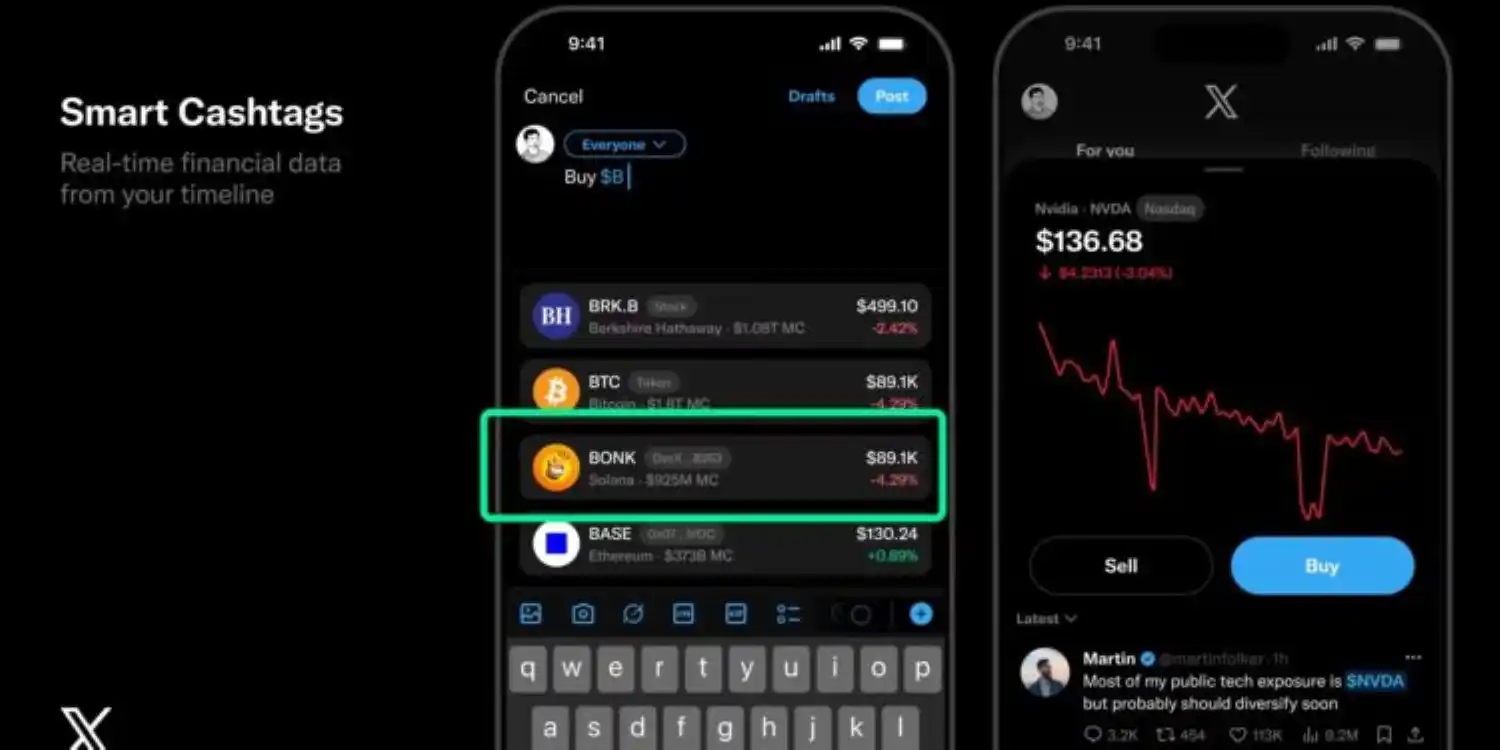
In the old system, a Cashtag (like $ABC) was merely a blue hyperlink for search. But in the decentralized world, anyone can issue a token named $ABC. This meant that when a big influencer shilled a coin, scammers could often deploy a token with the same name within minutes and manipulate search results through volume manipulation, causing many retail investors to buy the wrong contract address.

The core change with Smart-Cashtags is its introduction of a "hard binding of semantics and contract." Based on currently disclosed information, the new feature will allow posters or communities to directly associate a specific smart contract address when typing the $ symbol.

This means that in the future, $SOL will no longer be an ambiguous tag; it will directly point to the native asset on the Solana chain. For those highly liquid, short-lived Meme coins, this is equivalent to introducing an "anti-counterfeiting watermark" at the social layer. X is attempting to use technical means to cleanse the rampant scam noise on its platform, paving the way for subsequent compliant finance.

The "Bloomberg-ization" of the Social Interface: When the Information Flow Becomes the Trading Flow

If "anti-counterfeiting" is the foundation, then shaping X into the "Bloomberg Terminal for retail" is its true ambition.

In traditional finance, the Bloomberg Terminal is expensive because it integrates news, data, and trading on one screen. Smart-Cashtags is doing the same thing for retail. Once the feature goes live, clicking a tag will no longer redirect to a tweet search stream but will instead directly summon a floating financial dashboard.
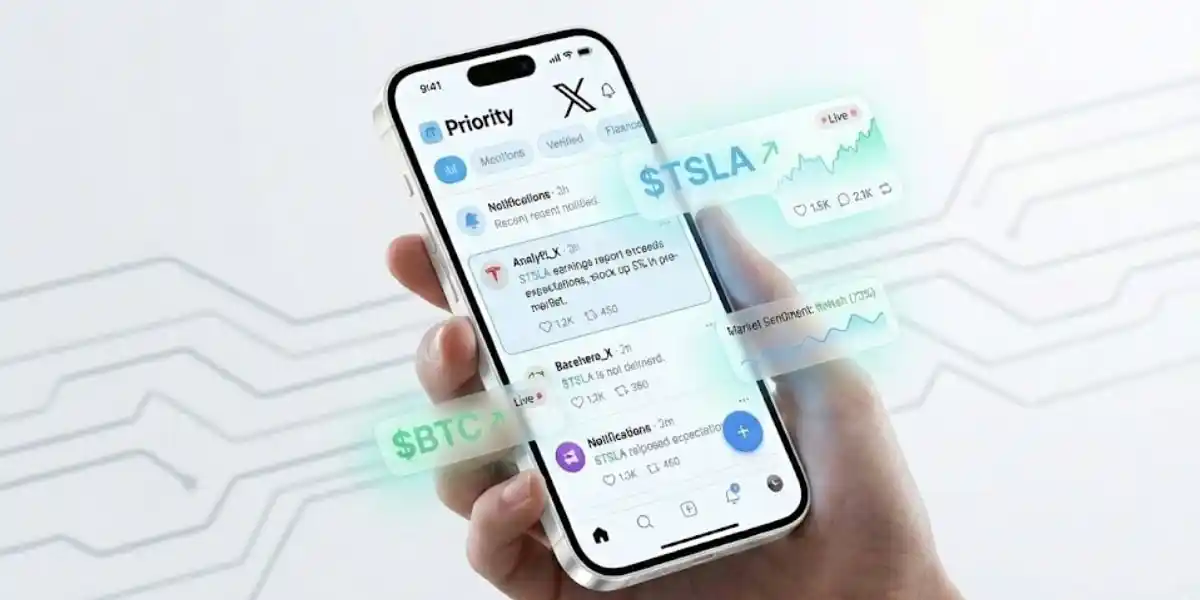
Imagine this scenario: You come across breaking news about a DeFi protocol being hacked. In the past, you would need to exit X, open a charting app to confirm the price drop, and then decide whether to buy the dip or cut losses. In the future, you simply click the tag in the tweet, and real-time price, trading volume changes, and on-chain fund flows will be instantly displayed on the current page.

This "zero-redirect" experience will drastically shorten the time window from "acquiring information" to "making a decision." For the market, this means the speed of sentiment transmission will further accelerate, and X's immediate influence on asset pricing will reach an unprecedented height.

The Endgame of Social-Fi: A Direct Challenge to Telegram

We cannot view this update in isolation. Behind Smart-Cashtags lies the invisible war between X and Telegram for the "Web3 traffic gateway."

Over the past two years, Telegram,凭借 Unibot, Banana Gun, and other trading bots, has successfully captured a significant portion of mobile trading demand. Users see a message in a Telegram group and buy directly with one click via a bot—an experience that once could only be envied by X.

Smart-Cashtags is X's powerful counterattack. Although the initial functionality focuses on market display,结合 Musk's acquisition of payment licenses in multiple US states and X's testing of an "in-app wallet" feature, it is reasonable to speculate that integrating "Buy/Sell" buttons directly on the tag page is only a matter of time.

Once the payment layer is connected, X will instantly升级 from a "square for arguments" to the world's largest "social exchange." It boasts a more public arena for discourse, more sophisticated algorithm recommendations, and a larger user base of institutions compared to Telegram.

Conclusion

2026 is destined to be a year where Social-Fi (Social Finance) separates the wheat from the chaff.

The emergence of Smart-Cashtags means X is no longer content with just being a traffic "referral"; it wants to become the "checkout counter" itself. For the average investor, this may mean more convenient tools; but for professional crypto practitioners, this heralds a new battlefield: those who can first leverage this new tool to capture emotional value will occupy the high ground in the new traffic distribution mechanism.

It is reported that the feature is expected to be rolled out to global users in February. When that happens, every time we click the $ symbol, we might be participating in a tiny rewrite of financial history.


Related Questions

QWhat is the core innovation of X's Smart-Cashtags feature, and what key problem does it solve?

AThe core innovation of Smart-Cashtags is the 'hard binding of semantics and contracts.' It solves the critical problem of token identity confirmation by allowing a cashtag (e.g., $ABC) to be directly linked to a specific on-chain smart contract address, preventing users from being scammed by fake, identically named tokens.

QHow does the Smart-Cashtags feature transform the user experience on X into a 'Bloomberg Terminal for retail'?

AIt transforms the experience by displaying a financial dashboard directly within the X interface when a user clicks a cashtag. This provides real-time price, trading volume, and on-chain data without requiring the user to switch to another app, drastically shortening the time between receiving information and making a trading decision.

QWhich competing platform has been a leader in capturing mobile Web3 trading flow, and how is X's Smart-Cashtags a response to it?

ATelegram has been the leading platform, capturing mobile Web3 trading flow through integrated trading bots like Unibot and Banana Gun. Smart-Cashtags is X's direct response, aiming to compete by integrating financial data and, in the future, potentially direct buy/sell functionality within its social feed.

QBeyond just displaying data, what is the article's prediction for the future evolution of the Smart-Cashtags feature?

AThe article predicts that the feature will eventually integrate direct 'Buy/Sell' buttons, leveraging the payment licenses acquired by Elon Musk. This would turn X from a social platform into a massive 'social exchange,' directly competing with Telegram's bot-based trading model.

QWhat broader shift in X's strategy does the introduction of Smart-Cashtags represent according to the article?

AIt represents a strategic shift where X is no longer content with just being a source of traffic and information (a 'lead generator') but is moving to become the complete financial infrastructure itself, acting as the 'cash register' by closing the loop between social discourse and financial action.

Related Reads

Bitcoin's 'Rally Ends,' Officially Entering the Later Stage of a Bear Market?

Bitcoin prices declined 13% this week, reversing the recent rebound and signaling a likely transition into the later stages of a bear market. Key on-chain metrics deteriorated, with the short-term holder cost basis falling below the Realized Price—a pattern last seen in early 2022, characteristic of bear market maturity. The rally to ~$82k proved to be a bear market bounce, as evidenced by the 90-day realized profit/loss ratio failing to sustain above the bullish threshold of 2. Daily realized losses surged to $1.35B, including significant selling from long-term holders who accumulated near cycle tops, indicating ongoing supply redistribution. Price was rejected almost precisely at the aggregate US spot ETF cost basis of ~$83k, turning that level into resistance and leaving the average ETF investor underwater again. Spot market selling pressure intensified, with the 7-day volume delta turning significantly negative to its weakest level since February. While a major long liquidation event cleared over $400M in leverage, spot demand has not yet stepped in to absorb the resulting supply. Options markets continue pricing in higher future volatility (elevated volatility risk premium) and maintain a skew toward put options, reflecting persistent demand for downside protection, though not yet panic. Overall, market structure remains fragile. Sustained recovery likely requires a reclaim of the ETF cost basis, a shift back to positive spot demand, and a slowdown in realized loss-taking. Until then, the market risks further downside or extended consolidation within the broader bear trend.

Foresight News1h ago

Bitcoin's 'Rally Ends,' Officially Entering the Later Stage of a Bear Market?

Foresight News1h ago

How Risky is the "Death Spiral" of MSTR and STRC?

Summary: This article explores the perceived "death spiral" risk between MicroStrategy (MSTR), its Bitcoin holdings, and its perpetual preferred stock (STRC), drawing comparisons to the LUNA-UST collapse. While both systems feature price anchors, high yields for holders, and potential feedback loops, their core mechanisms differ fundamentally. The MSTR-STRC structure relies on continuous financing to sustain its high dividend payouts, primarily through stock ATM offerings. A negative feedback cycle could occur: falling MSTR stock price makes raising equity capital harder, increasing pressure to sell Bitcoin, which undermines STRC confidence and further depresses MSTR. However, unlike LUNA-UST's automated, direct linkage, the MSTR-STRC loop is weaker and has brakes: STRC dividends can be deferred or rates lowered, and STRC holders have a $100/share liquidation preference in bankruptcy, providing a price floor. The company's sustainability hinges on its ability to continue financing. Its current ~$900 million USD reserves cover only about 6.3 months of its ~$1.71 billion annual interest/dividend burden. The next six months are critical, aligning with both the potential bottom in Bitcoin's four-year cycle and the depletion timeline of its reserves. While a LUNA-style catastrophic collapse is deemed highly unlikely due to structural differences, the key question is whether MicroStrategy can navigate this period through healthy deleveraging to restart its capital engine.

Foresight News1h ago

How Risky is the "Death Spiral" of MSTR and STRC?

Foresight News1h ago

Trading

Spot
Futures
活动图片