
Deciphering the Top Ten Bearish Factors in the Crypto Market: How Severe Is This 'Siege of Bright Summit'?

marsbitPublished on 2026-02-25Last updated on 2026-02-25

Abstract

Title: Decoding the Top 10 Bearish Factors in the Crypto Market: How Severe is This "Siege of Bright Summit"? The crypto market is experiencing a severe downturn, driven by multiple simultaneous pressures: tightening global regulations, escalating geopolitical conflicts, industry leaders exiting, and collapsing retail confidence. This "siege" consists of four major forces. 1. Regulatory Crackdown: The U.S. banking lobby is pushing to ban interest payments on stablecoins, which may reduce short-term appeal but could lead to a compromised solution. The OECD’s Crypto Asset Reporting Framework (CARF) has taken effect in 48 jurisdictions, increasing compliance costs but potentially paving the way for institutional adoption. X (formerly Twitter) has tightened ad policies for crypto projects, raising user acquisition costs. 2. Geopolitical Tensions: Escalating Middle East conflicts and Trump’s tariff hikes have strengthened the U.S. dollar and traditional safe-haven assets, draining liquidity from crypto. Market uncertainty may persist until potential U.S.-China summit talks in late March. 3. Internal Selling Pressure: Bitmain’s Jihan Wu sold over 1,100 BTC to fund AI data center ventures, while Vitalik Buterin sold ETH to support ecosystem development. Key opinion leaders (KOLs) are also reducing exposure, amplifying panic selling. 4. Emotional Meltdown: Searches for "Bitcoin is dead" hit a post-FTX peak, and stablecoin FUD caused brief depegging. An upcoming expose by ZachXBT...

Author: Shouyi, Biteye Content Team

This is the toughest year for the crypto community: Bitcoin keeps falling, contracts are constantly liquidated, no one is sending red envelopes in group chats, and everyone has shifted from "buying the dip" to "playing dead."

This decline is not just a technical correction but a simultaneous eruption of multiple pressures: global regulation tightening, escalating geopolitical conflicts, industry leaders retreating, and retail investor confidence collapsing. These four forces are converging, staging a "Siege of Bright Summit" battle in the crypto world.

However, upon closer examination of these ten bearish factors, many of the "bad things" are actually necessary steps for the industry's maturation. Below, Biteye breaks them down one by one. After reading, you'll know how to respond.

I. Regulatory Iron Curtain: Stablecoins, Taxation, and Platform Regulation

1. Stablecoin Interest Earnings to Be Cut Off

https://x.com/CryptosR_Us/status/2021523353769480336

Amid the legislative stalemate over the U.S. "Clarity for Payment Stablecoins Act," the American Bankers Association (ABA) and major Systemically Important Banks (SIBs) have lobbied regulators to prohibit stablecoin issuers and intermediary platforms from paying interest to users. Violators face daily fines of up to $500,000.

Short-term impact: Stablecoins' attractiveness will undoubtedly decline, and with the weakening dollar, some TVL will flow elsewhere;

Long-term impact: A complete ban is unrealistic; a compromise with limited rewards is more probable. Policies are expected to be finalized in Q2, and the market will gradually digest this expectation over the next 3-6 months.

2. Global Tax Dragnet Arrives

https://x.com/Foresight_News/status/2010935974742937622

The Crypto Asset Reporting Framework (CARF), led by the Organisation for Economic Co-operation and Development (OECD), has taken effect in 48 jurisdictions (including the EU's 27 countries, the UK, Japan, and South Korea). It requires exchanges to automatically exchange cross-border transaction data of users, with the U.S. simultaneously implementing Form 1099-DA.

Short-term impact: Compliance costs will rise significantly, triggering panic selling among retail investors;

Long-term impact: Tax transparency is a prerequisite for traditional institutional entry. Trillions in institutional funds may only flow in after full implementation in 2026; this is just the painful transition period.

3. Even X Platform Starts Restricting Ad Qualifications

https://x.com/nikitabier/status/2025337476391608540

X platform has updated its advertising policy for prediction markets, mandating mandatory disclosures for all promotional content, effectively significantly raising customer acquisition costs for projects.

Short-term impact: Shitcoin hype is completely dead; marketing on X is basically unworkable;

Long-term impact: Good money drives out bad, helping rebuild industry credibility. However, frankly, there aren't many serious projects still advertising on X; this rule is more symbolic, and its impact depends on enforcement.

II. Geopolitical Strangulation: War, Tariffs, and Summit Diplomacy

4. Middle East Conflict, Capital Fleeing to Safety

https://x.com/StateDept/status/2026518216600858881

Trump's maximum pressure on Iran, threatening "small strikes first, then big ones," has driven risk-averse sentiment, pushing the U.S. Dollar Index (DXY) to 97.7, raising the 10-year Treasury yield, and Brent crude breaking $65/barrel. The Global Economic Policy Uncertainty Index hit a record high since FRED database records began, with capital flooding into traditional safe-haven assets.

Short-term impact: Crypto market liquidity was instantly drained, most evident in the disappearance of USDT premiums, which even turned into discounts;

Long-term impact: Geopolitical shocks often come and go quickly. Historically, suppressed buying often rebounds violently within 1-2 months. Selling now to switch to dollars likely means selling at the bottom.

5. Trump's 15% Tariff Hammer Falls

https://x.com/baldwin_daniel_/status/2025246781592773073

After the Supreme Court rejected related relief requests, the Trump administration, under Section 122 of the Trade Act of 1974, raised the global baseline tariff from 10% to 15% on February 24 for 150 days. This policy transmits through the chain of "tariffs → inflation expectations → stronger dollar," and crypto, as a high-beta risk asset, is hit first.

Short-term impact: Negative shocks typically peak at policy onset. If major countries later break the ice in talks, the pressure will quickly turn positive;

Long-term impact: Trump habitually uses maximum pressure before negotiations; the TACO (Tariff-Agreement Cycle) is a classic pattern and won't last the full 150 days.

6. Market Awaits U.S.-China "Summit Diplomacy"

https://x.com/AJEnglish/status/2025111127110418517

The Trump administration announced plans to visit China from March 31 to April 2, but may implement "pre-negotiation maximum pressure" through tariff escalations and tech bans beforehand—a typical game theory strategy. The market must continue trading under policy suspense until late March.

Short-term impact: This bearish factor artificially amplifies volatility, keeping the market under a cloud of policy uncertainty;

Long-term impact: If talks yield substantial progress, global risk assets will see a liquidity release window. Expectations are that this bearish news will be digested after the late March meeting results. Until then, "uncertainty" persists, and market volatility may increase.

III. Internal Bleeding: Liquidations, Selling, and Retreat

7. Jihan Wu Liquidates BTC, Fully Shifts to AI

https://x.com/CupidMonday/status/2025956106833449279

Bitdeer (NASDAQ: BTDR), controlled by Jihan Wu, recently liquidated about 1,132 BTC (approx. $72 million at the time) and announced a full transition to AI Data Center (AIDC) business. The company's IR statement emphasized this as a "non-permanent zero position," essentially balance sheet management to cope with miner upgrade pressures (4nm/3nm chips) and capital expenditure needs for AI computing infrastructure.

Short-term impact: Panic over "miner selling" is amplified. If even a mining tycoon is selling, why should retail hold?

Long-term impact: AI-crypto computing fusion is an industry upgrade trend, not a systemic crisis. Expect funds to flow back into crypto after AIDC construction.

8. Vitalik Continues Selling ETH, Lower and Lower

https://x.com/DeFiTracer/status/2018698179277963356

Ethereum co-founder Vitalik Buterin recently continued selling ETH via a multisig address, offloading 1,869 coins in two days, totaling over 7,000 ETH (approx. $15.5 million) sold. Official confirmation stated funds are for Ethereum Foundation R&D and long-term investments in biotech. Relative to his ~$430 million holdings, the sell-off is less than 0.36%.

Short-term impact: In the weak market, Vitalik's actions precisely hit ETH bulls' confidence, creating a vicious cycle of "selling more as price drops, price drops as more is sold." Many on X question if Vitalik has lost faith in ETH, and this sentiment spread is dangerous;

Long-term impact: Normal operation for founders to cash out and feed the ecosystem, just at an unfortunate time.

9. Influencers Collective Call to Exit, Smart Money Leaves

https://x.com/dotyyds1234/status/2026097439850303512

High-impact trader KOLs like "Honba Dragon King" publicly announced reducing on-exchange positions by 30%-50% and released bearish言论. In a illiquid market, such voices amplify via social media, causing emotional contagion. Now, people in groups are posting empty position screenshots, showing signs of follow-on panic selling.

Short-term impact: Bearish言论 from on-chain leaders and traders significantly affect the market;

Long-term impact: When market-recognized "smart money" collectively exits loudly, it often forms an excellent contrarian bottom indicator. Of course, whether this time is an exception is uncertain. Some KOLs may delete posts and turn bullish later; use @xhunt_ai plugin to check deletion history.

IV. Emotional Nuclear Bomb: "Bitcoin Is Dead," Depegging, and Trust Crisis

10. FUD Erupts, "Bitcoin Is Dead" Trends

https://x.com/XHuntCN/status/2025963293920342134

Google Trends shows "Bitcoin is dead" searches peaked since the 2022 FTX collapse; USD1 stablecoin briefly depegged to 0.98 USDT due to FUD; on-chain detective ZachXBT预告 will expose insider trading evidence of "the most profitable company in crypto" on February 26.

Short-term impact: In this environment, trust mechanisms are severely damaged, triggering indiscriminate selling;

Long-term impact: "BTC is dead" search peaks are often the strongest signal of market bottoms—as in 2018 and 2022. Expect ZachXBT's exposure to cause short-term flight to safety but long-term industry cleansing and renewal.

V. Technical Data: It's Bad, but Maybe Nearing the Bottom

A look at the data shows it's indeed bad. Three core indicators (BTC oversold Index, ahr999 buying index, Extreme Fear Index) are near historical extremes. Indicators suggest the market's oversold level is approaching historical limits but hasn't broken the longest record;震荡寻底 may continue for 1-2 months.
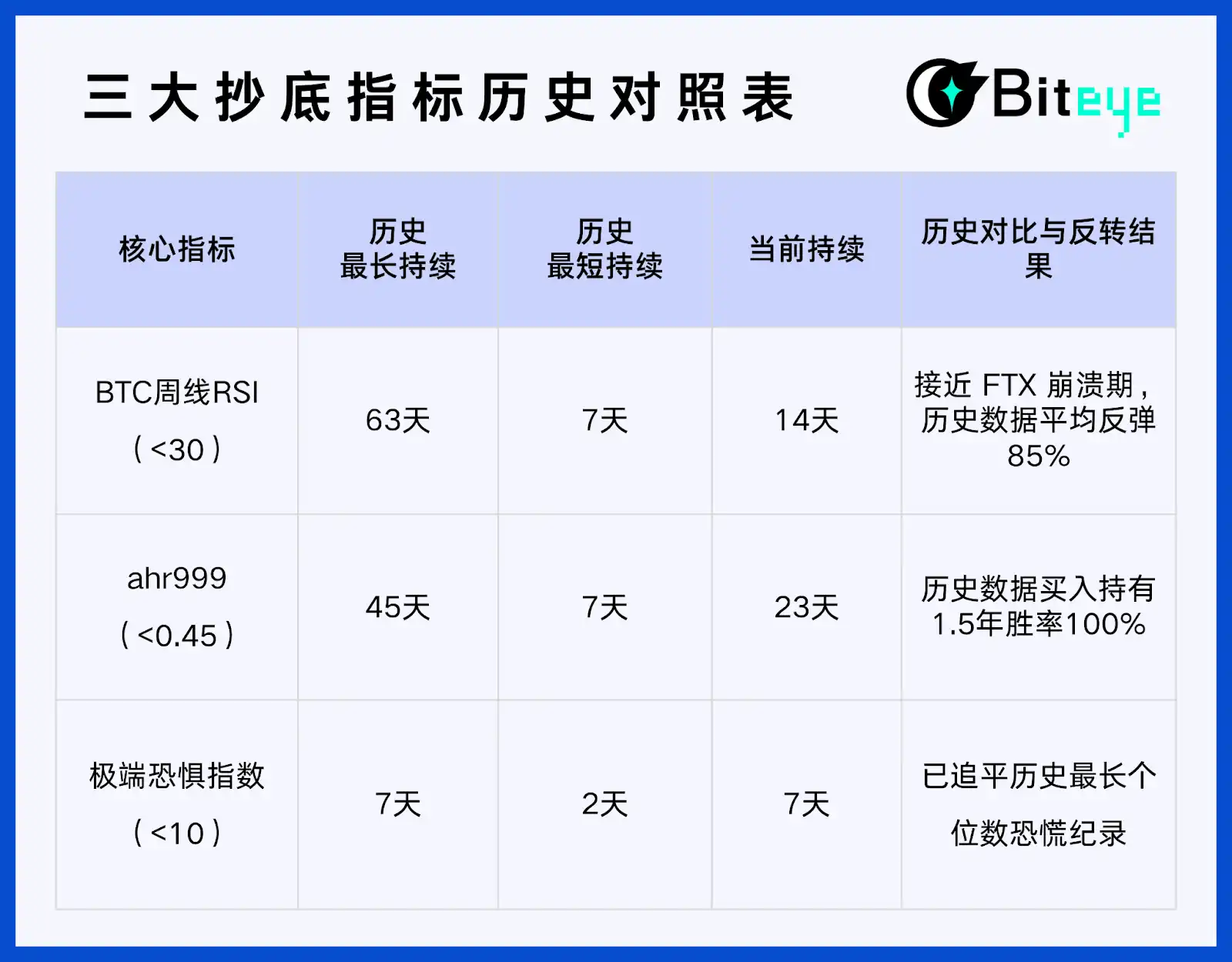
Optimistically, historical data shows "despair often breeds new life." After exiting such extreme indicators, BTC's 90-day return averaged over +50%. Combined with Trump's late March China visit schedule, the fastest reversal window may open in March.

Pessimistically, if Trump's visit fails in late March or ZachXBT drops a bombshell (e.g., Tether reserve fraud confirmed), all these "bottom signals" may fail. Users are advised to坚决 remove leverage short-term and closely monitor ZachXBT's爆料 and Trump's visit progress.

Market Advice: Survival Over Profits

Reviewing the recent ten bearish factors, 60% come from regulation and geopolitics, 40% from internal selling pressure and emotional collapse. It seems all bearish, but upon closer calculation, about 70% of bearish factors turn bullish medium-to-long term—regulatory iron curtains build合规 moats for traditional funds, and low sentiment is often the darkest before dawn.

"Buy the dip" and "short" on Twitter are more about emotion. When the real bottom hits, groups should be dead silent, not still arguing "is this the bottom?"

The "Siege of Bright Summit" is not crypto's end—more important than profit is staying at the table.


Related Questions

QWhat are the main categories of negative factors affecting the crypto market according to the article?

AThe main categories are regulatory crackdowns (stablecoins, taxation, platform regulations), geopolitical tensions (war, tariffs, summit diplomacy), internal bleeding (sell-offs by key figures and institutions), and emotional collapse (FUD, de-pegging, trust crisis).

QHow does the article assess the long-term impact of the OECD's Crypto Asset Reporting Framework (CARF)?

AThe article states that while tax transparency increases compliance costs and causes panic selling in the short term, it is a prerequisite for traditional institutional entry in the long term. It is expected that trillions in institutional funds may flow into the market after full implementation in 2026.

QWhat is the significance of the 'Bitcoin is dead' search trend reaching a peak, as mentioned in the article?

AThe article indicates that a peak in 'Bitcoin is dead' search volume is historically one of the strongest signals of a market bottom, as seen in 2018 and 2022. It often signifies that a new beginning is孕育 (breeding) in despair.

QWhat action did Wu Jihan's company take, and what was the stated reason for it?

AWu Jihan's company, Bitdeer (NASDAQ: BTDR), sold approximately 1,132 BTC (worth about $72 million at the time). The company's IR statement clarified this was a 'non-permanent zero position' and a balance sheet management move to cope with miner iteration pressure and the capital expenditure needs for AI data center (AIDC) construction.

QWhat does the article suggest is the most important thing for users to do in the current market situation?

AThe article's core advice is that surviving is more important than calculating profits. It recommends users decisively remove leverage in the short term and closely monitor the developments from ZachXBT's爆料 (revelations) and Trump's visit to China.

Related Reads

The Essence of AI Layoffs: Why More AI Adoption Leads to More Corporate Anxiety?

The author, awaiting potential inclusion on an 8000-person layoff list, analyzes the true nature of recent "AI-driven" layoffs. They argue that while AI use, particularly tools like Claude for code generation, has skyrocketed and boosted developer output (e.g., 2-5x more code commits), this has not translated into proportional business growth or revenue. The core issue is a misalignment between increased "Input" (code) and tangible "Outcomes" (user value, revenue). AI acts as a costly B2B SaaS, inflating operational expenses without guaranteed returns. Two key problems emerge: 1) The friction that once filtered out bad ideas is gone, as AI allows cheap pursuit of even weak concepts. 2) Organizational "alignment tax"—the difficulty of coordinating across teams—becomes crippling when development velocity outpaces consensus-building. Thus, layoffs serve two immediate purposes: 1) To offset ballooning AI costs (Token consumption) and maintain cash flow, as rising input costs without outcome growth destroys unit economics. 2) To reduce organizational bloat and alignment friction by simply removing teams, thereby speeding up execution in the short term. Therefore, these layoffs are fundamentally caused by AI, even if AI doesn't directly replace roles. They represent a painful correction until companies learn to convert AI-driven productivity into real business outcomes and streamline organizational coordination to match the new pace of work. The cycle will continue until this learning curve is mastered.

marsbit4m ago

The Essence of AI Layoffs: Why More AI Adoption Leads to More Corporate Anxiety?

marsbit4m ago

Can the Solana Foundation and Google's Collaboration on Pay.sh Bridge the Payment Link Between Web2 and Web3 in the Agent Economy?

Solana Foundation, in collaboration with Google Cloud, has launched Pay.sh, a payment gateway designed to bridge the gap between AI agents and enterprise-grade service infrastructure. The initiative aims to solve a key bottleneck in the "agent economy": existing payment systems are ill-suited for autonomous AI agents. Traditional methods like credit cards require human verification, while newer on-chain protocols like x402 and MPP create a separate, Web3-native system that raises barriers for service providers. Pay.sh functions as a universal payment layer. It allows users to fund a Solana wallet via credit card or stablecoin, which then acts as an identity and payment proxy for AI agents. When an agent needs to access a paid API service (e.g., Google Cloud, Alibaba Cloud), Pay.sh handles the transaction seamlessly. It leverages the HTTP 402 status code ("Payment Required") to initiate payments, intelligently choosing between one-time transfers (x402-style) or session-based authorizations (MPC-style) based on the service's billing model. This spares agents from manual account registration and API key management. A key feature for service providers is low integration effort. They can adopt Pay.sh by providing a declarative configuration file, enabling features like tiered pricing, free tiers, and automatic revenue splitting to multiple addresses (e.g., for royalties, cloud costs). Providers can also list their APIs in a central Pay Skill Registry for agent discovery. The collaboration with Google Cloud provides crucial infrastructure for API proxying, traffic routing, and compliance logging, aiming to keep agent activities within regulated boundaries. By connecting Web2 services with Web3 payment rails, Pay.sh positions the Solana wallet as a foundational identity and payment tool for AI agents, potentially driving more transaction volume to the Solana ecosystem. However, the report notes challenges. The service registry currently lacks robust vetting, risking exposure to unauthorized or malicious third-party APIs. Pay.sh also inherits security and compatibility risks from its underlying payment protocols (x402, MPC). Furthermore, adoption may be hindered by varying regional data privacy and payment compliance regulations among API providers. Despite these hurdles, Pay.sh represents a significant step towards integrating Web2 and Web3 for autonomous agent commerce.

marsbit11m ago

Can the Solana Foundation and Google's Collaboration on Pay.sh Bridge the Payment Link Between Web2 and Web3 in the Agent Economy?

marsbit11m ago

Bitcoin's Bull-Bear Cycle Indicator Turns Positive for the First Time in 7 Months: End of Bear Market or False Breakout?

Bitcoin's "Bull-Bear Market Cycle Indicator" from CryptoQuant has turned positive for the first time since October 2025. This gauge, based on the P&L Index relative to its 365-day moving average, suggests a potential shift from a bear market phase. Concurrently, the Bull Score Index rose to a neutral reading of 50 in late April. The indicator's move into positive territory follows a roughly 35% price rebound from a low near $60,000 in February to above $81,000. The recovery over approximately three months was faster than the 12-month period observed during the 2022 bear market. However, analysts caution against premature optimism, citing a historical precedent from March 2022. Back then, the Bull Score Index briefly hit 50, but it proved to be a false signal as Bitcoin's price subsequently plunged further. Structural differences exist in the current cycle, including consistent inflows into spot Bitcoin ETFs and an increase in large holder addresses. Yet, some models, referencing the four-year halving cycle, suggest a potential deeper bottom near $50,000 might still be possible around late 2026. In summary, while on-chain data shows marked improvement and the worst panic may be over, market participants remain cautious. A convincing trend reversal confirmation likely requires Bitcoin to sustainably break above key resistance, such as the 200-day moving average near $82,000.

marsbit18m ago

Bitcoin's Bull-Bear Cycle Indicator Turns Positive for the First Time in 7 Months: End of Bear Market or False Breakout?

marsbit18m ago

How to Automate Any Workflow with Claude Skills (Complete Tutorial)

This is a comprehensive guide to mastering Claude Skills, a feature for creating permanent, reusable instruction sets that automate specific workflows. Unlike simple saved prompts, Skills function like trained employees, delivering consistent, high-quality outputs by defining the entire task process, standards, error handling, and output format. The guide is structured in four phases: **Phase 1: Installation (5 minutes).** Skills are folders containing a `SKILL.md` file. The user is instructed to find a relevant Skill online, install it, test it on a real task, and compare its performance to one-off prompts. **Phase 2: Building Your First Custom Skill.** Start by rigorously defining the Skill's purpose, trigger phrases, and providing a concrete example of perfect output. The `SKILL.md` file has two parts: a YAML frontmatter with a specific name/description/triggers, and a detailed, step-by-step workflow written in natural language with examples and quality standards. **Phase 3: Testing & Optimization for Production.** Test the Skill in three scenarios: 1) a standard, common task; 2) edge cases with missing or conflicting data; and 3) a pressure test with maximum complexity. Any failure indicates a needed instruction. Implement a weekly optimization cycle to continuously refine the Skill based on real usage. **Phase 4: Building a Complete Skill Library.** The goal is to create a team of Skills for all repetitive tasks. Examples are given for industries like real estate, marketing, finance, consulting, and e-commerce. The user should list their tasks, prioritize them, and build one new Skill per week, maintaining a master document to track their library. The conclusion emphasizes the compounding time savings: ten Skills saving 30 minutes each per week reclaims over 260 hours (6.5 work weeks) per year, fundamentally transforming one's work system.

marsbit42m ago

How to Automate Any Workflow with Claude Skills (Complete Tutorial)

marsbit42m ago

Trading

Spot
Futures
活动图片




