Data Reveals: Is Solana's Slower Transfer Speed Actually Caused by Validators 'Playing Games'?

比推Published on 2026-01-08Last updated on 2026-01-08

Abstract

Jito Labs launched the IBRL Explorer tool to analyze Solana validator behavior in block construction, revealing widespread "timing games" that slow down the network. The tool evaluates validators based on slot time (35%), even distribution of non-vote transactions (40%), and early vote processing (25%). Many validators engage in "late packing," where non-vote transactions are delayed until the final ticks of a slot, prioritizing profit maximization through MEV extraction (e.g., backrunning or sandwich attacks) at the expense of network latency and user experience. This disrupts Solana’s intended streaming design, increases execution variance, and exacerbates negative market structure effects like wider bid-ask spreads. A debate exists between Jito and Temporal (developer of Harmonic client) over what constitutes optimal block construction. Temporal argues IBRL scores favor Jito’s approach and misclassify Harmonic’s auction-based method, which batches transactions but claims continuous execution. Harmonic outperforms in per-block revenue but faces scrutiny over potential user trade-offs. Protocol-level solutions like Multi-Concurrent Proposers (MCP) aim to eliminate single-leader monopolies by enabling parallel block building, but depend on Alpenglow’s mainnet launch (est. 2026). Meanwhile, Jito’s BAM client, now adopted by ~12% of stake, offers auditable ordering logic to mitigate MEV externalities. The competition highlights tensions between validator profitability and net...

Author: Carlos, Luke Leasure

Original Title: Solana’s block-building wars

Compiled and Edited by: BitpushNews


2026年1月5日, JITO launched a public tool called IBRL Explorer, designed to measure the block packaging behavior of validators on Solana and expose the previously invisible "timing games" in block construction.

First, we need to understand some background about Solana's market structure. Solana is designed as a streaming system: ideally, while a block is being built, the leader continuously disseminates data fragments (i.e., small data packets). This behavior aims to minimize transaction landing latency (the interval between a validator receiving a transaction and that transaction being processed). However, whether Solana's transaction pipeline is truly continuous actually depends on how validators assemble their blocks.

Jito defines the optimal block packaging behavior from the validator's perspective: fast construction, continuous streaming transmission, and early state propagation. Jito's IBRL score is a weighted mix of these three variables:

  • Slot Time (35%): Validators score higher if their block is built within the following thresholds: a handover slot taken over from another validator is less than 550 milliseconds, or as a continuous slot (i.e., any remaining slot in the leader's rotation) is less than 380 milliseconds.

  • Non-Vote Transaction Packaging (40%): Validators are rewarded with points when transactions are evenly distributed across the 64 ticks of a slot (rather than cramming most non-vote transactions into the last few ticks of the slot, i.e., "delayed packaging"). This is the most controversial variable in the IBRL score, which will be explained in detail later.

  • Early Voting (25%): Validators get a full score when at least 90% of the vote transactions are processed within the first 32 ticks. The score decreases if votes are pushed to later parts of the block.

IBRL Explorer shows that many validators exhibit delayed packaging of non-vote transactions, and in some cases, even extend the slot time. Delayed packaging postpones state propagation, increases the variance of execution results, undermines Solana's streaming design, and thus reduces network latency. What you get is not a continuous data stream, but a bursty data eruption.

In an optimal block, as in the example below from a Helius validator, most vote transactions are processed in the first half of the block ("early state propagation"), while non-vote transactions are relatively evenly distributed across the 64 ticks of the slot ("continuous streaming transmission").
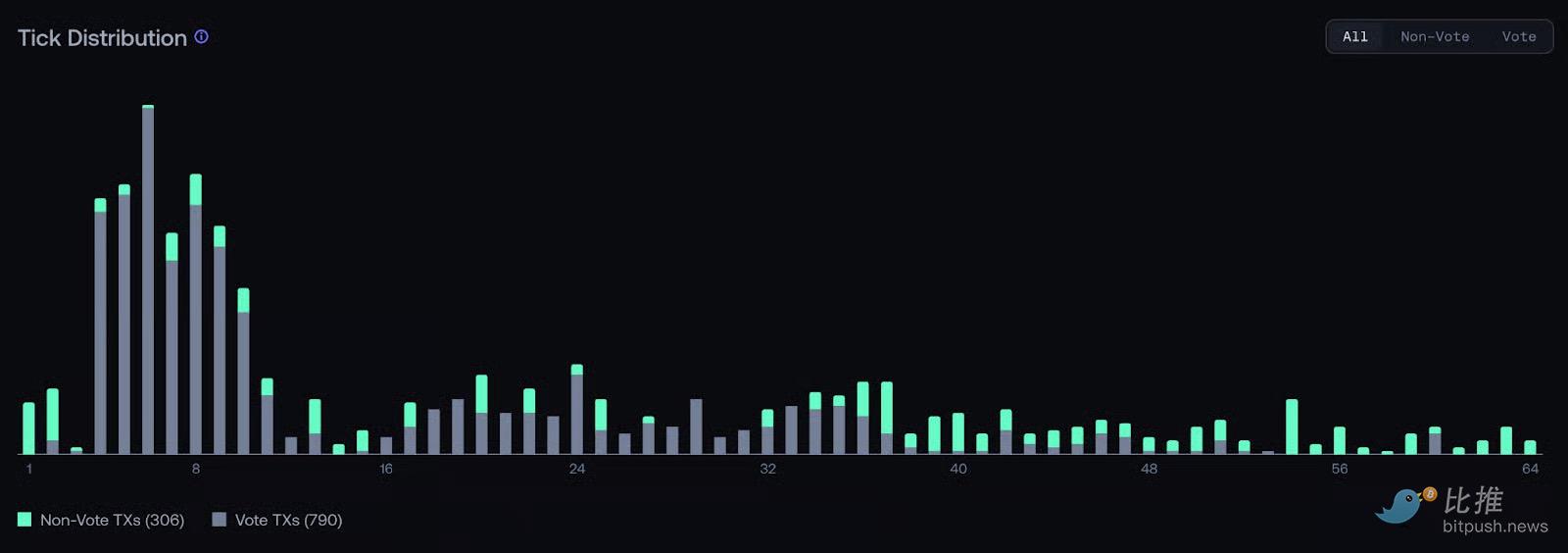
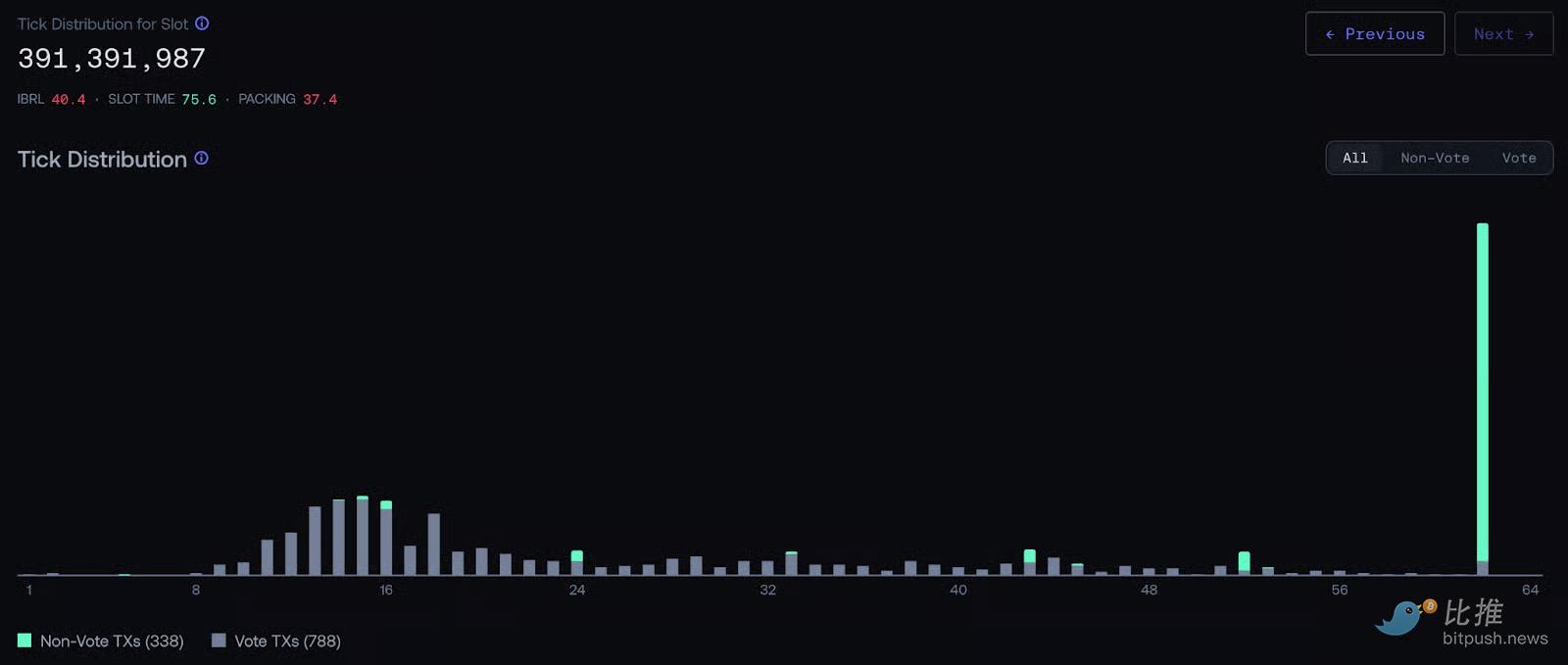
In contrast, intentional delayed packaging is evident in the example block from Galaxy below, where most non-vote transactions are crammed into the last few ticks of the slot. By doing this, validators prioritize extractive value over network health by delaying state transitions until the last moment.

According to Lucas Bruder, co-founder and CEO of Jito Labs, validators are incentivized to wait until the last moment of the slot to observe more incoming transactions, selecting those with the highest fees to maximize rewards.

But why should users care? While maximizing profit is rational behavior for an individual validator, this behavior introduces hidden censorship, delays state propagation, and forces the next leader to "catch up," thereby slowing down the entire network.

More importantly, delayed packaging is also directly related to Solana's emerging "Payment for Order Flow" (PFOF) dynamics, as outlined by Benedict Brady in this article. Because wallets and applications often generate pre-routed signed transactions (i.e., market orders with slippage limits), valuable "back-running" options are embedded in the orders. The user-beneficial practice is to sell this back-running right to trading firms, while the extractive practice is to conduct "sandwich attacks." Either way, there is an incentive to increase the value of back-running by slowing down transaction landing speed, which is exactly what delayed packaging achieves.

This incentive pushes Solana towards a more adversarial market structure for applications and users. It also weakens the key guarantees that market makers rely on, particularly regarding in-block cancellations and deterministic execution, leading to wider bid-ask spreads. Without streaming, no matter how excellent the application logic, a truly real-time market remains out of reach for Solana.

Temporal vs. Jito Debate

Before delving into how Solana addresses this issue, it must be acknowledged that there is an active debate even about what constitutes "good" block construction. Temporal, a core contributor to Harmonic, has raised objections to Jito's framework and IBRL scoring method. Their criticism is that the score embeds a specific set of design preferences that favor Jito's block construction method and by default make Harmonic appear worse, reflected in the consistently lower scores of validators running Harmonic.

According to the Harmonic co-founder, Harmonic's blocks are executed continuously without delay, but data fragments are only released after an auction process lasting about 300 milliseconds is completed. This method gives block builders enough time to compete and gives the rest of the network enough time to replay Harmonic's block. The visualization below shows the same slot (391,822,619) from Temporal Emerald, a validator running Harmonic.
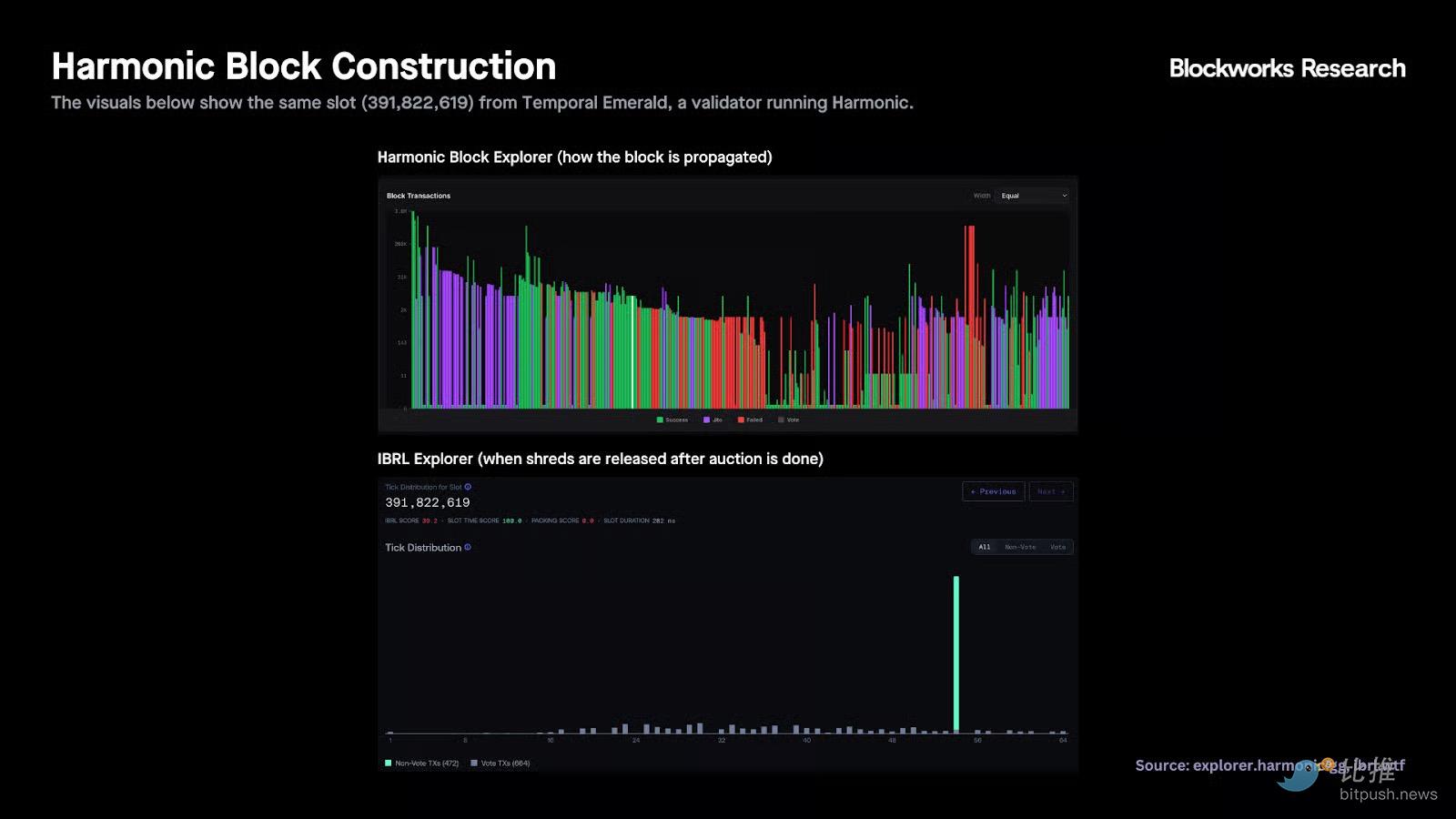
From the context of how the block is propagated (above figure), Harmonic's execution appears to be evenly spaced. In other words, the block builder continuously constructs the block through parallel block construction, and the reason transactions are only concentrated in the final ticks (below figure) is because that is the moment the auction resolves.

Over the past 30 days, Harmonic has outperformed both Jito and Firedancer in terms of average and median total revenue per block (priority fees + tips), thereby delivering higher rewards to validators and stakers. The open question is whether this superior performance is achieved at the expense of users through the timing games described above.
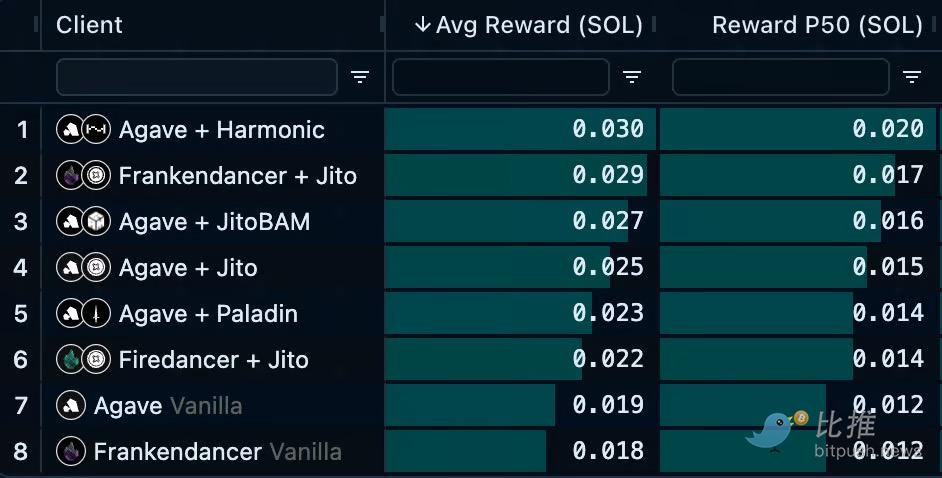
Source: https://reports.firedancer.io/

Multiple Concurrent Proposers (MCP) & BAM

After presenting both sides, one point still holds true: continuous streaming is crucial.

Harmonic's claim is not that streaming is unimportant, but that IBRL fails to capture how Harmonic achieves it and may misclassify its auction mechanism as "timing games." At this stage, I do not yet have sufficient technical background or data to form a definitive opinion, but Solana is already developing a protocol-level solution aimed at addressing the underlying incentive problem.

This solution is Multiple Concurrent Proposers (MCP), an architecture developed by Anatoly Yakovenko and Max Resnick. The motivation is simple: under the current single-leader model, one proposer controls ordering and can effectively act later than others, enabling delayed packaging and reinforcing the PFOF-like dynamics described above. MCP eliminates the single leader's monopoly by having multiple proposers build candidate blocks in parallel and independently. This architecture prevents a single leader from unilaterally suppressing transactions or delaying execution to extract profits.

That said, a prerequisite for MCP is the launch of Alpenglow on the mainnet. Alpenglow is expected to launch in 2026, but the timeline remains uncertain. In the meantime, Jito's BAM might drive change by making ordering logic auditable. BAM aims to expand Solana's micro-structural design space, enabling applications that require finer control over ordering (e.g., prioritizing cancellation orders for perpetual contract trading venues), while also helping to mitigate negative MEV externalities like front-running. The figure below outlines BAM's transaction pipeline.
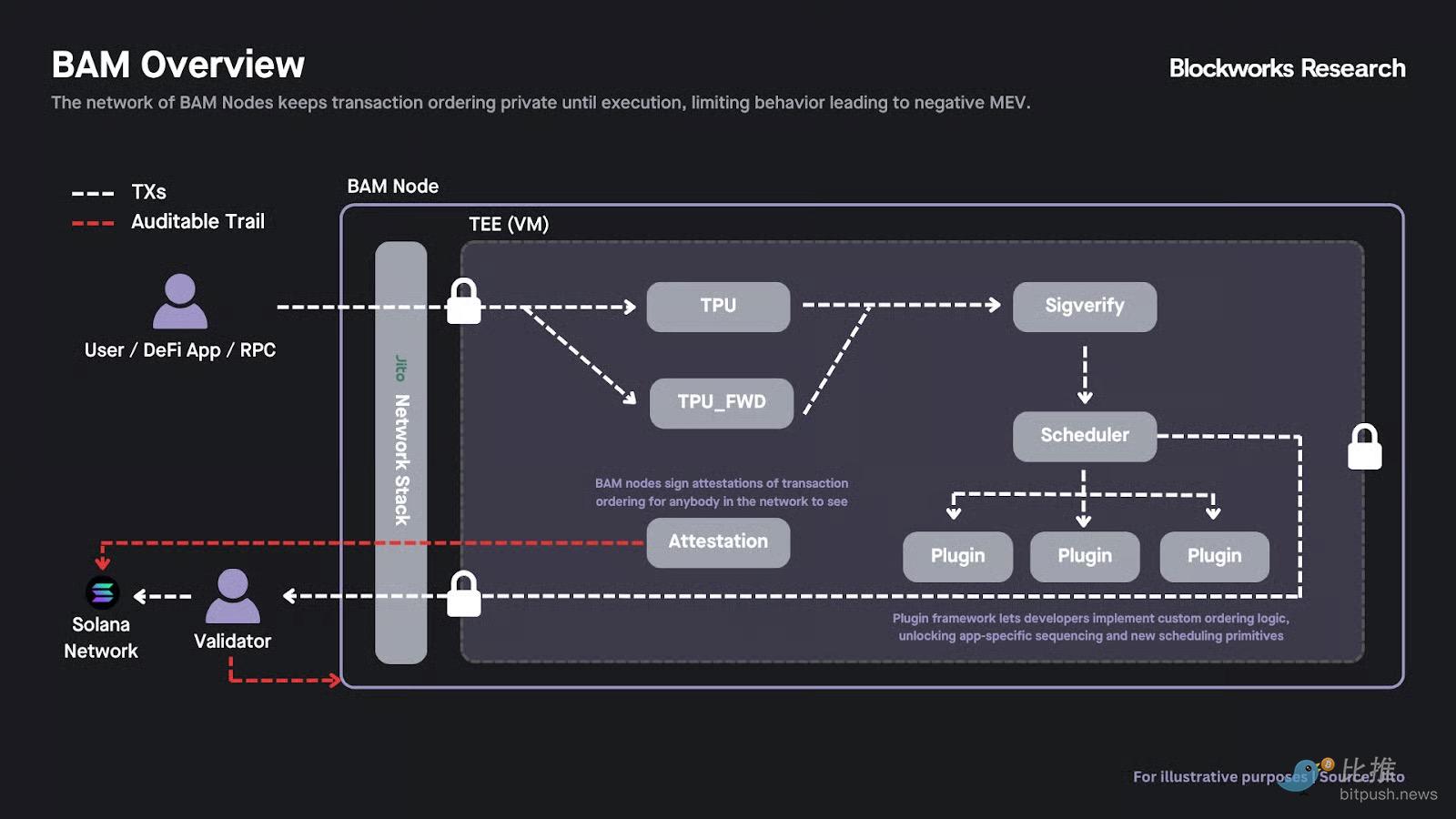
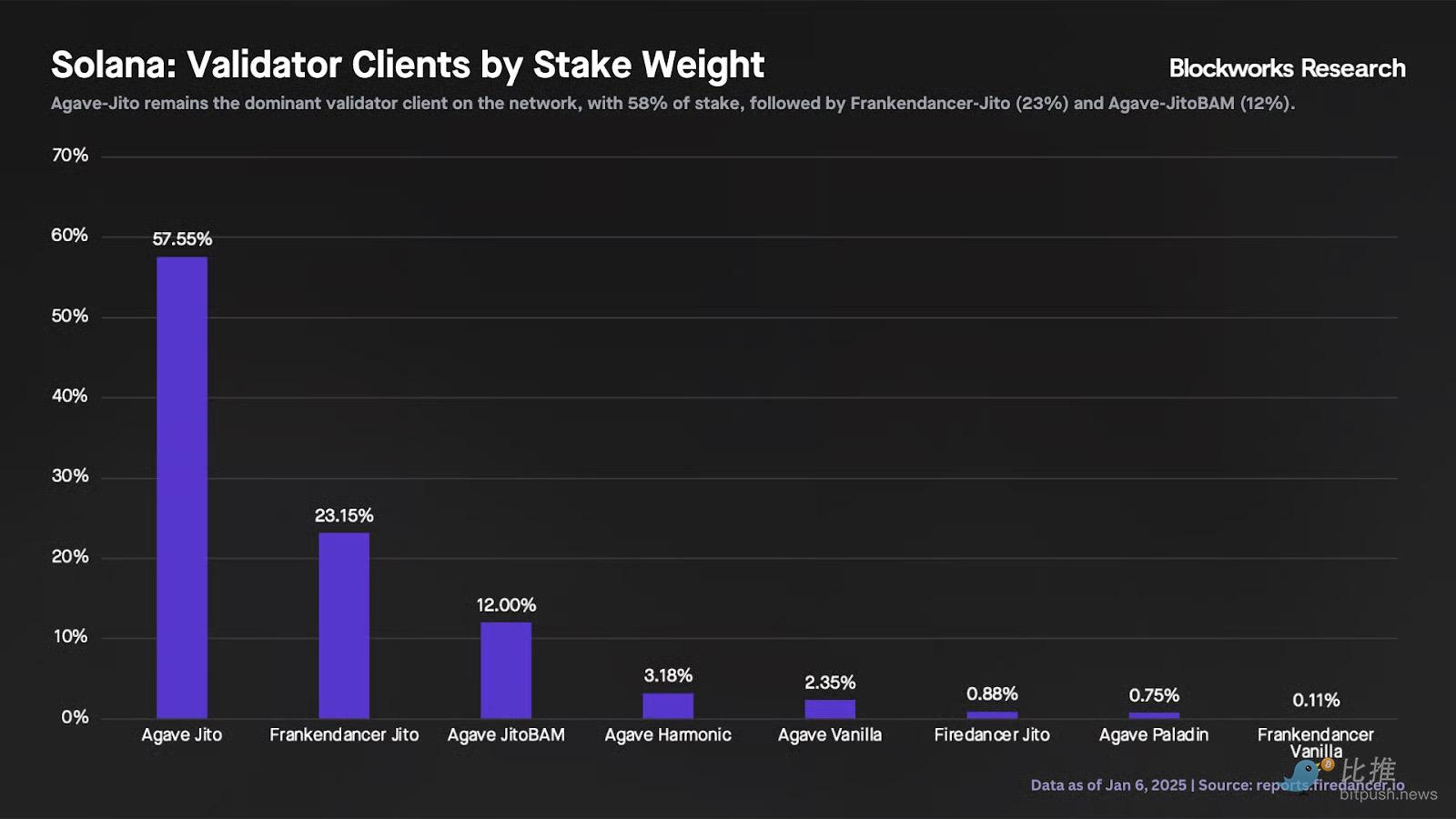
BAM (Agave-BAM) is currently the third-largest client on Solana by stake share (approx. 12%), behind Agave-Jito and Frankendancer-Jito. Approximately 205 validators are already running BAM, highlighting its rapid adoption among the Solana validator set. In contrast, Harmonic remains relatively small, holding just over 3% of the stake share and about 20 validators.

It will be worth watching how the competitive dynamics of block construction evolve in the coming months and what this means for Solana's market structure.


Original article link: https://www.bitpush.news/articles/7601133

Related Questions

QWhat is the purpose of Jito's IBRL Explorer tool, and what problem does it aim to address on the Solana network?

AJito's IBRL Explorer is a public tool designed to measure validator block packing behavior on Solana and expose the previously invisible 'timing games' in block construction. It aims to address issues where validators delay packing non-vote transactions to the end of a slot, which postpones state propagation, increases variance in execution results, and undermines Solana's streaming design, ultimately degrading network latency.

QAccording to the Jito framework, what are the three key variables that make up the IBRL score, and what is the weight of each?

AThe three key variables in the IBRL score are: 1. Slot Time (35% weight): Validators score higher if their block is built within a threshold time. 2. Non-Vote Transaction Packing (40% weight): Validators are rewarded when transactions are evenly distributed across the slot's 64 ticks, rather than being packed late. 3. Early Voting (25% weight): Validators get a full score if at least 90% of vote transactions are processed within the first 32 ticks.

QWhat is 'delayed packing' by validators, and why are they incentivized to do it according to Lucas Bruder?

A'Delayed packing' is when validators intentionally hold non-vote transactions and pack most of them into the final few ticks of a slot. According to Lucas Bruder, co-founder and CEO of Jito Labs, validators are incentivized to wait until the last moment of a slot to observe more incoming transactions and select those paying the highest fees, thereby maximizing their rewards and extractable value.

QWhat is the core criticism from Harmonic (Temporal) regarding Jito's IBRL scoring method?

AHarmonic's core criticism is that Jito's IBRL score embeds a specific set of design preferences that favor Jito's own block-building method. They argue that the score incorrectly classifies Harmonic's auction mechanism as a 'timing game,' making validators running Harmonic appear worse, even though Harmonic claims its blocks are executed continuously and data shards are only released after an auction resolves.

QWhat are the two proposed solutions mentioned in the article to address the underlying incentive problems in Solana's block building?

AThe two proposed solutions are: 1. Multi-Concurrent Proposers (MCP): A protocol-level solution that allows multiple proposers to build candidate blocks in parallel, eliminating the single leader's monopoly and its ability to delay packing. 2. Jito's BAM (Block-Engine & Auction Manager): A solution that aims to make ordering logic auditable, extend Solana's micro-structure design space, and help mitigate negative MEV externalities like front-running.

Related Reads

Trading

Spot
Futures

Hot Articles

What is SONIC

Sonic: Pioneering the Future of Gaming in Web3 Introduction to Sonic In the ever-evolving landscape of Web3, the gaming industry stands out as one of the most dynamic and promising sectors. At the forefront of this revolution is Sonic, a project designed to amplify the gaming ecosystem on the Solana blockchain. Leveraging cutting-edge technology, Sonic aims to deliver an unparalleled gaming experience by efficiently processing millions of requests per second, ensuring that players enjoy seamless gameplay while maintaining low transaction costs. This article delves into the intricate details of Sonic, exploring its creators, funding sources, operational mechanics, and the timeline of significant events that have shaped its journey. What is Sonic? Sonic is an innovative layer-2 network that operates atop the Solana blockchain, specifically tailored to enhance the existing Solana gaming ecosystem. It accomplishes this through a customised, VM-agnostic game engine paired with a HyperGrid interpreter, facilitating sovereign game economies that roll up back to the Solana platform. The primary goals of Sonic include: Enhanced Gaming Experiences: Sonic is committed to offering lightning-fast on-chain gameplay, allowing players and developers to engage with games at previously unattainable speeds. Atomic Interoperability: This feature enables transactions to be executed within Sonic without the need to redeploy Solana programmes and accounts. This makes the process more efficient and directly benefits from Solana Layer1 services and liquidity. Seamless Deployment: Sonic allows developers to write for Ethereum Virtual Machine (EVM) based systems and execute them on Solana’s SVM infrastructure. This interoperability is crucial for attracting a broader range of dApps and decentralised applications to the platform. Support for Developers: By offering native composable gaming primitives and extensible data types - dining within the Entity-Component-System (ECS) framework - game creators can craft intricate business logic with ease. Overall, Sonic's unique approach not only caters to players but also provides an accessible and low-cost environment for developers to innovate and thrive. Creator of Sonic The information regarding the creator of Sonic is somewhat ambiguous. However, it is known that Sonic's SVM is owned by the company Mirror World. The absence of detailed information about the individuals behind Sonic reflects a common trend in several Web3 projects, where collective efforts and partnerships often overshadow individual contributions. Investors of Sonic Sonic has garnered considerable attention and support from various investors within the crypto and gaming sectors. Notably, the project raised an impressive $12 million during its Series A funding round. The round was led by BITKRAFT Ventures, with other notable investors including Galaxy, Okx Ventures, Interactive, Big Brain Holdings, and Mirana. This financial backing signifies the confidence that investment foundations have in Sonic’s potential to revolutionise the Web3 gaming landscape, further validating its innovative approaches and technologies. How Does Sonic Work? Sonic utilises the HyperGrid framework, a sophisticated parallel processing mechanism that enhances its scalability and customisability. Here are the core features that set Sonic apart: Lightning Speed at Low Costs: Sonic offers one of the fastest on-chain gaming experiences compared to other Layer-1 solutions, powered by the scalability of Solana’s virtual machine (SVM). Atomic Interoperability: Sonic enables transaction execution without redeployment of Solana programmes and accounts, effectively streamlining the interaction between users and the blockchain. EVM Compatibility: Developers can effortlessly migrate decentralised applications from EVM chains to the Solana environment using Sonic’s HyperGrid interpreter, increasing the accessibility and integration of various dApps. Ecosystem Support for Developers: By exposing native composable gaming primitives, Sonic facilitates a sandbox-like environment where developers can experiment and implement business logic, greatly enhancing the overall development experience. Monetisation Infrastructure: Sonic natively supports growth and monetisation efforts, providing frameworks for traffic generation, payments, and settlements, thereby ensuring that gaming projects are not only viable but also sustainable financially. Timeline of Sonic The evolution of Sonic has been marked by several key milestones. Below is a brief timeline highlighting critical events in the project's history: 2022: The Sonic cryptocurrency was officially launched, marking the beginning of its journey in the Web3 gaming arena. 2024: June: Sonic SVM successfully raised $12 million in a Series A funding round. This investment allowed Sonic to further develop its platform and expand its offerings. August: The launch of the Sonic Odyssey testnet provided users with the first opportunity to engage with the platform, offering interactive activities such as collecting rings—a nod to gaming nostalgia. October: SonicX, an innovative crypto game integrated with Solana, made its debut on TikTok, capturing the attention of over 120,000 users within a short span. This integration illustrated Sonic’s commitment to reaching a broader, global audience and showcased the potential of blockchain gaming. Key Points Sonic SVM is a revolutionary layer-2 network on Solana explicitly designed to enhance the GameFi landscape, demonstrating great potential for future development. HyperGrid Framework empowers Sonic by introducing horizontal scaling capabilities, ensuring that the network can handle the demands of Web3 gaming. Integration with Social Platforms: The successful launch of SonicX on TikTok displays Sonic’s strategy to leverage social media platforms to engage users, exponentially increasing the exposure and reach of its projects. Investment Confidence: The substantial funding from BITKRAFT Ventures, among others, emphasizes the robust backing Sonic has, paving the way for its ambitious future. In conclusion, Sonic encapsulates the essence of Web3 gaming innovation, striking a balance between cutting-edge technology, developer-centric tools, and community engagement. As the project continues to evolve, it is poised to redefine the gaming landscape, making it a notable entity for gamers and developers alike. As Sonic moves forward, it will undoubtedly attract greater interest and participation, solidifying its place within the broader narrative of blockchain gaming.

1.2k Total ViewsPublished 2024.04.04Updated 2024.12.03

What is SONIC

What is $S$

Understanding SPERO: A Comprehensive Overview Introduction to SPERO As the landscape of innovation continues to evolve, the emergence of web3 technologies and cryptocurrency projects plays a pivotal role in shaping the digital future. One project that has garnered attention in this dynamic field is SPERO, denoted as SPERO,$$s$. This article aims to gather and present detailed information about SPERO, to help enthusiasts and investors understand its foundations, objectives, and innovations within the web3 and crypto domains. What is SPERO,$$s$? SPERO,$$s$ is a unique project within the crypto space that seeks to leverage the principles of decentralisation and blockchain technology to create an ecosystem that promotes engagement, utility, and financial inclusion. The project is tailored to facilitate peer-to-peer interactions in new ways, providing users with innovative financial solutions and services. At its core, SPERO,$$s$ aims to empower individuals by providing tools and platforms that enhance user experience in the cryptocurrency space. This includes enabling more flexible transaction methods, fostering community-driven initiatives, and creating pathways for financial opportunities through decentralised applications (dApps). The underlying vision of SPERO,$$s$ revolves around inclusiveness, aiming to bridge gaps within traditional finance while harnessing the benefits of blockchain technology. Who is the Creator of SPERO,$$s$? The identity of the creator of SPERO,$$s$ remains somewhat obscure, as there are limited publicly available resources providing detailed background information on its founder(s). This lack of transparency can stem from the project's commitment to decentralisation—an ethos that many web3 projects share, prioritising collective contributions over individual recognition. By centring discussions around the community and its collective goals, SPERO,$$s$ embodies the essence of empowerment without singling out specific individuals. As such, understanding the ethos and mission of SPERO remains more important than identifying a singular creator. Who are the Investors of SPERO,$$s$? SPERO,$$s$ is supported by a diverse array of investors ranging from venture capitalists to angel investors dedicated to fostering innovation in the crypto sector. The focus of these investors generally aligns with SPERO's mission—prioritising projects that promise societal technological advancement, financial inclusivity, and decentralised governance. These investor foundations are typically interested in projects that not only offer innovative products but also contribute positively to the blockchain community and its ecosystems. The backing from these investors reinforces SPERO,$$s$ as a noteworthy contender in the rapidly evolving domain of crypto projects. How Does SPERO,$$s$ Work? SPERO,$$s$ employs a multi-faceted framework that distinguishes it from conventional cryptocurrency projects. Here are some of the key features that underline its uniqueness and innovation: Decentralised Governance: SPERO,$$s$ integrates decentralised governance models, empowering users to participate actively in decision-making processes regarding the project’s future. This approach fosters a sense of ownership and accountability among community members. Token Utility: SPERO,$$s$ utilises its own cryptocurrency token, designed to serve various functions within the ecosystem. These tokens enable transactions, rewards, and the facilitation of services offered on the platform, enhancing overall engagement and utility. Layered Architecture: The technical architecture of SPERO,$$s$ supports modularity and scalability, allowing for seamless integration of additional features and applications as the project evolves. This adaptability is paramount for sustaining relevance in the ever-changing crypto landscape. Community Engagement: The project emphasises community-driven initiatives, employing mechanisms that incentivise collaboration and feedback. By nurturing a strong community, SPERO,$$s$ can better address user needs and adapt to market trends. Focus on Inclusion: By offering low transaction fees and user-friendly interfaces, SPERO,$$s$ aims to attract a diverse user base, including individuals who may not previously have engaged in the crypto space. This commitment to inclusion aligns with its overarching mission of empowerment through accessibility. Timeline of SPERO,$$s$ Understanding a project's history provides crucial insights into its development trajectory and milestones. Below is a suggested timeline mapping significant events in the evolution of SPERO,$$s$: Conceptualisation and Ideation Phase: The initial ideas forming the basis of SPERO,$$s$ were conceived, aligning closely with the principles of decentralisation and community focus within the blockchain industry. Launch of Project Whitepaper: Following the conceptual phase, a comprehensive whitepaper detailing the vision, goals, and technological infrastructure of SPERO,$$s$ was released to garner community interest and feedback. Community Building and Early Engagements: Active outreach efforts were made to build a community of early adopters and potential investors, facilitating discussions around the project’s goals and garnering support. Token Generation Event: SPERO,$$s$ conducted a token generation event (TGE) to distribute its native tokens to early supporters and establish initial liquidity within the ecosystem. Launch of Initial dApp: The first decentralised application (dApp) associated with SPERO,$$s$ went live, allowing users to engage with the platform's core functionalities. Ongoing Development and Partnerships: Continuous updates and enhancements to the project's offerings, including strategic partnerships with other players in the blockchain space, have shaped SPERO,$$s$ into a competitive and evolving player in the crypto market. Conclusion SPERO,$$s$ stands as a testament to the potential of web3 and cryptocurrency to revolutionise financial systems and empower individuals. With a commitment to decentralised governance, community engagement, and innovatively designed functionalities, it paves the way toward a more inclusive financial landscape. As with any investment in the rapidly evolving crypto space, potential investors and users are encouraged to research thoroughly and engage thoughtfully with the ongoing developments within SPERO,$$s$. The project showcases the innovative spirit of the crypto industry, inviting further exploration into its myriad possibilities. While the journey of SPERO,$$s$ is still unfolding, its foundational principles may indeed influence the future of how we interact with technology, finance, and each other in interconnected digital ecosystems.

54 Total ViewsPublished 2024.12.17Updated 2024.12.17

What is $S$

What is AGENT S

Agent S: The Future of Autonomous Interaction in Web3 Introduction In the ever-evolving landscape of Web3 and cryptocurrency, innovations are constantly redefining how individuals interact with digital platforms. One such pioneering project, Agent S, promises to revolutionise human-computer interaction through its open agentic framework. By paving the way for autonomous interactions, Agent S aims to simplify complex tasks, offering transformative applications in artificial intelligence (AI). This detailed exploration will delve into the project's intricacies, its unique features, and the implications for the cryptocurrency domain. What is Agent S? Agent S stands as a groundbreaking open agentic framework, specifically designed to tackle three fundamental challenges in the automation of computer tasks: Acquiring Domain-Specific Knowledge: The framework intelligently learns from various external knowledge sources and internal experiences. This dual approach empowers it to build a rich repository of domain-specific knowledge, enhancing its performance in task execution. Planning Over Long Task Horizons: Agent S employs experience-augmented hierarchical planning, a strategic approach that facilitates efficient breakdown and execution of intricate tasks. This feature significantly enhances its ability to manage multiple subtasks efficiently and effectively. Handling Dynamic, Non-Uniform Interfaces: The project introduces the Agent-Computer Interface (ACI), an innovative solution that enhances the interaction between agents and users. Utilizing Multimodal Large Language Models (MLLMs), Agent S can navigate and manipulate diverse graphical user interfaces seamlessly. Through these pioneering features, Agent S provides a robust framework that addresses the complexities involved in automating human interaction with machines, setting the stage for myriad applications in AI and beyond. Who is the Creator of Agent S? While the concept of Agent S is fundamentally innovative, specific information about its creator remains elusive. The creator is currently unknown, which highlights either the nascent stage of the project or the strategic choice to keep founding members under wraps. Regardless of anonymity, the focus remains on the framework's capabilities and potential. Who are the Investors of Agent S? As Agent S is relatively new in the cryptographic ecosystem, detailed information regarding its investors and financial backers is not explicitly documented. The lack of publicly available insights into the investment foundations or organisations supporting the project raises questions about its funding structure and development roadmap. Understanding the backing is crucial for gauging the project's sustainability and potential market impact. How Does Agent S Work? At the core of Agent S lies cutting-edge technology that enables it to function effectively in diverse settings. Its operational model is built around several key features: Human-like Computer Interaction: The framework offers advanced AI planning, striving to make interactions with computers more intuitive. By mimicking human behaviour in tasks execution, it promises to elevate user experiences. Narrative Memory: Employed to leverage high-level experiences, Agent S utilises narrative memory to keep track of task histories, thereby enhancing its decision-making processes. Episodic Memory: This feature provides users with step-by-step guidance, allowing the framework to offer contextual support as tasks unfold. Support for OpenACI: With the ability to run locally, Agent S allows users to maintain control over their interactions and workflows, aligning with the decentralised ethos of Web3. Easy Integration with External APIs: Its versatility and compatibility with various AI platforms ensure that Agent S can fit seamlessly into existing technological ecosystems, making it an appealing choice for developers and organisations. These functionalities collectively contribute to Agent S's unique position within the crypto space, as it automates complex, multi-step tasks with minimal human intervention. As the project evolves, its potential applications in Web3 could redefine how digital interactions unfold. Timeline of Agent S The development and milestones of Agent S can be encapsulated in a timeline that highlights its significant events: September 27, 2024: The concept of Agent S was launched in a comprehensive research paper titled “An Open Agentic Framework that Uses Computers Like a Human,” showcasing the groundwork for the project. October 10, 2024: The research paper was made publicly available on arXiv, offering an in-depth exploration of the framework and its performance evaluation based on the OSWorld benchmark. October 12, 2024: A video presentation was released, providing a visual insight into the capabilities and features of Agent S, further engaging potential users and investors. These markers in the timeline not only illustrate the progress of Agent S but also indicate its commitment to transparency and community engagement. Key Points About Agent S As the Agent S framework continues to evolve, several key attributes stand out, underscoring its innovative nature and potential: Innovative Framework: Designed to provide an intuitive use of computers akin to human interaction, Agent S brings a novel approach to task automation. Autonomous Interaction: The ability to interact autonomously with computers through GUI signifies a leap towards more intelligent and efficient computing solutions. Complex Task Automation: With its robust methodology, it can automate complex, multi-step tasks, making processes faster and less error-prone. Continuous Improvement: The learning mechanisms enable Agent S to improve from past experiences, continually enhancing its performance and efficacy. Versatility: Its adaptability across different operating environments like OSWorld and WindowsAgentArena ensures that it can serve a broad range of applications. As Agent S positions itself in the Web3 and crypto landscape, its potential to enhance interaction capabilities and automate processes signifies a significant advancement in AI technologies. Through its innovative framework, Agent S exemplifies the future of digital interactions, promising a more seamless and efficient experience for users across various industries. Conclusion Agent S represents a bold leap forward in the marriage of AI and Web3, with the capacity to redefine how we interact with technology. While still in its early stages, the possibilities for its application are vast and compelling. Through its comprehensive framework addressing critical challenges, Agent S aims to bring autonomous interactions to the forefront of the digital experience. As we move deeper into the realms of cryptocurrency and decentralisation, projects like Agent S will undoubtedly play a crucial role in shaping the future of technology and human-computer collaboration.

562 Total ViewsPublished 2025.01.14Updated 2025.01.14

What is AGENT S

Discussions

Welcome to the HTX Community. Here, you can stay informed about the latest platform developments and gain access to professional market insights. Users' opinions on the price of S (S) are presented below.

活动图片













