Data Estimates Show Polymarket's Annual Revenue Could Easily Exceed 100 Million, Under the Assumption That...

marsbitPublished on 2026-01-28Last updated on 2026-01-28

Abstract

Polymarket, a prediction market platform, has begun charging fees on its "15-minute crypto up/down" markets since January 6, with a variable rate structure where fees are higher when odds are near 50% (up to 1.56%) and lower near 0% or 100%. After three weeks of implementation, data shows the platform has accumulated approximately $2.19 million in fee revenue, averaging about $730,000 per week. This translates to a projected annual revenue of around $38 million if current trading activity remains stable. The platform is expected to extend this fee model to other markets beyond crypto price movements. Analysis of the past week’s trading volume shows that the "15-minute crypto up/down" segment accounted for $159 million, or about 9.1% of Polymarket’s total weekly volume of $1.75 billion. If similar fees were applied across all markets, the platform revenue could theoretically reach around $418 million annually. It is important to note that these are estimates based on limited data and current trading behavior. Actual revenue may vary due to factors such as future growth, potential adjustments to fee structures, and differences in user activity across market types. Nevertheless, the move demonstrates Polymarket’s transition toward a sustainable revenue model, with significant growth potential ahead, especially with major events like the 2026 World Cup and U.S. midterm elections likely to drive further engagement.

Original | Odaily Planet Daily (@OdailyChina)

Author | Azuma (@azuma_eth)

On January 6th of this year, Polymarket officially began charging transaction fees for markets related to "15-minute cryptocurrency price movements." The specific fee rate varies with the real-time odds of the market — the closer the odds are to 0% or 100%, the lower the fee; conversely, the closer the odds are to 50%, the higher the fee, with a maximum of 1.56%.
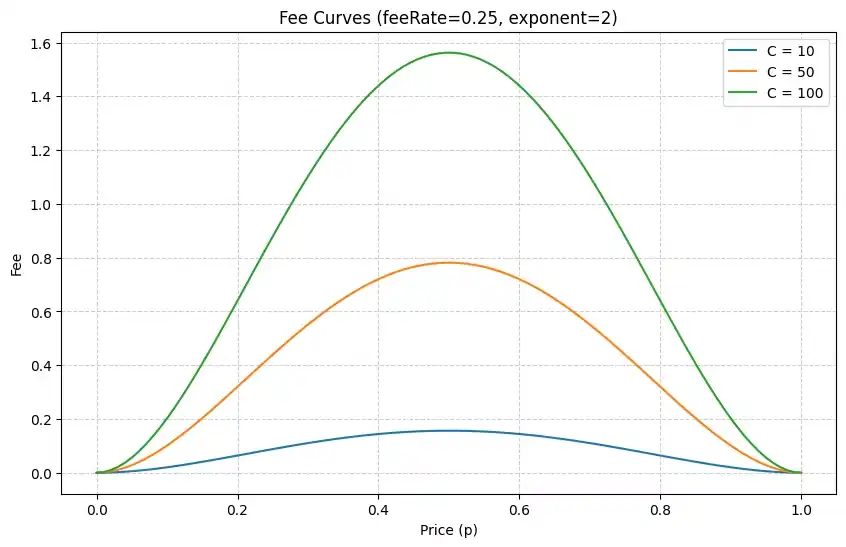
This marks the first time, outside of the U.S. market (where Polymarket charges a 0.01% fee), that Polymarket has ended its completely free model and started charging transaction fees for a specific type of market. Now, three weeks later, there is a sufficient observable data sample, making it time to conduct a rough estimate of Polymarket's revenue potential.

First, let's look at the most direct measure: the scale of fee revenue. According to data compiled by Gate Research on Duna, since the introduction of these fees, Polymarket has accumulated approximately $2.19 million in fee revenue, averaging about $730,000 per week. Based on this data, if the trading volume and activity structure of the relevant markets remain unchanged, it is projected to generate approximately $38 million in annual revenue for Polymarket.
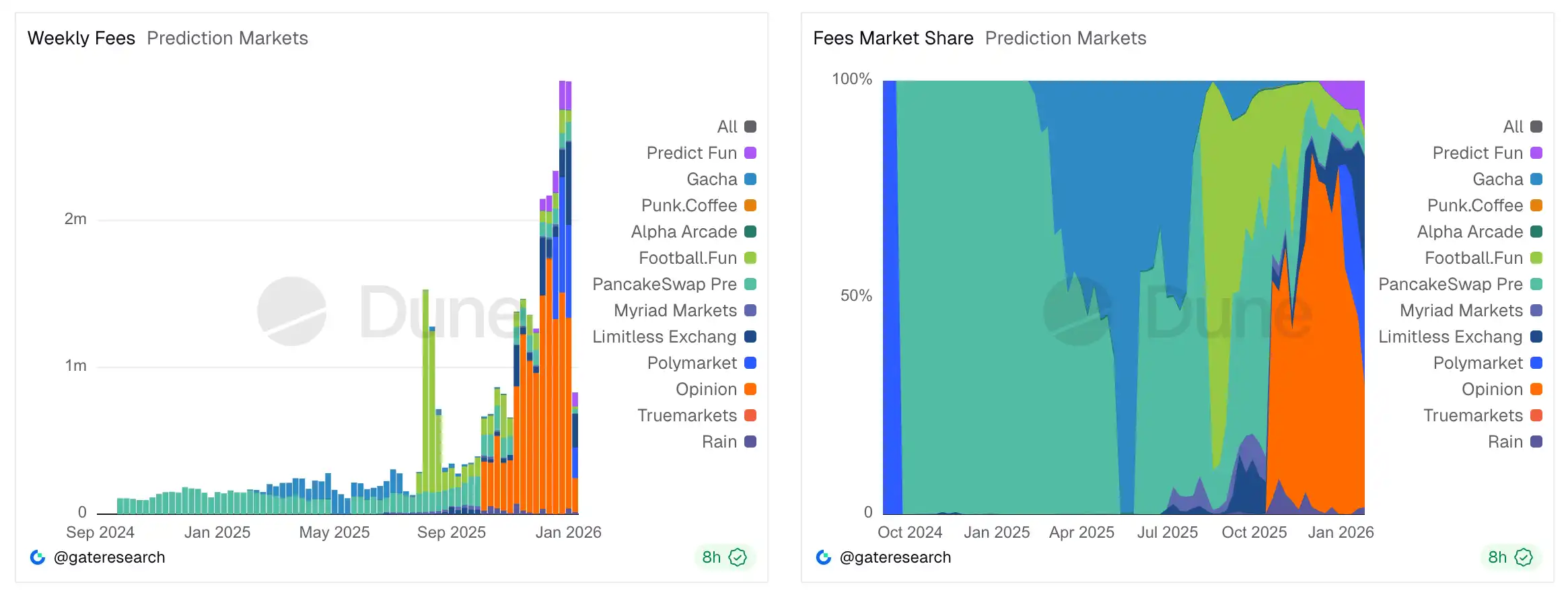
It is foreseeable that Polymarket's fee-charging scope will not be limited to just the "15-minute cryptocurrency price movements" category. Prior to officially charging fees for this category, Polymarket had long maintained a completely free model while also subsidizing market liquidity out of its own pocket. At the end of last year, Coplan himself admitted that Polymarket was operating at a loss... But we have seen too many such "burning cash" stories in the internet market. As Polymarket's user habits and market position gradually solidify, it would not be surprising to see fees introduced for more markets in the future.

  • Odaily Note: For more on Polymarket's revenue issues, refer to Odaily's recent Tea Talk column "Odaily Editorial Tea Talk (January 7th)."

Assuming Polymarket continues to apply the current fee standards to other markets in the future, we might gauge the theoretical revenue ceiling for Polymarket at the current trading volume level by comparing the trading volume of the "15-minute cryptocurrency price movements" market with Polymarket's total platform trading volume. The more markets that charge fees, the higher the revenue.

Data obtained by Odaily shows that the total trading volume of the "15-minute cryptocurrency price movements" market on Polymarket over the past week was approximately $159 million (among the four major tokens, BTC accounted for $114 million, ETH for $30.29 million, SOL for $8.93 million, and XRP for $5.73 million). This represents about 9.1% of Polymarket's total trading volume of approximately $1.75 billion over the past week. Based on this ratio, if Polymarket introduces a similar fee model across all markets under the current trading volume and structure, it is projected to generate $418 million in annual revenue for the platform.

It should be noted that the above are all estimates by Odaily based on historical data. In reality, Polymarket's actual revenue situation will inevitably deviate due to various variables — first, Polymarket has only been charging fees for three weeks, so the sample size is still relatively small; second, Polymarket may not adopt a similar fee mechanism for other markets, and differences in user trading habits across markets will also lead to variations in the final fee results under a dynamic fee mechanism; third, and most crucially, Polymarket is still in a strong growth phase. It is expected that with the further popularization of the prediction market concept, coupled with potential highlights like the 2026 World Cup and mid-term elections, the platform's trading volume will continue to grow in the future.

Even considering these uncertainties, one trend is already quite clear — Polymarket is demonstrating the revenue potential of this entirely new format of prediction markets. It is no longer just a novel innovative concept but a truly sustainable, self-generating business with immensely imaginative profit space.


Related Questions

QWhat is the estimated annual revenue Polymarket could generate from its current fee structure on '15-minute crypto up/down' markets, based on recent data?

ABased on recent data, Polymarket is estimated to generate approximately $38 million in revenue annually from its fee structure on '15-minute crypto up/down' markets, assuming trading volume and activity remain constant.

QWhat was the article's method for estimating Polymarket's potential total annual revenue if fees were applied to all markets?

AThe article estimated potential total annual revenue by comparing the trading volume of the '15-minute crypto up/down' markets (9.1% of total volume) to the platform's total weekly trading volume ($1.75 billion). It then scaled the current fee revenue from that segment proportionally, projecting an annual figure of approximately $418 million.

QAccording to the article, what is a key factor that could lead to even higher future revenue for Polymarket beyond current estimates?

AA key factor for potential higher future revenue is Polymarket's strong growth trajectory. The article specifically mentions the further popularization of the prediction market concept and potential major events like the 2026 World Cup and midterm elections as catalysts for continued increases in platform volume.

QHow does Polymarket's fee structure for the '15-minute crypto up/down' markets work?

AThe fee varies with the real-time odds of a market. Fees are lower when the odds are closer to 0% or 100% and higher when the odds are closer to 50%, with a maximum fee of 1.56%.

QWhat significant change did Polymarket implement on January 6th regarding its business model?

AOn January 6th, Polymarket began charging trading fees on its '15-minute cryptocurrency up/down' markets. This marked the first time the platform ended its completely free model for a specific market type outside of the US (which has a separate 0.01% fee).

Related Reads

9.42 Million Retail Investors Compete for Changxin Technology, Who Got Allotted?

Evergreen Technology's IPO subscription results are now available. On July 20, the domestic memory chip giant announced the offline preliminary allotment results and online lottery results for its IPO. A total of approximately 9.43 million retail investors participated in the online subscription, generating 770,000 winning lots with a final winning rate of about 0.4714%, setting a record for new shares on the STAR Market. After triggering a clawback mechanism from institutional to retail investors, the online retail allocation was significantly increased to 3.851 billion shares. Simultaneously, 285 institutional investors participated in the offline subscription, ultimately receiving 2.173 billion shares at an allotment rate of approximately 0.1756%. Leading insurers and public funds were among the major recipients. Notably, Liang Wenfeng, founder of the major AI model company DeepSeek, through his quantitative investment firms Ningbo Huanfang Quantitative and Zhejiang Jiuzhang Asset, secured the largest share among private funds, with a total allotment worth approximately 175 million yuan. Estimates suggest potential profits could reach 730 million yuan if Evergreen Technology's market capitalization reaches 3 trillion yuan post-listing. The company is expected to list on July 27 and could become the highest-valued tech stock on the A-share market, with various brokerages providing valuations ranging from 1 trillion to over 4 trillion yuan. However, recent significant corrections in global tech stocks may impact its post-listing performance. (Character count: 1,196)

marsbit45m ago

9.42 Million Retail Investors Compete for Changxin Technology, Who Got Allotted?

marsbit45m ago

L2 'Recalibration': When L1 Becomes Its Own Rollup, What Is Ethereum's Endgame?

The article discusses the evolving relationship between Ethereum's Layer 1 (L1) and Layer 2 (L2) solutions, moving beyond the initial "L2 for scaling" model. As Ethereum L1 itself scales (increasing Gas Limit, statelessness, zkEVM), the unique value proposition of L2s shifts from merely providing cheap execution to offering differentiated features like application-specific optimization, privacy, and flexible governance. The piece explores three key themes: 1. **L2's New Role:** L2s are transitioning from a pure scaling technology to a spectrum of execution environments with varying degrees of security inheritance from Ethereum L1. 2. **Interoperability as State Trust:** Solving L2 fragmentation is less about cross-chain bridges and more about enabling faster, trust-minimized state verification between environments. This involves initiatives like faster L1 finality, intent-based architectures (Open Intents Framework), and native account abstraction. 3. **Blurring Layers:** With the potential integration of zk-proofs into L1 validation (making L1 akin to its own "Rollup") and the concept of "Native Rollups," the rigid boundary between L1 and L2 may fade. The future could be a unified system with multiple execution domains (for DeFi, gaming, privacy, etc.) sharing a common security, settlement, and state framework. In conclusion, Ethereum's goal is not to abandon L2s or re-centralize everything on L1, but to re-integrate the fragmented user experience—liquidity, accounts, applications—while preserving the scaling benefits of a multi-environment ecosystem. The endgame is a cohesive "one chain" feeling for users, powered by diverse but securely interconnected execution layers.

marsbit1h ago

L2 'Recalibration': When L1 Becomes Its Own Rollup, What Is Ethereum's Endgame?

marsbit1h ago

Trading

Spot
活动图片




