DAT Companies Take on Side Businesses

Foresight NewsPublished on 2026-06-18Last updated on 2026-06-18

Abstract

The article details the strategic shifts of Digital Asset Treasury (DAT) companies amid a prolonged market downturn. Initially popularized by firms like MicroStrategy, the DAT model—where companies hold cryptocurrencies on their balance sheets—has faced significant pressure as crypto ETFs eroded their investment thesis and bear markets strained finances. Key players are adapting in several ways. Some, like ETHzilla, have abandoned the model entirely. Others are pivoting towards becoming active, revenue-generating participants in the crypto ecosystem rather than passive holders. This evolution is taking two main paths: 1. **Transformation into Institutional Crypto Asset Managers:** Companies like SharpLink Gaming and GameSquare are leveraging their holdings to generate yield, moving beyond simple storage. They employ strategies like 100% ETH staking or using machine learning to optimize DeFi yields, positioning themselves as platforms offering institutional-grade crypto yield products. 2. **Becoming Blockchain Infrastructure Operators:** This is prominent in the Solana ecosystem. Firms like DeFi Development and SOL Strategies are acquiring validator businesses, issuing liquid staking tokens (e.g., dfdvSOL, fwdSOL), and integrating them into DeFi protocols. They generate fee-based revenue from these operations, building network effects. The article notes that successful转型 hinges on building operational expertise and defensible business models around crypto assets, such as ...


Author: Eric, Foresight News


How long has it been since you last heard news about Metaplanet?


In the first quarter of 2026, this company, Japan's and even Asia's largest Bitcoin treasury firm, adjusted its capital strategy. It chose not to dilute equity when its mNAV was less than 1 (meaning the company's market cap to crypto holdings value ratio was below 1), shifting towards strategies including Bitcoin-collateralized financing and share buybacks to maintain its stock price to some extent.


Although the Q1 financial report showed Metaplanet still purchased 5,075 Bitcoins, since the beginning of the second quarter, aside from announcing the acquisition of the Japanese licensed securities firm Siiibo Securities about a week ago to promote Bitcoin-backed bond-like products and explore security tokenization, there has been little other news.


Even Strategy, which guaranteed countless times it would never sell Bitcoin, has experimented with the market impact of selling a small amount of Bitcoin to replenish cash. The once "never sell" vow has become "ensure total holdings increase." When the DAT companies holding the top two positions in Bitcoin reserves are stretched thin, it's not hard to imagine the predicament other companies are currently facing.


In fact, aside from a few companies like Strategy, Metaplanet, and BitMine who are still holding on, most former DAT companies have begun seeking other avenues.


Two Paths to Survival


In the face of an unexpected bear market, many DAT companies have directly chosen to "quit the game."


ETHZilla is a typical example. Backed by Peter Thiel, this company held over 90,000 ETH at its peak in 2025 but sold a total of $115 million worth of ETH twice by the end of that year to repay debt. This year, it has abandoned the DAT model altogether, pivoting to businesses like RWA tokenization.


Bitcoin DAT companies like Prenetics Global and Sequans Communications have also chosen to quit, returning to their core businesses. Many bandwagon altcoin DAT companies are in the same boat, with their stock prices nearing zero and the coins in their hands difficult to liquidate, so they simply give up. Data shows that in July 2025 alone, DAT companies bought approximately $20 billion worth of cryptocurrency, while the total purchase volume in Q1 this year was only about $3.7 billion.


Facing the stalling of their flywheel, aside from quitting or giving up, mid-tier treasury companies have begun a collective strategic pivot, which can roughly be summarized into three directions. They all point to one core proposition: DAT must evolve from a passive balance sheet manager to an active ecosystem participant to truly possess commercial value.


The first direction is repositioning themselves as institutional-grade crypto asset management platforms and yield funds. SharpLink Gaming is a representative of this path. From day one, this company has staked nearly 100% of its ETH holdings and allocated all staking rewards to shareholders without taking any fees. This stands in stark contrast to spot ETH ETFs, which, although granted staking permission by the SEC, can only stake about 50% of their holdings to meet daily liquidity requirements. Building on this, SharpLink partnered with the Wall Street veteran crypto investment bank Galaxy Digital in early 2026 to launch the $125 million "Galaxy Sharplink On-Chain Yield Fund," investing approximately $100 million worth of staked ETH into DeFi liquidity protocols seeking excess returns. This company is transforming from a simple cryptocurrency holding company into a management platform providing institutional clients with access to on-chain yield configurations.


The exploration by GameSquare, which holds about 15,000 ETH, is more radical. This listed company, which owns gaming assets like FaZe Clan, collaborated with crypto asset management firm Dialectic to integrate Dialectic's self-developed Medici platform. This platform uses machine learning models and automated algorithms to dynamically allocate funds across 72 to 250 different DeFi protocols, targeting annualized returns of 8% to 14%, far exceeding the 3% to 4% benchmark of standard Ethereum staking.


The second direction is transforming into blockchain infrastructure operators, which is particularly evident in the Solana ecosystem. DeFi Development is one that has gone the furthest. This company not only purchases large amounts of SOL but also acquired a validator company and launched its own liquid staking token, dfdvSOL. dfdvSOL has been integrated into multiple core Solana DeFi protocols like Kamino, Orca, Drift, and Jupiter Lend, used as lending collateral and liquidity pool assets. DeFi Development earns fee income from every staking operation and protocol integration, building a self-reinforcing network effect loop.


SOL Strategies acquired three validator companies, constructing a complete business line from digital asset holding to infrastructure operation. It manages over 3.4 million SOL in delegated staking, far exceeding its own treasury size, shifting from serving its own balance sheet to providing staking infrastructure for institutional clients across the entire ecosystem.


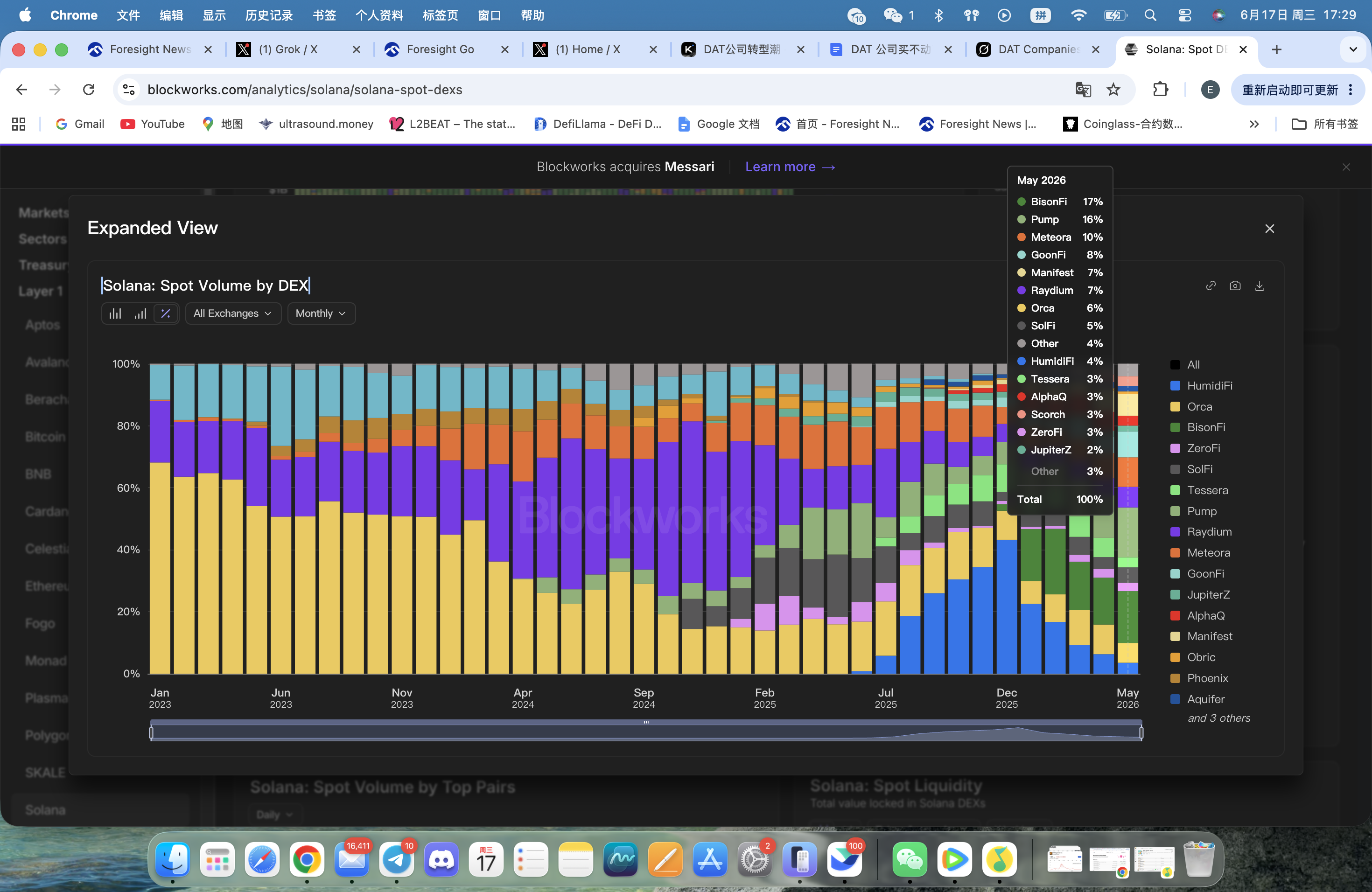
Forward Industries has followed a similar path. Besides launching its liquid staking token fwdSOL, Forward Industries also collaborated with Galaxy Digital and Jump Crypto to launch the propAMM project BisonFi. Since its launch, BisonFi has surged ahead to become the highest volume DEX on Solana, squeezing the once-dominant HumidiFi to less than a 4% market share.


These two routes essentially correspond to the capital market's different attitudes towards Ethereum and Solana. ETH's recognition as an "asset" itself is still higher than SOL's. ETH treasury companies can position themselves as "funds managing ETH," providing institutions with exposure to yield-generating assets. On the other side, Solana's crypto-native attributes are more pronounced. SOL treasury companies need to demonstrate their profitability within this ecosystem, showcasing their value in a logic closer to the "look at the financials" approach of regular listed companies.


Can the Transformation Succeed?


The collective transformation of DAT companies actually reflects a profound cognitive upgrade the entire crypto industry is undergoing. The treasury model initially pioneered by Strategy was essentially a form of financial engineering that leveraged the convenience of public market financing and investor sentiment for capital arbitrage. When participants expanded from a few early adopters to hundreds of companies, and from Bitcoin to various altcoins, scarcity was diluted, and premiums naturally evaporated. The launch of cryptocurrency ETFs further accelerated this process. When investors can purchase ETH ETFs with staking yields directly through traditional brokerage accounts at prices close to net asset value, the logic of holding DAT stocks at a premium is fundamentally shaken.


The answer given by successful transformation cases is operational capability. Whether it's SharpLink's 100% staking strategy and institutional-grade yield fund, DeFi Development's dfdvSOL ecosystem and validator network, or GameSquare's machine-learning-driven yield platform, they are all attempting to build difficult-to-replicate operational barriers around crypto assets. These barriers may stem from technological advantages, network effects, institutional partnerships, or deep participation in the on-chain financial ecosystem.


However, these transformations are not without risks. The 8% to 14% DeFi yield pursued by GameSquare is built on smart contract risks and protocol risks; any major DeFi protocol vulnerability or extreme market event could lead to significant losses. DeFi Development's business model is highly dependent on the healthy development of the Solana network; once the ecosystem cools, its entire business would be impacted.


For the Web3 market, the impact of this transformation is profound and complex. Those DAT companies that have successfully evolved into infrastructure operators and asset management platforms are building bridges between traditional finance and the blockchain ecosystem, promoting the maturation and standardization of institutional-grade services. But the process of the DAT model moving from frenzy to sobriety also sends an important signal to the market: in the crypto space, pure capital games are not for everyone. Entities that truly participate in network building, create actual cash flow, and provide user value possess greater anti-cyclical capabilities.


The DAT movement is entering a stage of sober restructuring from a capital carnival. This might not be bad news. An industry can only truly see who is swimming naked and who is building an ark after the泡沫 recedes. The collective pivot of treasury companies is both a passive response to survival pressure and the inevitable growing pains of a nascent industry maturing.


Related Questions

QAccording to the article, what are the two main survival paths for DAT companies mentioned, and can you give an example of a company for each path?

AThe two main survival paths are: 1) Transforming into an institutional-level crypto asset management platform/yield fund. An example is SharpLink Gaming, which stakes nearly 100% of its ETH and launched a chain-based yield fund with Galaxy Digital. 2) Transforming into a blockchain infrastructure operator, particularly evident in the Solana ecosystem. An example is DeFi Development, which acquired validator firms and launched its own liquid staking token dfdvSOL.

QWhat significant change did Metaplanet make to its capital strategy in Q1 2026, and what recent acquisition did it announce?

AIn Q1 2026, Metaplanet adjusted its capital strategy to avoid diluting equity when its mNAV (market capitalization to crypto holdings ratio) was less than 1. Instead, it turned to strategies like borrowing against Bitcoin and stock buybacks. More recently, it announced the acquisition of the licensed Japanese securities firm Siiibo Securities to promote bond-like products with Bitcoin as the underlying asset and explore tokenization.

QWhy does the article suggest the initial DAT model pioneered by Strategy is losing its appeal?

AThe article suggests the initial DAT model is losing its appeal because its scarcity and premium have been diluted as hundreds of companies adopted it for various cryptocurrencies. Furthermore, the launch of cryptocurrency ETFs (like ETH ETFs) allows investors to buy the asset with yields directly through traditional brokerage accounts at near NAV, fundamentally undermining the logic of paying a premium for DAT company shares.

QWhat are some of the key risks associated with the new strategic directions DAT companies are taking, according to the article?

AKey risks include: For companies like GameSquare pursuing higher DeFi yields (8-14%), there are significant smart contract and protocol risks, where a major exploit or market crash could lead to substantial losses. For infrastructure-focused companies like DeFi Development, their business model is highly dependent on the health of a specific blockchain ecosystem (e.g., Solana), making them vulnerable if that ecosystem declines.

QHow does the article characterize the current phase of the DAT movement and its potential impact on the Web3 market?

AThe article characterizes the current phase as a move from a 'capital frenzy' into a 'cooling reconstruction' phase. It sees this as a necessary growing pain for the industry's maturation. For the Web3 market, successful DAT companies that become infrastructure operators or asset managers can help build bridges between traditional finance and blockchain. The process signals that in crypto, entities that genuinely participate in network building, create cash flow, and provide user value have greater resilience against market cycles than those engaged in pure capital games.

Related Reads

Options Don't Work in DeFi? Vitalik Might Not Agree

For years, the prevailing view has been that options struggle to gain traction in DeFi due to complexity, fragmented liquidity, and lack of natural demand compared to products like perpetual futures. However, a recent algorithmic stablecoin design proposed by Vitalik Buterin presents a different perspective, using options not as a standalone trading product, but as foundational infrastructure for other financial instruments. In this design, one unit of ETH is split into two components: a "stable" side (P) that retains value up to a specified strike price, and an "upside" side (N) that captures all appreciation above that strike. Combined, they always equal one ETH, eliminating debt, margin, and liquidation risks inherent in typical collateralized debt position (CDP) stablecoins. The stable component essentially mimics the payoff of a covered call option. To function as a stablecoin, this structure requires continuously rolling deep in-the-money calls, which introduces challenges like rollover slippage, predictable transaction flow vulnerable to front-running, and persistent liquidity needs. A core hurdle is finding consistent buyers for the leveraged ETH upside exposure (N). While it offers leverage without funding rates or liquidation, it must compete with simpler alternatives like direct call options or perpetuals. The system's scalability depends on a sustained demand for this specific form of leverage. The author draws parallels to their experience with Rysk, where earlier versions of DeFi options protocols struggled. The breakthrough came with Rysk V12, which aligns incentives: asset holders generate yield by selling covered calls against their holdings, while market makers efficiently acquire the desired option exposure. This demonstrates that options can find product-market fit when embedded as a risk distribution and pricing engine within structured products, stablecoins, or yield-generating assets, rather than marketed as a complex direct trading instrument. Vitalik's proposal reinforces this architectural approach—using fully collateralized, non-custodial, and physically settled options as a fundamental building block. The real opportunity for options in DeFi may lie not in becoming the next perpetual swap, but in powering the next generation of on-chain financial products.

marsbit25m ago

Options Don't Work in DeFi? Vitalik Might Not Agree

marsbit25m ago

Conversation with Investor Zheng Di: MicroStrategy's Coin Sale Experiment, AI Economy, and Opportunities in US Stocks

Frontier tech investor Zheng "Didier" Di discusses the recent Bitcoin price drop, the financial strategy shift at MicroStrategy, the AI-driven surge in U.S. stocks, and the evolving role of crypto exchanges. Didier posits that the recent BTC decline stems less from macro factors or ETF outflows, and more from market repricing due to MicroStrategy's new financial structure. Following a wave of preferred stock and debt issuance (STRC, STRZ, etc.), MicroStrategy must now manage cash flow to pay dividends, potentially leading to a market expectation of sustained, small-scale BTC sales to maintain its "per-share bitcoin neutral" principle. Didier views this as a financial "experiment" testing market capacity for such recurring sell pressure, which, while creating near-term structural headwinds, likely avoids a true "death spiral" absent major new external shocks. Shifting to AI, Didier argues that tokens are becoming the new form of labor, with AI models and compute (tokenized inputs) increasingly replacing human roles in execution and middle-management. This drives enterprise efficiency and higher margins, fueling the sustained rally in U.S. semiconductor, data center, and infrastructure stocks. He foresees an emerging "machine economy" where automated agents transact and collaborate on-chain. Regarding crypto exchanges offering U.S. equities, Didier sees this as a natural evolution. With few crypto-native assets generating lasting value, exchanges are pivoting towards real-world assets (RWAs) like stocks and bonds. This doesn't necessarily cannibalize crypto but reflects a maturing industry focusing on blockchain's core utilities: decentralized choice and efficient settlement. He notes that trading logic for crypto natives doesn't need to drastically change, as meme-driven and fundamentalist strategies find analogs in U.S. markets. The "1011 event" (likely referring to a major market crash) severely damaged crypto market liquidity, marking a probable end to the altcoin speculative cycle, with capital flowing towards the deeper liquidity of U.S. markets. For the macro outlook, Didier is cautious about near-term market pressure from potential mega-IPOs (e.g., SpaceX) and the U.S. midterm elections, which could bring more regulatory scrutiny. Long-term, he remains bullish on AI's productivity gains and its convergence with blockchain/Web3, predicting a shift from speculative frenzy to a more institutionalized, industrial phase for the crypto sector.

marsbit1h ago

Conversation with Investor Zheng Di: MicroStrategy's Coin Sale Experiment, AI Economy, and Opportunities in US Stocks

marsbit1h ago

Playnance’s $GCOIN Lists on KoinBX Amid Rapid Growth in India

Playnance's native token, $GCOIN, has been listed on the cryptocurrency exchange KoinBX as of June 18. This move aims to enhance accessibility for its rapidly growing community, particularly in India, where the blockchain-powered Web3 iGaming ecosystem has gained significant traction. Over 130 partners in Playnance's "Be the Boss" program have built communities engaging thousands of active players in the region. The "Be the Boss" model allows participants to create and manage their own gaming communities, earning rewards tied to community activity. CEO Pini Peter noted India's high engagement, with community leaders successfully building player networks. One partner, Dr. Nicolas, reported earning over $57,000 through the program in recent months, highlighting both the financial rewards and the opportunity to grow an engaged community. $GCOIN serves as the ecosystem's core utility token, incentivizing participation and aligning the interests of players and community leaders ("Bosses"). The listing on KoinBX is part of Playnance's strategy to expand globally, increasing the token's utility and accessibility by combining community ownership, gamified engagement, and blockchain-based incentives. Founded in 2020, Playnance is a Web3 iGaming infrastructure company focused on creating live, non-custodial, on-chain products to onboard mainstream users. It currently processes approximately one million transactions daily, aiming to simplify the user experience while maintaining full on-chain transparency.

TheNewsCrypto1h ago

Playnance’s $GCOIN Lists on KoinBX Amid Rapid Growth in India

TheNewsCrypto1h ago

STRC Hits Historic Low, Saylor's Perpetual Motion Machine Grinds to a Halt

STRC, the perpetual preferred stock issued by MicroStrategy to fund its Bitcoin purchases, hit a historic low of $85.32, a 17% discount to its $100 par value. Designed as a "digital credit engine" to trade stably near par and enable continuous share issuance for buying Bitcoin, its plunge signals a breakdown in this model. Three key factors drove the decline: 1. Bitcoin's price fell over 50% from its peak, trading around $63,000 amid hawkish Fed signals. 2. MicroStrategy's cash reserves were depleted after a $1.5 billion convertible note repayment, slashing the dividend coverage for STRC's 11.5% yield to ~7 months. The company then sold 32 BTC to cover dividends—Michael Saylor's first Bitcoin sale since 2022—damaging the "never sell" narrative. 3. A competing Bitcoin-backed preferred stock, Strive's SATA, offers a higher yield (~13%) and daily dividends, drawing investors away from STRC. The drop triggers a negative cycle: STRC below par halts ATM share issuances, cutting off a key funding source for Bitcoin buys and potentially forcing more BTC sales for dividends, further eroding confidence. While Saylor argues the model is mathematically sound—needing only 2.3% annual Bitcoin growth to sustain itself—the market is testing the resilience of the leveraged Bitcoin treasury strategy in a bear market. The STRC price now reflects rising skepticism about this financial machinery's durability during downturns.

marsbit2h ago

STRC Hits Historic Low, Saylor's Perpetual Motion Machine Grinds to a Halt

marsbit2h ago

Trading

Spot
Futures
活动图片