CZ Got Rugged Too? Bloody Battle for Control of BNB Treasury CEA Industries

Odaily星球日报Published on 2026-03-25Last updated on 2026-03-25

Abstract

CZ, the founder of Binance, appears to have fallen victim to a major financial scheme involving CEA Industries (NASDAQ: BNC), a company he selected to manage a BNB treasury initiative. Despite CZ’s trust in David Namdar, founder of Galaxy Digital and CEO of 10X Capital, the company has been accused of acting as a "private ATM" for insiders. In 2025, CEA Industries raised $500 million in private funding led by YZi Labs to implement a BNB reserve plan. However, by late 2025, conflicts erupted between YZi Labs and CEA’s board, chaired by Namdar. YZi Labs, a major shareholder with 9.4% stake, accused the board of financial misconduct, including millions in questionable payments to 10X Capital and a $1.98 million exit package for Namdar upon his March 2026 resignation. Despite YZi Labs' efforts to gain control by expanding the board—including proposing CZ as a director—Namdar’s board resisted fiercely. They delayed the annual meeting and implemented a "poison pill" strategy, making a takeover prohibitively expensive and difficult. YZi Labs now claims the company is an empty shell with no active management. The battle for control continues, with YZi Labs vowing to pursue action, but Namdar has largely succeeded in stripping the company of value before exiting.

Original | Odaily Planet Daily (@OdailyChina)

Author | Golem (@web3_golem)

The winds in the crypto world come fast and go fast.

DAT once stirred up huge waves in 2025, with a large number of speculators teaming up with shell companies listed on the US stock market to fabricate a false prosperity of "crypto assets invading US stocks." By the time FOMO investors came to their senses, their accounts had already been cleaned out. If you were one of them, the following news might make you feel a bit better: Even CZ fell into the hands of the same group.

At that time, more than 30 listed companies were competing to deploy BNB treasuries, and CZ stated he would "carefully select." He ultimately chose CEA Industries, founded by Galaxy Digital co-founder David Namdar. In July 2025, CEA Industries (NASDAQ: BNC) completed a $500 million private financing round led by YZi Labs and officially began implementing the BNB reserve plan.

CZ's choice of David Namdar seemed impeccable—a stellar resume, close personal ties, someone he considered within his "circle of trust." Unfortunately, CZ's investment acumen has always been "questionable," and this time, he misjudged again.

In November 2025, the conflict between YZi Labs and CEA Industries erupted completely. YZi Labs accused BNC of issues like continuously declining stock prices and board inaction, and also demanded the election of new directors. At the time, Odaily Planet Daily analyzed that YZi Labs would most likely take over BNC, David Namdar would be ousted, and the matter would end there. (Related reading:BNB Treasury Leader Heavily Criticized, "CZ's Confidant" May Be Ousted?)

No one expected that the real show had just begun.

The Person Who Rugged CZ Has Fled

On March 24, YZi Labs published an article condemning CEA Industries for paying nearly $1.98 million in severance compensation to the departing CEO to ensure a soft landing, demanding the board publicly justify the reasonableness of the severance payment.

Simultaneously, YZi Labs accused the CEA Industries board of having funneled millions of dollars to related parties, having paid a total of $3.8 million to 10X Capital since June 7, 2025; and previously, the CEO and CFO roles were held by the same person (Odaily Note: CEA Industries appointed a new CFO on March 9), with the company lacking adequate verification controls in key areas such as revenue, taxation, and equity compensation.

YZi Labs investment partner Alex Odagiu finally stated what should have been realized a year ago—"CEA Industries' board has turned a Nasdaq-listed company into a private ATM."

Who is this departing CEO? And who is 10X Capital?

This CEO is still David Namdar. That's right, he wasn't kicked out by YZi Labs last November; instead, he has now hollowed out CEA Industries before leisurely resigning. Furthermore, he is also the CEO of 10X Capital. 10X Capital is the asset manager for CEA Industries and was the biggest promoter behind turning CEA Industries into a BNB treasury company last year.

According to the information in the 8-K form filed with the SEC by CEA Industries on March 16, David Namdar, from his appointment as CEO on August 5, 2025, until signing the transition agreement on March 16, 2026, did not receive any cash or equity compensation, so it is being paid now; legally, it seems fine. David Namdar has successfully executed a golden cicada shedding its shell. On March 25, the pinned post on the official CEA Industries X account was changed to indicate they are looking for a new CEO.
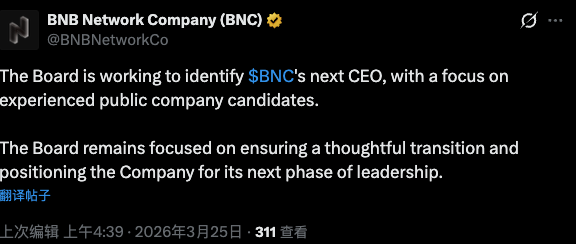
According to external media reports, in early March this year, a BNC investor visited the CEA Industries office in Nevada, USA, and found that CEA Industries was an empty shell, with no management or operations. On the business front, official information shows that CEA Industries currently holds 515,544 BNB with a cost basis of $855, but its last public purchase of BNB was in November 2025.

After being criticized by YZi Labs, CEA Industries immediately recruited a new director as demanded by YZi Labs—Annemarie Tierney, founder of Liquid Advisors. Tierney also has an excellent resume, but she is not from the YZi Labs camp. CEA Industries responds to every demand from YZi Labs, but nothing ever gets properly resolved.

Speaking of which, why wasn't David Namdar ousted by YZi Labs last November? Did CZ protect him? The answer is certainly not. YZi Labs had the intention but lacked the capability.

The Battle Between David Namdar's Camp and YZi Labs' Camp

In fact, since last November, David Namdar's camp and YZi Labs' camp have been engaged in an ongoing battle for control of CEA Industries.

David Namdar's camp includes his established 10X Capital and the entire board of CEA Industries, and these two organizations have a high degree of personnel overlap. They effectively control CEA Industries.

YZi Labs is a major shareholder of CEA Industries. According to a filing YZi Labs submitted to the US SEC on January 8, YZi Labs collectively holds 4,255,043 shares of CEA Industries common stock, representing approximately 9.4% of the issued common shares.

The core purpose of YZi Labs' struggle is to expand the CEA Industries board from 6 members to 13 members, with all 7 new members coming from YZi Labs. CZ is also among the candidates. If successful, YZi Labs would control the majority of the new board.

Although YZi Labs is already a major shareholder of CEA Industries, it still doesn't have enough votes to directly place people on the board. Therefore, YZi Labs must unite with other shareholders to initiate a written consent solicitation to implement the overhaul it has wanted since November. This is also why YZi Labs is so keen on publicizing that David Namdar's actions are an infringement on all shareholders' rights.

But David Namdar's board, of course, would not let YZi Labs' plan succeed easily. First, David Namdar postponed the CEA Industries 2025 Annual General Meeting by 16 months, cutting off a crucial opportunity for shareholders to vote on board members. Second, and most ruthlessly, David Namdar launched a "poison pill" plan and amended the company's bylaws on December 26.

The formal name of this plan is an amended Stockholder Rights Plan. CEA Industries stated plainly in its filing with the US SEC that because YZi Labs had formed a shareholder group (YZi Labs Group) intending to control the company, the board decided to amend the Stockholder Rights Plan and the company's bylaws—the last time these bylaws were amended was in 2018.

At this point in the story, David Namdar has completely stopped pretending. "Easy to invite the god, hard to send him away." He set a dead end for CZ: If you want to replace me, not only will it be costly, but you also need my approval first.First, the new Stockholder Rights Plan stipulates that if any group or individual beneficially owns 15% or more of the shares without board approval, the rights held by other shareholders will activate, allowing them to purchase additional shares at a 50% discount. This means if YZi Labs continues to increase its shareholding percentage, other shareholders may get the chance to "buy in cheaply," diluting YZi Labs' ownership and drastically increasing the cost of its fight for control of CEA Industries; Furthermore, warrants are also counted towards beneficial ownership, and if these are included, YZi Labs' ownership percentage actually exceeds 19.99%.

Second, the new company bylaws stipulate that any shareholder seeking to take action via written consent must first request the company to set a record date, and also impose more stringent disclosure requirements. This means YZi Labs' consent solicitation to add new company directors first needs approval from the board led by David Namdar, procedurally obstructing and delaying YZi Labs' actions.

On March 24, after YZi Labs condemned David Namdar and his board for lining their own pockets, the CEA Industries board counterattacked. It stated that the consent solicitation application letter YZi Labs proposed in January for adding new company directors did not comply with the company's bylaws and would not be registered. The specific reason given by CEA Industries was that YZi Labs did not disclose the amount of BNB held by its related parties and their agents, nor did it disclose the financial relationships between YZi Labs and its agents; if YZi Labs controlled the board, it could cause harm to other shareholders' interests.

The ginger is still spicier when old. From the current perspective, in this battle for control, David Namdar had already won long ago. All YZi Labs, which invested heavily, can do now is condemn, condemn, and condemn again.

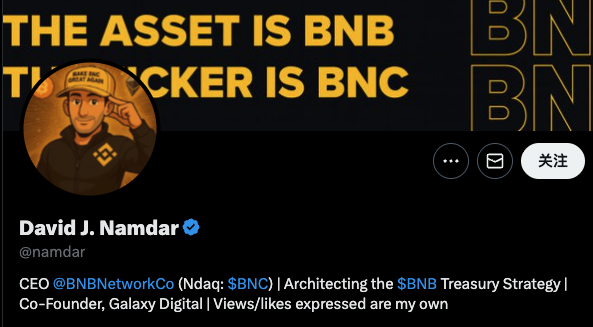
Although David Namdar has already squeezed CEA Industries dry, if you click on his X account, you'll find his avatar wearing a shirt with the Binance logo and a hat that says "MAKE BNC GREAT AGAIN." His pinned post is still congratulating CZ on being pardoned by the US government. Perhaps from the very beginning, David Namdar saw CZ as nothing more than an ATM.
On March 20, David Namdar's important partner, 10X Capital co-founder Hans Thomas, also resigned from the CEA Industries board. But YZi Labs is not willing to just let them get away with it scot-free. YZi Labs investment partner Alex Odagiu posted on X platform, "Hans Thomas is out, but we are not done yet"......


Related Questions

QWhat is the main reason for the conflict between YZi Labs and CEA Industries?

AThe conflict arises from YZi Labs' accusations that CEA Industries' board, led by David Namdar, has been using the company as a 'private ATM', misappropriating funds, and engaging in poor governance, while YZi Labs seeks to gain control of the board to protect its investment.

QWho is David Namdar and what role did he play in the CEA Industries controversy?

ADavid Namdar is the former CEO of CEA Industries and founder of 10X Capital. He is accused of orchestrating a scheme to drain CEA Industries' assets, including receiving a $1.98 million severance payment and funneling millions to related parties, before resigning and leaving the company as an empty shell.

QWhat measures did David Namdar's board implement to prevent YZi Labs from taking control?

ADavid Namdar's board implemented a 'poison pill' strategy, including a revised Stockholder Rights Plan that dilutes shares if any entity acquires over 15% ownership without board approval, and amended bylaws to require board consent for written consent solicitations, effectively blocking YZi Labs' attempts to gain control.

QHow much BNB does CEA Industries currently hold, and what is its average cost?

ACEA Industries currently holds 515,544 BNB with an average cost basis of $855 per BNB.

QWhat was YZi Labs' primary goal in its battle for control of CEA Industries?

AYZi Labs aimed to expand CEA Industries' board from 6 to 13 members, with 7 new directors from its own camp including CZ, to secure a majority and overturn the existing management led by David Namdar.

Related Reads

The Essence of AI Layoffs: Why More AI Adoption Leads to More Corporate Anxiety?

The author, awaiting potential inclusion on an 8000-person layoff list, analyzes the true nature of recent "AI-driven" layoffs. They argue that while AI use, particularly tools like Claude for code generation, has skyrocketed and boosted developer output (e.g., 2-5x more code commits), this has not translated into proportional business growth or revenue. The core issue is a misalignment between increased "Input" (code) and tangible "Outcomes" (user value, revenue). AI acts as a costly B2B SaaS, inflating operational expenses without guaranteed returns. Two key problems emerge: 1) The friction that once filtered out bad ideas is gone, as AI allows cheap pursuit of even weak concepts. 2) Organizational "alignment tax"—the difficulty of coordinating across teams—becomes crippling when development velocity outpaces consensus-building. Thus, layoffs serve two immediate purposes: 1) To offset ballooning AI costs (Token consumption) and maintain cash flow, as rising input costs without outcome growth destroys unit economics. 2) To reduce organizational bloat and alignment friction by simply removing teams, thereby speeding up execution in the short term. Therefore, these layoffs are fundamentally caused by AI, even if AI doesn't directly replace roles. They represent a painful correction until companies learn to convert AI-driven productivity into real business outcomes and streamline organizational coordination to match the new pace of work. The cycle will continue until this learning curve is mastered.

marsbit7m ago

The Essence of AI Layoffs: Why More AI Adoption Leads to More Corporate Anxiety?

marsbit7m ago

Can the Solana Foundation and Google's Collaboration on Pay.sh Bridge the Payment Link Between Web2 and Web3 in the Agent Economy?

Solana Foundation, in collaboration with Google Cloud, has launched Pay.sh, a payment gateway designed to bridge the gap between AI agents and enterprise-grade service infrastructure. The initiative aims to solve a key bottleneck in the "agent economy": existing payment systems are ill-suited for autonomous AI agents. Traditional methods like credit cards require human verification, while newer on-chain protocols like x402 and MPP create a separate, Web3-native system that raises barriers for service providers. Pay.sh functions as a universal payment layer. It allows users to fund a Solana wallet via credit card or stablecoin, which then acts as an identity and payment proxy for AI agents. When an agent needs to access a paid API service (e.g., Google Cloud, Alibaba Cloud), Pay.sh handles the transaction seamlessly. It leverages the HTTP 402 status code ("Payment Required") to initiate payments, intelligently choosing between one-time transfers (x402-style) or session-based authorizations (MPC-style) based on the service's billing model. This spares agents from manual account registration and API key management. A key feature for service providers is low integration effort. They can adopt Pay.sh by providing a declarative configuration file, enabling features like tiered pricing, free tiers, and automatic revenue splitting to multiple addresses (e.g., for royalties, cloud costs). Providers can also list their APIs in a central Pay Skill Registry for agent discovery. The collaboration with Google Cloud provides crucial infrastructure for API proxying, traffic routing, and compliance logging, aiming to keep agent activities within regulated boundaries. By connecting Web2 services with Web3 payment rails, Pay.sh positions the Solana wallet as a foundational identity and payment tool for AI agents, potentially driving more transaction volume to the Solana ecosystem. However, the report notes challenges. The service registry currently lacks robust vetting, risking exposure to unauthorized or malicious third-party APIs. Pay.sh also inherits security and compatibility risks from its underlying payment protocols (x402, MPC). Furthermore, adoption may be hindered by varying regional data privacy and payment compliance regulations among API providers. Despite these hurdles, Pay.sh represents a significant step towards integrating Web2 and Web3 for autonomous agent commerce.

marsbit14m ago

Can the Solana Foundation and Google's Collaboration on Pay.sh Bridge the Payment Link Between Web2 and Web3 in the Agent Economy?

marsbit14m ago

Bitcoin's Bull-Bear Cycle Indicator Turns Positive for the First Time in 7 Months: End of Bear Market or False Breakout?

Bitcoin's "Bull-Bear Market Cycle Indicator" from CryptoQuant has turned positive for the first time since October 2025. This gauge, based on the P&L Index relative to its 365-day moving average, suggests a potential shift from a bear market phase. Concurrently, the Bull Score Index rose to a neutral reading of 50 in late April. The indicator's move into positive territory follows a roughly 35% price rebound from a low near $60,000 in February to above $81,000. The recovery over approximately three months was faster than the 12-month period observed during the 2022 bear market. However, analysts caution against premature optimism, citing a historical precedent from March 2022. Back then, the Bull Score Index briefly hit 50, but it proved to be a false signal as Bitcoin's price subsequently plunged further. Structural differences exist in the current cycle, including consistent inflows into spot Bitcoin ETFs and an increase in large holder addresses. Yet, some models, referencing the four-year halving cycle, suggest a potential deeper bottom near $50,000 might still be possible around late 2026. In summary, while on-chain data shows marked improvement and the worst panic may be over, market participants remain cautious. A convincing trend reversal confirmation likely requires Bitcoin to sustainably break above key resistance, such as the 200-day moving average near $82,000.

marsbit21m ago

Bitcoin's Bull-Bear Cycle Indicator Turns Positive for the First Time in 7 Months: End of Bear Market or False Breakout?

marsbit21m ago

How to Automate Any Workflow with Claude Skills (Complete Tutorial)

This is a comprehensive guide to mastering Claude Skills, a feature for creating permanent, reusable instruction sets that automate specific workflows. Unlike simple saved prompts, Skills function like trained employees, delivering consistent, high-quality outputs by defining the entire task process, standards, error handling, and output format. The guide is structured in four phases: **Phase 1: Installation (5 minutes).** Skills are folders containing a `SKILL.md` file. The user is instructed to find a relevant Skill online, install it, test it on a real task, and compare its performance to one-off prompts. **Phase 2: Building Your First Custom Skill.** Start by rigorously defining the Skill's purpose, trigger phrases, and providing a concrete example of perfect output. The `SKILL.md` file has two parts: a YAML frontmatter with a specific name/description/triggers, and a detailed, step-by-step workflow written in natural language with examples and quality standards. **Phase 3: Testing & Optimization for Production.** Test the Skill in three scenarios: 1) a standard, common task; 2) edge cases with missing or conflicting data; and 3) a pressure test with maximum complexity. Any failure indicates a needed instruction. Implement a weekly optimization cycle to continuously refine the Skill based on real usage. **Phase 4: Building a Complete Skill Library.** The goal is to create a team of Skills for all repetitive tasks. Examples are given for industries like real estate, marketing, finance, consulting, and e-commerce. The user should list their tasks, prioritize them, and build one new Skill per week, maintaining a master document to track their library. The conclusion emphasizes the compounding time savings: ten Skills saving 30 minutes each per week reclaims over 260 hours (6.5 work weeks) per year, fundamentally transforming one's work system.

marsbit45m ago

How to Automate Any Workflow with Claude Skills (Complete Tutorial)

marsbit45m ago

Trading

Spot
Futures
活动图片