[Introduction] The AutoMIA system developed by the Tsinghua University team can transform any two images into 3D artworks with a mirror illusion effect, achieving different visual patterns on the front and mirror-reflected sides, and supporting 3D printing.
First, look at the following two sets of photos: in each set, the left side shows the front pattern of an object placed in front of a mirror, and the right side shows its reflection in the mirror. Interestingly, the front view and the mirror reflection appear to be two almost completely unrelated things—in the first set, the front reads 'CVPR', but in the mirror it becomes '2026'; in the second set, the front shows a 'mountain', while the mirror shows 'water'.
Their contours, colors, and even meanings don't match, as if creating an 'illusion'.
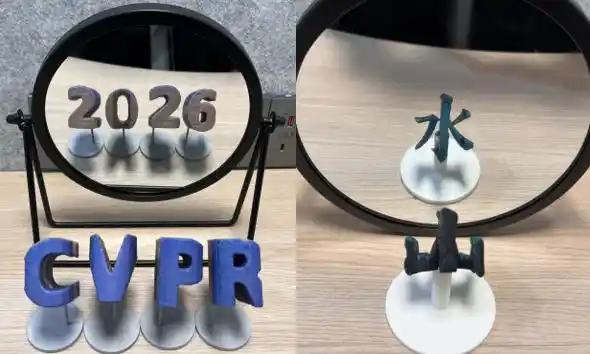
The reason behind this is that it originates from a specially designed 3D object that exploits the 'symmetry completion effect' of the human visual system to create an illusion, a phenomenon known as mirror illusion art.
Researchers meticulously design the three-dimensional geometry and surface color, allowing a real object to present drastically different visual effects when viewed directly and when viewed in a mirror.
Below are two corresponding 'explanation' videos.

Traditionally, the design of such artworks requires clever conceptualization by professional artists, along with extensive complex manual design experience and mathematical calculations, making the creation of such art highly inaccessible for the average person.
So, is there a method that can automatically assist people in completing such artistic design, allowing ordinary individuals to transform their inspiration into artworks?
Recently, a research team from Tsinghua University and other institutions proposed AutoMIA, an AI-driven method for automatically generating mirror illusion art. Users only need to arbitrarily specify two images, corresponding to the patterns in front of the mirror and in the mirror respectively, and AutoMIA can automatically complete the 3D artwork design, supporting direct 3D printing to create the artwork.
Paper link: http://arxiv.org/abs/2607.02015
Code link: https://github.com/zxp555/AutoMIA
The paper has been accepted by CVPR 2026 and selected as a Highlight Paper. Due to its high computational efficiency, this work also received the Efficient CVPR Award.
Research Background
Optical illusion art has long been an important topic at the intersection of art, psychology, and computer vision. Common 2D illusions include hybrid images, visual metamorphosis images, etc.; 3D illusions include Shadow Art, Multi-View Wire Art, etc.
These methods typically rely on specific viewpoints, projections, or shadow relationships to make the same object appear different under various observation conditions.
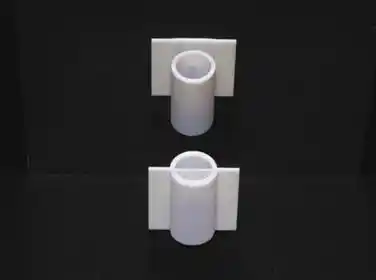
Mirror Illusion Art is a more specialized 3D illusion: when a real object is placed in front of a mirror, the observer sees one pattern from the front and another pattern in the mirror.
Previously, related designs often required extensive manual derivation and adjustment, and mostly focused on shape design, making it difficult to handle colored patterns simultaneously. Directly borrowing methods from Shadow Art could easily produce surface noise, floating background patches, or internal fractures, affecting visual quality and physical fabrication.
Therefore, the authors posed a direct question: Can AI be made to automatically design such mirror illusion objects? Given two target images, can the system simultaneously optimize the 3D shape and color so that the same object presents two specified appearances from two viewpoints?
Research Methodology
AutoMIA models this problem as a dual-view inverse design task. The system represents the 3D object using voxels, each containing density and color information. Through differentiable volume rendering, the object is rendered from two specified viewpoints, and the rendering results are compared with the two target images.
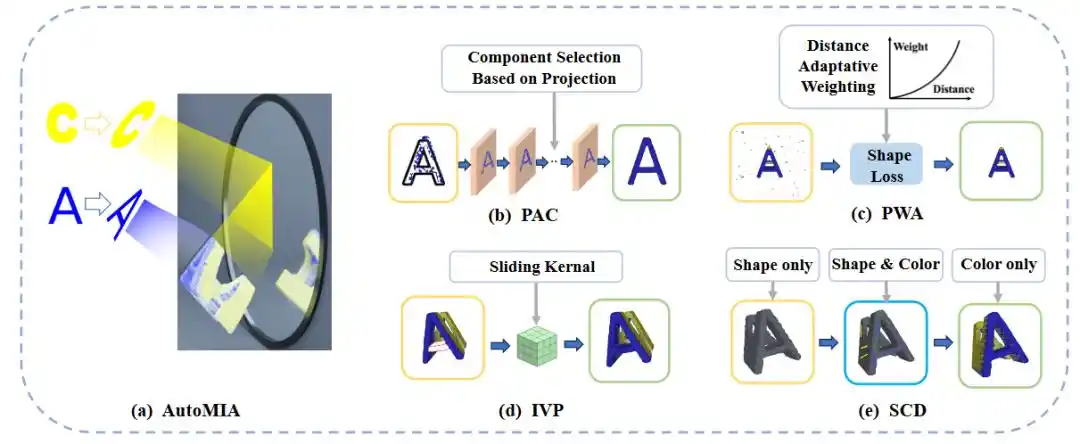
The optimization objective includes both shape similarity and color similarity, enabling the generated object to meet contour requirements while also producing the colors of the target images.
During actual optimization, the authors identified four key issues: surface noise, background noise, internal fractures, and imbalance between shape and color optimization.
To address these, the paper proposes four core mechanisms.
The first is PAC, Projection-Alignment-based Connected Component Pruning. The system projects connected components from the current voxel grid onto the two viewpoints one by one, scores them based on their overlap with the target mask and background spillover, retaining structures that genuinely contribute to the target pattern and removing floating or ineffective noise.
The second is PWA, Position-based Weight-Adaptive Noise Suppression. It adjusts the background penalty weight based on the pixel's distance to the target region, imposing stronger penalties on erroneous projections far from the target pattern, thereby reducing background noise in distant areas.
The third is IVP, Internal Voxel Protection. Since the supervision images primarily constrain the object's surface, internal voxels are prone to being erroneously weakened during optimization, leading to structural fractures. IVP identifies internal voxels and applies a lower density limit, helping to maintain object integrity, which is particularly important for subsequent 3D printing.
Finally, SCD, Shape-Color Decoupled Optimization. AutoMIA divides the training process into stages of shape optimization, joint shape-color optimization, and color refinement, avoiding premature color interference with geometric structure and reducing conflicts between colors from different viewpoints.
Experimental Results
The paper validates AutoMIA using various types of 2D images as input, including English letters, numbers, Chinese characters, geometric patterns, emojis, cartoon patterns, and logos.
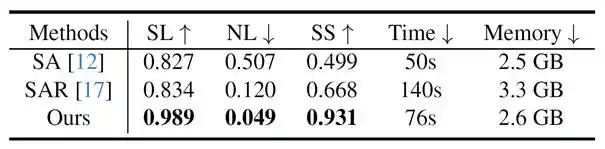
In experiments, the authors compared AutoMIA with methods like Shadow Art (SA) and Shadow Art Revisited (SAR). Since baseline methods mainly support shape optimization, the comparison focused on metrics like smoothness, noise level, and shape consistency.
Results show that AutoMIA achieves significant advantages in reconstruction quality. According to the paper, AutoMIA's Smoothness Level (SL) reaches 0.989, Noise Level (NL) drops to 0.049, and Shape Similarity (SS) reaches 0.931. In contrast, SA and SAR show clear gaps in shape consistency and noise control.
Meanwhile, AutoMIA's average design time on a single RTX 3090 is only 76 seconds, with an average GPU memory usage of about 2.6GB, demonstrating high computational efficiency.
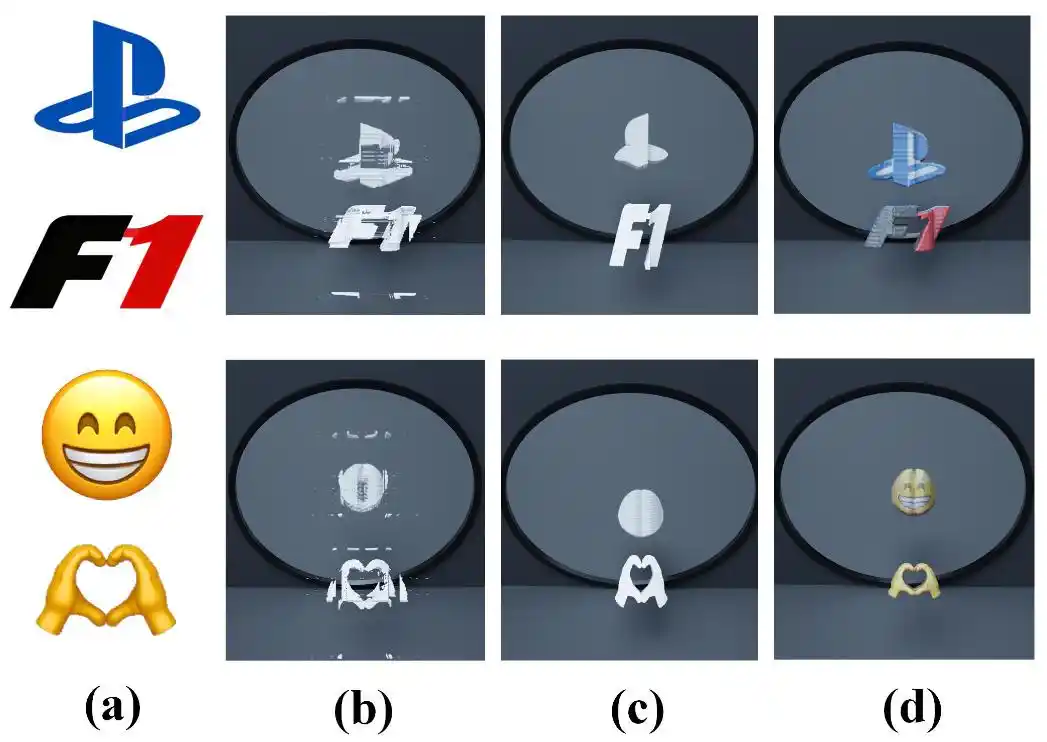
Visual results show that SA and SAR are prone to issues like floating noise, uneven surfaces, or internal fractures, making it difficult to form stable, complete solid structures.
In contrast, results generated by AutoMIA not only better match the contours of the two target images but also reconstruct the colored surfaces of the input images, giving clear visual semantics to both the front and mirror views.
For mirror illusion art, this point is crucial: if the shape is correct but colors are chaotic, or if colors are close but the structure is fragmented, it ultimately fails to create a convincing illusion effect.
Ablation studies further indicate that PAC, PWA, IVP, and SCD all contribute to the final result. Removing any module leads to a decline in reconstruction quality. For example, removing PAC significantly increases noise and reduces shape consistency; removing SCD affects shape, color, and smoothness.
This indicates that AutoMIA does not rely solely on voxel optimization but incorporates systematic design to address problems specific to mirror illusion art creation.
The following provides a set of examples from the digital world. As can be seen in the figures, mirror illusion objects with good rendering effects are produced in the Blender digital simulation software.
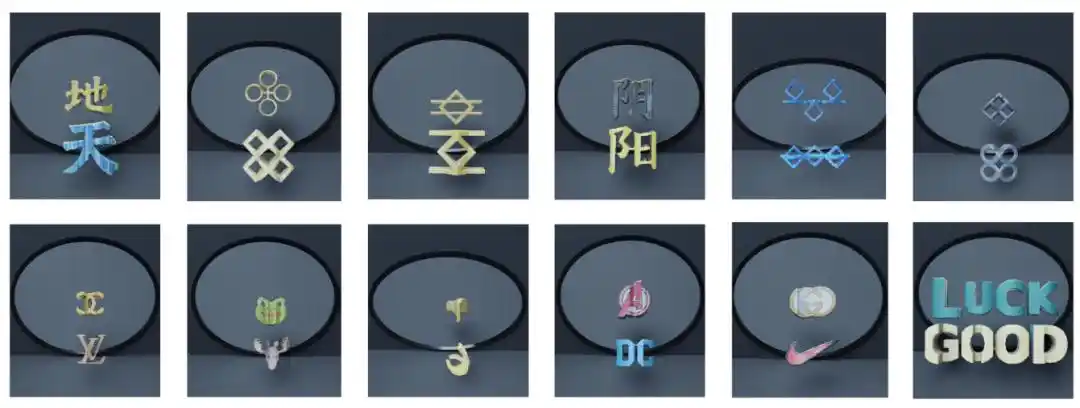




In addition to digital results, the paper also showcases several physical fabrication cases. The authors convert the optimized voxel models into 3D-printable formats and fabricate real objects via 3D printing.
In photos of the physical objects, the front and mirror sides present different patterns, demonstrating that the method can successfully transition from digital design to the physical world.
Users can utilize this method to create various types of artworks.
Conclusion and Outlook
The researchers proposed AutoMIA, an AI design system for automatically generating Mirror Illusion Art.
Starting from two 2D images, it can jointly optimize the shape and color of a 3D object. Through mechanisms like PAC, PWA, IVP, and SCD, it enhances result quality, making the generated objects smoother, more complete, and more suitable for physical fabrication.
This work showcases new possibilities for AI in computational design and artistic creation: it can not only generate images but also design 3D illusion objects with physical realizability. An object has only one form in reality but can present another visual identity in the mirror. This effect of 'inconsistency between the front and the mirror' also provides new research directions for visual perception, inverse graphics, and digital fabrication.
About the Authors
The authors of the paper, in order, are: Zhu Xiaopei, Tsinghua University Shuimu Scholar, collaborating supervisor Professor Zhu Jun; Li Zeyuan (co-first author), undergraduate student at Huazhong University of Science and Technology; and Tsinghua University Professor Zhu Jun and Associate Professor Hu Xiaolin (corresponding author).
Reference: http://arxiv.org/abs/2607.02015
This article is from the WeChat public account "Xin Zhi Yuan," author: Xin Zhi Yuan; editor: LRST






