Crypto VCs Pivot to AI: A 'Coming of Age' Ceremony Beginning with a Collapse of Belief

比推Published on 2026-02-05Last updated on 2026-02-05

Abstract

In a personal reflection, the author expresses sadness over Kyle Samani, a partner at crypto VC firm Multicoin Capital, publicly announcing his departure from the crypto industry to focus on AI, longevity tech, and robotics. Kyle was known for his thesis-driven, opinionated, and often controversial investment style—publicly criticizing Ethereum’s scaling roadmap, backing Solana early, and supporting DePIN projects like Helium. Despite mistakes (EOS, FTX exposure), he was transparent about losses and decisions. His exit feels symbolic: an honest, sharp voice leaving crypto. Before deleting the tweet, Kyle stated that crypto is primarily an asset ledger with limited use beyond finance, marking a shift from evangelist to realist—a “loss of faith” rather than just market loss. The author contrasts crypto’s current state—filled with memecoins, gambling, and technical debates—with AI’s rapid, tangible progress. Yet, they choose to stay, seeing crypto as a permissionless, open field for upward mobility and financial infrastructure innovation (e.g., stablecoins, DeFi, RWA), while remaining open to future possibilities.

Author: Dora B Dream, Deep Tide TechFlow

Original Title: Kyle Left the Crypto Industry, and I'm a Bit Sad


*This article expresses personal opinions.

On the morning of February 5th, a day that began with a market crash, I was scrolling through Twitter as usual when a departure announcement from Kyle Samani, a partner at the well-known crypto VC firm Multicoin, suddenly appeared in my feed. My finger paused on the screen for a few seconds. My heart sank. Why him?

I know Kyle, or more accurately, I know *of* him.

Back in 2020, during my junior year of college, I read Multicoin's "pitch" paper for the first time. It was eye-opening. The concept of being "Thesis-Driven" was imprinted in my mind.

I realized VCs could write like this—not using vague, PPT-style phrases like "we see long-term value in the XX sector," but thinking like traders, directly providing clear bullish and bearish logic, avoiding ambiguity, and presenting sharp, distinct viewpoints.

Kyle's persona on Twitter has always been distinct: aggressive, mean, offending countless people.

He dared to publicly criticize Ethereum's scaling roadmap when everyone was bullish on it. He dared to place firm bets on Solana when others dismissed it. He dared to promptly, transparently disclose losses and复盘 decision-making after the FTX collapse, where Multicoin suffered significant losses.

Many in the Western crypto circle dislike him, finding him *too arrogant*. But I've always felt the industry needs people like him.

Now he's gone. Pivoting to AI, longevity technology, robotics. I suddenly felt a pang of sadness: If even Kyle doesn't want to play anymore, what's wrong with this industry?

When Kyle Left

What makes me sad isn't just another VC pivoting to AI—who isn't talking about AI these days?

What makes me sad is that it's specifically Multicoin's Kyle, someone I viewed as very resolute.

What is the investment logic of most Crypto VCs? Spray and pray, bet on sectors, say nice things but never make a definitive judgment, or just follow others' leads.

Open the investment reports of those famous firms; it's always "we believe in a decentralized future," "we are optimistic about innovation in the XX field," but you never see a firm statement like "we think Project A will outperform Project B."

This isn't prudence; it's worldliness. No matter who wins, they can always say, "See, we were positioned early."

Kyle, or rather Multicoin, wasn't like that. He dared to make "life-or-death judgments."

He publicly declared Ethereum's sharding roadmap a dead end as early as 2017. He once bet on EOS and failed. In 2018, he placed his bets on Solana. In 2020, he strongly supported Helium, believing DePIN was the only viable non-financial use case for Crypto.

Yes, he missed many opportunities and made big mistakes—EOS and FTX are bloody lessons. But he never hid them, disclosing losses transparently and owning up to every error he should.

He wasn't the smartest VC, nor the gentlest evangelist, but he was one of the most "real" ones. His departure symbolizes a certain kind of "honesty and sharpness" fading from this industry.

That Instantly Deleted Tweet

What struck me even more was the tweet he sent just before leaving, though he deleted it instantly.

He said: "Crypto is not fundamentally as interesting as many crypto enthusiasts want it to be. I used to believe in the Web3 vision, I used to believe in dApps. I no longer do. Blockchains are primarily asset ledgers. They can reshape finance, but their potential in other areas is limited."
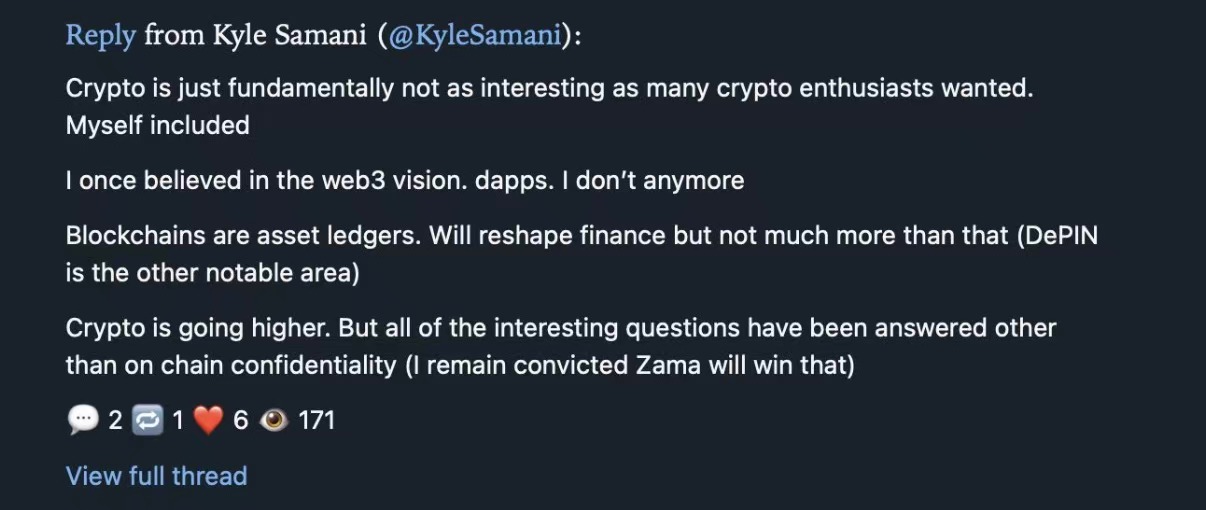
Why delete it instantly? Because saying it out loud makes you a "heretic."

Why couldn't he resist posting it? It's the conclusion reached by someone trapped between faith and reality, after spending 8 years and investing hundreds of millions of dollars.

I understand this feeling all too well because it mirrors my own journey this past year.

What did we believe in when we entered in 2021? That decentralized social would颠覆 Twitter. That on-chain identity (DID) would let users control their data. That GameFi would let players truly "own their assets." Back then, everyone on Twitter timelines was discussing "how Web3 will change the world." Every new project felt like a gateway to the future.

What is the reality in 2025? Friend.tech died. Lens Protocol has no users. ENS has become a tool for speculation; no one actually uses DID beyond wallet addresses. The collapses of Axie and StepN proved "X to Earn" is just a Ponzi scheme in disguise.

But Kyle didn't否定 everything. He still sees value in stablecoins, DeFi, RWA (these financial applications), and projects like Helium (DePIN). He's still betting on technologies like Zama's fully homomorphic encryption.

The question is: Do these things still require "faith"? Or just rational calculation?

Some see Kyle's departure as a betrayal. In my eyes, it's a process of "disenchantment"—transitioning from a Crypto Evangelist to a Crypto Realist. This transformation might be the necessary coming-of-age ceremony the entire industry must undergo.

Last Time We Lost Money, This Time We're Losing Confidence

When FTX imploded in 2022, the entire industry hit rock bottom. Luna went to zero, Three Arrows Capital破产, the market was halved and halved again. But back then, everyone still held onto a belief: The market crashed, but we weren't wrong. If we persevere, the bull market will prove us right.

Back then, we still believed in Ethereum's "endgame narrative"—from PoW to PoS, from a single chain to modularity—thinking it was the necessary path to the "world computer."

We still believed in Solana's "performance revolution," thinking that high-performance chains would surely win if they could just survive the bear market.

We still believed in Web3's "paradigm shift," believing the next chapter of the internet必然 was decentralization.

What about now, in 2025?

Objectively, the data is much better than the last trough. BTC briefly surpassed $100,000, ETFs were approved, and Crypto's ties with Wall Street grew stronger.

But the subjective feeling is completely opposite. Prices are higher, but confidence is lower.

The "culprit," or perhaps the "revealing mirror," is AI.

When ChatGPT launched in 2023, everyone was discussing "how AI will change the world." What was Crypto discussing at the same time? "Should L2 sequencers be decentralized?" One was talking about a productivity revolution; the other was arguing over technical details.

The subsequent two years saw AI progress at a dizzying pace: Gemini, Claude, ChatGPT—a three-way battle, with new developments daily. Lately, everyone is obsessed with OpenClaw.

And Crypto? There are more and more L2s and chains, but no one can clearly explain "why we need 100 L2s." Even Vitalik has reflected on past roadmap mistakes. NFT, GameFi, SocialFi have all had their moments, but they were all flashes in the pan.

By now, the biggest innovation of this cycle has turned out to be Meme Coins and "reinventing gambling."

I often ask myself late at night: AI is redefining productivity with technology. Crypto is redistributing wealth with financial games. The former creates; the latter transfers. What are we actually building?

Kyle's departure is, at its core, a "value choice."

He chose to chase AI, longevity tech, robotics—fields that are truly "expanding human frontiers." Crypto, at least for now,更像 is a high-stakes casino.

But I'm Not Ready to Leave Yet

After saying all this, you might think I'm about to announce my exit too.

But no, I still want to "gamble" one more time.

Kyle can leave because he is already financially free and can pursue grander dreams. But for young people like me, Crypto still represents: a relatively fair channel for "upward mobility," a "permissionless" testing ground that doesn't require diplomas, background, or connections—just cognition and courage. It's an emerging industry not yet completely monopolized by the elite class.

More importantly, perhaps the grand Web3 narrative has failed, but that doesn't mean Crypto is worthless.

The revolution in financial infrastructure has already happened. The daily settlement volume of stablecoins has surpassed Visa. DeFi allows people worldwide to use financial services and RWA 24/7.

Most crucially: I haven't figured out my own answer yet.

Kyle spent 8 years concluding "Crypto is just an asset ledger."

But I'm still just a rookie; what right do I have to make that judgment now?

Maybe in a few years, I'll leave like he did. But for now, I want to stay at the table to see if this industry still holds some unseen possibilities.

Years from now, Crypto might no longer be the "disrupt-everything" revolution but rather the value settlement layer for the AI era.

When that time comes, I'll order a coffee and chat about the scenery I saw along the way.


Twitter:https://twitter.com/BitpushNewsCN

Bitpush TG Discussion Group:https://t.me/BitPushCommunity

Bitpush TG Subscription: https://t.me/bitpush

Original article link:https://www.bitpush.news/articles/7609106

Related Questions

QWhy did Kyle Samani's departure from the crypto industry resonate so deeply with the author?

ABecause Kyle represented a rare combination of honesty, sharpness, and a willingness to make bold, public judgments in an industry often filled with vague, non-committal statements. His departure felt like the loss of a 'real' and aggressive voice that the author believed the industry needed.

QWhat was the core belief that Kyle Samani expressed in his since-deleted tweet?

AHe expressed that cryptocurrency is not as revolutionary as many enthusiasts hope. He no longer believes in the Web3 vision or dApps, concluding that blockchain is primarily a ledger for assets with significant potential mainly in finance, but limited potential in other fields.

QHow does the author contrast the current state of the AI and Crypto industries?

AThe author contrasts them by stating that AI is focused on a 'productivity revolution,' creating new things and pushing the boundaries of human capability with rapid, tangible progress. In contrast, much of Crypto's recent innovation has been in 'Meme Coin and reinventing gambling,' which is more about wealth transfer than creation, leading to a crisis of confidence despite higher prices.

QDespite the author's sense of disillusionment, what reasons do they give for staying in the crypto industry?

AThe author cites that crypto still offers a relatively fair path for social mobility ('class leap'), a permissionless testing ground that doesn't require traditional credentials, and that the financial infrastructure revolution (e.g., stablecoins, DeFi) is already real. They feel it's too early in their own journey to make a final judgment and want to see if there are still unseen possibilities.

QWhat does the author mean by calling Kyle's departure a '祛魅' (disenchantment) and the industry's 'adult ceremony'?

AIt means that Kyle's shift from a 'Crypto Evangelist' to a 'Crypto Realist' represents a loss of naive faith and a transition to a more mature, sober, and pragmatic understanding of the technology's actual capabilities and limitations, which the author believes is a necessary growing-up phase for the entire industry.

Related Reads

The Changing Landscape: What Are Crypto VCs Experiencing?

Title: The Shifting Landscape of Crypto Venture Capital The era of dedicated crypto venture capital funds is undergoing a significant transformation. Once essential for navigating the sector's complexity and high risk, these specialized funds are now facing an identity crisis as the market matures. This shift mirrors historical patterns in other specialized investment classes like cleantech and SPACs, where initial information advantages dissipate as technologies become mainstream and integrated into existing industry frameworks. The article argues that crypto is reaching a critical inflection point, transitioning from a "building phase" to an "integration phase." Major players like Stripe, BlackRock, and Visa now engage with crypto not for its novel mechanics but as a foundational financial infrastructure. Their needs—regulatory compliance, banking partnerships, distribution channels—align with traditional fintech, a domain easily understood by large, generalist funds like Sequoia and Founders Fund. This evolution creates a "barbell effect" within the VC landscape. On one end are massive, diversified platforms that can incorporate crypto as one vertical among many. On the other are small, nimble funds focused on niche, experimental projects. The middle ground—medium-sized dedicated crypto funds—is being squeezed out. Their typical fund size makes it impossible to generate sufficient returns solely from early-stage crypto bets, yet they cannot compete with giants for later-stage deals. Consequently, leading crypto-native firms like Paradigm and Framework Ventures are expanding into AI, robotics, and other sectors, driven partly by LP pressure for better returns amid a broader VC DPI crisis. Others, like Dragonfly and a16z, have narrowed their crypto focus predominantly to financial infrastructure like stablecoins, reframing the sector's core narrative. For crypto entrepreneurs, this consolidation presents challenges. While generalist funds offer larger checks and broader resources, crypto projects now compete fiercely with AI for attention and capital within these firms. Furthermore, the long-term, non-commercial foundational work that built the ecosystem—funded by dedicated crypto VCs—is less likely to attract generalist capital focused on direct returns. The conclusion is that "crypto investor" as a standalone category is becoming obsolete, akin to "internet investor." Crypto is becoming a baseline infrastructure layer. The future will see a barbell structure: large-scale growth financing handled by generalist funds, while pioneering, speculative projects are funded by small, specialized vehicles. The dedicated crypto funds of the 2017-2021 boom, which incubated core infrastructure, are giving way to this new, bifurcated reality.

Foresight News5m ago

The Changing Landscape: What Are Crypto VCs Experiencing?

Foresight News5m ago

As Consensus Accelerates, What Are Young Investors Betting On?

Title: As Consensus Forms Faster, What Are Young Investors Betting On? In the rapid evolution of tech investment, a new generation of young investors is navigating a landscape where AI, robotics, commercial aerospace, and quantum computing are advancing simultaneously. Traditional investment logic based on financial models is giving way to a need for deep technical understanding and the ability to act before industry consensus forms. An analysis of trends from the "WAIC FUTURE TECH" list of young investment leaders reveals key shifts in focus. The first major trend is the movement of AI from the digital screen into the physical world. Investment is shifting from large language models and chatbots towards embodied AI, robotics, AI hardware, and edge computing. While demonstrations generate excitement, the real challenge lies in achieving scalable, reliable, and cost-effective delivery in complex real-world environments like factories and logistics. Success depends not just on algorithms but on the integration of sensors, actuators, and control systems. Second, the competitive focus for large models is moving beyond raw capability toward building an "intelligence flywheel." The goal is to create self-reinforcing systems where user interaction generates data, improving the model, which in turn enhances the user experience and attracts more engagement. Companies that successfully embed AI into workflows to create these closed-loop systems can build lasting value that isn't easily erased by the next model upgrade. Third, facing a potential bottleneck in high-quality human-generated data, investors are looking at new underlying technologies. Reinforcement learning and self-play, as demonstrated by AlphaGo Zero, offer paths for AI to generate its own experience. Scientific foundation models, which aim to build general AI capabilities for fields like life sciences and materials discovery, represent a non-consensus direction that could unlock new frontiers of knowledge and data. Finally, in deep-tech areas like quantum computing, commercial aerospace, and space-based infrastructure, patient capital is essential. These fields have long, uncertain development and validation cycles involving complex engineering, supply chains, and regulations. Investment here requires a long-term view, focusing on foundational team capabilities and the eventual emergence of market demand, even if commercial returns are distant. Collectively, these trends illustrate how young investors are adapting to a new era. They are learning to make earlier, technically-informed judgments, balance hype with real-world viability, and provide the patient capital needed to build the deep-tech foundations of the future.

marsbit33m ago

As Consensus Accelerates, What Are Young Investors Betting On?

marsbit33m ago

Can Japan Buy Growth with AI? Will the Bond Market Believe It?

Japan's cabinet has introduced the 2026 Basic Policy on Economic and Fiscal Management and Reform, shifting its primary fiscal target. The new framework moves away from the traditional annual primary balance goal and instead prioritizes a stable reduction of the debt-to-GDP ratio. This change is tied to a strategy of increased "responsible proactive fiscal" spending, aiming to boost long-term growth through investments in strategic sectors like AI, semiconductors, energy, and robotics. The government estimates total public and private investment in 62 key technologies could exceed 370 trillion yen by 2040. The market reaction has been mixed and cautious. While equity markets may respond to policy signals, bond markets are focused on fiscal credibility. Concerns center on whether the weakening of the clear primary balance anchor could lead to looser fiscal discipline. If investors doubt that these strategic investments will generate sufficient productivity gains, tax revenue, and nominal growth to outpace rising interest costs, they may demand higher yields on Japanese Government Bonds (JGBs). Recent volatility in the yen and JGB yields, with the 10-year yield briefly reaching 2.9%, reflects this skepticism. The success of this new framework hinges on two factors: whether Japan can achieve a nominal growth rate consistently higher than its long-term interest rates, and whether future budgets demonstrate disciplined control over bond issuance. The government's narrative is that strategic investment is essential to break Japan's cycle of low growth, aging, and labor shortages. However, the bond market will continuously assess the credibility of this plan, pricing the risk that it may represent fiscal expansion rather than a viable growth strategy.

marsbit1h ago

Can Japan Buy Growth with AI? Will the Bond Market Believe It?

marsbit1h ago

Trading

Spot
活动图片





