Crypto treasuries regain footing after recent downturn: Grayscale

ambcryptoPublished on 2026-03-28Last updated on 2026-03-28

Abstract

After a challenging period since late 2025, digital asset treasuries (DATs) are showing signs of recovery, according to Grayscale's head of research Zach Pandl. Companies have adopted strategies such as optimizing capital structures, generating income, and diversifying business models to navigate the crypto downturn. For instance, Strategy shifted from convertible bonds to preferred stocks and established a $2.25 billion USD reserve, while BitMine aims to generate $300 million annually by staking its Ethereum holdings. Other firms, like MARA, sold portions of their crypto assets to invest in AI. Although some companies, such as Nakamoto, faced significant stock declines, forced sell-offs were limited overall. DATs have been net accumulators in recent weeks, indicating a return to stability.

After rough headwinds since late 2025, digital asset treasuries are now showing signs of relief.

According to Zach Pandl, head of research at asset manager Grayscale, the sector has crawled out of distress through new strategies.

The DATs are finding their footing again. They have pulled this off by optimizing capital structures, generating income, and diversifying business models.

How DATs are handling crypto winter

The market segment leader, Strategy, for example, pivoted from convertible bonds to preferred stocks. And Stretch (STRC) emerged as a key capital driver for its Bitcoin buying spree.

Additionally, it launched a $2.25 billion USD reserve. This would help cover short-term dividend obligations associated with its preferred stock line-up.

Collectively, the new and optimized capital structures helped the firm reduce its overall debt burden. By extension, it also helped Strategy avoid being removed from major benchmark indices such as the MSCI Index.

On the other hand, some players, such as SharpLink Gaming and BitMine Immersion Technologies, the world’s largest Ethereum treasury firm, opted to stake and restake their crypto holdings to generate income.

In fact, BitMine is targeting $300 million in annual revenue if it stakes its entire 4.6 million ETH stash in the following weeks.

At the same time, other treasury firms, such as Bitcoin miner MARA, sold part of their holdings to bet on AI adoption, as a means of diversifying away from the crypto sector to maximize revenue potential.

Treasury firms pivot amid pressure

But not all managed to adjust accordingly without burning through their holdings. For example, the BTC treasury firm backed by David Bailey, Nakamoto, saw its stock drop nearly to zero. Notably, Sequans sold 970 BTC and paid 50% of its convertible debt, slashing the burden from $189M to $94.5M.

Similarly, ETHZilla liquidated part of its ETH holdings, worth $114M, to fund share buybacks, pay down debt, and pivot to tokenization.

It’s worth pointing out that nearly all the treasury firms’ crypto holdings value fell below their enterprise value in the past few months, forcing most of them to buy back shares to boost their stocks.

This was done either by offloading crypto holdings or by taking additional loans. Metaplanet, for example, raised a $500 million loan and pledged its BTC holdings rather than selling them.

Overall, forced sell-offs among DATs were limited. In fact, they have been net accumulators in the past few weeks.
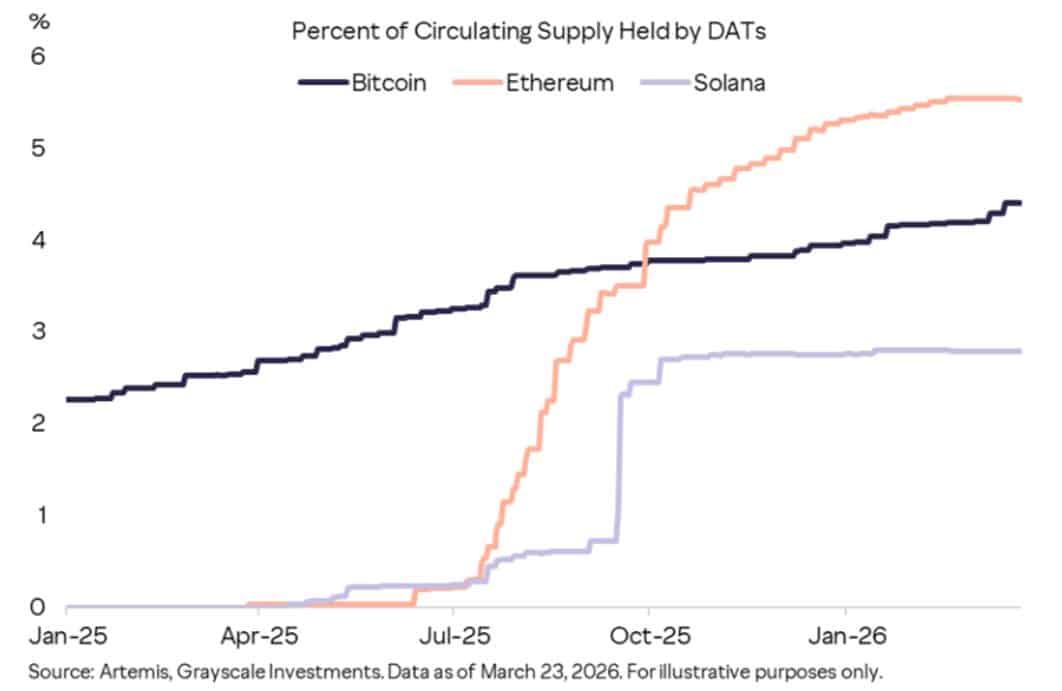
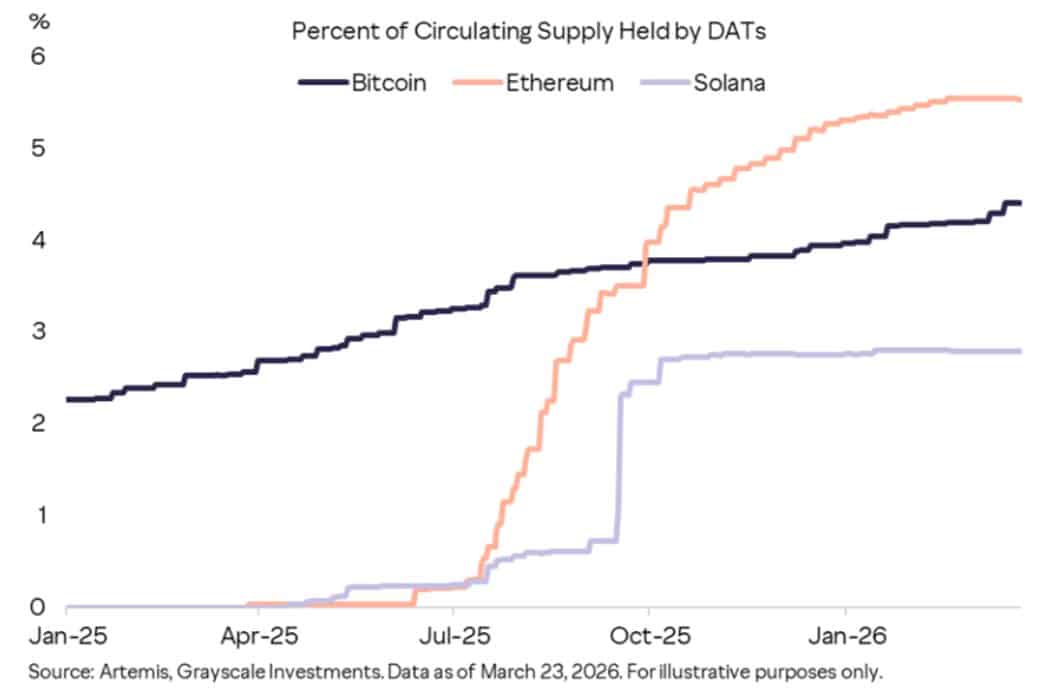
Source: Grayscale

Final Summary

  • DATs, led by Strategy, MARA, and BitMine, opted for new capital structures, new income streams, and diversification into other sectors to survive crypto distress.
  • Grayscale noted that DATs were net buyers in the past few weeks, underscoring that they were finding their ‘footing again.’


Related Questions

QWhat are the key strategies that digital asset treasuries (DATs) used to recover from recent distress according to Grayscale?

ADATs recovered by optimizing capital structures, generating income through methods like staking, and diversifying business models into sectors like AI.

QWhich company emerged as a key capital driver due to its Bitcoin buying spree?

AStretch (STRC) emerged as a key capital driver for its Bitcoin buying spree.

QHow much annual revenue does BitMine Immersion Technologies target by staking its entire Ethereum holdings?

ABitMine is targeting $300 million in annual revenue by staking its entire 4.6 million ETH stash.

QWhat action did Metaplanet take to avoid selling its BTC holdings while raising funds?

AMetaplanet raised a $500 million loan and pledged its BTC holdings as collateral instead of selling them.

QWere digital asset treasuries net accumulators or sellers of crypto in the past few weeks?

ADATs were net accumulators (buyers) of crypto in the past few weeks, according to Grayscale.

Related Reads

Five Counterparty Risk Architectures: A Settlement-Layer Methodology for Classifying TradFi Models in Crypto Exchanges

**Summary:** This companion piece reframes the five TradFi-on-crypto exchange architectures, previously classified by "architectural fingerprint," through the lens of counterparty risk. The core question is: whose balance sheet bears the loss first in a stress scenario, and has it historically done so? Each of the five models corresponds to a distinct risk holder with its own documented failure modes. * **Model 1 (Stablecoin-Settled CEX Perpetuals):** Risk is held by the stablecoin issuer (e.g., reserve composition, bank connectivity) and the CEX's own book. History includes Tether's banking disconnections (2017) and reserve misrepresentations (CFTC 2021 Order). * **Model 2 (CFD Brokers):** Risk resides on the broker's balance sheet (B-book model). Regulatory differences (e.g., ESMA's mandatory negative balance protection vs. Mauritius FSC's lack thereof) define loss allocation rules, as seen in the 2015 SNB event (Alpari UK insolvency). * **Model 3 (Off-Chain Custody & Transfer Agent Chain):** Risk lies with the off-chain custodian/platform. User asset recovery depends on Terms of Use and corporate structure, exemplified by the Celsius bankruptcy ruling (2023) where Earn Account assets were deemed property of the estate. * **Model 4 (DEX Perpetual Protocols):** No single balance sheet bears risk. Loss absorption relies on a protocol's insurance fund and Auto-Deleveraging (ADL) mechanism, as demonstrated in the GMX V1 (2022) and dYdX v3 YFI (2023) incidents. * **Model 5 (Regulated CCP - DCM-DCO-FCM):** The most institutionalized model concentrates risk in the Central Counterparty (CCP). However, history shows CCPs can employ non-standard tools under extreme stress, such as mass trade cancellation (LME Nickel, 2022) or enabling negative price settlements (CME WTI, 2020). The report argues that regulatory choices and counterparty risk structures are co-extensive, not in an upstream-downstream relationship. It concludes with five separate observation checklists (not predictions) for monitoring the structural vulnerabilities of each risk model.

marsbit16m ago

Five Counterparty Risk Architectures: A Settlement-Layer Methodology for Classifying TradFi Models in Crypto Exchanges

marsbit16m ago

Trading

Spot
Futures
活动图片




