Crypto treasuries regain footing after recent downturn: Grayscale

ambcryptoPublished on 2026-03-28Last updated on 2026-03-28

Abstract

After a challenging period since late 2025, digital asset treasuries (DATs) are showing signs of recovery, according to Grayscale's head of research Zach Pandl. Companies have adopted strategies such as optimizing capital structures, generating income, and diversifying business models to navigate the crypto downturn. For instance, Strategy shifted from convertible bonds to preferred stocks and established a $2.25 billion USD reserve, while BitMine aims to generate $300 million annually by staking its Ethereum holdings. Other firms, like MARA, sold portions of their crypto assets to invest in AI. Although some companies, such as Nakamoto, faced significant stock declines, forced sell-offs were limited overall. DATs have been net accumulators in recent weeks, indicating a return to stability.

After rough headwinds since late 2025, digital asset treasuries are now showing signs of relief.

According to Zach Pandl, head of research at asset manager Grayscale, the sector has crawled out of distress through new strategies.

The DATs are finding their footing again. They have pulled this off by optimizing capital structures, generating income, and diversifying business models.

AD

How DATs are handling crypto winter

The market segment leader, Strategy, for example, pivoted from convertible bonds to preferred stocks. And Stretch (STRC) emerged as a key capital driver for its Bitcoin buying spree.

Additionally, it launched a $2.25 billion USD reserve. This would help cover short-term dividend obligations associated with its preferred stock line-up.

Collectively, the new and optimized capital structures helped the firm reduce its overall debt burden. By extension, it also helped Strategy avoid being removed from major benchmark indices such as the MSCI Index.

On the other hand, some players, such as SharpLink Gaming and BitMine Immersion Technologies, the world’s largest Ethereum treasury firm, opted to stake and restake their crypto holdings to generate income.

In fact, BitMine is targeting $300 million in annual revenue if it stakes its entire 4.6 million ETH stash in the following weeks.

At the same time, other treasury firms, such as Bitcoin miner MARA, sold part of their holdings to bet on AI adoption, as a means of diversifying away from the crypto sector to maximize revenue potential.

Treasury firms pivot amid pressure

But not all managed to adjust accordingly without burning through their holdings. For example, the BTC treasury firm backed by David Bailey, Nakamoto, saw its stock drop nearly to zero. Notably, Sequans sold 970 BTC and paid 50% of its convertible debt, slashing the burden from $189M to $94.5M.

Similarly, ETHZilla liquidated part of its ETH holdings, worth $114M, to fund share buybacks, pay down debt, and pivot to tokenization.

It’s worth pointing out that nearly all the treasury firms’ crypto holdings value fell below their enterprise value in the past few months, forcing most of them to buy back shares to boost their stocks.

This was done either by offloading crypto holdings or by taking additional loans. Metaplanet, for example, raised a $500 million loan and pledged its BTC holdings rather than selling them.

Overall, forced sell-offs among DATs were limited. In fact, they have been net accumulators in the past few weeks.
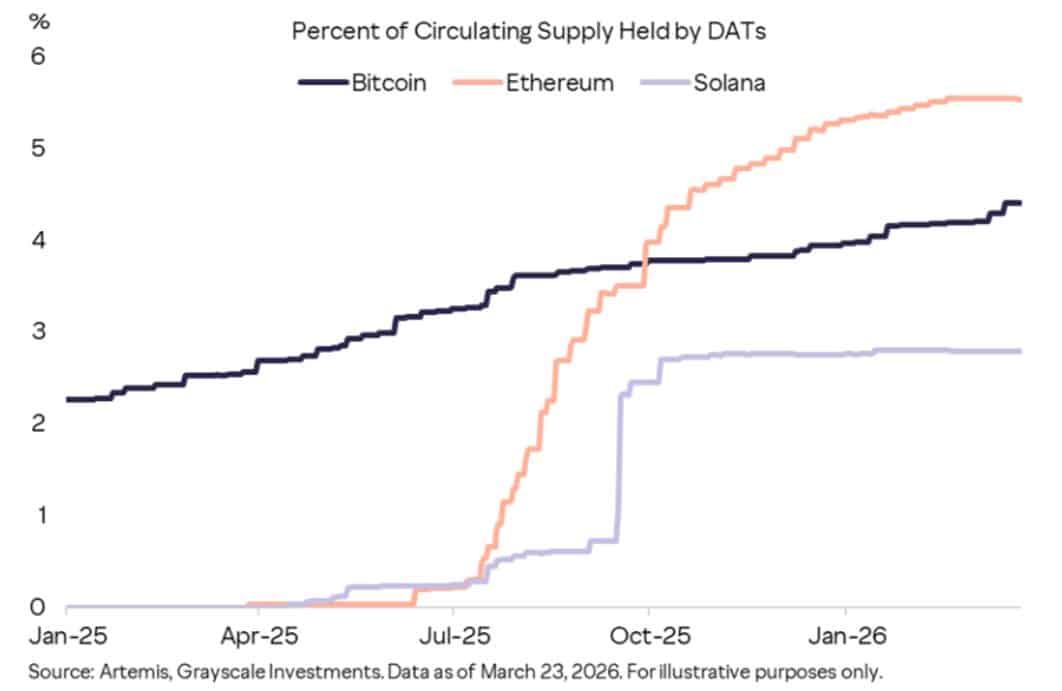
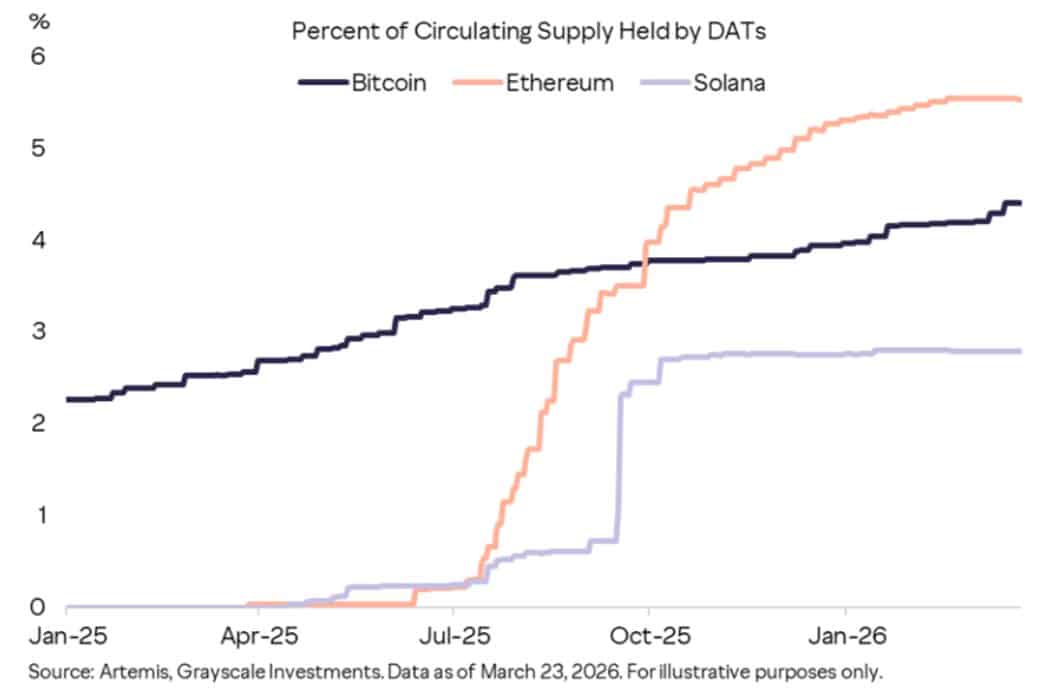
Source: Grayscale

Final Summary

  • DATs, led by Strategy, MARA, and BitMine, opted for new capital structures, new income streams, and diversification into other sectors to survive crypto distress.
  • Grayscale noted that DATs were net buyers in the past few weeks, underscoring that they were finding their ‘footing again.’


Related Questions

QWhat are the key strategies that digital asset treasuries (DATs) used to recover from recent distress according to Grayscale?

ADATs recovered by optimizing capital structures, generating income through methods like staking, and diversifying business models into sectors like AI.

QWhich company emerged as a key capital driver due to its Bitcoin buying spree?

AStretch (STRC) emerged as a key capital driver for its Bitcoin buying spree.

QHow much annual revenue does BitMine Immersion Technologies target by staking its entire Ethereum holdings?

ABitMine is targeting $300 million in annual revenue by staking its entire 4.6 million ETH stash.

QWhat action did Metaplanet take to avoid selling its BTC holdings while raising funds?

AMetaplanet raised a $500 million loan and pledged its BTC holdings as collateral instead of selling them.

QWere digital asset treasuries net accumulators or sellers of crypto in the past few weeks?

ADATs were net accumulators (buyers) of crypto in the past few weeks, according to Grayscale.

Related Reads

In Jinjiang, Fujian, a Storage Super Unicorn Lies Quiet

In Fujian's Jinjiang, a city known for sportswear, lies a quiet semiconductor giant: Fujian Jinhua Integrated Circuit Co. (JHICC). Once a promising domestic DRAM manufacturer alongside Yangtze Memory and ChangXin Memory Technologies (CXMT), its journey was derailed in 2018 when the U.S. placed it on an Entity List and filed criminal charges for alleged trade secret theft. This halted production for years. A turning point came in February 2024 when a U.S. federal court found JHICC not guilty. However, it had lost crucial time. While CXMT soared to become a top-valued A-share company in 2024, JHICC, with an estimated valuation of 80 billion RMB, was just restarting. Its current output is primarily customized DDR4 chips, not the advanced DDR5/HBM demanded for AI, but it still benefits from the broader memory chip upcycle. JHICC's story is tied to Chen Zhengkun, a veteran engineer who left Micron to lead the venture. Founded in 2016 with state-backed funding, JHICC partnered with Taiwan's UMC to develop DRAM technology. Rapid progress was cut short by the U.S. actions, which Micron initiated, partly due to its heavy reliance on the Chinese market. Post-sanctions, Chen's team worked to rebuild the production line with reduced reliance on U.S. technology. According to its records, JHICC achieved small-scale production and revenue growth under immense pressure. It now focuses on the stable "niche" DRAM market (e.g., TVs, routers) with a monthly capacity of ~40,000 wafers, aiming for 60,000 by 2026. It holds over 1,000 patents but remains on the Entity List. For Jinjiang, investing in JHICC was a bold industrial leap. The local government provided unwavering financial and logistical support during the crisis, helping the company survive. JHICC has become the anchor for a growing local semiconductor cluster. Though its scale lags behind domestic peers, JHICC's persistence symbolizes a hard-won foothold in a global market long dominated by Samsung, SK Hynix, and Micron. Having missed one boom, it seeks a place in the new AI-driven memory supercycle.

marsbit1h ago

In Jinjiang, Fujian, a Storage Super Unicorn Lies Quiet

marsbit1h ago

Trading

Spot
活动图片




