Crypto traders alert! Why Trump’s weekend post could trigger liquidations on Monday

ambcryptoPublished on 2026-04-04Last updated on 2026-04-04

Abstract

Crypto traders are on high alert as former President Trump's weekend social media post regarding a potential escalation with Iran could trigger significant market liquidations on Monday. The crypto market, already vulnerable, closed Q1 with a nearly 21% loss, extending a severe downturn. This decline has moved in lockstep with soaring oil prices, which surged nearly 70% in Q1 due to Middle East tensions. Trump's post, warning of a severe attack on Iran's infrastructure, adds a critical layer of uncertainty. With U.S. stock markets closed over the weekend, the full market reaction has been delayed. Analysts now anticipate a highly volatile session when markets reopen, with oil potentially surging toward $200 per barrel. This could spark a sharp sell-off in equities, which would severely impact the crypto market. Bitcoin's positioning index has already turned negative, indicating traders are betting on further downside. The market is trapped in a liquidity crunch, making it extremely sensitive to any catalyst. A major, liquidation-driven downturn is now likely as Monday's session begins.

Is the worst still yet to come for crypto?

From a technical standpoint, the market is officially rolling into Q2. However, to see where it’s headed, we need to check where it’s been. Q1 closed with the total crypto market cap down nearly 21%, extending losses from Q4 2025 when it fell by about 24%.

In just six months, crypto has technically lost over $1.5 trillion. Bitcoin [BTC] hasn’t been spared either, making up 60% of those outflows – A sign that it’s lagging compared to other volatile assets. Backing this, the XAU/BTC ratio closed Q1 up almost 40%, underlining BTC’s relative weakness versus gold.
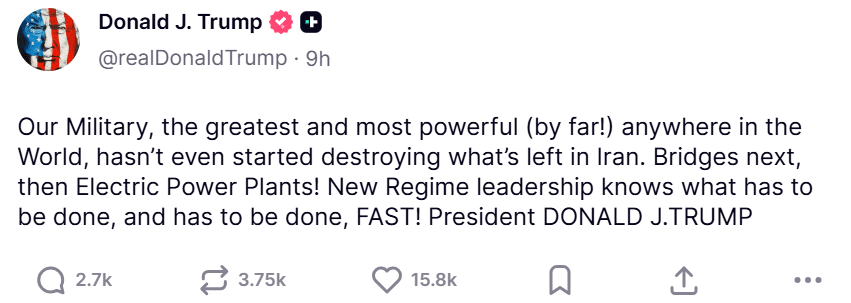
Source: TruthSocial

In short, despite recent optimism around Bitcoin’s “relative” resilience, Q1 revealed crypto was still the weakest performer across asset classes. Against this backdrop, a recent post by U.S President Donald Trump couldn’t have come at a more critical time.

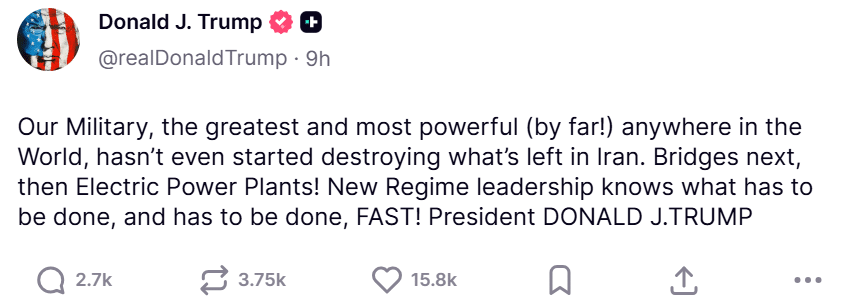
In it, President Trump sounded a warning about a potentially severe attack on Iran’s infrastructure, putting ceasefire expectations on hold. However, more than the content, it’s the “timing” of the post that’s sparked a full-blown market frenzy. Notably, the U.S stock market will remain closed over the weekend, which means the post has temporarily prevented a liquidation cascade.

The real momentum shift, however, is in oil prices. Even before the post, oil had been rattling global markets. Now, the added geopolitical risk layers in more uncertainty. Traders and investors are likely to react as soon as the market reopens, making Monday a highly volatile session for equities. The spotlight, however, falls on crypto – Is a massive bloodbath looming?

Crypto locked in a liquidity trap as weekend market risk spikes

The crypto market’s nearly 21% drop in Q1 has moved almost in lockstep with oil prices.

Notably, this trend is set to shape Monday’s market, especially with equities likely to react. Take the NASDAQ (NDX), for example – It closed Q1 down nearly 6%, marking its worst quarterly performance since Q1 2025.

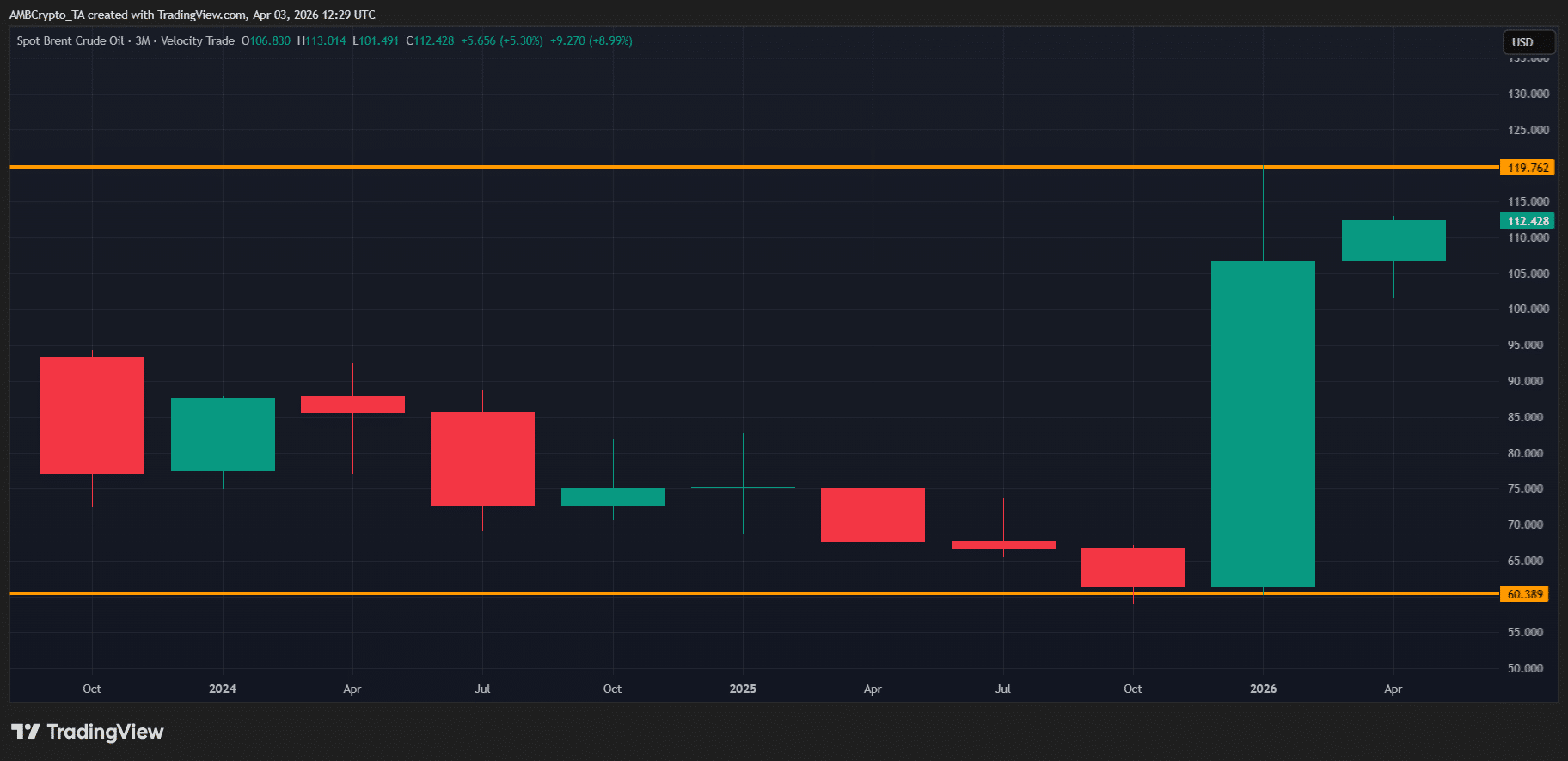
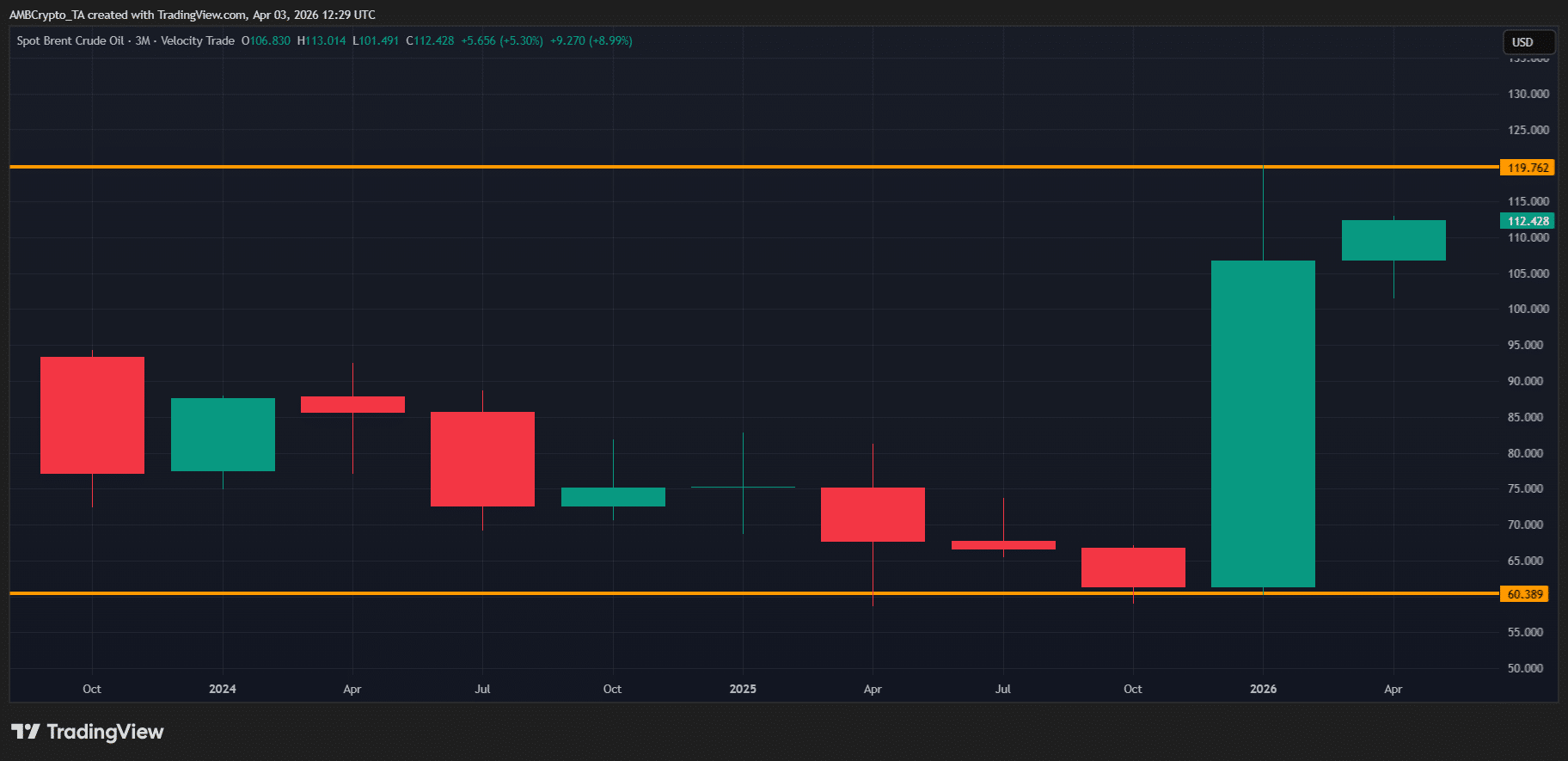
Here, the culprit is the ongoing Middle East conflict, which has created a massive oil supply squeeze. The Strait of Hormuz, responsible for roughly 20% of global oil exports, remains under serious threat. The impact is clear – Oil closed Q1 up nearly 70%, sending ripples across risk assets, including crypto.
Source: TradingView (BRENT/USD)

According to AMBCrypto, that’s where President Trump’s recent post comes into play. With the escalation now official, analysts are expecting oil prices to surge towards $200 per barrel. In this context, Monday’s market reaction could be critical, with the odds of a sharp sell-off looking high.

Meanwhile, Bitcoin’s positioning index flipped negative, signaling that shorts are returning. This isn’t random. Instead, it’s a strategic move by traders, positioning for a potential downside in crypto once Monday’s session kicks off. With crypto heavily locked in a liquidity trap, even a small move could trigger sharp price swings, making the market extra sensitive to any catalyst.

Against this backdrop, President Trump’s post is now a key bearish trigger. Once Monday’s session begins, equities are set to react, putting crypto at high risk of a liquidation-driven bloodbath.


Final Summary

  • Q1 losses, negative positioning, and a liquidity trap are setting the stage for sharp downside moves.
  • President Trump’s post and surging oil prices could trigger a major market reaction on Monday.

Related Questions

QWhat was the overall performance of the crypto market in Q1, and how does it compare to Q4 2025?

AThe total crypto market cap was down nearly 21% in Q1, which extended the losses from Q4 2025 when it fell by about 24%.

QAccording to the article, what is the significance of the XAU/BTC ratio closing Q1 up almost 40%?

AThe XAU/BTC ratio's significant increase underlines Bitcoin's relative weakness as an asset compared to gold.

QWhy is the timing of President Trump's post considered so critical for the markets?

AThe timing is critical because the U.S. stock market was closed over the weekend, temporarily preventing an immediate liquidation cascade. The post is expected to trigger a major market reaction when trading resumes on Monday.

QWhat key factor, besides Trump's post, is identified as a major driver of risk asset performance and a threat to crypto?

ASurging oil prices, driven by the ongoing Middle East conflict and a potential supply squeeze from the Strait of Hormuz, are a major driver putting pressure on risk assets like crypto.

QWhat does the shift in Bitcoin's positioning index to negative signal, according to the analysis?

AThe shift to a negative positioning index signals that traders are opening short positions, strategically preparing for a potential downside move in the crypto market once Monday's trading session begins.

Related Reads

STRC Major De-pegging's First Financial Report, How Will Strategy Repair Its Capital Flywheel?

Bitcoin treasury company Strategy released its Q2 2026 earnings report on July 31. Despite a 6.9% year-over-year revenue increase to $122 million, the company recorded a net loss of $8.22 billion, largely due to $8.32 billion in unrealized losses from Bitcoin price fluctuations. As of quarter-end, Strategy holds 843,775 BTC with an average cost of $75,000 per coin, and Bitcoin per share increased. The report highlights a critical shift in Strategy's capital model following the de-pegging of its key financing tool, STRC (Strategic Coin), which fell below its $100 target. Management's top priority is restoring STRC to its target value, aiming for a recovery by September 8. They rule out discounted STRC issuances and plan to maintain its dividend yield at 12%, instead focusing on bolstering its $3.75 billion cash reserve. Strategy has moved from a one-way "buy-and-hold" Bitcoin strategy to active capital management. This new approach, part of its "Digital Credit Capital Framework," involves flexibly managing its balance sheet across four elements: BTC, USD cash, common stock (MSTR), and digital credit securities like STRC. This allows for BTC monetization (having sold $218.4 million in BTC so far), strategic repurchases of discounted securities, and debt optimization, as seen with a $1.5 billion convertible bond buyback. The company's future hinges on two key tests: successfully re-pegging STRC to restore market confidence in its digital credit system, and a long-term recovery in Bitcoin's price to ultimately support its growth thesis.

marsbit38m ago

STRC Major De-pegging's First Financial Report, How Will Strategy Repair Its Capital Flywheel?

marsbit38m ago

STRC's First Financial Report Post-Depegging, How is Strategy Restoring the Capital Flywheel?

On July 31, 2026, Bitcoin treasury company Strategy released its Q2 financial report. Despite a 6.9% year-over-year increase in revenue to $122 million, the company recorded a substantial net loss of $8.22 billion, primarily due to $8.32 billion in unrealized losses from Bitcoin holdings. While Strategy's core Bitcoin strategy remains intact—its holdings grew 11% to 843,775 BTC—the company is undergoing a fundamental shift in its capital model. Following the de-pegging of its key financing tool, the STRCoin (STRC), from its $100 target in May, Strategy has pivoted from a one-directional "raise funds, buy Bitcoin" cycle to a more dynamic, multi-asset capital management approach. A key part of this new framework is the "Monetization Program," through which Strategy has sold approximately $218.4 million worth of BTC to bolster liquidity. The company's top priority is repairing STRC's peg, committing not to issue discounted shares until it returns to its target range. It has initiated a $1 billion buyback program for discounted digital credit securities, having repurchased $28.9 million face value of STRC so far. Management aims to restore the peg around September 8, 2026. Strategy now actively manages a matrix of assets: Bitcoin (for accumulation or strategic sales), USD cash reserves (now at $3.75 billion), common stock (MSTR), and digital credit securities like STRC. This allows for tactical moves like repurchasing discounted debt or equity to capture value. The future success of Strategy's "capital flywheel" hinges on two factors: the short-term ability to successfully re-peg STRC to restore market confidence in its digital credit system, and the long-term price trajectory of Bitcoin, upon which its entire investment thesis ultimately depends.

Odaily星球日报43m ago

STRC's First Financial Report Post-Depegging, How is Strategy Restoring the Capital Flywheel?

Odaily星球日报43m ago

With Two Consecutive Quarters of Losses, Coinbase Must Rely on Paths Beyond Trading

Coinbase posted its second consecutive quarterly net loss of $359 million on $1.22 billion in revenue for Q2, highlighting its vulnerability to crypto market cycles where weaker prices and lower volatility reduce user trading. However, the report also reveals a strategic shift in its business model. Despite a 25% quarter-over-quarter decline in global spot trading volume, Coinbase increased its market share to a company-record 10.3%. This suggests its position as a compliant U.S. on-ramp is strengthening even in a cooler market. A key development is the diversification of revenue streams. Transaction revenue fell to $599 million, nearly equaling subscription and services revenue of $555 million. Stablecoin services, generating $292 million, are becoming a crucial revenue "floor." This income, derived from interest on the $20 billion average USDC balance held on its platform, is less tied to daily trading activity. Furthermore, while spot trading volume dropped significantly, derivatives volume held steady at $1.03 trillion. Coinbase is pushing to integrate spot, stablecoin, and derivatives liquidity to create a more interconnected and sticky ecosystem for users. The GAAP net loss includes non-cash expenses like stock-based compensation and crypto asset valuation changes. Its adjusted EBITDA remained positive at $208 million for the 14th straight quarter, indicating core operations can cover ongoing costs. The company is also reducing expenses to manage the downturn. The central question moving forward is whether Coinbase's growing market share, stablecoin revenues, and expanding product integration can sufficiently offset the inherent cyclicality of its core trading business during future market contractions.

marsbit59m ago

With Two Consecutive Quarters of Losses, Coinbase Must Rely on Paths Beyond Trading

marsbit59m ago

Trading

Spot
活动图片