Crypto traders alert! Why Trump’s weekend post could trigger liquidations on Monday

ambcryptoPublished on 2026-04-04Last updated on 2026-04-04

Abstract

Crypto traders are on high alert as former President Trump's weekend social media post regarding a potential escalation with Iran could trigger significant market liquidations on Monday. The crypto market, already vulnerable, closed Q1 with a nearly 21% loss, extending a severe downturn. This decline has moved in lockstep with soaring oil prices, which surged nearly 70% in Q1 due to Middle East tensions. Trump's post, warning of a severe attack on Iran's infrastructure, adds a critical layer of uncertainty. With U.S. stock markets closed over the weekend, the full market reaction has been delayed. Analysts now anticipate a highly volatile session when markets reopen, with oil potentially surging toward $200 per barrel. This could spark a sharp sell-off in equities, which would severely impact the crypto market. Bitcoin's positioning index has already turned negative, indicating traders are betting on further downside. The market is trapped in a liquidity crunch, making it extremely sensitive to any catalyst. A major, liquidation-driven downturn is now likely as Monday's session begins.

Is the worst still yet to come for crypto?

From a technical standpoint, the market is officially rolling into Q2. However, to see where it’s headed, we need to check where it’s been. Q1 closed with the total crypto market cap down nearly 21%, extending losses from Q4 2025 when it fell by about 24%.

In just six months, crypto has technically lost over $1.5 trillion. Bitcoin [BTC] hasn’t been spared either, making up 60% of those outflows – A sign that it’s lagging compared to other volatile assets. Backing this, the XAU/BTC ratio closed Q1 up almost 40%, underlining BTC’s relative weakness versus gold.
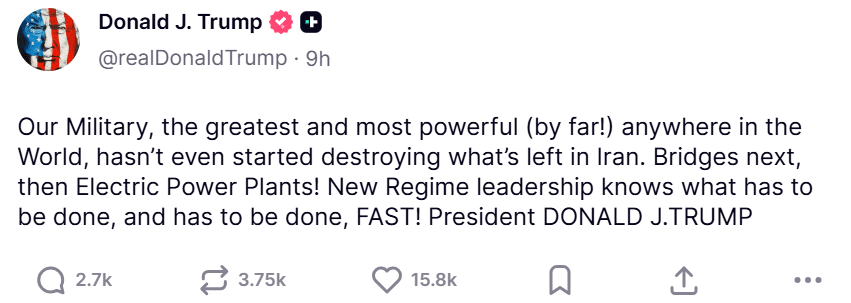
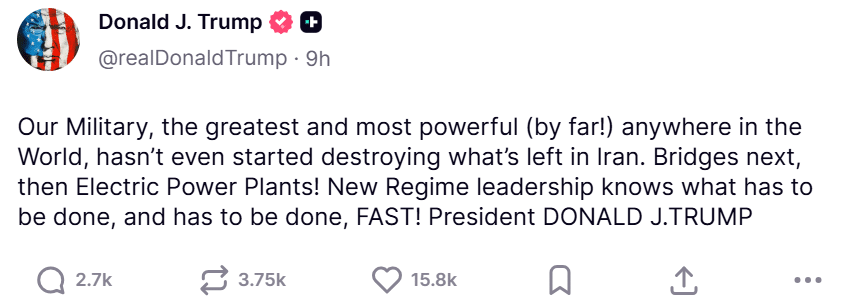
Source: TruthSocial

In short, despite recent optimism around Bitcoin’s “relative” resilience, Q1 revealed crypto was still the weakest performer across asset classes. Against this backdrop, a recent post by U.S President Donald Trump couldn’t have come at a more critical time.

In it, President Trump sounded a warning about a potentially severe attack on Iran’s infrastructure, putting ceasefire expectations on hold. However, more than the content, it’s the “timing” of the post that’s sparked a full-blown market frenzy. Notably, the U.S stock market will remain closed over the weekend, which means the post has temporarily prevented a liquidation cascade.

The real momentum shift, however, is in oil prices. Even before the post, oil had been rattling global markets. Now, the added geopolitical risk layers in more uncertainty. Traders and investors are likely to react as soon as the market reopens, making Monday a highly volatile session for equities. The spotlight, however, falls on crypto – Is a massive bloodbath looming?

Crypto locked in a liquidity trap as weekend market risk spikes

The crypto market’s nearly 21% drop in Q1 has moved almost in lockstep with oil prices.

Notably, this trend is set to shape Monday’s market, especially with equities likely to react. Take the NASDAQ (NDX), for example – It closed Q1 down nearly 6%, marking its worst quarterly performance since Q1 2025.

Here, the culprit is the ongoing Middle East conflict, which has created a massive oil supply squeeze. The Strait of Hormuz, responsible for roughly 20% of global oil exports, remains under serious threat. The impact is clear – Oil closed Q1 up nearly 70%, sending ripples across risk assets, including crypto.
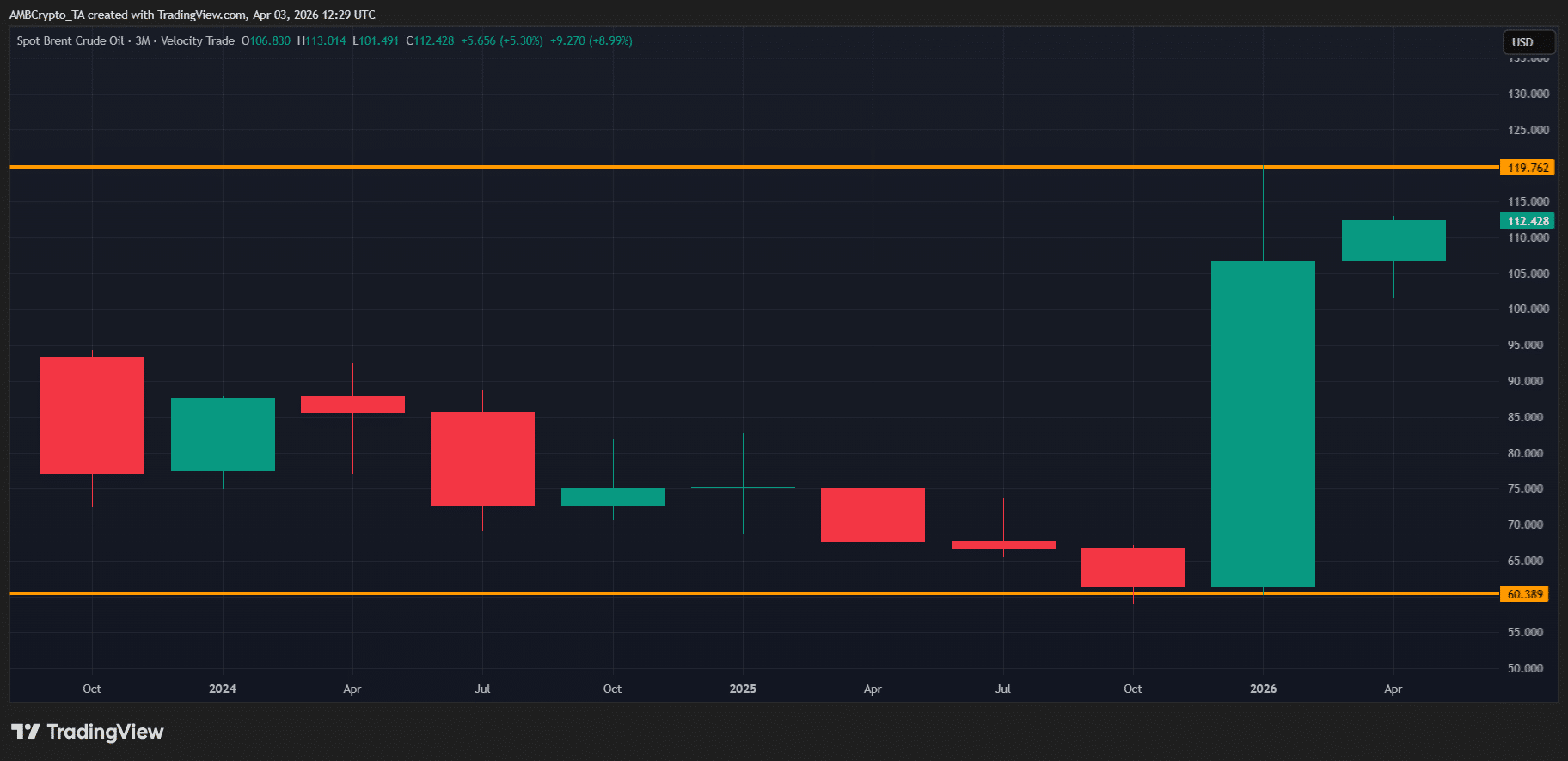
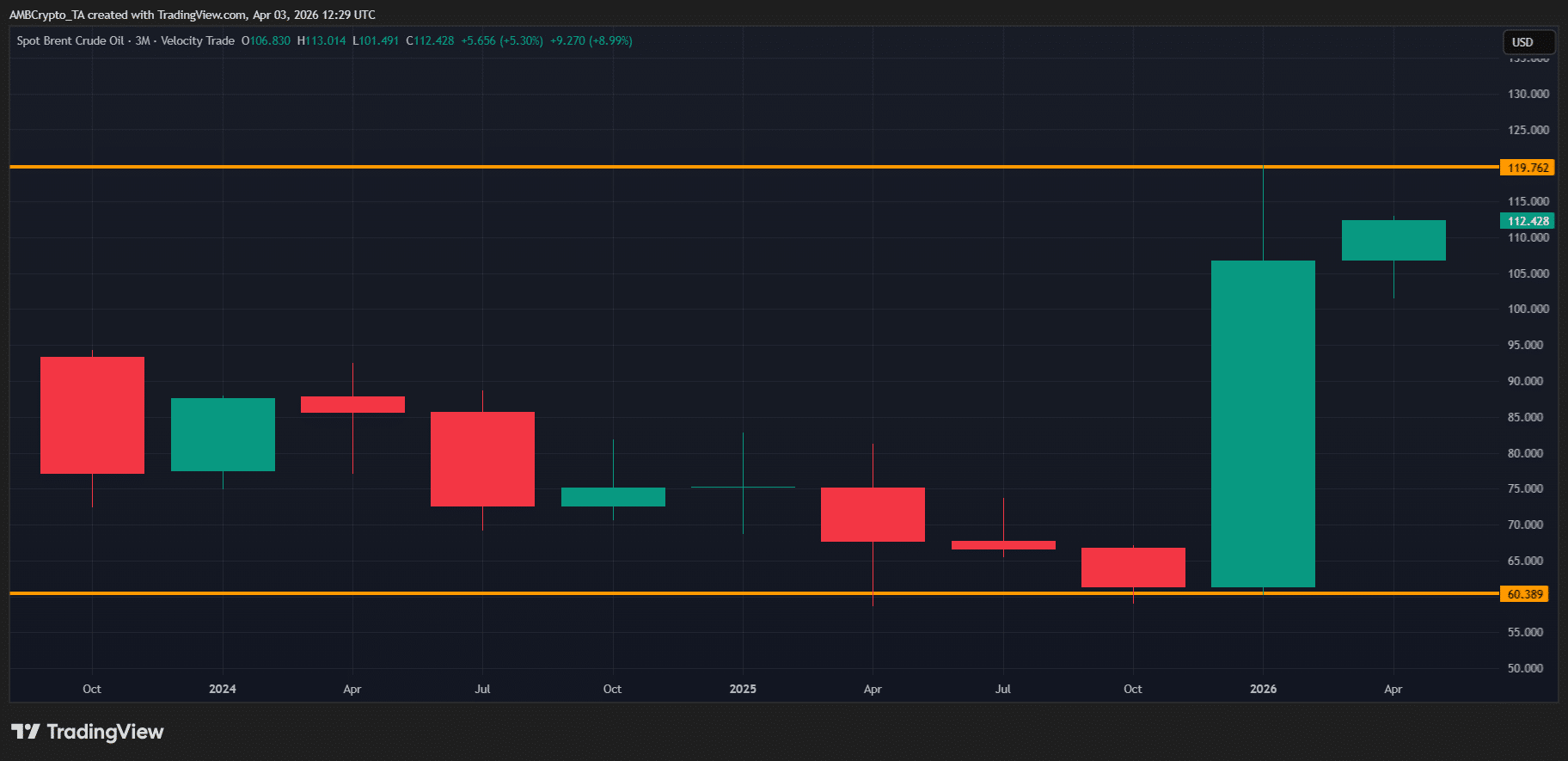
Source: TradingView (BRENT/USD)

According to AMBCrypto, that’s where President Trump’s recent post comes into play. With the escalation now official, analysts are expecting oil prices to surge towards $200 per barrel. In this context, Monday’s market reaction could be critical, with the odds of a sharp sell-off looking high.

Meanwhile, Bitcoin’s positioning index flipped negative, signaling that shorts are returning. This isn’t random. Instead, it’s a strategic move by traders, positioning for a potential downside in crypto once Monday’s session kicks off. With crypto heavily locked in a liquidity trap, even a small move could trigger sharp price swings, making the market extra sensitive to any catalyst.

Against this backdrop, President Trump’s post is now a key bearish trigger. Once Monday’s session begins, equities are set to react, putting crypto at high risk of a liquidation-driven bloodbath.


Final Summary

  • Q1 losses, negative positioning, and a liquidity trap are setting the stage for sharp downside moves.
  • President Trump’s post and surging oil prices could trigger a major market reaction on Monday.

Related Questions

QWhat was the overall performance of the crypto market in Q1, and how does it compare to Q4 2025?

AThe total crypto market cap was down nearly 21% in Q1, which extended the losses from Q4 2025 when it fell by about 24%.

QAccording to the article, what is the significance of the XAU/BTC ratio closing Q1 up almost 40%?

AThe XAU/BTC ratio's significant increase underlines Bitcoin's relative weakness as an asset compared to gold.

QWhy is the timing of President Trump's post considered so critical for the markets?

AThe timing is critical because the U.S. stock market was closed over the weekend, temporarily preventing an immediate liquidation cascade. The post is expected to trigger a major market reaction when trading resumes on Monday.

QWhat key factor, besides Trump's post, is identified as a major driver of risk asset performance and a threat to crypto?

ASurging oil prices, driven by the ongoing Middle East conflict and a potential supply squeeze from the Strait of Hormuz, are a major driver putting pressure on risk assets like crypto.

QWhat does the shift in Bitcoin's positioning index to negative signal, according to the analysis?

AThe shift to a negative positioning index signals that traders are opening short positions, strategically preparing for a potential downside move in the crypto market once Monday's trading session begins.

Related Reads

The Crypto Scene Is Dead, Perpetual Swaps Are Eternal

The crypto industry is undergoing a fundamental shift. The era defined by minting novel, native digital assets (altcoins) is fading. These assets, lacking real-world cash flows or clear value, are losing relevance as attention and capital flow elsewhere. Two powerful external forces are reshaping the space. First, traditional assets like U.S. stocks, bonds, gold, and oil are being tokenized and traded on-chain. Second, the explosive growth of AI, with its tangible products, has overshadowed crypto's once-dominant "future narrative." This marks a critical pivot: crypto is transitioning from being a "factory for new assets" to becoming a "global conduit for existing assets." Its validated utility is not complex financial reinvention but efficient global settlement, transfer, and trading—the original promise of blockchain. Stablecoins like USDT and USDC exemplify this, offering faster dollar movement rather than replacing it. Consequently, native ecosystems like Ethereum face profound challenges. While still crucial infrastructure, ETH struggles to capture value as users interact with Layer 2s or trade traditional assets without needing to hold it. DeFi's grand narrative of rebuilding finance has narrowed to core needs like cheap transfers and deep liquidity. The true breakout innovation is the perpetual contract (Perp). It brilliantly bypasses the complexities of direct asset ownership (custody, compliance, dividends) by creating pure price exposure. Users can speculate on the price movement of *any* asset—NVIDIA, gold, oil—24/7, globally, and with leverage. This "price casino" model, while risky and ethically fraught, delivers unmatched liquidity and accessibility. Projects like Hyperliquid succeeded not by inventing new mechanics but by perfecting the timing and execution of this model. Key drivers included making on-chain Perps feel like centralized exchanges, post-FTX trust migration towards transparency, and rising demand to trade macro assets and equities round-the-clock. In conclusion, the crypto world's most enduring successes are the dollar (via stablecoins), Bitcoin, and trading. Its new frontier is not creating alternative assets but providing a seamless, perpetual trading layer—a new API—for the world's existing financial system. The age of native altcoins is over; the age of perpetual synthetic exposure has begun.

Odaily星球日报7m ago

The Crypto Scene Is Dead, Perpetual Swaps Are Eternal

Odaily星球日报7m ago

After Marvell's 32% Surge, the Chinese Chip Family Behind It Emerges

The stock price of Marvell Technology surged 32.5% on June 2nd, driven by NVIDIA CEO Jensen Huang highlighting its custom ASICs and optical interconnects as core to AI data center architecture. This event brought attention to the Chinese semiconductor family behind Marvell: the Dai siblings. The story centers on three siblings, all UC Berkeley graduates, whose three-decade entrepreneurial journey aligns with major semiconductor industry shifts. In 1995, youngest sister Dai Wei Li co-founded Marvell with her husband Sehat Sutardja and his brother, focusing on storage controllers. Eldest brother Dai Wei Min founded EDA company Ultima, later sold to Cadence, and later founded VeriSilicon (芯原) in China, becoming a leading semiconductor IP provider. Second brother Dai Wei Jin co-founded EDA firm Silicon Perspective (sold to Cadence) and GPU IP company Vivante, later acquired by VeriSilicon. The combined "Dai-Sutardja" family network extends beyond Marvell. Their ventures and investments form a comprehensive ecosystem for the post-Moore's Law, chiplet era. Key holdings include: Dream Big Semiconductor (AI SuperNICs, acquired by Arm), Alphawave (high-speed SerDes IP, acquired by Qualcomm), and Silicon Box (a chiplet advanced packaging foundry). VeriSilicon itself thrives on the AI ASIC and IP boom in China. Collectively, the family's AI infrastructure-related portfolio is estimated at over $22 billion. Their strategy represents a distinct path: building critical components for open standards and key manufacturing capacity in the chiplet era, rather than pursuing standalone AI chip dominance. While this path may not create the next NVIDIA, it has enabled repeated successful exits and sustained influence within the global semiconductor industry.

marsbit1h ago

After Marvell's 32% Surge, the Chinese Chip Family Behind It Emerges

marsbit1h ago

Microsoft is Afraid of Being Marginalized by AI Giants

Microsoft, once the defining force of the PC era, now faces a familiar challenge in the AI age: the risk of being relegated to a profitable but invisible infrastructure provider. This anxiety was laid bare at Build 2026, where CEO Satya Nadella unveiled a major strategic pivot. The catalyst was a quiet April agreement that dissolved Microsoft's exclusive licensing and cloud-hosting deal with OpenAI, its once-vital partner. This erased Microsoft's key AI moat. With OpenAI and Anthropic defining AI applications and gaining enterprise traction—even within Microsoft's own ranks—Nadella had to answer: without exclusivity, what is Microsoft's role? The answer was a suite of seven in-house AI models, a developer-focused AI workstation (Surface RTX Spark Dev Box), and, most crucially, the Agent 365 platform for enterprise AI governance. The models, notably targeting Anthropic's strengths in coding and enterprise, signal a defensive move. However, the broader strategy is to make the models themselves less decisive. Financially, Microsoft's AI revenue is strong, driven largely by Azure running others' models. Yet its user-facing products like Copilot show weak penetration and engagement. Microsoft earns infrastructure money but lacks direct user mindshare. Nadella's core fear is being "hollowed out." As OpenAI and Anthropic prepare for IPOs and gain financial independence, they may build their own infrastructure, threatening Azure's lucrative AI revenue stream. Microsoft's window is to entrench itself deeper: not as the model creator, but as the indispensable platform for securely deploying, managing, and governing all AI models within the enterprise through Agent 365. Build 2026 revealed Microsoft's bet: in the AI era, the ultimate power lies not in any single model, but in the enterprise "operating system" that controls them. Nadella is determined to ensure Microsoft is the driver of this new era, not just a passenger.

marsbit1h ago

Microsoft is Afraid of Being Marginalized by AI Giants

marsbit1h ago

Trading

Spot
Futures
活动图片





