Crypto Payments Just Changed In South Korea — Will This Avalanche Bet Rewrite The Rules?

bitcoinistPublished on 2026-04-14Last updated on 2026-04-14

Abstract

A South Korean payment giant, NHN KCP, has partnered with Ava Labs to build a new payments-focused Layer-1 blockchain on Avalanche. This chain, developed via Ava Cloud, is designed for real-world payments with features like sub-second authorization, encrypted transaction data, and support for tokenized deposits and multi-stablecoin settlements. The collaboration aims to merge traditional payment expertise with blockchain technology to create an innovative business model. Its success depends on South Korea's upcoming crypto regulations. If implemented, it could position Avalanche (AVAX) as a major real-world payments network, potentially boosting its adoption and market appeal.

A South Korean payment firm has teamed up with Avalanche to create a crypto-like Layer‐1 blockchain tailored specifically for payments.

A Crypto-Spin For TradFi In South Korea

TradFi continues its race to not be left behind DeFi innovation. This time, however, a traditional payments giant most recent move is not aimed at just integrating with crypto, but it’s actually spinning up its own chain intended at real‐world payments.

According to The Block, NHN KCP, one of South Korea’s biggest payment processors, has signed a memorandum of understanding (MOU) with Avalanche developer Ava Labs to build its own payments‐focused Layer 1.

Avalanche is a high‐performance Layer 1 blockchain platform designed for smart contracts and custom blockchains, with near‐instant transaction finality and low fees.

The planned L1 will be built via Ava Cloud and optimized for real‐world payments: sub‐second payment authorization, on‐chain transaction data encryption, and customizable merchant payment infrastructure. NHN KCP and Ava Labs want to plug in tokenized deposits, multi‐stablecoin settlement, and cross‐border payments on top of that base layer.

Jun-seok Park, CEO of NHN KCP, said in a statement:

This agreement is highly significant as it combines NHN KCP’s industry-leading payment operational expertise with world-class blockchain technology to derive an innovative model that can be immediately applied to real-world business.

The pair intend to test whether the project is technically viable via a proof‐of‐concept, and to broaden their ties with financial and payment firms worldwide.

South Korea’s Most Recent History With Crypto

According to the Korean outlet Fntimes, NHN KCP is already positioning itself as a “first mover” in crypto payments and has been working on stablecoin infrastructure and on/off‐ramp tech with a dedicated task force. The payment firm has already filed trademarks for KRW‐ and USD‐pegged stablecoins (e.g., USDW), signaling it wants to operate across both domestic and international rails.

South Korea has been recently pushing toward clear rules for stablecoins and digital assets, with the expectation that a comprehensive crypto bill and bank‐grade rules for exchanges and payment providers will land around this year after it was postponed until after the June 3 local elections. Bitcoinist reported on it at the beginning of the month.

What This Means For AVAX Traders

Let’s keep in mind that launch timing and scale will depend heavily on how South Korea finalizes its crypto and stablecoin framework, something Ava Labs itself acknowledges.

If NHN KCP can route even a small slice of its existing volume through an Avalanche‐based mainnet, it could become one of the largest “real‐world payments” experiments on any L1. AVAX could start looking like a real‐world payments bet, which the market tends to reward with higher multiples in bull phases.

If the proof‐of‐concept leads to live merchant traffic, AVAX gains a concrete adoption case that traders can track in metrics and narratives, making it easier for funds to justify rotating from slower‐growth L1s into Avalanche.
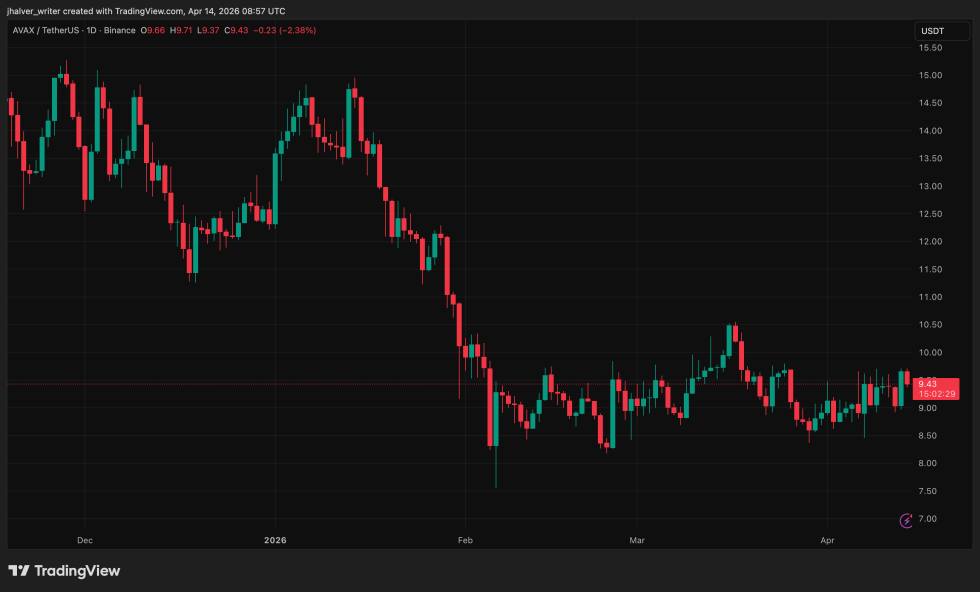
At the moment of writing, AVAX trades for $9,43 on the daily chart. Source: AVAXUSDT on Tradingview.

Cover image from Perplexity. AVAXUSDT chart from Tradingview.

Related Questions

QWhat is the main partnership announced between a South Korean payment firm and Avalanche?

ANHN KCP, one of South Korea's biggest payment processors, has signed an MOU with Avalanche developer Ava Labs to build its own payments-focused Layer 1 blockchain.

QHow is the planned Layer 1 blockchain being built and what are its key features?

AThe planned L1 is being built via Ava Cloud and is optimized for real-world payments, featuring sub-second payment authorization, on-chain transaction data encryption, and customizable merchant payment infrastructure.

QWhat does NHN KCP's CEO say about the significance of this agreement?

AJun-seok Park stated that the agreement is highly significant as it combines NHN KCP's industry-leading payment operational expertise with world-class blockchain technology to create an innovative model for real-world business applications.

QHow is South Korea's regulatory environment influencing this project?

AThe launch timing and scale of the project depend heavily on how South Korea finalizes its crypto and stablecoin framework, with comprehensive regulations expected around this year after being postponed until after the June local elections.

QWhat potential impact could this partnership have on AVAX traders and the token's value?

AIf successful, it could make AVAX a real-world payments bet that the market tends to reward with higher multiples in bull phases, and provide a measurable adoption case that could attract investment from slower-growth L1s.

Related Reads

Global Stock Market's Storm Center: South Korea's Stock Market De-leveraging Is Largely Complete

Storm's Eye: South Korean Market De-leveraging Nears Completion The recent sharp correction in South Korean equities, with the KOSPI index dropping 32% from its June high, has been a key trigger for global tech stock volatility. The core driver was not a fundamental shift but a forced de-leveraging process within the market's unique structure, which is now largely complete. Two main leverage channels amplified the sell-off: 1. **Leveraged ETFs:** Their size, proportionally four times larger than in the U.S., peaked near $50 billion. Their mandatory daily rebalancing mechanism created a vicious cycle of "price drop → forced selling → further drop." Approximately 75% of this excess has been unwound, shrinking to $26 billion, with regulatory curbs now blocking new inflows. 2. **Hedge Fund Leverage:** Using swaps to magnify exposure, hedge funds saw their net long positioning fall by over 50% from peak levels. The most intense phase of this institutional de-leveraging is over. In contrast, **retail margin debt** poses minimal systemic risk. At 0.5% of market cap, it is far lower than in the U.S. or China, lacks automatic triggers, and is concentrated in smaller stocks. The conclusion: the high-leverage structures most prone to "chain-reaction selling" have been substantially cleared. The market is transitioning from a liquidity-driven crash to one priced more on fundamentals. The article argues that the AI trend—centered on Korean memory chips—remains intact. This episode represents a painful but necessary clearing of crowded trades, not the end of the AI revolution. For investors, the key question is conviction in the long-term AI direction; if the trend is real, current volatility is a cost of entry, not a terminal risk.

链捕手53m ago

Global Stock Market's Storm Center: South Korea's Stock Market De-leveraging Is Largely Complete

链捕手53m ago

The Eternal Fragments of Money: Third-Party Payment Has No First Principle

"The Enduring Fragments of Money: Third-Party Payments Lack a First Principle" Stripe is reportedly attempting to acquire PayPal, marking a significant shift reminiscent of PayPal's merger with the original X.com 30 years ago. The article analyzes Stripe's strategic challenges and the broader payments industry landscape. Despite its initial success with a developer-friendly API model, Stripe missed its optimal IPO window during the pandemic and has since seen its valuation decline. Its attempts to expand through acquisitions and new ventures, particularly in stablecoins (like its OUSD project) and Agent-focused payments (ACP/MPP protocols), have faced headwinds. The author argues that the payment industry remains highly fragmented and is ultimately an adjunct to the traditional banking system. This structure limits the potential for any single player, including Stripe, to achieve complete dominance. While stablecoins and the future rise of autonomous Agent economies present potential growth avenues, they are not yet mainstream and still require integration with the existing financial system. For now, Agent-based transactions are largely used for speculative "volume boosting" rather than substantive business applications. Stripe's current move to acquire PayPal is seen as an attempt to bolster its weak consumer-facing (C-side) business after its stablecoin-focused strategies faltered. Meanwhile, PayPal is described as structurally outdated, unable to revive itself through new products like Venmo or PYUSD. The future of payments may lie not in payments themselves but in value-added services like more efficient settlement networks. The author suggests that companies like Stripe and Circle, which are building their own blockchains (Tempo, Arc) and stablecoins, are positioning themselves to eventually profit from high-efficiency settlement systems. These new networks could potentially bypass some traditional banking layers. In conclusion, the article posits that third-party payment is a perpetually fragmented battlefield where scale alone cannot ensure victory. Players must find new models, focusing on efficiency to compete with the entrenched banking system. Stripe's acquisition of PayPal represents a bet on this uncertain future.

链捕手1h ago

The Eternal Fragments of Money: Third-Party Payment Has No First Principle

链捕手1h ago

Trading

Spot
活动图片





