Crypto Morning Report: US ADP Data Falls Short of Expectations, Binance SAFU Fund Buys Another $100 Million in Bitcoin

marsbitPublished on 2026-02-05Last updated on 2026-02-05

Abstract

U.S. ADP employment data fell short of expectations, reporting 22,000 jobs vs. 48,000 expected. Binance's SAFU fund purchased an additional $100 million worth of Bitcoin. In regulatory news, U.S. Senate Democrats are discussing crypto market structure, while the SEC charged three crypto market makers—ZM Quant, Gotbit, and CLS Global—with market manipulation. CME Group is exploring the launch of its own cryptocurrency, "CME Coin." On the investment front, TRM Labs raised $70 million, while Tether lowered its fundraising target to $5 billion amid investor skepticism. Solana co-founder updated his profile picture, sparking speculation about Backpack's upcoming TGE. Yi Lihua’s Trend Research transferred significant amounts to Binance, likely for loan repayments. Prediction markets Opinion and BLUFF secured $20 million and $21 million in funding, respectively.

Author: Deep Tide TechFlow

Yesterday's Market Dynamics

US Senate Democrats Restart Cryptocurrency Market Structure Discussions

According to Crypto in America, Senate Democrats plan to restart discussions on cryptocurrency market structure this afternoon. This is an important meeting following the postponement of last month's markup session for the "Clarity Act." The meeting will focus on key issues including ethics and DeFi. Previously, the White House had convened representatives from the cryptocurrency and banking industries for "constructive" dialogue on topics such as stablecoin yields. Patrick Witt, Executive Director of the White House Cryptocurrency Committee, urged all parties to reach an agreement by the end of the month.

US January ADP Employment: 22,000, Expected 48,000

US January ADP employment was 22,000, compared to an expectation of 48,000 and a previous value of 41,000.

US SEC Files Market Manipulation Charges Against Three Crypto Market Makers ZM Quant, Gotbit, and CLS Global

According to Financefeeds, the US Securities and Exchange Commission (SEC) has filed market manipulation charges against three crypto market makers—ZM Quant, Gotbit, and CLS Global. The SEC alleges that these companies used algorithms for wash trading, creating artificial trading volume to deceive retail investors. Additionally, the SEC has sued nine individuals, including promoters and company employees, accusing them of hiring manipulation services and executing meaningless trades, violating the anti-fraud and registration provisions of securities laws.

As part of the investigation, the US Federal Bureau of Investigation (FBI) conducted a sting operation using a fictional token called NexFundAI, exposing these companies' willingness to engage in wash trading. This case has led to 15 entities being charged and has triggered related criminal proceedings.

Binance SAFU Fund Buys Another $100 Million in Bitcoin

According to on-chain data monitoring, the Binance SAFU Fund withdrew 1,315 Bitcoin from a Binance hot wallet address one minute ago, worth approximately $100 million.

Solana Co-Founder Changes Avatar, Adds Backpack and Laser Eye Elements; Community Speculates TGE May Be Imminent

Solana co-founder Toly changed his X platform avatar, adding laser eyes and Backpack elements to the original Moonbird derivative avatar.

Some community users interpreted this change as a possible hint that Backpack's Token Generation Event (TGE) is approaching.

CME Group Plans to Launch Token "CME Coin," Collaborates with Google on Tokenized Cash Solution

According to CoinDesk, derivatives exchange CME Group CEO Terry Duffy revealed that the company is exploring the launch of its own cryptocurrency, "CME Coin," which may operate on a decentralized network.

Duffy stated in the latest earnings call that CME Group is evaluating different forms of margin and is collaborating with Google to develop a "tokenized cash" solution, expected to launch later this year.

Yi Lihua's Trend Research Transferred Another 25,000 ETH to Binance Early This Morning, Worth Approximately $53.24 Million

According to monitoring by Onchain Lens (@OnchainLens), Yi Lihua's Trend Research transferred another 25,000 ETH (worth approximately $53.24 million) to Binance exchange early this morning.

Data shows that Trend Research has now deposited a cumulative total of 188,588 ETH (worth approximately $426.87 million) into Binance for sale and loan repayment.

Prediction Market Opinion Completes $20 Million Series A Funding

According to CoinDesk, blockchain prediction market platform Opinion announced the completion of a $20 million Pre-A funding round. Investors included Hack VC, Jump Crypto, Primitive Ventures, and Decasonic, among others. The platform uses a fully on-chain settlement mechanism and currently handles one-third of the global prediction market trading volume, with open interest exceeding $130 million.

Prediction Market Platform BLUFF Completes $21 Million Funding Round, Led by 1kx

According to Chainwire, prediction market platform BLUFF has completed a $21 million strategic funding round led by 1kx, with participation from Makers Fund, Maximum Frequency Ventures, Delphi Ventures Founders, and other institutions, as well as sports champion and tech investor Tristan Thompson.

The BLUFF team consists of former executives from platforms like Stake, Bet365, William Hill, and Bodog, and is building a socialized prediction market platform for the new generation. The platform focuses on speed, transparency, and user benefit alignment, offering instant registration, real-time settlement, provably fair prediction mechanisms, and reward mechanisms for user participation in the ecosystem.

Blockchain Intelligence Company TRM Labs Completes $70 Million Series C Funding, Led by Blockchain Capital

According to Fortune magazine, UK-based blockchain intelligence company TRM Labs announced the completion of a $70 million Series C funding round, reaching a valuation of $1 billion. This round was led by early investor Blockchain Capital, with participation from traditional institutions such as Goldman Sachs, Bessemer, Brevan Howard, Thoma Bravo, and Citi Ventures.

Financial Times: Tether Lowers Funding Target to Just $5 Billion as Investors Question $500 Billion Valuation

According to the Financial Times, global largest stablecoin issuer Tether has lowered its funding target, from the original $15-20 billion to possibly just $5 billion, due to investor skepticism about its $500 billion valuation target.

Tether CEO Paolo Ardoino stated in an interview that the $15-20 billion funding amount was a "misunderstanding," and it was merely the maximum amount they were willing to sell, not the target. He emphasized that the company is highly profitable and "very satisfied" even without selling equity.

Ardoino also compared Tether to AI companies, saying: "AI companies generate the same amount of profit as us, just with a negative sign in front." It is reported that Tether's profit last year was approximately $10 billion, mainly from returns on its held assets, but profits in 2025 decreased by about 25% year-on-year.

Last September, it was reported that stablecoin giant Tether was seeking to raise up to $20 billion at a $500 billion valuation.

Market Dynamics
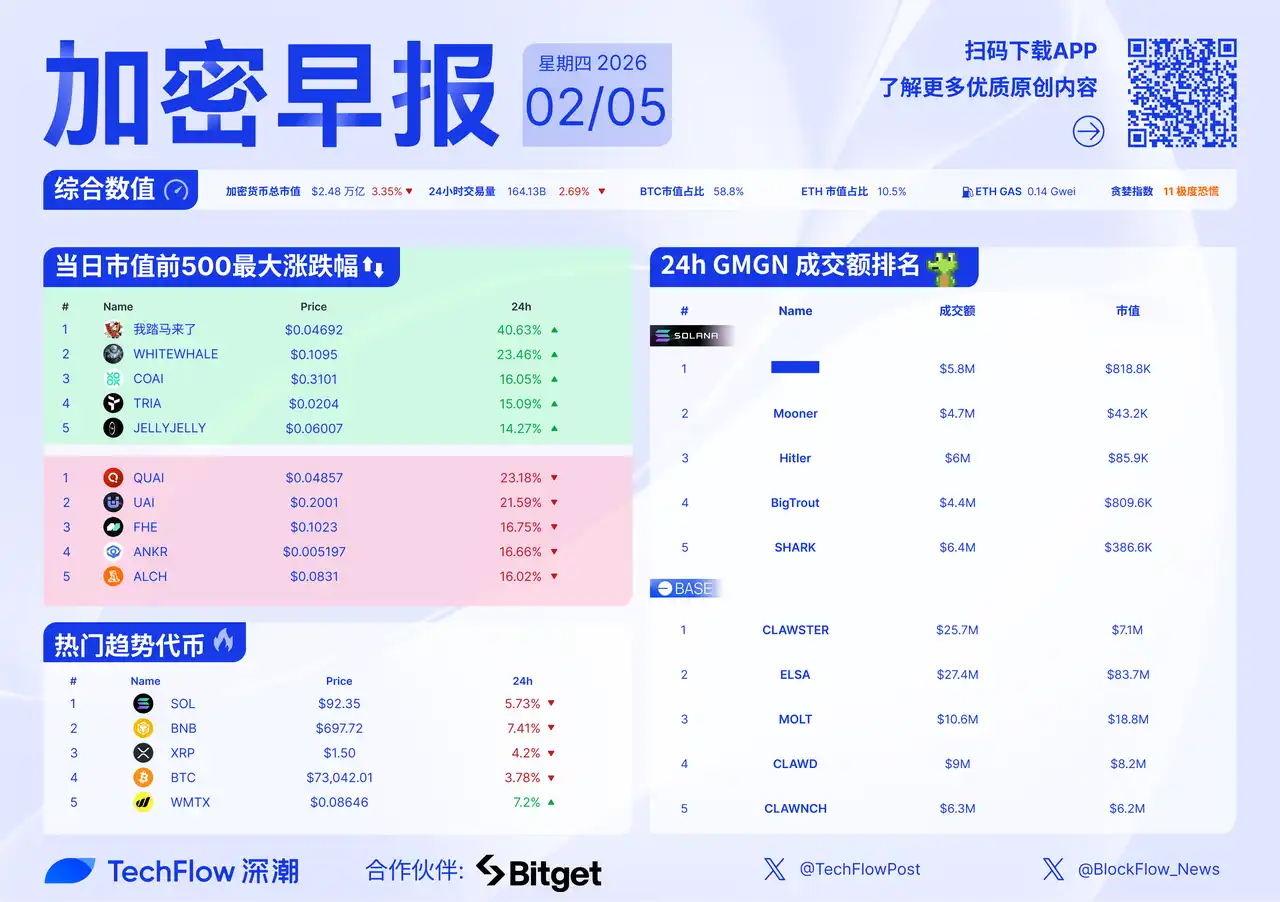
Recommended Reading

GameStop Exits and Runs Away, Saylor Keeps Buying

This article discusses how GameStop once attempted to explore new growth paths through Bitcoin investment but ultimately chose to exit. In contrast, Strategy company firmly holds and continues to accumulate Bitcoin, demonstrating a completely different belief and strategy. The article analyzes the logic and risks of companies using Bitcoin as a treasury asset and predicts three possible future development paths.

X Spends $1 Million Rewarding Good Articles; What Kind of Content Finally Got the Money?

This article discusses a long-form content creation contest hosted by platform X with a total prize pool of $2.15 million, aimed at incentivizing creators to produce high-quality original content, while attracting paying users and supporting the platform's long-form content features and AI models.

February 4th Market Summary: Software Stock Crash Triggers Chain Reaction, Safe-Haven Assets Rally Sharply

This article analyzes the volatility in global markets on February 4, 2026, particularly the crash in software stocks and the cryptocurrency market. It explores the impact of AI technology on SaaS companies, the reasons behind gold's rebound, and the core contradictions in the market.

OpenClaw and Moltbook Event Recap: From AI Social Narrative to Agent Economy Outlook

This article explores the latest developments in AI Agent technology, particularly the events surrounding OpenClaw and Moltbook and their market impact. It analyzes OpenClaw's technical architecture and innovation, discusses the false prosperity phenomenon of the Moltbook platform, and looks at future trends in the combination of AI × Crypto.

Tiger Research: How Is This Crypto Winter Different?

This article analyzes that the current crypto market is in a downward cycle, with increasing skepticism. Past crypto winters were mainly triggered by internal issues, while current market fluctuations are more driven by external factors such as ETF approvals, tariff policies, and interest rate changes. The macroeconomic environment is crucial for the future of the crypto market, and expectations of interest rate cuts and liquidity release may be key to driving market recovery. The future bull market will no longer be a blanket rise but will see separate development in compliant and non-compliant zones, with differentiated market performance.


Related Questions

QWhat was the reported US ADP employment number for January, and how did it compare to expectations?

AThe US ADP employment number for January was 22,000, which was significantly below the expected 48,000.

QWhich three crypto market makers did the US SEC charge with market manipulation?

AThe US SEC charged ZM Quant, Gotbit, and CLS Global with market manipulation.

QHow much Bitcoin did the Binance SAFU fund recently purchase, and what was its approximate value?

AThe Binance SAFU fund purchased 1,315 Bitcoin, valued at approximately $100 million.

QWhat is the name of the new cryptocurrency that CME Group is exploring, and who are they partnering with for its development?

ACME Group is exploring a cryptocurrency called 'CME Coin' and is partnering with Google to develop a tokenized cash solution.

QWhat was the final adjusted fundraising target for Tether, and why was it lowered from the initial goal?

ATether lowered its fundraising target to potentially just $5 billion from an initial $15-20 billion because investors were skeptical of its $500 billion valuation target.

Related Reads

Gensyn AI: Don't Let AI Repeat the Mistakes of the Internet

In recent months, the rapid growth of the AI industry has attracted significant talent from the crypto sector. A persistent question among researchers intersecting both fields is whether blockchain can become a foundational part of AI infrastructure. While many previous AI and Crypto projects focused on application layers (like AI Agents, on-chain reasoning, data markets, and compute rentals), few achieved viable commercial models. Gensyn differentiates itself by targeting the most critical and expensive layer of AI: model training. Gensyn aims to organize globally distributed GPU resources into an open AI training network. Developers can submit training tasks, nodes provide computational power, and the network verifies results while distributing incentives. The core issue addressed is not decentralization for its own sake, but the increasing centralization of compute power among tech giants. In the era of large models, access to GPUs (like the H100) has become a decisive bottleneck, dictating the pace of AI development. Major AI companies are heavily dependent on large cloud providers for compute resources. Gensyn's approach is significant for several reasons: 1) It operates at the core infrastructure layer (model training), the most resource-intensive and technically demanding part of the AI value chain. 2) It proposes a more open, collaborative model for compute, potentially increasing resource utilization by dynamically pooling idle GPUs, similar to early cloud computing logic. 3) Its technical moat lies in solving complex challenges like verifying training results, ensuring node honesty, and maintaining reliability in a distributed environment—making it more of a deep-tech infrastructure company. 4) It targets a validated, high-growth market with genuine demand, rather than pursuing blockchain integration without purpose. Ultimately, the boundaries between Crypto and AI are blurring. AI requires global resource coordination, incentive mechanisms, and collaborative systems—areas where crypto-native solutions excel. Gensyn represents a step toward making advanced training capabilities more accessible and collaborative, moving beyond a niche controlled by a few giants. If successful, it could evolve into a fundamental piece of AI infrastructure, where the most enduring value in the AI era is often created.

marsbit14h ago

Gensyn AI: Don't Let AI Repeat the Mistakes of the Internet

marsbit14h ago

Why is China's AI Developing So Fast? The Answer Lies Inside the Labs

A US researcher's visit to China's top AI labs reveals distinct cultural and organizational factors driving China's rapid AI development. While talent, data, and compute are similar to the West, Chinese labs excel through a pragmatic, execution-focused culture: less emphasis on individual stardom and conceptual debate, and more on teamwork, engineering optimization, and mastering the full tech stack. A key advantage is the integration of young students and researchers who approach model-building with fresh perspectives and low ego, prioritizing collective progress over personal credit. This contrasts with the US culture of self-promotion and "star scientist" narratives. Chinese labs also exhibit a strong "build, don't buy" mentality, preferring to develop core capabilities—like data pipelines and environments—in-house rather than relying on external services. The ecosystem feels more collaborative than tribal, with mutual respect among labs. While government support exists, its scale is unclear, and technical decisions appear driven by labs, not state mandates. Chinese companies across sectors, from platforms to consumer tech, are building their own foundational models to control their tech destiny, reflecting a broader cultural drive for technological sovereignty. Demand for AI is emerging, with spending patterns potentially mirroring cloud infrastructure more than traditional SaaS. Despite challenges like a less mature data industry and GPU shortages, Chinese labs are propelled by vast talent, rapid iteration, and deep integration with the open-source community. The competition is evolving beyond a pure model race into a contest of organizational execution, developer ecosystems, and industrial pragmatism.

marsbit15h ago

Why is China's AI Developing So Fast? The Answer Lies Inside the Labs

marsbit15h ago

3 Years, 5 Times: The Rebirth of a Century-Old Glass Factory

Corning, a 175-year-old glass company, is experiencing a dramatic revival as a key player in AI infrastructure, driven by surging demand for high-performance optical fiber in data centers. AI data centers require vastly more fiber than traditional ones—5 to 10 times as much per rack—to handle high-speed data transmission between GPUs. This structural demand shift, coupled with supply constraints from the lengthy expansion cycle for fiber preforms, has created a significant supply-demand gap. Nvidia has invested in Corning, along with Lumentum and Coherent, in a $4.5 billion total commitment to secure the optical supply chain for AI. Corning's competitive edge lies in its expertise in producing ultra-low-loss, high-density, and bend-resistant specialty fiber, which is critical for 800G+ and future 1.6T data rates. Its deep involvement in co-packaged optics (CPO) with partners like Nvidia further solidifies its position. While not the largest fiber manufacturer globally, Corning's revenue from enterprise/data center clients now exceeds 40% of its optical communications sales, and it has secured multi-year supply agreements with major hyperscalers including Meta and Nvidia. Financially, Corning's optical communications revenue has surged, doubling from $1.3 billion in 2023 to over $3 billion in 2025. Its stock price has risen nearly 6-fold since late 2023. Key future catalysts include the rollout of Nvidia's CPO products and the scale of undisclosed customer agreements. However, risks include high current valuations and potential disruption from next-generation technologies like hollow-core fiber. The company's long-term bet on light over electricity, maintained even through the telecom bubble crash, is now being validated by the AI boom.

marsbit16h ago

3 Years, 5 Times: The Rebirth of a Century-Old Glass Factory

marsbit16h ago

Trading

Spot
Futures

Hot Articles

What is $BITCOIN

DIGITAL GOLD ($BITCOIN): A Comprehensive Analysis Introduction to DIGITAL GOLD ($BITCOIN) DIGITAL GOLD ($BITCOIN) is a blockchain-based project operating on the Solana network, which aims to combine the characteristics of traditional precious metals with the innovation of decentralized technologies. While it shares a name with Bitcoin, often referred to as “digital gold” due to its perception as a store of value, DIGITAL GOLD is a separate token designed to create a unique ecosystem within the Web3 landscape. Its goal is to position itself as a viable alternative digital asset, although specifics regarding its applications and functionalities are still developing. What is DIGITAL GOLD ($BITCOIN)? DIGITAL GOLD ($BITCOIN) is a cryptocurrency token explicitly designed for use on the Solana blockchain. In contrast to Bitcoin, which provides a widely recognized value storage role, this token appears to focus on broader applications and characteristics. Notable aspects include: Blockchain Infrastructure: The token is built on the Solana blockchain, known for its capacity to handle high-speed and low-cost transactions. Supply Dynamics: DIGITAL GOLD has a maximum supply capped at 100 quadrillion tokens (100P $BITCOIN), although details regarding its circulating supply are currently undisclosed. Utility: While precise functionalities are not explicitly outlined, there are indications that the token could be utilized for various applications, potentially involving decentralized applications (dApps) or asset tokenization strategies. Who is the Creator of DIGITAL GOLD ($BITCOIN)? At present, the identity of the creators and development team behind DIGITAL GOLD ($BITCOIN) remains unknown. This situation is typical among many innovative projects within the blockchain space, particularly those aligning with decentralized finance and meme coin phenomena. While such anonymity may foster a community-driven culture, it intensifies concerns about governance and accountability. Who are the Investors of DIGITAL GOLD ($BITCOIN)? The available information indicates that DIGITAL GOLD ($BITCOIN) does not have any known institutional backers or prominent venture capital investments. The project seems to operate on a peer-to-peer model focused on community support and adoption rather than traditional funding routes. Its activity and liquidity are primarily situated on decentralized exchanges (DEXs), such as PumpSwap, rather than established centralized trading platforms, further highlighting its grassroots approach. How DIGITAL GOLD ($BITCOIN) Works The operational mechanics of DIGITAL GOLD ($BITCOIN) can be elaborated on based on its blockchain design and network attributes: Consensus Mechanism: By leveraging Solana’s unique proof-of-history (PoH) combined with a proof-of-stake (PoS) model, the project ensures efficient transaction validation contributing to the network's high performance. Tokenomics: While specific deflationary mechanisms have not been extensively detailed, the vast maximum token supply implies that it may cater to microtransactions or niche use cases that are still to be defined. Interoperability: There exists the potential for integration with Solana’s broader ecosystem, including various decentralized finance (DeFi) platforms. However, the details regarding specific integrations remain unspecified. Timeline of Key Events Here is a timeline that highlights significant milestones concerning DIGITAL GOLD ($BITCOIN): 2023: The initial deployment of the token occurs on the Solana blockchain, marked by its contract address. 2024: DIGITAL GOLD gains visibility as it becomes available for trading on decentralized exchanges like PumpSwap, allowing users to trade it against SOL. 2025: The project witnesses sporadic trading activity and potential interest in community-led engagements, although no noteworthy partnerships or technical advancements have been documented as of yet. Critical Analysis Strengths Scalability: The underlying Solana infrastructure supports high transaction volumes, which could enhance the utility of $BITCOIN in various transaction scenarios. Accessibility: The potential low trading price per token could attract retail investors, facilitating wider participation due to fractional ownership opportunities. Risks Lack of Transparency: The absence of publicly known backers, developers, or an audit process may yield skepticism regarding the project's sustainability and trustworthiness. Market Volatility: The trading activity is heavily reliant on speculative behavior, which can result in significant price volatility and uncertainty for investors. Conclusion DIGITAL GOLD ($BITCOIN) emerges as an intriguing yet ambiguous project within the rapidly evolving Solana ecosystem. While it attempts to leverage the “digital gold” narrative, its departure from Bitcoin's established role as a store of value underscores the need for a clearer differentiation of its intended utility and governance structure. Future acceptance and adoption will likely depend on addressing the current opacity and defining its operational and economic strategies more explicitly. Note: This report encompasses synthesised information available as of October 2023, and developments may have transpired beyond the research period.

363 Total ViewsPublished 2025.05.13Updated 2025.05.13

What is $BITCOIN

Discussions

Welcome to the HTX Community. Here, you can stay informed about the latest platform developments and gain access to professional market insights. Users' opinions on the price of BTC (BTC) are presented below.

活动图片