Author: Deep Tide TechFlow
Yesterday's Market Dynamics
ADP Weekly Employment Report: Private sector employers added an average of 9,000 jobs per week in the four weeks ending February 28, 2026
According to Jinshi Data, the ADP Weekly Employment Report shows that private sector employers added an average of 9,000 jobs per week in the four weeks ending February 28, 2026.
SEC Chairman Atkins Releases Crypto Asset Regulatory Framework, Clarifies Four Types of Assets Not Classified as Securities
As disclosed on the SEC official website, U.S. Securities and Exchange Commission (SEC) Chairman Paul S. Atkins delivered a speech at the Washington DC Summit on March 17, officially announcing the launch of the crypto asset regulatory framework "Regulation Crypto Assets" and releasing an interpretive document on token classification and investment contract determination.
Regarding asset classification, the SEC clarified that four types of crypto assets are not securities: digital commodities, digital collectibles, digital tools, and payment stablecoins defined under the GENIUS Act. The only category of crypto assets still subject to securities laws is digital securities, which are tokenized forms of traditional securities.
Regarding investment contract determination, the SEC clarified the termination conditions for investment contracts, requiring project parties to provide unambiguous disclosure of their promised core management activities. Once an investment contract is terminated, the related crypto asset can be exempt from securities law jurisdiction.
Regarding exemption pathways, Atkins proposed three mechanisms: first, a "startup exemption," allowing project parties to raise up to $5 million within four years; second, a "fundraising exemption," allowing up to $75 million to be raised within 12 months, with disclosure documents submitted to the SEC; third, an "investment contract safe harbor," providing clear non-security determination standards for crypto assets that meet certain conditions.
Atkins stated that the SEC plans to solicit public comments on the draft rules in the coming weeks and will collaborate with the Commodity Futures Trading Commission (CFTC) to advance implementation. He also emphasized that comprehensive market structure legislation passed by Congress is the fundamental path to ensuring long-term regulatory stability.
Senator Tim Scott: Crypto Market Structure Bill Negotiations Make Progress, Stablecoin Yield Draft Expected This Week
According to CoinDesk, U.S. Senate Banking Committee Chairman Senator Tim Scott stated at the Washington DC Blockchain Summit on March 18 that the previously stalled crypto market structure bill is making substantial progress behind the scenes, with the first draft of stablecoin yield-related language expected this week.
Scott stated that the stablecoin yield issue is the most discussed topic in the bill, and Democratic Senator Angela Alsobrooks, Republican Senator Thom Tillis, and White House official Patrick Witt are actively promoting its resolution.
Regarding other pending issues, Scott revealed that several disagreements have entered negotiations in the past month, including: ethical issues arising from former President Trump and his family's crypto projects, the lack of a statutory quorum for bipartisan commissioner seats at major regulatory agencies, and DeFi regulation and anti-money laundering (AML) compliance requirements. Scott stated that these issues are progressing, and the overall situation is positive.
Based Foundation: BASED Token TGE to Occur on March 30
The Based Foundation, a Hyperliquid ecosystem cryptocurrency trading and consumption platform, posted on X that the BASED token TGE will be held on March 30.
Previous news: Hyperliquid ecosystem cryptocurrency trading and consumption platform Based raised $11.5 million in Series A funding led by Pantera Capital.
Tether Releases Cross-Platform BitNet LoRA Framework, Supports Large Model Training and Inference on Consumer GPUs and Smartphones
According to Tether CEO Paolo Ardoino, the Tether AI team released a new version of QVAC Fabric, integrating a cross-platform BitNet LoRA framework that enables training and inference for billion-parameter large models on consumer GPUs and smartphones.
The new QVAC Fabric LLM is the first to achieve cross-platform BitNet LoRA fine-tuning and inference on AMD, Intel, Apple Metal, and mobile GPUs. On flagship devices, GPU inference speed is 2 to 11 times faster than CPU, with memory usage reduced by up to 90% compared to full-precision models. The Tether team has completed fine-tuning of up to 3.8 billion parameter models on flagship phones like the Pixel 9, S25, and iPhone 16, and achieved fine-tuning of up to 13 billion parameter models on the iPhone 16. Related code has been open-sourced on GitHub.
NVIDIA Forecasts Revenue to Reach $1 Trillion by 2027, AI Inference Demand Continues to Rise
According to Nikkei Asia, NVIDIA CEO Jensen Huang delivered a keynote speech at GTC 2026, with the company forecasting cumulative revenue to exceed $1 trillion by 2027, driven mainly by strong demand for AI chips. Despite external skepticism about the sustainability of large-scale AI infrastructure construction, NVIDIA's growth momentum remains strong. Additionally, Samsung's foundry division will produce the new Groq chip for NVIDIA, further deepening their cooperation in the AI hardware field.
Ant Group Chairman Eric Jing Donates 130 Million Yuan to Support Shanghai Jiao Tong University AI Fund
According to Caibao Xingqiu, Ant Group Chairman Eric Jing and his wife jointly donated cash and Ant Group shares worth 130 million yuan to their alma mater Shanghai Jiao Tong University on March 17 to support the school's "AI Future Cornerstone Fund."
Bitrefill Attacked by North Korean Hacker Group, Approximately 18,500 User Purchase Records Accessed
According to an official post on Bitrefill's X platform, on March 1, 2026, the encrypted gift card platform Bitrefill suffered a cyber attack. Based on multiple indicators such as attack methods, malware used, on-chain tracking, and reused IP and email addresses, investigators believe this attack is highly similar to previous attacks on the crypto industry by the North Korean DPRK Lazarus/Bluenoroff hacker group.
The initial entry point was an employee's compromised laptop, which attackers used to obtain historical credentials, access snapshots containing production keys, and gradually laterally infiltrate broader infrastructure, including some databases and cryptocurrency hot wallets. Funds from the hot wallets were subsequently transferred to addresses controlled by the attackers.
Regarding user data, approximately 18,500 purchase records were accessed by the attackers, involving metadata such as email addresses, encrypted payment addresses, and IPs; about 1,000 of these records contained user names. Although stored encrypted, because attackers may have obtained the encryption keys, affected users have been notified separately via email. The company stated there is currently no evidence that the attackers fully exported the database.
Currently, Bitrefill has resumed normal operations. The company stated that its financial situation is solid, it will cover the losses with its own operating funds, and it will continue to strengthen access control, log monitoring, and emergency response mechanisms.
Mastercard Plans to Acquire Stablecoin Infrastructure Startup BVNK for Up to $1.8 Billion
According to Bloomberg, Mastercard plans to acquire stablecoin infrastructure startup BVNK for up to $1.8 billion, including $300 million in contingent consideration. This acquisition news comes just four months after BVNK's approximately $2 billion merger talks with Coinbase fell through. Both parties issued a joint statement on Tuesday confirming the deal.
GSR Acquires Autonomous and Architech for $57 Million, Launches Integrated Crypto Capital Markets and Treasury Platform
According to Chainwire, cryptocurrency market maker GSR announced the acquisition of digital asset operations company Autonomous and fungible token issuance and customized liquidity strategy consulting company Architech for $57 million, aiming to provide tokenized projects with integrated capital markets and treasury management services from inception to scale.
Post-acquisition, Autonomous will retain its original brand under the GSR Group, continuing to provide launch operations, operational support, and financial infrastructure services for tokenized projects; Architech will become the core of GSR's digital asset advisory business (GSR Digital Asset Advisory), operating in coordination with GSR's existing institutional trading, liquidity, and asset management capabilities.
Robinhood Venture Fund Invests Approximately $35 Million in Stripe and AI Audio Startup ElevenLabs
According to The Block, Robinhood Ventures Fund recently completed two private market investments totaling approximately $35 million. This includes an investment of about $14.6 million in payment company Stripe and about $20 million in AI audio startup ElevenLabs. Stripe is currently valued at approximately $159 billion and owns the stablecoin platform Bridge.
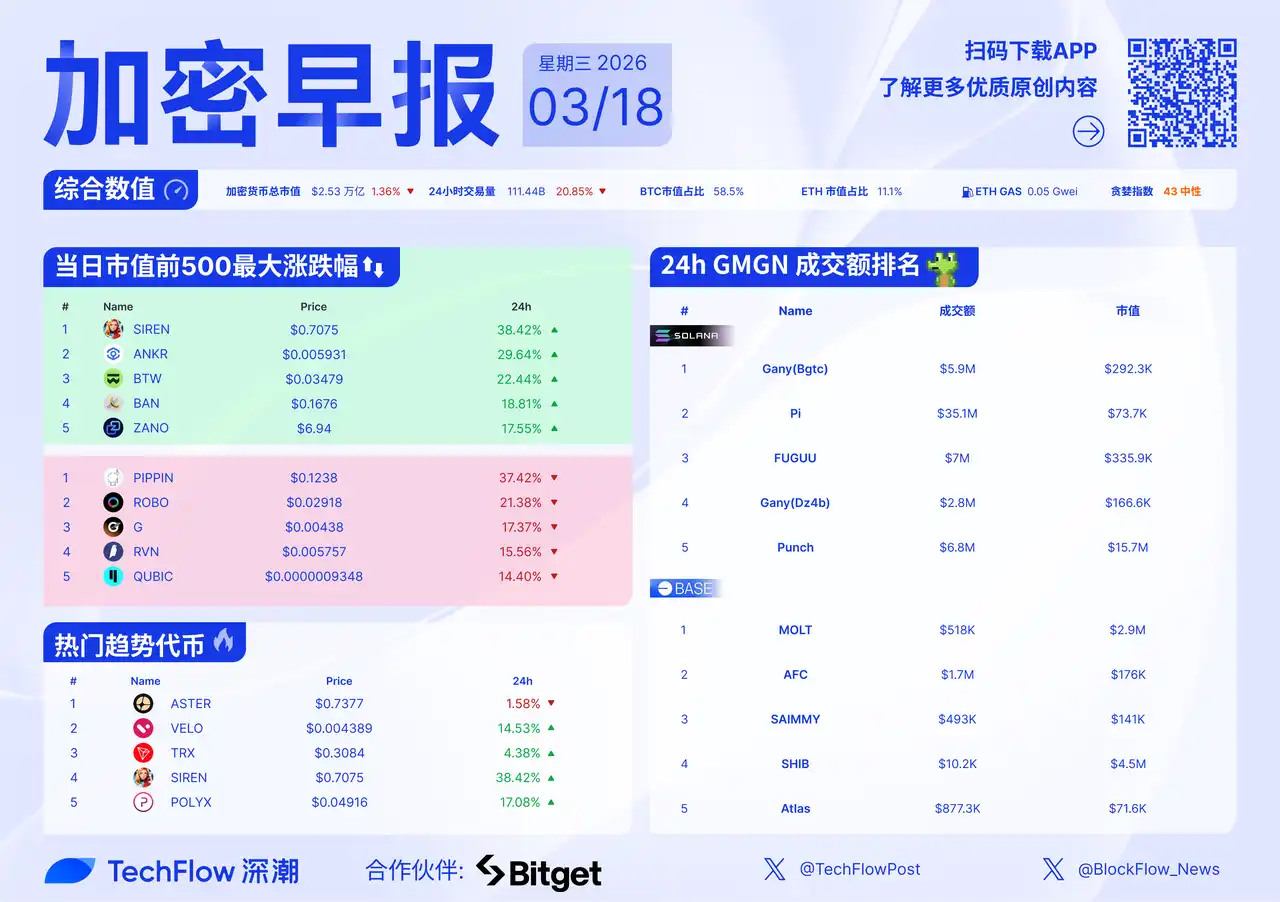
Market Dynamics
Recommended Reading
When the Safe Haven King Fails: Bitcoin Quietly Outperforms Everything in Two Weeks
This article analyzes the market performance of gold and Bitcoin during the 2026 US-Iran war, revealing the different reactions of the two assets to geopolitical shocks. Gold's safe-haven function was hampered by inflation and interest rates, while Bitcoin performed strongly due to technical rebounds, liquidity advantages, institutional inflows, and portability during the war. This war redefined the concept of "safe-haven assets."
March 17 Market Summary: Bitcoin's Epic Breakthrough of $75,000, the Market Torn Between Oil Price Nightmare and Crypto Euphoria
This article explores the divided state of the market on March 17, 2026, focusing on Bitcoin's breakthrough of $75,000 and the logic behind it, including the surge in oil prices, the plunge in gold, and the performance of related assets. It also discusses the potential impact of the Federal Reserve's policy decision and the impact of geopolitical shocks on oil supply and the global economy.
The Stablecoin Yield Debate Stalls US Crypto Regulation Legislation
This article details the legislative work in the US Congress around the CLARITY Act, which aims to establish more comprehensive regulatory rules for the cryptocurrency market. It focuses on analyzing the controversy over stablecoin yields and the disagreements between the banking industry and crypto businesses. Additionally, the article explores the timeline for the bill's passage and its potential impact on the industry.
Can't Sell Tokens? 90% of Crypto Projects Overlook Investor Relations
This article discusses the importance of Investor Relations (IR) in crypto projects and its best practices, emphasizing the optimization of investor structure through data-driven and effective communication, expanding the potential holder base, and creating greater market value for project tokens.
a16z: "Expensive and Hard-to-Use" Enterprise Software is the Real AI Gold Mine
This article analyzes the potential of artificial intelligence (AI) in the enterprise software field, particularly how AI technology can improve the programmability and usability of existing legacy systems (such as SAP, ServiceNow, Salesforce). It analyzes the pain points of current enterprise software and proposes a framework for how AI can bring value to enterprises during the implementation, use, and maintenance phases.






