Crypto market cap falls to 8-month low, analysts see more pain ahead

cointelegraphPublished on 2025-12-19Last updated on 2025-12-19

Abstract

The total crypto market capitalization has fallen to an eight-month low of $2.93 trillion, erasing all gains made this year and declining 33% from its October all-time high. Analysts predict further short-term declines, citing macroeconomic pressures and reduced investor risk appetite. The Bank of Japan’s rate hike to 0.75% added to market uncertainty, though Bitcoin saw a brief 2.3% rise. Social sentiment reflects extreme fear, with the Crypto Fear & Greed Index at 16. Despite the bearish trend, some analysts view the pullback as a potential buying opportunity for fundamentally strong projects, noting that high fear levels historically precede market bounces.

The total crypto market capitalization has fallen to an eight-month low, wiping out all gains this year, as analysts remain bearish in the short-term.

Total market capitalization fell to $2.93 trillion in late trading on Thursday, its lowest level since April, according to CoinGecko.

The total market value of crypto has declined by around 33% since its all-time high of around $4.4 trillion in early October and is down almost 14% since the beginning of this year, prompting many analysts and observers to claim the bear market is underway.

It fell to a 2025 low of $2.5 trillion on April 9 before recovering to all-time highs six months later. The crypto market cap has been largely range-bound since March 2024, and it has now returned to the middle of that range.

Bank of Japan hikes rates

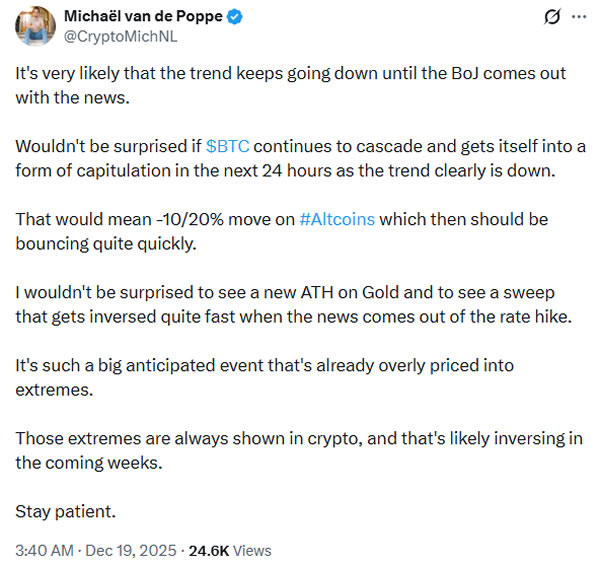
MN Fund co-founder Michaël van de Poppe predicted on Friday that more short-term pain is likely and the trend will continue downward until the Bank of Japan makes its decision on interest rates.

Japan’s central bank raised rates to 0.75% Friday morning, and while some analysts have said this will be bad news for crypto, Bitcoin (BTC) climbed by 2.3%.
Source: Michaël van de Poppe

“Wouldn’t be surprised if BTC continues to cascade and gets itself into a form of capitulation in the next 24 hours, as the trend clearly is down,” van de Poppe said. “That would mean -10/20% move on altcoins, which then should be bouncing quite quickly.”

Pullback presents buying opportunities

The recent decline in total market capitalization “reflects a broader correction driven by macroeconomic pressures and reduced risk appetite among investors,” Nick Ruck, director of LVRG Research, told Cointelegraph.

“While short-term volatility persists, this pullback presents potential accumulation opportunities in fundamentally strong projects as the sector continues to mature and attract institutional capital,” he said.

Social sentiment at rock bottom

Blockchain analytics platform Santiment reported on Friday that crypto sentiment was at fear levels again, with bearish commentary on social media following another minor pump and dump on Thursday.

“Commentary is mainly showing fear after Bitcoin bounced to $90.2K yesterday, and then quickly retraced to $84.8K,” it stated.

Related: Crypto has everything needed for a bull market, so why is the market down?

Santiment noted that historically, it is a strong sign when retail is pushing the bearish narrative harder than the bullish.

“Prices move opposite to the crowd’s expectations, so this volatility, being marked by fear, is a good signal for those who are patient enough to ride this out.”
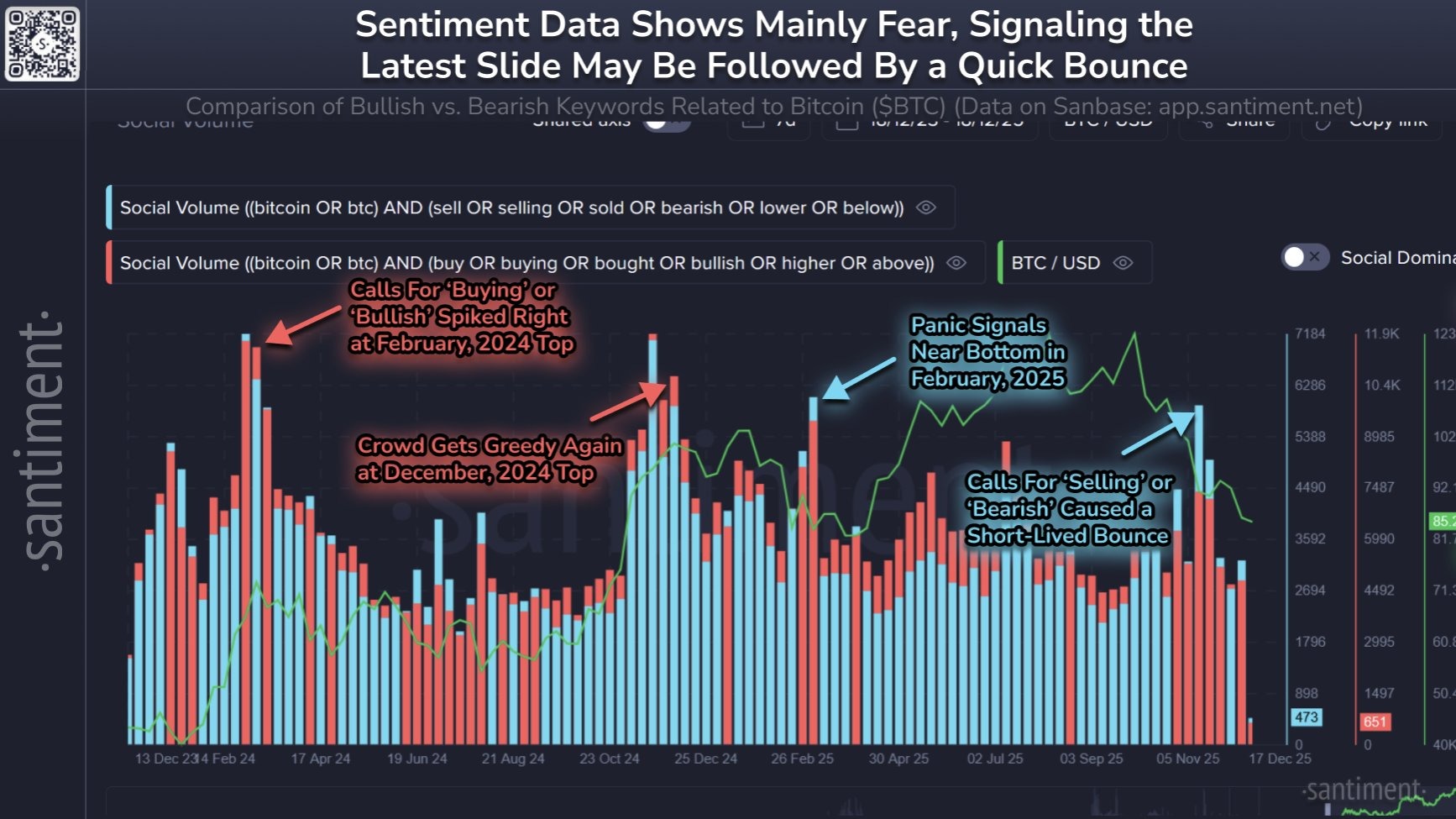
Social sentiment at bear market levels could cause a quick bounce. Source: Santiment


Meanwhile, the crypto Fear & Greed Index was buried at 16, indicating “extreme fear,” and has remained below 30 in “fear” territory since the beginning of November.

Magazine: Bitcoin’s critical level is $82.5K, Ethereum ‘not done yet’: Trade Secrets

Related Questions

QWhat is the current total crypto market capitalization and how does it compare to its all-time high?

AThe total crypto market capitalization has fallen to $2.93 trillion, which is its lowest level in eight months. This represents a decline of around 33% from its all-time high of approximately $4.4 trillion in early October.

QAccording to analysts, what is the primary reason for the recent decline in the crypto market?

AAccording to Nick Ruck of LVRG Research, the decline 'reflects a broader correction driven by macroeconomic pressures and reduced risk appetite among investors.'

QWhat did the Bank of Japan do with interest rates, and how did Bitcoin initially react?

AThe Bank of Japan raised its interest rates to 0.75%. Despite some analysts predicting this would be bad news for crypto, Bitcoin's price initially climbed by 2.3%.

QWhat is the current reading of the crypto Fear & Greed Index, and what does it indicate?

AThe crypto Fear & Greed Index is at a reading of 16, which indicates 'extreme fear.' It has remained below 30, in 'fear' territory, since the beginning of November.

QWhy does analyst Michaël van de Poppe believe the current market fear could be a positive signal?

AVan de Poppe, along with data from Santiment, suggests that prices often move opposite to the crowd's expectations. Therefore, high levels of fear and bearish sentiment can be a strong contrarian indicator and a good signal for patient investors, potentially leading to a quick bounce.

Related Reads

Unlocking $100 Million in Liquidity? Pump.fun's New Policy Tests the 5-Minute Pump Technique

Pump.fun, a popular meme coin launchpad, has introduced a new standard mechanism called BOOST. It aims to address a significant capital efficiency issue: when a newly launched token graduates from its initial bonding curve to a liquidity pool (LP), roughly 20% of its liquidity becomes permanently locked as "dead liquidity," estimated to waste over $100 million annually. Instead of locking these funds permanently, BOOST repurposes them. Upon a token's migration, approximately 20% of the settlement funds (e.g., 17.6 SOL or ~$2516 USDC) are used to buy back the token on the open market over a 5-minute period via a Time-Weighted Average Price (TWAP) mechanism. All purchased tokens are immediately burned. This creates a brief, systematic buy pressure immediately after migration, potentially generating a short-term price surge ("pump") while permanently reducing the token's circulating supply. The goal is to enhance the immediate post-launch trading experience, potentially increasing trader retention and sustainable protocol revenue, which funds ongoing token buybacks. However, concerns exist that this artificial 5-minute boost could lower the barrier for launching low-quality tokens and lead to steeper price crashes once the buy pressure stops, if followed by large sell-offs. The feature automatically applies to tokens migrating after July 21, 2024, but not to previously migrated tokens or those launched via the Mayhem AI Agent lab.

marsbit5m ago

Unlocking $100 Million in Liquidity? Pump.fun's New Policy Tests the 5-Minute Pump Technique

marsbit5m ago

Podcast Notes | Conversation with GSR Asset Management Head: To Determine if This Crypto Rally is Real, Just Watch the Lending Rates on Aave

Podcast Summary: Dialogue with GSR's Head of Asset Management: To Determine if This Crypto Rally is Real, Just Check Lending Rates on Aave Andy Baehr, Managing Director of Asset Management at GSR, discusses the current crypto market, characterizing it as stuck in a state of "ambivalence" with short-lived, unsustainable rallies. He outlines a simple framework: the market moves between "ambivalence" and "conviction" (sustained upward momentum). Currently, every rally resembles a single-stage rocket booster that quickly fizzles out. Baehr identifies three key signals to watch: 1) DeFi lending rates, 2) the potential passage of the CLARITY Act, and 3) the market forming a consensus on the "Fed hawkish peak." He emphasizes that the most immediate indicator for the sustainability of the recent CPI-triggered rally is the USDC borrowing rate on Aave, currently around 3.75%—close to U.S. Treasury yields. The absence of a credit spread indicates low leverage demand and a lack of market energy. He explains that a healthy, sustained rally requires layered buying pressure. Last year's rally progressed from an ETH short squeeze to crypto-native trader influx and finally to ETF inflows. Currently, this structure is missing. Other potential structural buyers like Digital Asset Treasury (DAT) companies are absent, and ETF flows have proven transient. Baehr notes that while small-cap crypto tokens outperformed large caps in Q2—a potential sign of capitation in major assets—capital is also flowing to more exciting opportunities like AI stocks and tech IPOs, leaving crypto sidelined. Regarding DeFi, he highlights that platforms like Aave provide a clear, real-time signal of leverage demand through their supply/demand-driven interest rates. A significant, sustained rate increase would signal genuine market conviction. He also observes the quiet emergence of fixed-income-like products and vaults in DeFi. On regulation, the probability of the CLARITY Act passing before the August 7th deadline has dropped linearly from 75% to below 40% on Polymarket. Baehr suggests its passage would be treated as a bullish surprise, a potent driver for price movement. However, political hurdles, including ethical clause debates and disclosures about the First Family's crypto profits, remain significant obstacles. Ultimately, the market awaits clarity on the Fed's terminal rate under Chair Warsh. Until the "Fed Solstice"—the point where the market collectively understands the peak of hawkish policy—sustained conviction will be difficult to achieve.

marsbit36m ago

Podcast Notes | Conversation with GSR Asset Management Head: To Determine if This Crypto Rally is Real, Just Watch the Lending Rates on Aave

marsbit36m ago

Trading

Spot
活动图片