Crypto Funds See Six Consecutive Weeks of Net Inflows, CLARITY Act Drives $858 Million Influx

marsbitPublished on 2026-05-11Last updated on 2026-05-11

Abstract

Global cryptocurrency investment products recorded a net inflow of $857.9 million last week, marking the sixth consecutive week of positive flows and the largest single-week inflow since April 24, according to CoinShares' latest report. The primary catalyst was legislative progress on the U.S. CLARITY Act, specifically the final compromise text for stablecoin yield provisions, alongside Bitcoin's price breaking above $80,000. U.S.-listed products dominated with $776.6 million in inflows, a significant jump from the prior week's $47.5 million. European markets also saw increased participation. Bitcoin products led with $706.1 million in inflows, while short-Bitcoin products experienced their largest weekly outflow of 2026, indicating unwinding bearish positions. Major altcoins like Ethereum, Solana, and XRP all saw renewed positive flows, with Ethereum reversing its prior week's outflow to attract $77.1 million. Total assets under management (AUM) climbed to $160 billion.

Author: James Butterfill (Head of Research, CoinShares)

Compiled by: Deep Tide TechFlow

Deep Tide Introduction: The latest weekly report from CoinShares shows that global crypto investment products recorded net inflows of $857.9 million last week, marking the sixth consecutive week of positive flows and the highest single-week inflow since April 24. The direct catalysts were the release of the compromise text for the stablecoin yield provisions in the CLARITY Act and Bitcoin's return above $80,000. Funds from the US market surged to $776.6 million from $47.5 million the previous week. Altcoin participation also expanded simultaneously, with ETH, SOL, and XRP all recording net inflows.

Progress on CLARITY Act Was the Core Variable Driving Fund Flows This Week

Global crypto investment products saw net inflows of $857.9 million last week, marking six consecutive weeks of positive flows and the largest single-week inflow since April 24. James Butterfill, Head of Research at CoinShares, directly attributed this acceleration to legislative progress on the CLARITY Act.

The timeline is clear: On May 1, Senators Tillis and Alsobrooks released the final compromise text for the stablecoin yield provisions; on May 4, the two lawmakers resisted lobbying pressure from the banking industry and maintained the compromise unchanged. A formal markup by the Senate Banking Committee is expected this week.

Bitcoin broke above $80,000 on Monday, reaching a new high since the February pullback. Total Assets Under Management (AUM) rose to $160 billion.
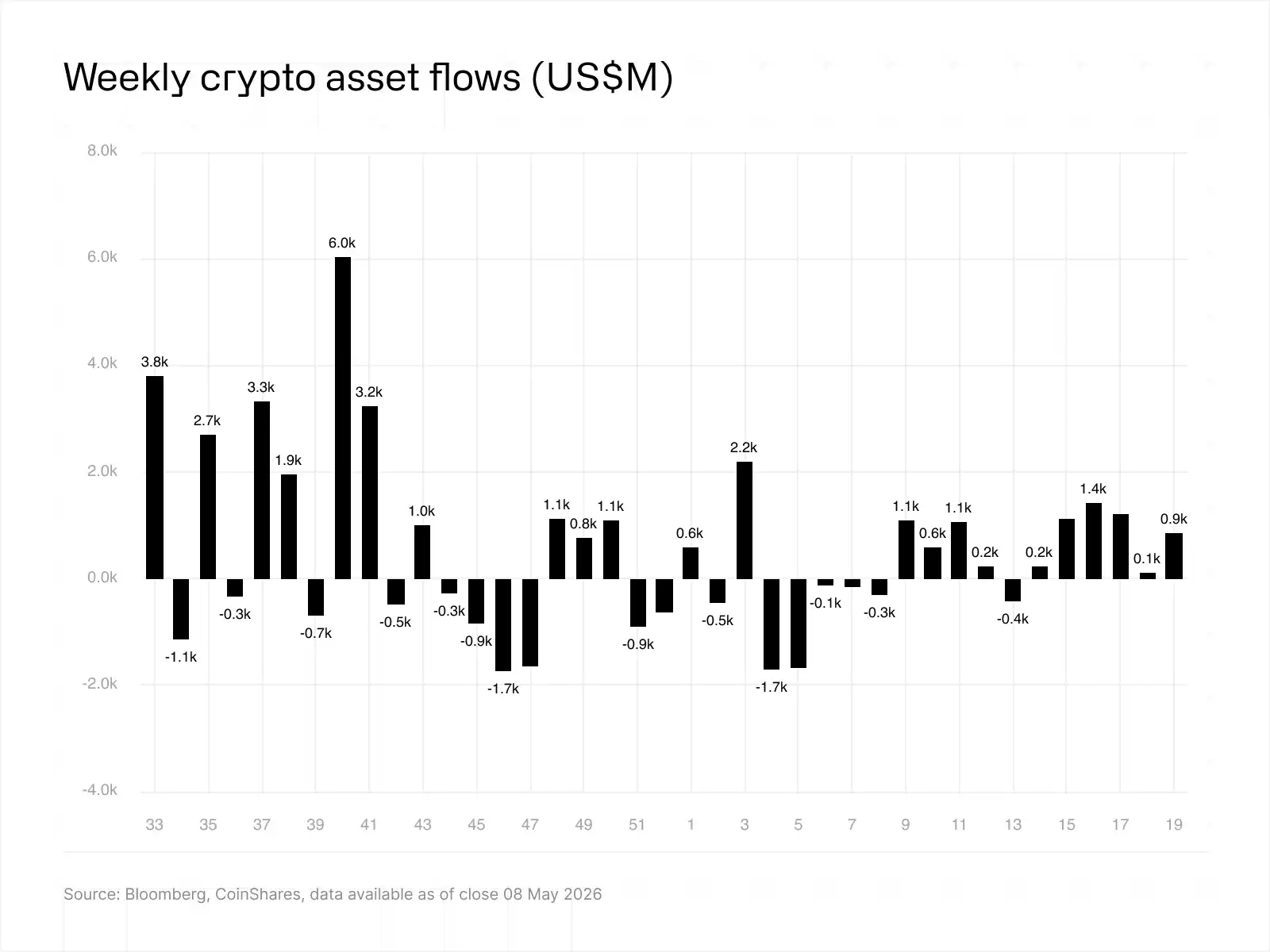
Caption: Weekly Global Crypto Asset Fund Flows, Source: CoinShares

US Fund Rebound Far Exceeds Previous Week

In terms of regional distribution, the United States dominated with net inflows of $776.6 million, showing a sharp rebound compared to the $47.5 million from the previous week.

Europe also showed improvement. Germany recorded $50.6 million, slightly higher than the previous week; Switzerland saw $21.1 million, and the Netherlands $5 million. Butterfill believes this indicates that while the buying momentum has returned to the US, there is also broader participation emerging in Europe.
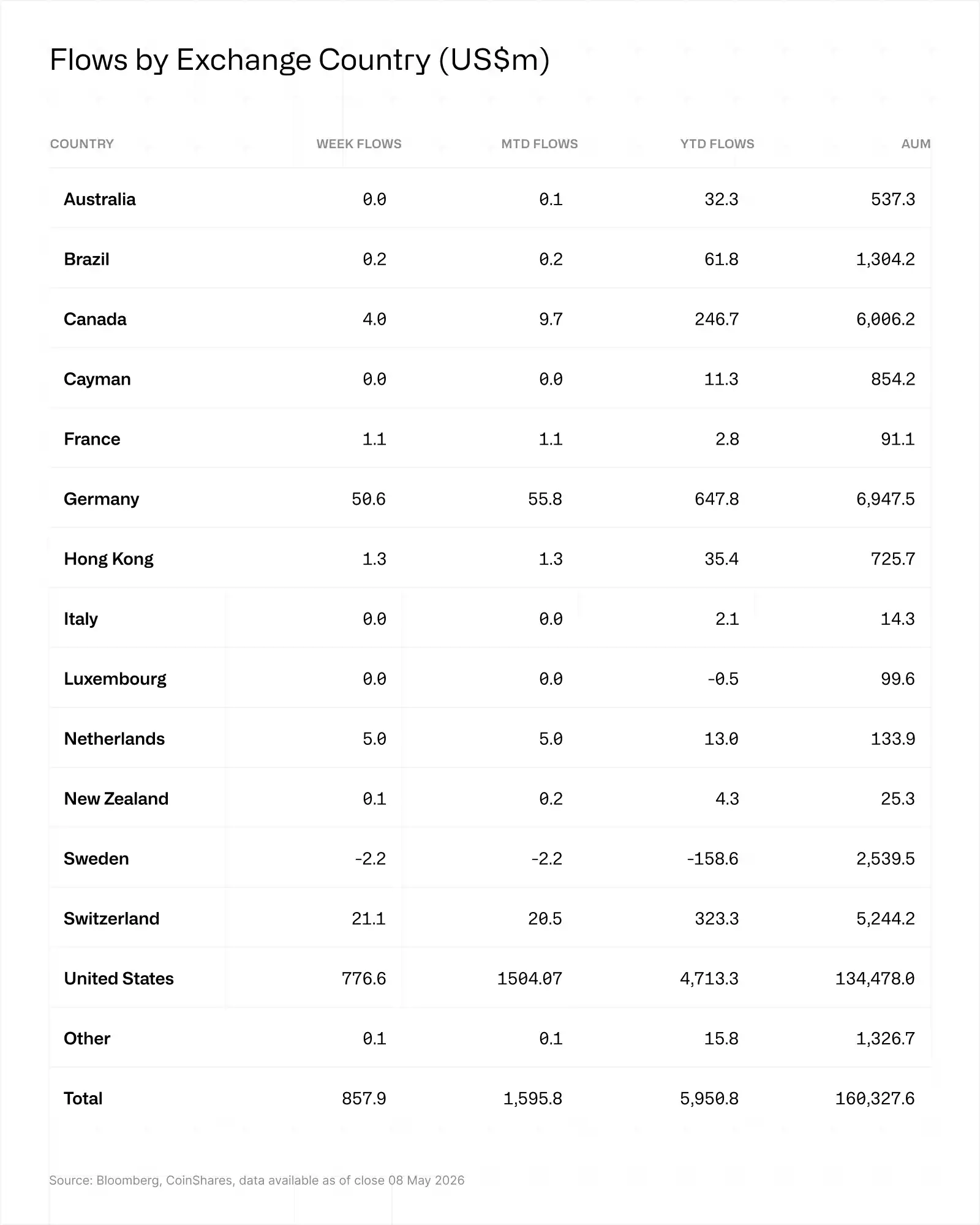
Caption: Fund Flows by Listing Country, Source: CoinShares

BTC Leads, Short Positions Accelerate Unwinding

Bitcoin products absorbed $706.1 million last week, bringing year-to-date cumulative inflows to $4.9 billion.

A noteworthy signal to unpack: Short-bitcoin products saw net outflows of $14.4 million last week, the largest single-week outflow in 2026. This suggests hedge positions are being unwound, indicating growing institutional confidence in the rebound.

Altcoins Rebound Across the Board, ETH Reverses Previous Week's Outflow

Ethereum products saw net inflows of $77.1 million, completely reversing the net outflow of $81.6 million from the previous week. Solana recorded $47.6 million, and XRP saw $39.6 million, both showing a significant acceleration compared to recent activity levels.

The only category with noticeable outflows was multi-asset products, with a net outflow of $5.5 million.
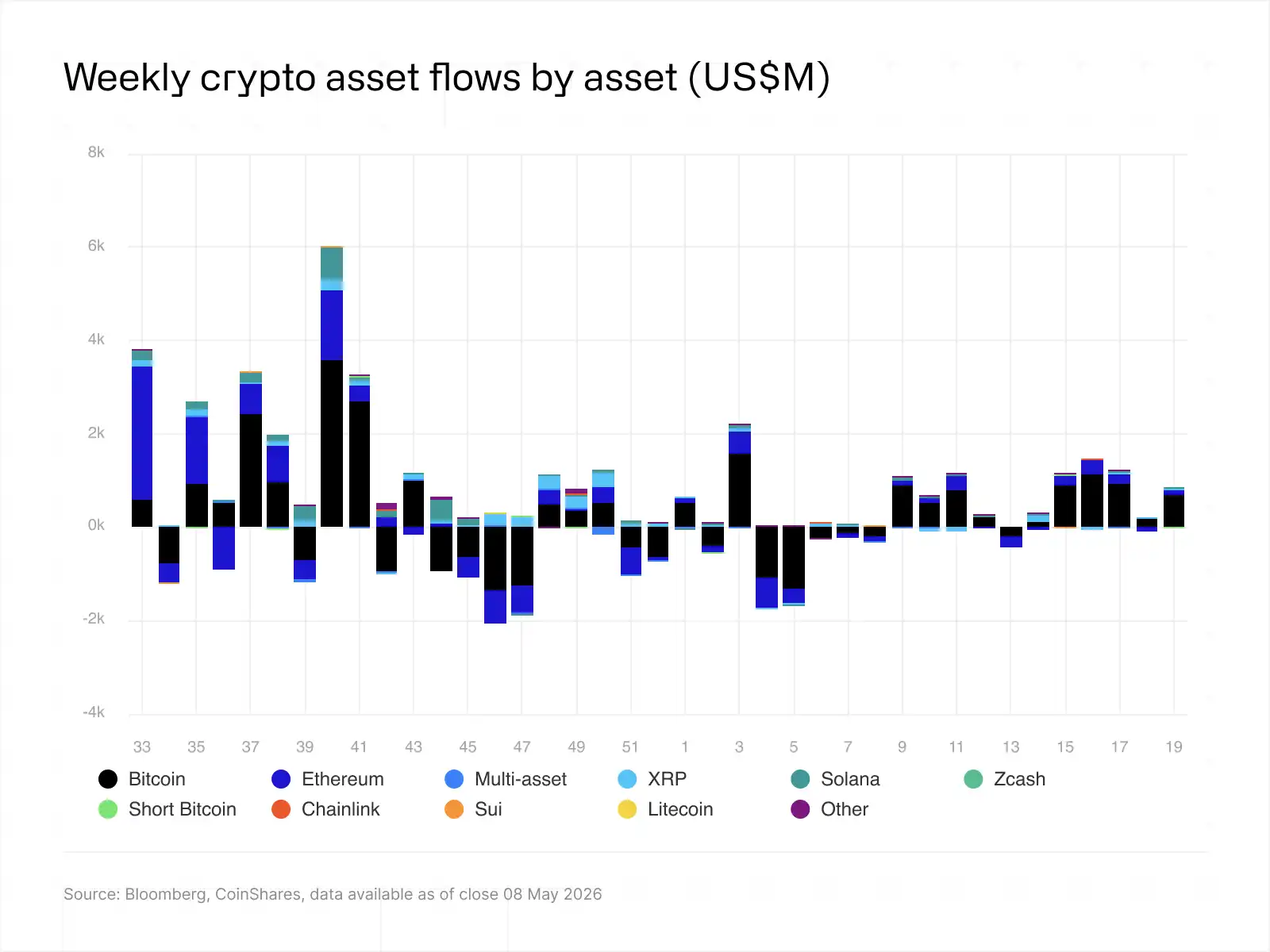
Caption: Weekly Fund Flows by Asset Class, Source: CoinShares
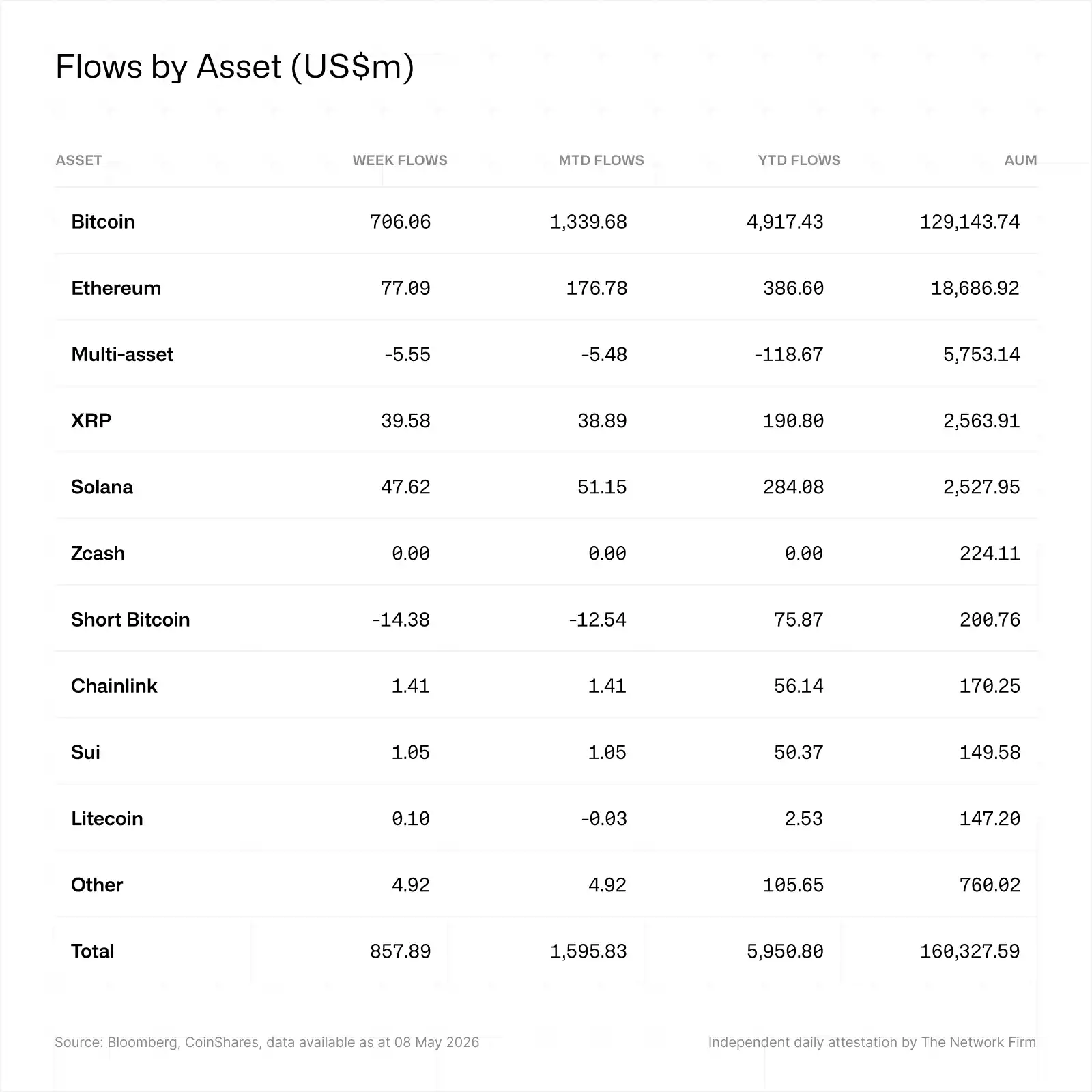
Caption: Detailed Fund Flows by Asset, Source: CoinShares
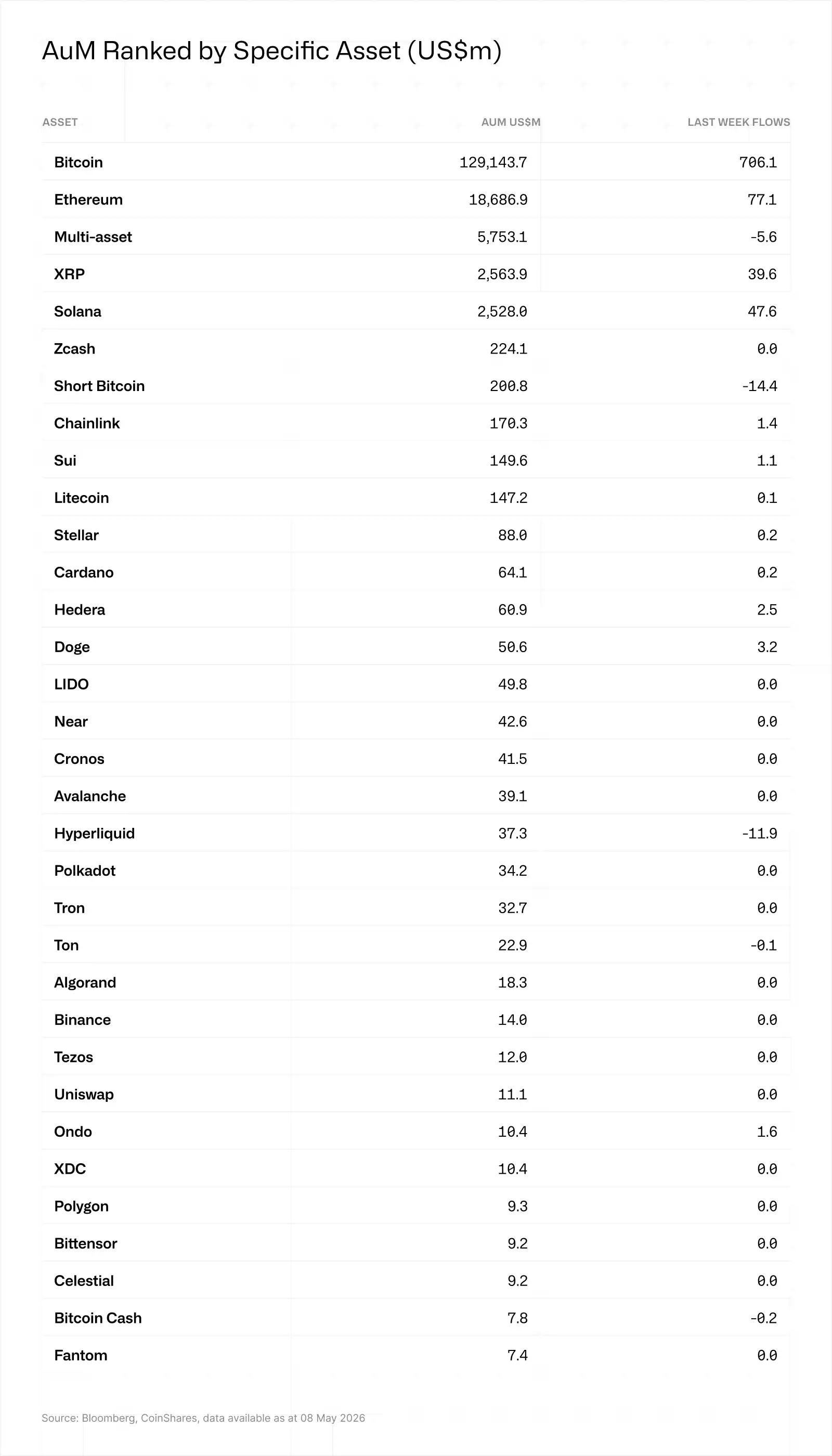
Caption: Assets Under Management Ranked by Specific Asset, Source: CoinShares


Related Questions

QWhat was the main catalyst behind the record $857.9 million weekly inflow into crypto investment products, according to CoinShares?

AThe main catalyst was legislative progress on the CLARITY Act, specifically the release of a final compromise text for the stablecoin yield provision on May 1 and the sponsors' resistance to banking lobbying pressure to keep the compromise intact.

QWhich region saw the most significant week-over-week increase in net inflows for crypto investment products, and by how much?

AThe United States saw the most significant increase, with net inflows surging from $47.5 million the previous week to $776.6 million.

QWhat does the $14.4 million net outflow from short-bitcoin products signal about market sentiment, according to the article?

AThe largest weekly outflow for short-bitcoin products in 2026 signals that hedge positions are being unwound, indicating growing institutional confidence in the market's rebound.

QWhich three altcoin investment products saw notable net inflows alongside Bitcoin?

AEthereum (ETH), Solana (SOL), and XRP investment products all saw notable net inflows of $77.1 million, $47.6 million, and $39.6 million, respectively.

QWhat was the total Assets Under Management (AUM) for global crypto investment products mentioned in the report, and what was Bitcoin's price milestone?

AThe total Assets Under Management (AUM) reached $160 billion, while Bitcoin's price broke above $80,000, marking a new high since its correction in February.

Related Reads

The Verdict in Choi Tae-won's Divorce Case: Revealing the Inheritance Undercurrent Behind SK Hynix's Trillion-Won Empire

SK Group Chairman Chey Tae-won's high-profile divorce case, involving a record 1.38 trillion won settlement, has drawn attention to the succession plans for Korea's second-largest conglomerate, especially its crown jewel, SK hynix. Unlike traditional chaebol scripts centered on the eldest son, Chey's three children from his marriage to former President Roh Tae-woo's daughter, Roh Soh-yeong, are carving distinct, non-traditional paths. Eldest daughter Chey Yun-jung (b. 1989) is seen as the most evident successor. With a scientific and consulting background, she holds executive roles at SK bioscience and SK Inc.'s growth support department, focusing on future strategy and biopharma. Her marriage is to an AI infrastructure entrepreneur, not a traditional business alliance. Second daughter Chey Min-jung (b. 1991) took a unique route, voluntarily serving as a South Korean naval officer, including an anti-piracy deployment. She later worked on policy and strategy for SK hynix in Washington D.C. before co-founding an AI-driven healthcare startup. She married a former U.S. Marine Corps officer, connecting her to U.S. defense and policy circles—networks crucial for a global semiconductor giant. The only son, Chey In-geun (b. 1995), who studied physics like his father, worked briefly at SK E&S before joining McKinsey. Despite fitting the traditional "heir" profile as the eldest son, he remains silent and holds no public position or shares in SK, suggesting the old succession playbook is obsolete. As SK hynix's valuation soars, becoming a geopolitical asset in the AI era, the heirs' legitimacy is no longer automatic. They must prove themselves in fields like AI biotech, global policy, and strategic consulting. Their marriages also reflect new elite networks in tech and defense, not old political alliances. Their inheritance is the complex challenge of navigating a globalized, tech-driven world, not just a corporate throne.

marsbit10h ago

The Verdict in Choi Tae-won's Divorce Case: Revealing the Inheritance Undercurrent Behind SK Hynix's Trillion-Won Empire

marsbit10h ago

From OpenSea to OpenRouter: Is Alex Atallah Repeating His 'Exit at the Peak' Playbook?

From OpenSea to OpenRouter: Is Alex Atallah Repeating His "Exit at the Peak" Playbook? According to the Wall Street Journal, payments giant Stripe is in talks to acquire the AI model aggregation platform OpenRouter in a potential deal valuing the company near $100 billion. This would mark founder Alex Atallah's second creation of a company reaching a $100 billion valuation, following his co-founding of NFT marketplace OpenSea. OpenRouter, founded just over three years ago, has grown rapidly by acting as a unified gateway for developers to access over 400 AI models. It currently has about 10 million users and processes over 200 trillion tokens monthly. While the platform's annualized revenue is around $50 million, its valuation has skyrocketed from $1.3 billion in March 2026. The potential acquisition by Stripe, a company OpenRouter's founder once likened it to, represents a major expansion into AI infrastructure for the payments leader. This move echoes Atallah's previous timing with OpenSea, where he departed before the NFT market's significant downturn. For OpenRouter, selling now may be strategic. Despite its scale, its business model—charging a 5-5.5% fee on AI inference calls—faces pressure from competition, open-source models, and potential price wars among model providers, limiting its profitability narrative for an IPO. A key asset for potential acquirers like Stripe is OpenRouter's vast repository of real-world AI usage data, which offers unique insights into model performance and developer preferences that are difficult to replicate. Whether this potential deal signifies a new valuation benchmark for AI infrastructure or another market peak signal remains to be seen.

链捕手10h ago

From OpenSea to OpenRouter: Is Alex Atallah Repeating His 'Exit at the Peak' Playbook?

链捕手10h ago

Trading

Spot
活动图片




