Crypto Funds Extend Three-Week Run With $1B Inflows Despite Geopolitical Stress

bitcoinistPublished on 2026-03-17Last updated on 2026-03-17

Global crypto funds attracted a remarkable $1 billion in inflows last week, marking their third consecutive week of positive net flows and best performance in two months, while underscoring resilience amid geopolitical challenges.

Crypto Funds’ Positive Streak Extends

According to the latest CoinShares data, crypto funds drew $1.06 billion in inflows last week, continuing their positive net flows run for the third consecutive week and extending their best performance since the year started.

Notably, crypto Exchange-Traded Products (ETPs) had a five-week run of negative net flows from January 19 to February 20 amid market weakness and broader negative sentiment. The investment products had cumulative outflows of $4 billion, registering their worst performance since the October 10 crash.

The US market experienced most of the negative net flows during this period, while Bitcoin-based ETPs saw the weakest performance among major cryptocurrencies, with over $3.80 billion in outflows.

However, US investors’ renewed demand for digital asset investment products since the end of February, particularly Bitcoin Exchange-Traded Funds (ETFs), has reduced the prior one-month outflows streak, bringing the three-week run of inflows to $2.62 billion.
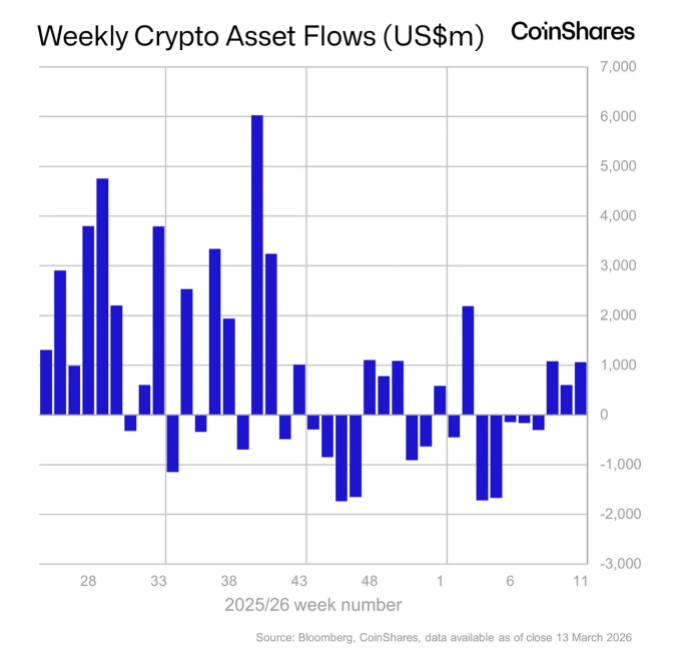
Crypto funds attract massive inflows for the third consecutive week.  Source: CoinShares

Regionally, 96% of the inflows originated from the US, with Canada and Switzerland following with $19.4 million and $10.4 million, respectively. Hong Kong also attracted $23.1 million in inflows, marking the best performance since August 2025. In contrast, Germany recorded outflows of $17.1 million, its first negative net flows in 2026, according to CoinShares’ data.

Funds based on the flagship cryptocurrency showed the strongest performance this week, with $793 million in inflows. This accounts for 75% of total inflows, bringing BTC’s three-week inflows to $2.2 billion.

The report noted that short Bitcoin investment products also attracted $8.1 million in inflows last week, highlighting that market opinion remains somewhat polarized.

Meanwhile, Ethereum funds also saw meaningful inflows worth $315 million, partially driven by BlackRock’s debut of its staked Ether ETF in the US. This brings the category’s year-to-date (YTD) flows, which are on a net outflow position, near a net-neutral position.

Digital Assets, Bitcoin’s ‘Safe Haven’ Narrative Reinforced

James Butterfill, head of research at CoinShares, highlighted crypto funds’ strong performance despite the increasing Middle East tensions, explaining that “significant geopolitical disruption has reinforced digital assets, particularly Bitcoin, as a relative safe haven compared with other asset classes.”

Since the beginning of the Iran crisis, total assets under management (AuM) in crypto ETPs have risen by 9.4% to $140 billion, Butterfill noted on Monday. Notably, Nate Geraci, co-founder of the ETF Institute, recently affirmed that ETF investors have “largely displayed diamond hands” since the October correction began.

The expert emphasized that 50% drawdowns “are a walk in the park for long-time BTC investors,” but observed that newer ETF investors also appear unfazed by the recent market volatility.

Bloomberg Intelligence Senior ETF Analyst Eric Balchunas also shared a similar perspective on the performance of spot Bitcoin ETFs, calling the investment products’ resilience “absurd” amid the market conditions.

The latest QCP Market Colour highlighted that crypto is rallying and institutional liquidity is also returning, while equities and gold remain under pressure. According to the Monday analysis, recent price actions suggest a resurgence of Bitcoin’s narrative as a “digital safe haven” or “geopolitical hedge,” with “markets stress-testing that thesis in real time.”

“If this pattern persists, it would be a late-quarter plot twist, given crypto’s underdog status and its familiar habit of correlating with traditional assets mostly on the way down,” the report stated.
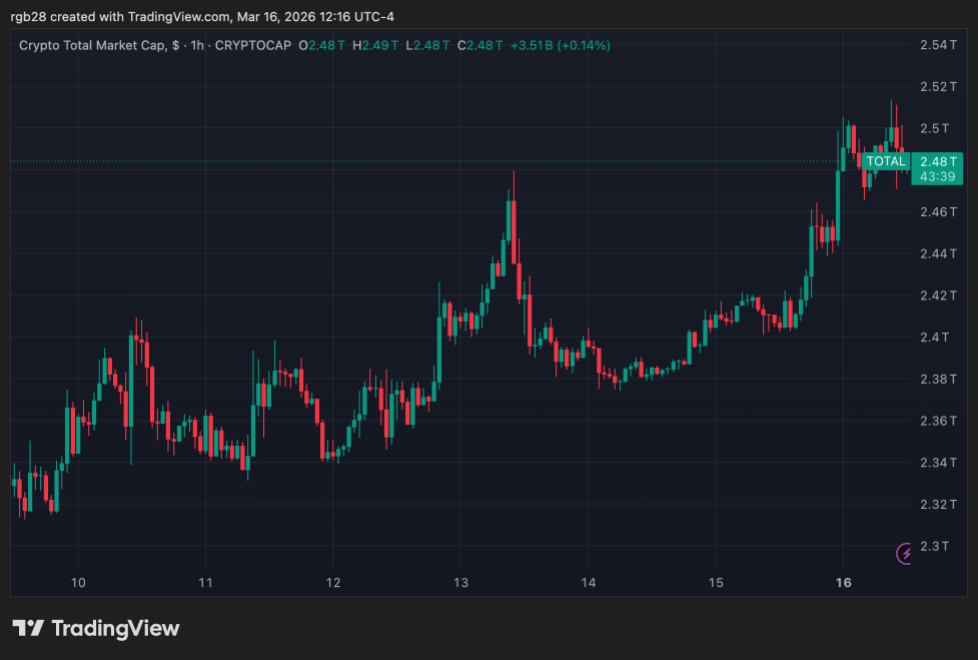
The total crypto market capitalization is at $2.48 trillion on the one-week chart. Source: TOTAL on TradingView


Related Questions

QHow much in inflows did crypto funds attract last week, and what does this represent?

ACrypto funds attracted $1.06 billion in inflows last week, marking their third consecutive week of positive net flows and their best performance in two months.

QWhich region was the primary source of the crypto fund inflows, and how much did it contribute?

AThe United States was the primary source, contributing 96% of the total inflows.

QWhat was the performance of Bitcoin-based funds specifically, and how much did they attract in inflows?

ABitcoin-based funds showed the strongest performance, attracting $793 million in inflows, which accounts for 75% of the total inflows for the week.

QAccording to the head of research at CoinShares, how has recent geopolitical disruption affected the perception of digital assets?

AJames Butterfill stated that significant geopolitical disruption has reinforced digital assets, particularly Bitcoin, as a relative safe haven compared to other asset classes.

QWhat notable inflow did Ethereum funds see, and what was a key driver behind this activity?

AEthereum funds saw inflows of $315 million, partially driven by BlackRock's debut of its staked Ether ETF in the US.

Related Reads

a16z: AI's 'Amnesia', Can Continuous Learning Cure It?

The article "a16z: AI's 'Amnesia' – Can Continual Learning Cure It?" explores the limitations of current large language models (LLMs), which, like the protagonist in the film *Memento*, are trapped in a perpetual present—unable to form new memories after training. While methods like in-context learning (ICL), retrieval-augmented generation (RAG), and external scaffolding (e.g., chat history, prompts) provide temporary solutions, they fail to enable true internalization of new knowledge. The authors argue that compression—the core of learning during training—is halted at deployment, preventing models from generalizing, discovering novel solutions (e.g., mathematical proofs), or handling adversarial scenarios. The piece introduces *continual learning* as a critical research direction to address this, categorizing approaches into three paths: 1. **Context**: Scaling external memory via longer context windows, multi-agent systems, and smarter retrieval. 2. **Modules**: Using pluggable adapters or external memory layers for specialization without full retraining. 3. **Weights**: Enabling parameter updates through sparse training, test-time training, meta-learning, distillation, and reinforcement learning from feedback. Challenges include catastrophic forgetting, safety risks, and auditability, but overcoming these could unlock models that learn iteratively from experience. The conclusion emphasizes that while context-based methods are effective, true breakthroughs require models to compress new information into weights post-deployment, moving from mere retrieval to genuine learning.

marsbit1h ago

a16z: AI's 'Amnesia', Can Continuous Learning Cure It?

marsbit1h ago

Can a Hair Dryer Earn $34,000? Deciphering the Reflexivity Paradox in Prediction Markets

An individual manipulated a weather sensor at Paris Charles de Gaulle Airport with a portable heat source, causing a Polymarket weather market to settle at 22°C and earning $34,000. This incident highlights a fundamental issue in prediction markets: when a market aims to reflect reality, it also incentivizes participants to influence that reality. Prediction markets operate on two layers: platform rules (what outcome counts as a win) and data sources (what actually happened). While most focus on rules, the real vulnerability lies in the data source. If reality is recorded through a specific source, influencing that source directly affects market settlement. The article categorizes markets by their vulnerability: 1. **Single-point physical data sources** (e.g., weather stations): Easily manipulated through physical interference. 2. **Insider information markets** (e.g., MrBeast video details): Insiders like team members use non-public information to trade. Kalshi fined a剪辑师 $20,000 for insider trading. 3. **Actor-manipulated markets** (e.g., Andrew Tate’s tweet counts): The subject of the market can control the outcome. Evidence suggests Tate’sociated accounts coordinated to profit. 4. **Individual-action markets** (e.g., WNBA disruptions): A single person can execute an event to profit from their pre-placed bets. Kalshi and Polymarket handle these issues differently. Kalshi enforces strict KYC, publicly penalizes insider trading, and reports to regulators. Polymarket, with its anonymous wallet-based system, has historically been more permissive, arguing that insider information improves market accuracy. However, it cooperated with authorities in the "Van Dyke case," where a user traded on classified government information. The core paradox is reflexivity: prediction markets are designed to discover truth, but their financial incentives can distort reality. The more valuable a prediction becomes, the more likely participants are to influence the event itself. The market ceases to be a mirror of reality and instead shapes it.

marsbit2h ago

Can a Hair Dryer Earn $34,000? Deciphering the Reflexivity Paradox in Prediction Markets

marsbit2h ago

Trading

Spot
Futures
活动图片