Crypto ETFs Continue to Decline with Major New Outflows

bitcoinistPublished on 2026-02-02Last updated on 2026-02-02

Abstract

Crypto ETFs, particularly U.S. spot bitcoin ETFs, are experiencing significant and sustained outflows, with a notable peak of approximately $818 million in net withdrawals on January 29th. This trend reflects a broader tactical pullback by investors amid renewed market volatility and a shift towards risk reduction, coinciding with turbulence in other risk-sensitive assets. While ETFs remain a crucial gateway for institutional crypto access due to their convenience and compliance benefits, their flows have become procyclical—amplifying bullish trends and exacerbating downturns. Meanwhile, the memecoin sector continues to develop actively, with new projects like MAXI Doge emerging. In January, U.S. spot bitcoin ETFs saw an estimated $1.6 billion in net outflows, indicating a more defensive start to the year than anticipated.

After a turbulent start to the year, exchange-traded funds (ETFs) backed by cryptocurrencies continue to record significant outflows. The movement, concentrated on spot Bitcoin ETFs, fuels the idea of a tactical withdrawal by investors in the face of renewed volatility. In this context, the market is watching a key indicator: the ability of ETFs to cushion stress phases, rather than amplify them.

Repeated Outflows from Spot Bitcoin ETFs

Withdrawals have accelerated over several sessions, with a notable peak on January 29, when U.S.-listed spot Bitcoin ETFs recorded approximately $818 million in net outflows, according to data tracked by Farside Investors and cited by market aggregators.
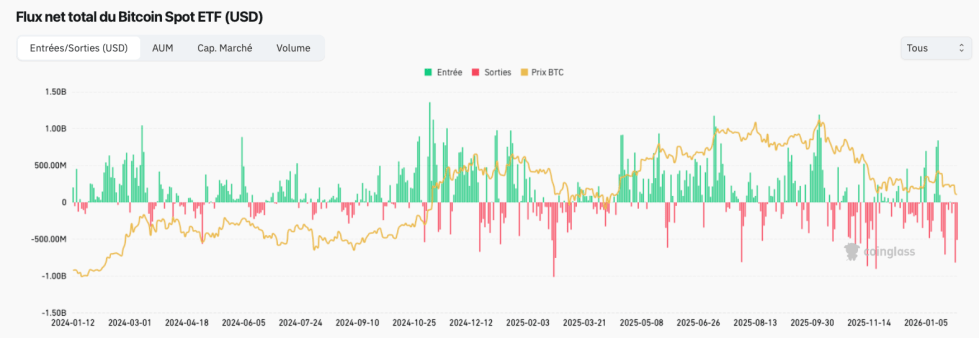
This mechanism is important because net redemptions mean that intermediaries are reducing exposure, which can lead to sales of underlying Bitcoins when shares are destroyed. In other words, the ETF becomes a rapid transition mechanism between market sentiment and the pressure that builds on-chain, especially when leverage deflates across the entire ecosystem.

The concentration of outflows on the largest vehicles is also being scrutinized. Even though major managers like BlackRock, Fidelity, or Grayscale remain structural for institutional access, short-term arbitrage is taking over during correction phases.

A Reduction in On-Chain Risk for Crypto Investors

These outflows are part of a broader climate of risk reduction, where investors are arbitrating towards more liquidity as the trajectory of U.S. monetary policy becomes uncertain again. Movements in Bitcoin and Ether have thus coincided with shocks in other assets deemed riskier, and with renewed nervousness in traditional markets.

Nevertheless, the interpretation remains open. ETFs retain a gateway role, as they simplify ownership, compliance, and portfolio integration. The question is therefore less about their utility and more about the pace, with flows becoming procyclical again, favorable in an upward trend, unfavorable when volatility dominates.

Another factor is the monthly reading. Several market summaries indicate that in January, U.S. spot Bitcoin ETFs would have accumulated approximately $1.6 billion in net outflows, a sign of a more defensive start to the year than expected given the geopolitical context.

Amid ETFs, Memecoins Show No Weakness and Accelerate Development

While ETFs are gaining ground, the world of memecoins is far from buried; on the contrary. The future is being built with new presales, notably MAXI Doge, which aims to do even better than DOGE in 2026. With a TGE approaching at high speed, this new figure in the crypto ecosystem is very promising.

Indeed, the Maxi Doge project features a token called MAXI, presented as a meme-inspired token. Its communication emphasizes a highly speculative identity and a market culture focused on performance. So, is a gain of over 300% within reach? This makes it an asset to watch closely.


This article does not constitute investment advice in any way. The information provided here should not be used as a basis for making financial decisions. Cryptocurrency investments carry risks and can lead to significant losses. You should only invest what you can afford to lose and conduct your own research before making any investment decision.


Related Questions

QWhat is the main trend observed in cryptocurrency ETFs according to the article?

ACryptocurrency ETFs are experiencing significant outflows, particularly spot Bitcoin ETFs, indicating a tactical pullback by investors due to increased market volatility.

QWhat was the peak net outflow amount for US spot Bitcoin ETFs on January 29th?

AUS spot Bitcoin ETFs recorded approximately $818 million in net outflows on January 29th.

QHow does the outflows from ETFs impact the underlying Bitcoin market?

ANet redemptions mean intermediaries are reducing their exposure, which can lead to sales of the underlying Bitcoins when the shares are destroyed, making ETFs a rapid transition tool between market sentiment and on-chain selling pressure.

QWhat broader market context are these crypto ETF outflows a part of?

AThe outflows are part of a broader climate of risk reduction, where investors are moving towards more liquidity as the trajectory of US monetary policy becomes uncertain, coinciding with shake-ups in other risky assets and traditional markets.

QDespite the outflows from ETFs, what other part of the crypto ecosystem is showing strong development?

AThe memecoin sector is not weakening but accelerating its growth, with new projects like MAXI Doge emerging and aiming for high performance, presenting itself as a promising asset to watch.

Related Reads

In Jinjiang, Fujian, a Storage Super Unicorn Lies Quiet

In Fujian's Jinjiang, a city known for sportswear, lies a quiet semiconductor giant: Fujian Jinhua Integrated Circuit Co. (JHICC). Once a promising domestic DRAM manufacturer alongside Yangtze Memory and ChangXin Memory Technologies (CXMT), its journey was derailed in 2018 when the U.S. placed it on an Entity List and filed criminal charges for alleged trade secret theft. This halted production for years. A turning point came in February 2024 when a U.S. federal court found JHICC not guilty. However, it had lost crucial time. While CXMT soared to become a top-valued A-share company in 2024, JHICC, with an estimated valuation of 80 billion RMB, was just restarting. Its current output is primarily customized DDR4 chips, not the advanced DDR5/HBM demanded for AI, but it still benefits from the broader memory chip upcycle. JHICC's story is tied to Chen Zhengkun, a veteran engineer who left Micron to lead the venture. Founded in 2016 with state-backed funding, JHICC partnered with Taiwan's UMC to develop DRAM technology. Rapid progress was cut short by the U.S. actions, which Micron initiated, partly due to its heavy reliance on the Chinese market. Post-sanctions, Chen's team worked to rebuild the production line with reduced reliance on U.S. technology. According to its records, JHICC achieved small-scale production and revenue growth under immense pressure. It now focuses on the stable "niche" DRAM market (e.g., TVs, routers) with a monthly capacity of ~40,000 wafers, aiming for 60,000 by 2026. It holds over 1,000 patents but remains on the Entity List. For Jinjiang, investing in JHICC was a bold industrial leap. The local government provided unwavering financial and logistical support during the crisis, helping the company survive. JHICC has become the anchor for a growing local semiconductor cluster. Though its scale lags behind domestic peers, JHICC's persistence symbolizes a hard-won foothold in a global market long dominated by Samsung, SK Hynix, and Micron. Having missed one boom, it seeks a place in the new AI-driven memory supercycle.

marsbit1h ago

In Jinjiang, Fujian, a Storage Super Unicorn Lies Quiet

marsbit1h ago

Trading

Spot
活动图片




