Crypto ETFs Continue to Decline with Major New Outflows

bitcoinistPublished on 2026-02-02Last updated on 2026-02-02

Abstract

Crypto ETFs, particularly U.S. spot bitcoin ETFs, are experiencing significant and sustained outflows, with a notable peak of approximately $818 million in net withdrawals on January 29th. This trend reflects a broader tactical pullback by investors amid renewed market volatility and a shift towards risk reduction, coinciding with turbulence in other risk-sensitive assets. While ETFs remain a crucial gateway for institutional crypto access due to their convenience and compliance benefits, their flows have become procyclical—amplifying bullish trends and exacerbating downturns. Meanwhile, the memecoin sector continues to develop actively, with new projects like MAXI Doge emerging. In January, U.S. spot bitcoin ETFs saw an estimated $1.6 billion in net outflows, indicating a more defensive start to the year than anticipated.

After a turbulent start to the year, exchange-traded funds (ETFs) backed by cryptocurrencies continue to record significant outflows. The movement, concentrated on spot Bitcoin ETFs, fuels the idea of a tactical withdrawal by investors in the face of renewed volatility. In this context, the market is watching a key indicator: the ability of ETFs to cushion stress phases, rather than amplify them.

Repeated Outflows from Spot Bitcoin ETFs

Withdrawals have accelerated over several sessions, with a notable peak on January 29, when U.S.-listed spot Bitcoin ETFs recorded approximately $818 million in net outflows, according to data tracked by Farside Investors and cited by market aggregators.
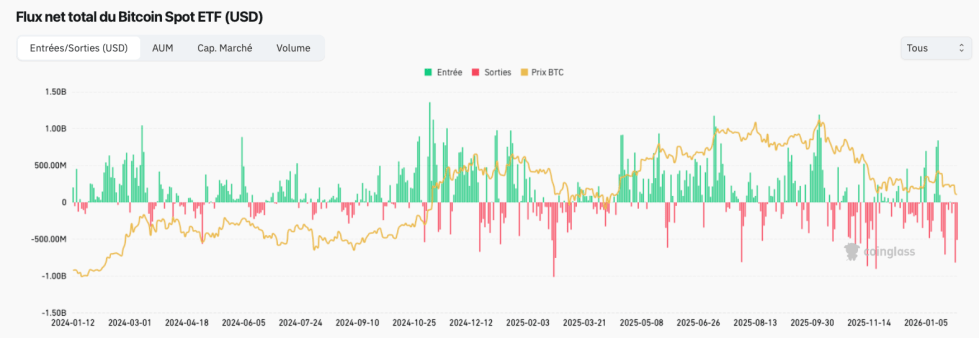
This mechanism is important because net redemptions mean that intermediaries are reducing exposure, which can lead to sales of underlying Bitcoins when shares are destroyed. In other words, the ETF becomes a rapid transition mechanism between market sentiment and the pressure that builds on-chain, especially when leverage deflates across the entire ecosystem.

The concentration of outflows on the largest vehicles is also being scrutinized. Even though major managers like BlackRock, Fidelity, or Grayscale remain structural for institutional access, short-term arbitrage is taking over during correction phases.

A Reduction in On-Chain Risk for Crypto Investors

These outflows are part of a broader climate of risk reduction, where investors are arbitrating towards more liquidity as the trajectory of U.S. monetary policy becomes uncertain again. Movements in Bitcoin and Ether have thus coincided with shocks in other assets deemed riskier, and with renewed nervousness in traditional markets.

Nevertheless, the interpretation remains open. ETFs retain a gateway role, as they simplify ownership, compliance, and portfolio integration. The question is therefore less about their utility and more about the pace, with flows becoming procyclical again, favorable in an upward trend, unfavorable when volatility dominates.

Another factor is the monthly reading. Several market summaries indicate that in January, U.S. spot Bitcoin ETFs would have accumulated approximately $1.6 billion in net outflows, a sign of a more defensive start to the year than expected given the geopolitical context.

Amid ETFs, Memecoins Show No Weakness and Accelerate Development

While ETFs are gaining ground, the world of memecoins is far from buried; on the contrary. The future is being built with new presales, notably MAXI Doge, which aims to do even better than DOGE in 2026. With a TGE approaching at high speed, this new figure in the crypto ecosystem is very promising.

Indeed, the Maxi Doge project features a token called MAXI, presented as a meme-inspired token. Its communication emphasizes a highly speculative identity and a market culture focused on performance. So, is a gain of over 300% within reach? This makes it an asset to watch closely.


This article does not constitute investment advice in any way. The information provided here should not be used as a basis for making financial decisions. Cryptocurrency investments carry risks and can lead to significant losses. You should only invest what you can afford to lose and conduct your own research before making any investment decision.


Related Questions

QWhat is the main trend observed in cryptocurrency ETFs according to the article?

ACryptocurrency ETFs are experiencing significant outflows, particularly spot Bitcoin ETFs, indicating a tactical pullback by investors due to increased market volatility.

QWhat was the peak net outflow amount for US spot Bitcoin ETFs on January 29th?

AUS spot Bitcoin ETFs recorded approximately $818 million in net outflows on January 29th.

QHow does the outflows from ETFs impact the underlying Bitcoin market?

ANet redemptions mean intermediaries are reducing their exposure, which can lead to sales of the underlying Bitcoins when the shares are destroyed, making ETFs a rapid transition tool between market sentiment and on-chain selling pressure.

QWhat broader market context are these crypto ETF outflows a part of?

AThe outflows are part of a broader climate of risk reduction, where investors are moving towards more liquidity as the trajectory of US monetary policy becomes uncertain, coinciding with shake-ups in other risky assets and traditional markets.

QDespite the outflows from ETFs, what other part of the crypto ecosystem is showing strong development?

AThe memecoin sector is not weakening but accelerating its growth, with new projects like MAXI Doge emerging and aiming for high performance, presenting itself as a promising asset to watch.

Related Reads

Podcast Notes | Conversation with GSR Asset Management Head: To Determine if This Crypto Rally is Real, Just Watch the Lending Rates on Aave

Podcast Summary: Dialogue with GSR's Head of Asset Management: To Determine if This Crypto Rally is Real, Just Check Lending Rates on Aave Andy Baehr, Managing Director of Asset Management at GSR, discusses the current crypto market, characterizing it as stuck in a state of "ambivalence" with short-lived, unsustainable rallies. He outlines a simple framework: the market moves between "ambivalence" and "conviction" (sustained upward momentum). Currently, every rally resembles a single-stage rocket booster that quickly fizzles out. Baehr identifies three key signals to watch: 1) DeFi lending rates, 2) the potential passage of the CLARITY Act, and 3) the market forming a consensus on the "Fed hawkish peak." He emphasizes that the most immediate indicator for the sustainability of the recent CPI-triggered rally is the USDC borrowing rate on Aave, currently around 3.75%—close to U.S. Treasury yields. The absence of a credit spread indicates low leverage demand and a lack of market energy. He explains that a healthy, sustained rally requires layered buying pressure. Last year's rally progressed from an ETH short squeeze to crypto-native trader influx and finally to ETF inflows. Currently, this structure is missing. Other potential structural buyers like Digital Asset Treasury (DAT) companies are absent, and ETF flows have proven transient. Baehr notes that while small-cap crypto tokens outperformed large caps in Q2—a potential sign of capitation in major assets—capital is also flowing to more exciting opportunities like AI stocks and tech IPOs, leaving crypto sidelined. Regarding DeFi, he highlights that platforms like Aave provide a clear, real-time signal of leverage demand through their supply/demand-driven interest rates. A significant, sustained rate increase would signal genuine market conviction. He also observes the quiet emergence of fixed-income-like products and vaults in DeFi. On regulation, the probability of the CLARITY Act passing before the August 7th deadline has dropped linearly from 75% to below 40% on Polymarket. Baehr suggests its passage would be treated as a bullish surprise, a potent driver for price movement. However, political hurdles, including ethical clause debates and disclosures about the First Family's crypto profits, remain significant obstacles. Ultimately, the market awaits clarity on the Fed's terminal rate under Chair Warsh. Until the "Fed Solstice"—the point where the market collectively understands the peak of hawkish policy—sustained conviction will be difficult to achieve.

marsbit32m ago

Podcast Notes | Conversation with GSR Asset Management Head: To Determine if This Crypto Rally is Real, Just Watch the Lending Rates on Aave

marsbit32m ago

7 Months After the Collapse of Huiwang, Southeast Asia's Escrow Platforms Undergo a Major Reshuffle

Following the collapse of Huione Pay—dubbed the "Alipay of Southeast Asia"—seven months ago, the region's underground financial guarantee platform sector is undergoing a significant reshuffle. This power vacuum has been swiftly filled by emerging platforms such as XinBi, Tiger/Navigator, JinBei (renamed JinBo), Dali/Tiancheng, and FullyLight. These platforms, operating largely via Telegram and offering services like escrow for illicit transactions, have absorbed the vast user base and markets left behind by Huione. While positioning themselves as "trust intermediaries," their primary clientele consists of networks involved in online scams, money laundering, illegal gambling, and even human trafficking. For instance, the Tiger/Navigator platform explicitly provides "escrow" services for kidnapping-for-ransom operations ("强押车交易"). Data underscores the immense scale: Huione alone processed over $103 billion in cryptocurrency payments and facilitated over $31 billion through its escrow market before its downfall, linking it to Cambodia's notorious Prince Group. Since its collapse, competitors have seen explosive growth. For example, the XinBi platform has accumulated over $1.6 billion in total USDT revenue, while platforms like NewPay, OkPay (under Dali), and FullyLight Wallet collectively processed over $4.8 billion in USDT in a single year. This ecosystem thrives in regions like Cambodia and Myanmar, where regulatory gaps allow these platforms to act as critical financial infrastructure for sprawling cybercrime industries, from scam compounds to online casinos. The article concludes that the moniker "Southeast Asian Alipay" is a misnomer, obscuring the platforms' fundamental role in enabling serious criminal enterprises rather than representing legitimate financial innovation.

Odaily星球日报1h ago

7 Months After the Collapse of Huiwang, Southeast Asia's Escrow Platforms Undergo a Major Reshuffle

Odaily星球日报1h ago

Trading

Spot
活动图片




