Crypto Entrepreneurs, VCs Have Become Immune to 'Storytelling'

比推Published on 2026-01-27Last updated on 2026-01-27

Abstract

Cryptocurrency funding surged to $50.6 billion in 2025, a 200% increase from 2024, but the growth was largely driven by mergers and acquisitions (M&A), which accounted for over 40% of total funding—up from just 9% the previous year. While venture capital (VC) investments still grew by 70%, their share of overall funding dropped significantly. VCs shifted focus toward later-stage rounds (Series B and C), which more than doubled, while early-stage funding (Pre-Seed, Seed, and Series A) declined. This indicates a market preference for lower-risk, proven ventures with existing traction, such as robust user bases and distribution networks, rather than speculative early ideas. Major acquisitions, like Coinbase’s purchase of Deribit and Naver’s acquisition of Dunamu, highlight this trend toward consolidation and leveraging established "flywheels." The data suggests that in 2026, capital concentration will continue, with investors prioritizing clear metrics, regulatory resilience, and sustainable business models over narrative-driven pitches. Early-stage founders must adapt by focusing on tangible growth indicators and distribution strategies to attract funding in a more cautious investment landscape.

Author: Prathik Desai

Source: The Token Dispatch

Compiled and Edited: BitpushNews


Preface

Money has a fascinating way of narrating. Through its flow in the global markets, it silently reveals its perspective on the world.

In a confident market, money behaves like a 'talent scout.' It dares to take risks, willing to pay for a business plan, a prototype, or a future vision that seems far-fetched today. It expresses its belief by signing investment checks.

However, in an anxious market, money behaves more like a 'cautious auditor.' It gravitates towards what has already proven successful. Think of businesses with stable cash flows, large user bases, distribution channels, or strong teams.

There is a third scenario, somewhere in between. In this case, funds begin to 'recycle' existing ideas and jump between different hands. This happens when we see changes in business ownership through mergers and acquisitions (M&A), business unit restructuring, etc. In these scenarios, although funds are flowing, they are not creating new liquidity.

This is why anyone interpreting capital flows and financing data should be cautious. Large financing figures may signal fresh risk-taking, or they may merely mean that funds are 'changing hands' among existing businesses.

The '2025 Cryptocurrency Financing Report' disclosed such a number: In 2025, $50.6 billion was raised through 1,409 rounds of financing, an increase of over 200% compared to $15.5 billion in 2024. It sounds like a狂欢, but only by breaking down this number can we see the real picture.

This article will delve into this data and explain what last year's capital flows tell us about the direction of the crypto market.

Farewell to Storytelling: Giants Only Pay for 'Ready-Made Flywheels'

A significant portion of so-called 'fundraising' is not necessarily new money flowing into the crypto market. The financing report divides the total funds raised into several categories: venture capital (VC)/private equity, mergers and acquisitions (M&A), and public offerings/IPOs.

Last year, over 40% of the funds raised came from M&A, compared to only 9% in 2024. Although the total financing amount more than doubled from the previous year, 2025 was more a year of consolidation for the cryptocurrency industry.
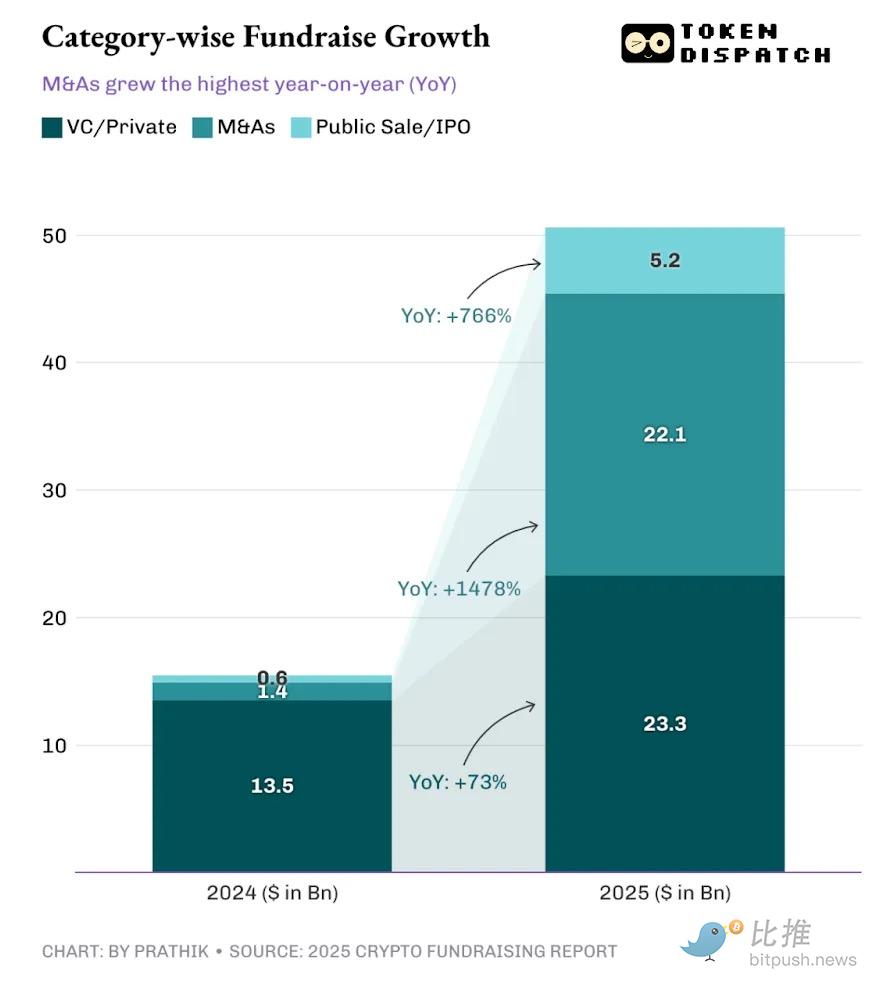
The report interprets these numbers as 'moderate growth' in venture capital activity and an 'explosive growth' in M&A transactions. However, I believe there is more hidden behind these numbers.

In a relatively nascent industry like cryptocurrency, business consolidation may signify maturity and progress. But if accompanied by capital withdrawal from other channels, it may tell a completely different story.

In 2025, funds were not just shifting from funding new projects to acquiring existing ones. Although the total financing amount increased by $35 billion year-on-year, M&A and public offerings/IPOs accounted for $27 billion of this increase.

Venture capital (VC) activity still grew by over 70% year-on-year last year, although its share in the overall financing categories declined.

In 2024, VC accounted for over 85% of total financing, but by 2025, this proportion dropped to 46%. This, combined with how VC allocated funds to different stages of crypto projects last year, is precisely what worries the new generation of crypto developers and founders: In 2025, VCs signed far fewer checks, but for much larger amounts, aiming to fund existing projects in the later stages of their life cycle, rather than funding newer early-stage projects.
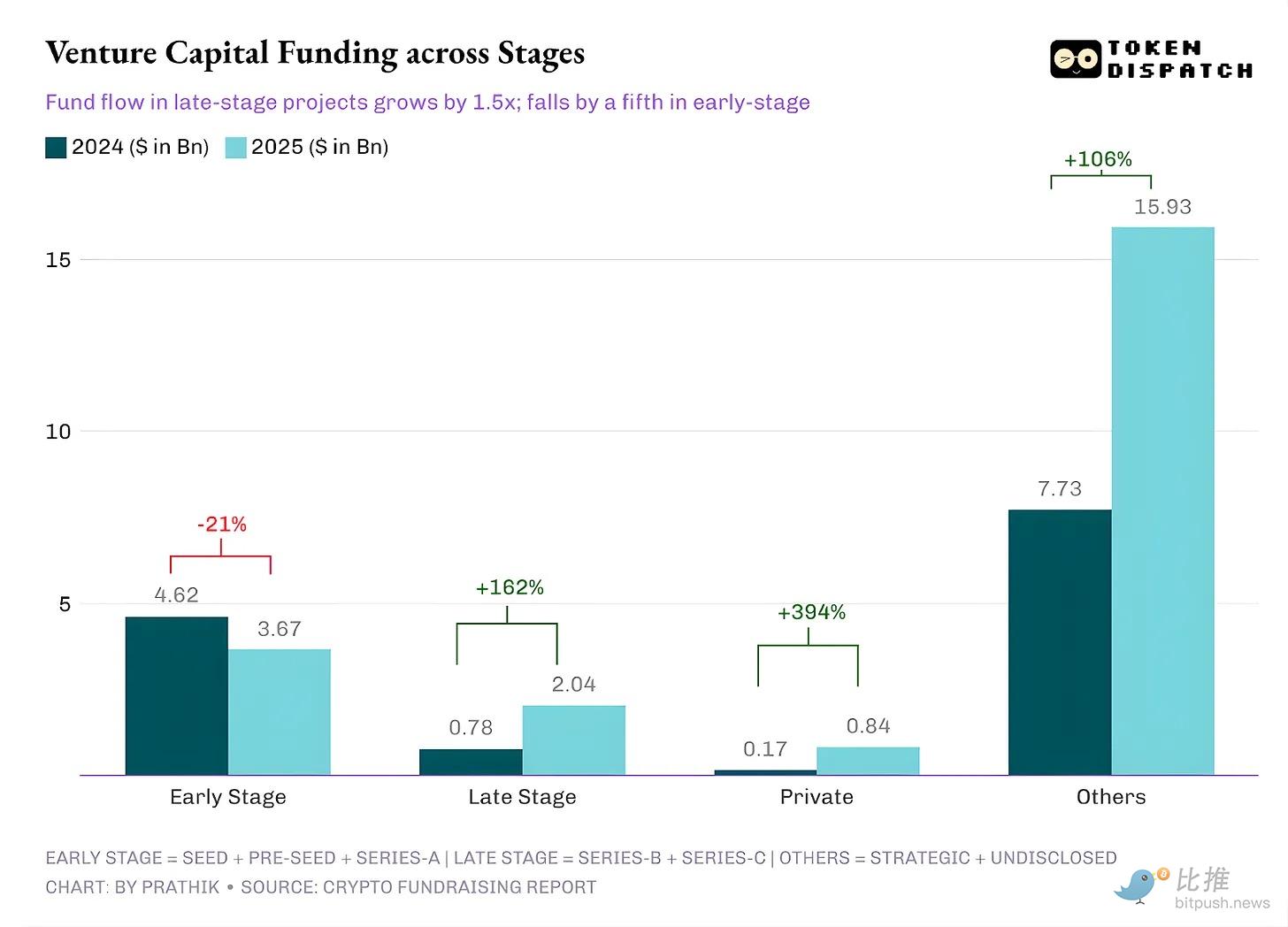
The data shows that Pre-Seed, Seed, and Series A financing decreased year-on-year, while Series B and Series C financing more than doubled in 2025. This behavior is also confirmed when looking at the number of checks signed across all financing stages.
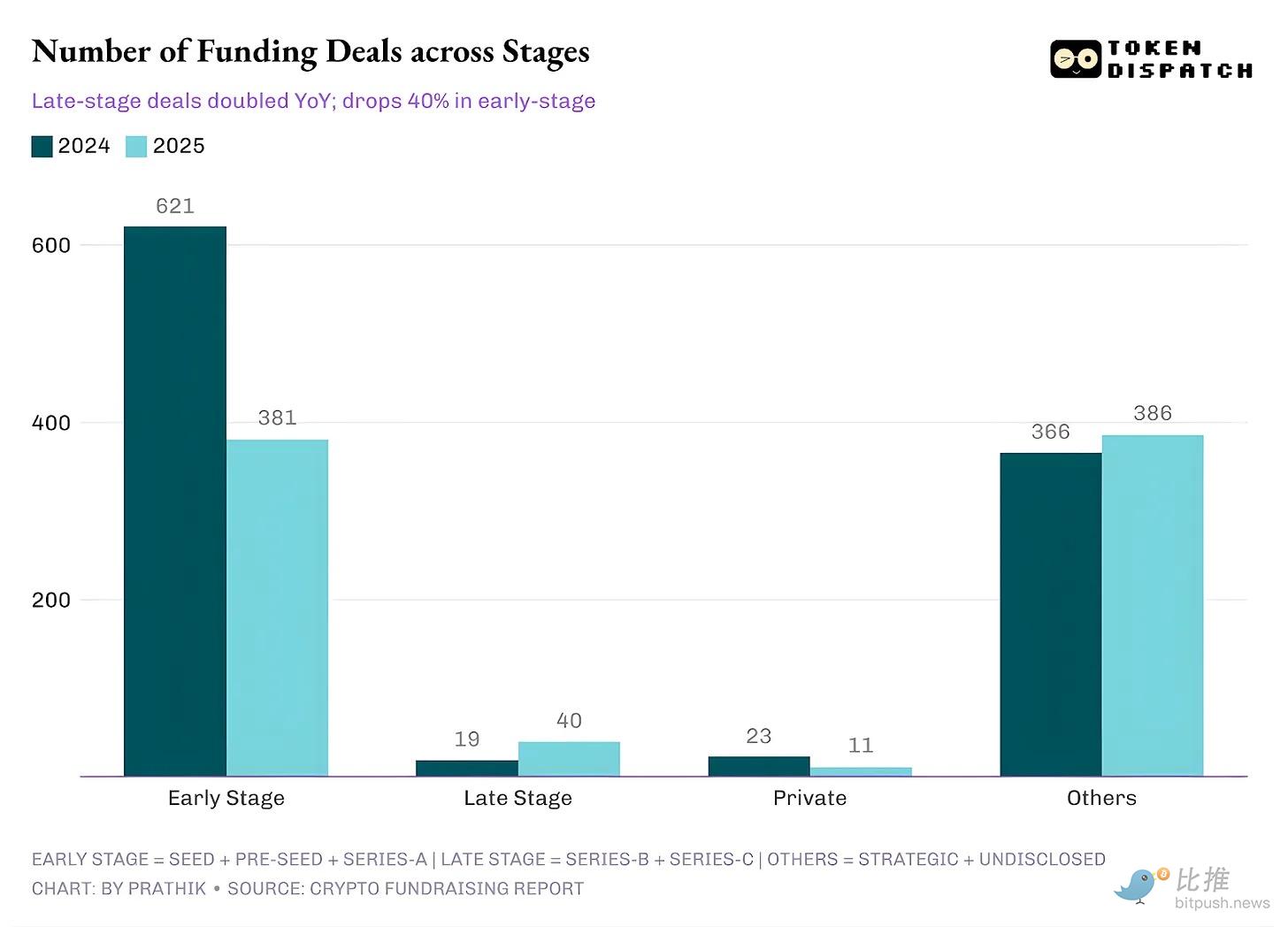
The two charts above together tell us: "Yes, capital has increased. But it has increased in places with lower uncertainty. Founders' fundraising pitches are no longer about 'the future of money,' but about 'here are some ready-made metrics worth betting on.'"

According to Equal Ventures' 'State of the Venture Economy Report,' while this portends fierce competition for early-stage founders, it may signal a value investment opportunity for investors seeking to inject funds into Series A and Series B projects.

This is because the competition to raise funds at the Seed and Pre-Seed stages has driven up valuation premiums. High valuation premiums mean investors are paying growth-stage valuation multiples for seed-stage risk profiles.

This shift prompts rational capital allocators to reallocate funds to lower-risk opportunities, such as Series A and B projects, which demand lower valuation premiums than Seed, Pre-Seed, Series C, and D+ rounds.
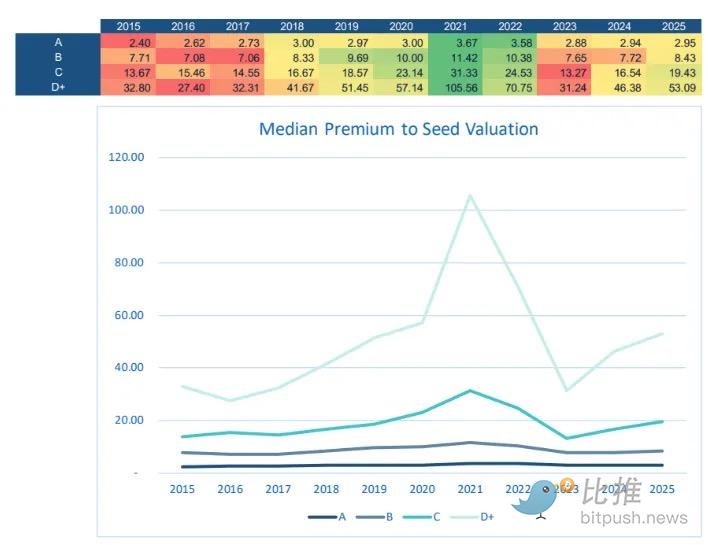
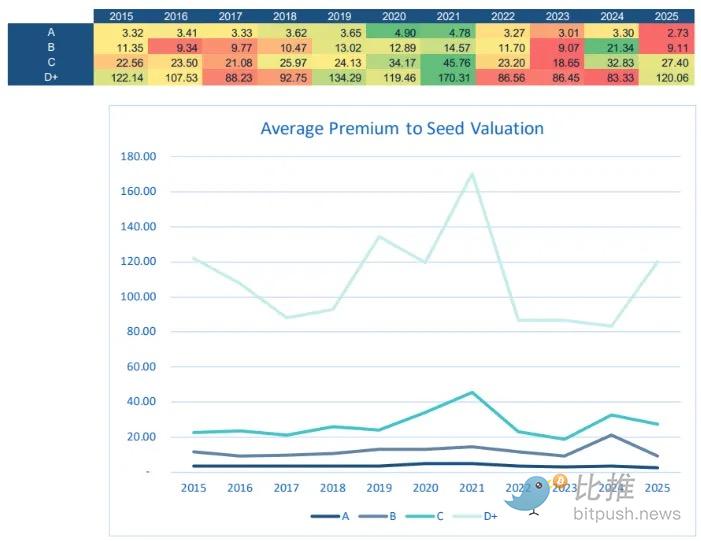
This, combined with the explosive growth in M&A transactions, shows how risk appetite has shifted across stages. On one hand, M&A accounted for over 40% of all 'funds raised,' which is inherently different from new funds injected through VC rounds. On the other hand, later-stage financing is favored because it appears easier to underwrite risk, offering greater certainty and higher potential return on investment (ROI).

When capital converges on specific tracks, two things naturally happen.

First, decision-making logic tends to focus. Entrepreneurs begin preparing for a more precise audience—a group focuses on similar metrics, shares industry insights with each other, and gradually forms a common evaluation language.

Second, the definition of a 'quality project' begins to converge. In the crypto field, this may mean extensive distribution networks, compliance resilience, enterprise-grade product readiness, and a business model that can operate independently without relying on bull or bear narratives.

This is why I am skeptical of the data in the '2025 Crypto Financing Report.' Although the amount of funds has increased, it is crucial to understand the drivers behind the explosive growth in M&A. Although cryptocurrency is a relatively new market, the technology stack has become very crowded, making it difficult to expand distribution channels.

In such times, it becomes a matter of course for existing giants to choose to buy and expand mature products rather than persuade users to adopt a new one. This was evident in last year's deals.
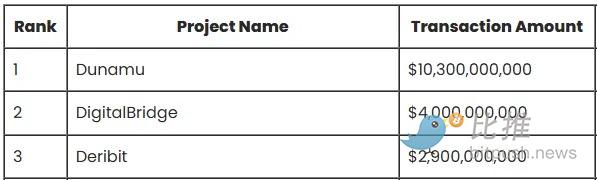
Take the top three M&A transactions listed in the report as examples: Dunamu, DigitalBridge, and Deribit. Their total value reached $17.2 billion, accounting for about 81% of the report's total M&A value.

Coinbase's acquisition of Deribit was not a bet on innovation or experimentation. This move was to leverage the flywheel Deribit had already built. Deribit provides a platform with ready-made liquidity, user habits, and options and derivatives products. Once the market matures, it can become the default trading venue for seasoned traders.Coinbase spotted the signal and prepared in advance.

South Korean internet giant Naver had a similar strategy when it decided to acquire Dunamu (operator of South Korea's largest cryptocurrency exchange Upbit) in an all-stock transaction worth $1.03 billion.This deal combines a massive consumer-grade distribution platform (an internet finance giant) with a regulated high-frequency financial product (an exchange).

What Does This Mean for 2026?

I expect the phenomenon of capital concentration to continue until we see clear exit paths. My only reservation regarding the report's 'consolidation' viewpoint is: Maturity does not necessarily have to mean the end of innovation. If too much capital is invested in rearranging ownership or doubling down on existing ideas, it could lead to stagnation and reduce breakthrough innovation.

If we fail to see successful IPOs and the reopening of large liquidity listing channels, expect later-stage investors to continue acting like strict underwriters, while early-stage founders will face a scarcity of attention.

But I don't think crypto seed rounds are dead.

2025 provided valuable lessons and clarity for early-stage founders. In 2026, they need to streamline their storytelling pitch decks and focus on the metrics the market values most. For example: how to have a distribution wedge, how to deliver products quickly while maintaining regulatory compliance, and how the product can survive robustly without the support of a bull market.


Twitter:https://twitter.com/BitpushNewsCN

Bitpush TG Discussion Group:https://t.me/BitPushCommunity

Bitpush TG Subscription: https://t.me/bitpush

Original link:https://www.bitpush.news/articles/7606417

Related Questions

QWhat does the 40% increase in M&A activity in 2025's crypto funding report primarily indicate about the market?

AIt indicates a significant year of consolidation, where a large portion of the 'raised funds' was not new capital entering the crypto market but rather money changing hands between existing companies through acquisitions.

QHow did the behavior of Venture Capital (VC) funding change from 2024 to 2025 according to the article?

AVC activity shifted from funding newer, early-stage projects to writing fewer but larger checks for later-stage, existing projects (B and C rounds), reducing its share of total funding from over 85% to 46%.

QWhat two natural consequences occur when capital concentrates in specific sectors, as described in the article?

AFirst, decision-making logic becomes more focused as entrepreneurs tailor pitches to a specific audience. Second, the definition of a 'quality project' converges, emphasizing metrics like distribution networks, regulatory resilience, and independent business models.

QWhy does the author express skepticism about the massive funding numbers in the 2025 report?

AThe author is skeptical because the large increase was heavily driven by M&A and later-stage funding, which represents a recycling of existing ideas and capital rather than fresh risk-taking and investment in genuine innovation.

QWhat key lessons from 2025 should early-stage founders apply to their strategies in 2026?

AThey should streamline their pitches to focus on metrics the market values most, such as having a distribution wedge, ensuring regulatory compliance, rapid product delivery, and building a product that can survive independently without relying on a bull market.

Related Reads

Must-Watch Events Next Week|CLARITY Act Could Face Senate Vote; SpaceX, Circle to Report Earnings (8.3-8.9)

**Summary: Key Events and Developments to Watch (August 3-9)** The upcoming week is marked by significant financial disclosures, key legislative deadlines, and notable product updates. **Major Financial Events:** Several companies are scheduled to release their Q2 2026 earnings. American Bitcoin (ABTC) will report on August 3, followed by SpaceX and Hut 8 Mining Corp. on August 4, and Circle on August 5. Notably, a significant portion of SpaceX shares (up to 12% of total shares) will be unlocked on August 6 following their earnings release. **Key Legislative Deadline:** The U.S. Senate faces an August 7 deadline to secure 60 votes for the CLARITY Act, a bipartisan bill aiming to establish a federal regulatory framework for cryptocurrencies. The Senate may hold a full vote on the bill during the week. **Economic Data:** The U.S. July Non-Farm Payrolls report will be released on August 7, providing crucial labor market data. **Technology & Product Updates:** * **Shutdowns:** DeFi portfolio tracker Zapper and wallet app Ctrl Wallet will cease operations on August 3. * **Upgrades:** LayerZero will deprecate its v1 relayers on August 3. XRP Ledger's new version 3.3.0, featuring five new functions, is expected next week. * **AI:** Elon Musk announced that the advanced Grok 4.6 AI model is set for release around August 7. * **Bitcoin:** The BIP-110 forced signaling for a potential Bitcoin network change is scheduled to begin around August 8. **Other Notable Events:** Chinese robotics firm Unitree Tech has set its preliminary price inquiry for its IPO for August 5. South Korean exchange Upbit will delist AQT and AERGO tokens on August 3.

marsbit1h ago

Must-Watch Events Next Week|CLARITY Act Could Face Senate Vote; SpaceX, Circle to Report Earnings (8.3-8.9)

marsbit1h ago

Stocks Are Plummeting More Sharply Than Cryptocurrencies. Where Has the Money Gone?

Stock Markets Plunge Deeper Than Cryptocurrencies: Where Did the Money Go? In late July, Seoul's Kospi index triggered circuit breakers for two consecutive days, plummeting over 40% from its June high. The collapse was led by heavyweight stocks like SK Hynix, whose record profits still disappointed investors, and devastating leveraged ETFs, with one major product losing over 83% of its value. This signaled a global, forced deleveraging targeting the most crowded trades. Interestingly, while stocks exhibited extreme volatility akin to crypto markets, Bitcoin rose nearly 15% in July after a prior steep drop. Analysis shows the money fleeing equities did not flow into Bitcoin. Instead, Bitcoin had already absorbed its sell-off in May-June, when U.S. spot Bitcoin ETFs saw historic outflows. The true safe-haven beneficiary was gold, whose price rose over 20% year-on-year, highlighting a decoupling between Bitcoin and gold as "digital gold." The sell-off was a targeted unwinding of leveraged positions in tech and semiconductors, accelerated by broker-dealer risk management and shifts in the AI narrative, including new competition from Chinese memory chipmakers. The retreat path was clear: from high-valuation tech stocks to cash and U.S. Treasuries, then to gold. For Bitcoin to attract sustained institutional inflows, conditions like eased global liquidity pressure, a "soft-landing" Fed rate cut, and U.S. regulatory clarity via legislation like the stalled CLARITY Act are needed. Currently, Bitcoin is not a safe haven but an already-cleared asset. Its low correlation with tech stocks, however, makes it a potential diversification play for institutional portfolios once the storm passes. The money isn't here yet, but the positioning is underway.

marsbit1h ago

Stocks Are Plummeting More Sharply Than Cryptocurrencies. Where Has the Money Gone?

marsbit1h ago

In Conversation with Ray Dalio: We Are Currently in an AI Bubble, with 1% of My Portfolio in Bitcoin

Ray Dalio, founder of Bridgewater Associates, warns in an interview that the current AI boom shows classic bubble characteristics, which could lead to significant economic downturns as seen in past cycles like 1929 or 2000. He explains that speculative enthusiasm, fueled by debt and overvaluation, often precedes a crash when rising rates or taxation force asset sales, causing widespread losses and recession. Dalio also outlines his "Big Cycle" theory, describing an approximate 80-year pattern where widening wealth gaps, massive government deficits, and shifting geopolitical power (like China's rise) create internal conflict and global instability. He emphasizes that we are in a late-cycle, transitional phase where traditional powers like the US and UK face decline. For personal wealth protection, Dalio advises diversification beyond cash into assets like stocks, bonds, real estate, and particularly gold, which he prefers over Bitcoin. While he holds about 1% of his portfolio in Bitcoin as a non-printable hard asset, he views gold as more secure from technological or governmental threats. Regarding AI's impact, Dalio believes it will disproportionately benefit capital owners, worsening inequality by replacing both physical and cognitive labor. He suggests that human intuition and emotional intelligence, combined with AI, will be key for future workers. On taxation, Dalio argues that wealth taxes are impractical and risk triggering asset sell-offs, reducing productive investment. He points to the UK as a cautionary example of debt, low productivity, and political strife. Geopolitically, Dalio foresees a more regionalized world, with the US showing weakness in prolonged conflicts like with Iran, akin to past imperial declines. The ideal outcome, he suggests, is coexisting powerful blocs (e.g., Americas, China-Asia Pacific) without major war.

marsbit5h ago

In Conversation with Ray Dalio: We Are Currently in an AI Bubble, with 1% of My Portfolio in Bitcoin

marsbit5h ago

Trading

Spot
活动图片





